
Goal
Estimate a threshold heart rate and pace from a controlled time trial, show heart-rate drift, and display transparent planning screens with clear limits.
Worldwide context
Saved once here, used across the site.
Currency changes display only. Country selection guides tax input; no tax rate is guessed.
Estimate a threshold heart rate and pace from a controlled time trial, show heart-rate drift, and display transparent planning screens with clear limits.
For the field-test screen, estimated threshold heart rate = last 20-minute average heart rate; speed = distance ÷ duration; pace = duration ÷ distance; drift = final-block heart rate − first-block heart rate.A clearer path to an answer
This page keeps the calculation transparent: define the goal, enter the matching values, inspect the method, and decide what the result means in your situation.
Estimate a threshold heart rate and pace from a controlled time trial, show heart-rate drift, and display transparent planning screens with clear limits.
First 10-minute average heart rate · Last 20-minute average heart rate · Time-trial duration · Distance covered
For the field-test screen, estimated threshold heart rate = last 20-minute average heart rate; speed = distance ÷ duration; pace = duration ÷ distance; drift = final-block heart rate − first-block heart rate.
Calculate, review the assumptions below, then compare a related tool when the decision needs more context.
Estimate a threshold heart rate and pace from a controlled time trial, show heart-rate drift, and display transparent planning screens with clear limits.
Open the Anaerobic Threshold Field-Test Calculator pageMore sports tools
Download PDFDownload Word (.doc)
Enter your values above and choose Calculate to see the result here.
Calculation map
For the field-test screen, estimated threshold heart rate = last 20-minute average heart rate; speed = distance ÷ duration; pace = duration ÷ distance; drift = final-block heart rate − first-block heart rate.
Bounded, transparent calculation
Your recent runs stay in this browser session only.
Formula: For the field-test screen, estimated threshold heart rate = last 20-minute average heart rate; speed = distance ÷ duration; pace = duration ÷ distance; drift = final-block heart rate − first-block heart rate.
A field test can provide a repeatable training reference when performed consistently, but it is not the same as a laboratory measurement. The calculator separates the protocol arithmetic from the interpretation and shows several percentage screens instead of claiming universal zones.
Worked example: The field-test screen estimates 170 bpm, 12 km/h, 5:00 min/km, with 10 bpm of heart-rate drift.
The displayed limits are checked before the handler runs. Model-specific domain checks may also reject impossible or non-finite inputs.
Methodology: This calculator follows the WorldCalculate input, formula, precision, and boundary policy. Read the official methodology.
Calculator usage statistics
This section counts anonymous successful Calculate submissions, not unique visitors. Counts and top tools appear only when trusted aggregate data is available; country analysis is shown only under the same condition and reporting threshold.
Answer-first guide
Estimate a threshold heart rate and pace from a controlled time trial, show heart-rate drift, and display transparent planning screens with clear limits. Start with one clearly defined goal, enter values in the units shown, and keep the result attached to the assumptions below.
This tool is useful when your question includes anaerobic threshold calculator, lactate threshold heart rate, threshold pace calculator. It returns the outputs declared in the calculator contract rather than a live quote, approval, diagnosis, or professional sign-off.
First 10-minute average heart rate · Last 20-minute average heart rate · Time-trial duration · Distance covered. Keep the same time period, unit system, and currency wherever the form requires comparable values.
Run the worked example first, compare its output with the page's example, then change one input at a time. This makes an unexpected result easier to trace to a unit, boundary, or assumption.
Need a wider view? Browse Sports Statistics Calculators or compare the related tools below. The WorldCalculate methodology explains how formulas, examples, limits, and revisions are reviewed.
For the field-test screen, estimated threshold heart rate = last 20-minute average heart rate; speed = distance ÷ duration; pace = duration ÷ distance; drift = final-block heart rate − first-block heart rate.
A field test can provide a repeatable training reference when performed consistently, but it is not the same as a laboratory measurement. The calculator separates the protocol arithmetic from the interpretation and shows several percentage screens instead of claiming universal zones.
The field-test screen estimates 170 bpm, 12 km/h, 5:00 min/km, with 10 bpm of heart-rate drift.
Context and background
A sports percentage or rate depends on attempts, outs, minutes, shots, or another denominator. Matching that definition is necessary before comparing players, teams, or seasons.
Box-score analysis became more useful as raw events were expressed as rates that account for opportunities. These tools show the denominator so the result remains tied to the supplied record.
Research and review
Researched by Hassan ALRowaie, Founder and editorial researcher at WorldCalculate.
This guide follows the live calculator's declared inputs, formula, worked example, assumptions, validation boundaries, and source-backed methodology. The review date describes editorial review of the calculator explanation; it is not a promise that external facts or rates remain current.
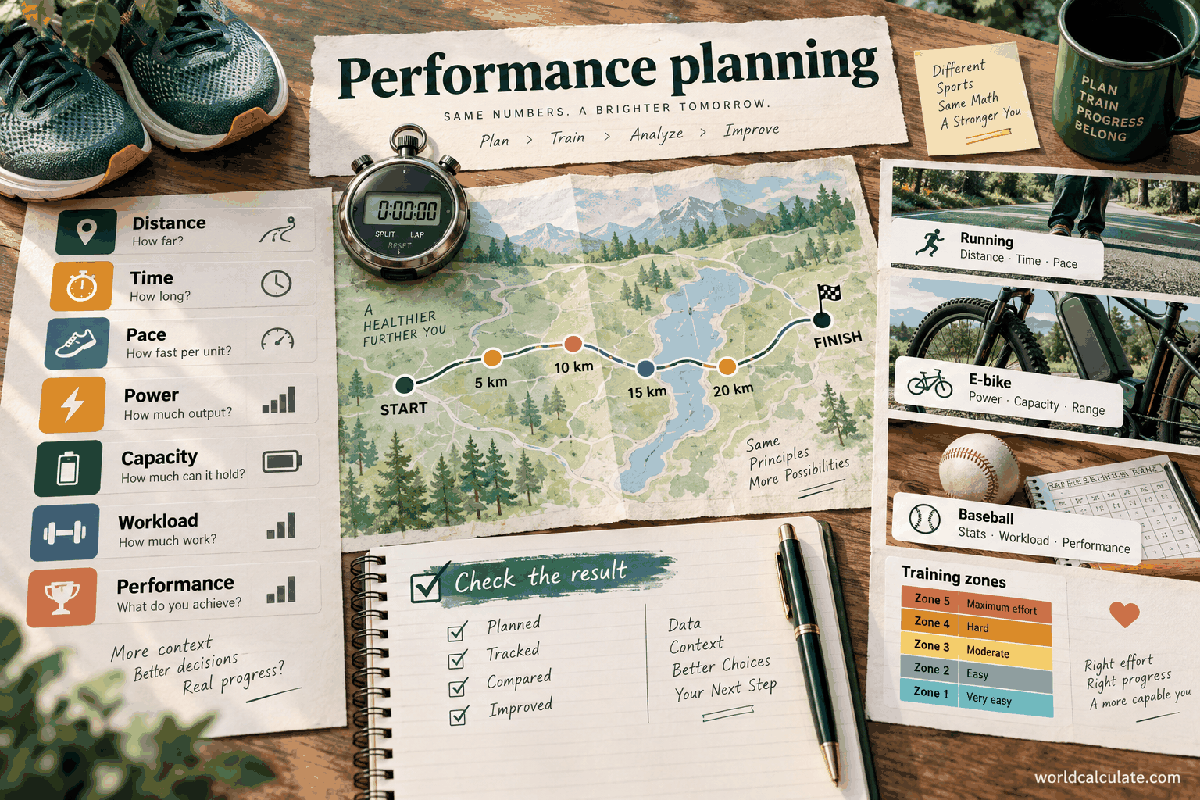
Threshold language is used for several different physiological concepts. This page intentionally labels its result as a field-test estimate: it applies an entered protocol, exposes the arithmetic, and keeps laboratory interpretation outside the calculator.
The model uses the average heart rate from the final twenty minutes of an entered sustained trial as an estimate of threshold heart rate. It also converts the distance and duration into pace and speed.
That is a practical training reference, not a diagnosis. A laboratory lactate or ventilatory assessment answers a different question with different equipment and protocols.
The default 30 minutes reflects a common field-test structure, while the form permits a controlled range from 20 to 60 minutes for comparison. Changing the duration changes the protocol and therefore the interpretation.
Record warm-up, course, weather, sensor, and pacing details if you want to compare tests over time. A single number without context is easy to overread.
The displayed threshold heart rate equals the final twenty-minute average entered by the visitor. The calculator does not blend the first and final blocks or apply a hidden correction factor.
This explicit rule makes repeat tests easier to audit. It also means a noisy final block should be treated as a data-quality problem rather than rescued by unexplained mathematics.
Speed is distance divided by elapsed hours. Pace is elapsed minutes divided by distance in kilometres. These are equivalent descriptions of the entered trial effort.
Use a measured distance and a consistent surface when comparing pace. Heart rate can remain useful when terrain changes, but the pace output itself is course-specific.
Drift is the final-block average minus the first-block average. A positive result means heart rate rose across the trial; a negative result can reflect pacing, sensor, or environmental effects.
Drift is a diagnostic clue for the test session, not a standalone fitness score. Heat, hydration, fatigue, and hills can all influence it.
The page shows 85%, 90%, 100%, and 101% of the estimated heart rate as labelled screens. They help a visitor inspect simple arithmetic around the estimate, but they are not universal training-zone prescriptions.
A coach or governing methodology may define different zones. Keep the method name beside any training plan so numbers are not mixed across systems.
A hard effort may be inappropriate for someone with symptoms, illness, injury, or a medical restriction. Stop for concerning symptoms and obtain qualified advice before testing.
This calculator cannot assess cardiac risk, lactate concentration, oxygen uptake, recovery, or whether the test was maximal enough for the intended protocol.
Can I use cycling data? You can use the arithmetic if the protocol and distance unit make sense, but a running pace label should not be attached to a bike test.
Should I call the result my exact anaerobic threshold? No. Call it the entered field-test estimate and document the protocol; the wording protects against false precision.
Estimate a threshold heart rate and pace from a controlled time trial, show heart-rate drift, and display transparent planning screens with clear limits.
For the field-test screen, estimated threshold heart rate = last 20-minute average heart rate; speed = distance ÷ duration; pace = duration ÷ distance; drift = final-block heart rate − first-block heart rate. A field test can provide a repeatable training reference when performed consistently, but it is not the same as a laboratory measurement. The calculator separates the protocol arithmetic from the interpretation and shows several percentage screens instead of claiming universal zones.
Enter First 10-minute average heart rate, Last 20-minute average heart rate, Time-trial duration, Distance covered, then choose Calculate.
The entered trial is a sustained, hard effort performed with a consistent protocol. The last 20-minute average is used as the threshold-heart-rate estimate for this field-test model. Heart-rate readings are in beats per minute and are not corrupted by sensor dropouts. Distance and duration describe the same effort and use kilometres and minutes. The 85%, 90%, 100%, and 101% outputs are planning screens, not validated universal zones. The page is not a lactate, ventilatory, or cardiac diagnosis. Visitors should stop for concerning symptoms and use qualified medical guidance where appropriate.
This calculator is part of the WorldCalculate library. Its formula, example, assumptions, input bounds, and output formatting follow the official methodology.
These WorldCalculate collections connect this tool with related questions while keeping each calculation separate and transparent.