
Goal
Estimate average flow, infiltration and inflow allowance, peak design flow, and a simple retention volume from population and entered planning assumptions.
Worldwide context
Saved once here, used across the site.
Currency changes display only. Country selection guides tax input; no tax rate is guessed.
Estimate average flow, infiltration and inflow allowance, peak design flow, and a simple retention volume from population and entered planning assumptions.
Base average flow = population × per-capita flow + other flow. Average flow with infiltration/inflow = base average flow × (1 + allowance ÷ 100). Peak design flow = average flow with infiltration/inflow × peak factor. Simple retained volume = average flow with infiltration/inflow × retention hours ÷ 24.A clearer path to an answer
This page keeps the calculation transparent: define the goal, enter the matching values, inspect the method, and decide what the result means in your situation.
Estimate average flow, infiltration and inflow allowance, peak design flow, and a simple retention volume from population and entered planning assumptions.
People or population equivalent · Average flow per person · Other average daily flow · Flow unit · Infiltration and inflow allowance · Peak-flow factor · Retention or equalization period
Base average flow = population × per-capita flow + other flow. Average flow with infiltration/inflow = base average flow × (1 + allowance ÷ 100). Peak design flow = average flow with infiltration/inflow × peak factor. Simple retained volume = average flow with infiltration/inflow × retention hours ÷ 24.
Calculate, review the assumptions below, then compare a related tool when the decision needs more context.
Estimate average flow, infiltration and inflow allowance, peak design flow, and a simple retention volume from population and entered planning assumptions.
Open the Wastewater Flow Planning Calculator pageMore science tools
Download PDFDownload Word (.doc)
Enter your values above and choose Calculate to see the result here.
Calculation map
Base average flow = population × per-capita flow + other flow. Average flow with infiltration/inflow = base average flow × (1 + allowance ÷ 100). Peak design flow = average flow with infiltration/inflow × peak factor. Simple retained volume = average flow with infiltration/inflow × retention hours ÷ 24.
Bounded, transparent calculation
Your recent runs stay in this browser session only.
Formula: Base average flow = population × per-capita flow + other flow. Average flow with infiltration/inflow = base average flow × (1 + allowance ÷ 100). Peak design flow = average flow with infiltration/inflow × peak factor. Simple retained volume = average flow with infiltration/inflow × retention hours ÷ 24.
This page is a transparent flow-planning worksheet. It separates residential or population-based flow, other flow, an explicit infiltration and inflow allowance, a peak factor, and a retention period so a visitor can replace each assumption with local data.
Worked example: Twenty people at 170 L/person/day produce 3,400 L/day; with a 10% allowance the planning average is 3,740 L/day, peak flow is 9,350 L/day, and a 24-hour average-flow volume is 3,740 L.
The displayed limits are checked before the handler runs. Model-specific domain checks may also reject impossible or non-finite inputs.
Methodology: This calculator follows the WorldCalculate input, formula, precision, and boundary policy. Read the official methodology.
Calculator usage statistics
This section counts anonymous successful Calculate submissions, not unique visitors. Counts and top tools appear only when trusted aggregate data is available; country analysis is shown only under the same condition and reporting threshold.
Answer-first guide
Estimate average flow, infiltration and inflow allowance, peak design flow, and a simple retention volume from population and entered planning assumptions. Start with one clearly defined goal, enter values in the units shown, and keep the result attached to the assumptions below.
This tool is useful when your question includes wastewater flow calculator, sewage flow calculator, design flow calculator. It returns the outputs declared in the calculator contract rather than a live quote, approval, diagnosis, or professional sign-off.
People or population equivalent · Average flow per person · Other average daily flow · Flow unit · Infiltration and inflow allowance · Peak-flow factor · Retention or equalization period. Keep the same time period, unit system, and currency wherever the form requires comparable values.
Run the worked example first, compare its output with the page's example, then change one input at a time. This makes an unexpected result easier to trace to a unit, boundary, or assumption.
Need a wider view? Browse Science Calculators or compare the related tools below. The WorldCalculate methodology explains how formulas, examples, limits, and revisions are reviewed.
Base average flow = population × per-capita flow + other flow. Average flow with infiltration/inflow = base average flow × (1 + allowance ÷ 100). Peak design flow = average flow with infiltration/inflow × peak factor. Simple retained volume = average flow with infiltration/inflow × retention hours ÷ 24.
This page is a transparent flow-planning worksheet. It separates residential or population-based flow, other flow, an explicit infiltration and inflow allowance, a peak factor, and a retention period so a visitor can replace each assumption with local data.
Twenty people at 170 L/person/day produce 3,400 L/day; with a 10% allowance the planning average is 3,740 L/day, peak flow is 9,350 L/day, and a 24-hour average-flow volume is 3,740 L.
Context and background
Science calculators define a system, choose an equation, apply units and constants, and show the substitution. Effects outside that model remain outside the result.
Introductory science problem solving builds from measured quantities and idealized relationships. Those models are valuable for learning and first-pass estimates, while experiments and engineering decisions need additional evidence.
Research and review
Researched by Hassan ALRowaie, Founder and editorial researcher at WorldCalculate.
This guide follows the live calculator's declared inputs, formula, worked example, assumptions, validation boundaries, and source-backed methodology. The review date describes editorial review of the calculator explanation; it is not a promise that external facts or rates remain current.

Wastewater planning starts with a flow assumption, but one number rarely describes a real system. This calculator lays out the population basis, other daily flow, infiltration and inflow allowance, peak factor, and time period so a reader can see which part of the estimate needs local evidence.
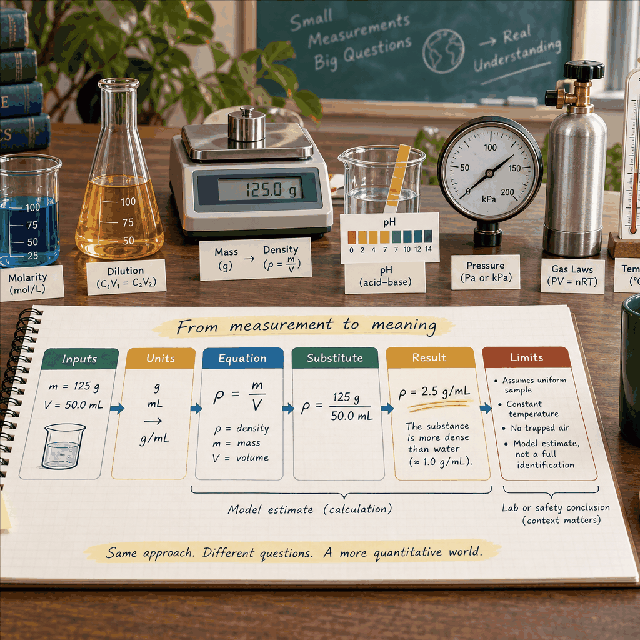
The page estimates a base average flow, an allowance-adjusted average, a peak design scenario, and a simple volume associated with the chosen retention period.
It is not a permit calculator or a complete hydraulic design. Its value is making the first-pass arithmetic auditable.
Population flow is population multiplied by average flow per person per day. Other average daily flow can represent a separately documented source, but it should not be used as a hidden catch-all for unknown conditions.
A per-capita figure is an assumption about the served community and water use. EPA manuals provide context, but the value appropriate to a jurisdiction, season, and facility may differ.
Infiltration and inflow can add water that is not represented by the base population calculation. This worksheet expresses it as a percentage of base average flow so the effect is visible.
A percentage is only a first-pass approximation. Monitored wet-weather data, groundwater conditions, collection-system age, and storm connections may justify a different approach.
Peak design flow is the allowance-adjusted average multiplied by the entered peak factor. With a factor of 2.5, a daily average of 3,740 litres becomes a peak scenario of 9,350 litres per day.
The result is a scenario, not a statement that every hour or day will follow one fixed multiplier. Peak definitions differ between jurisdictions and system types.
For 20 people at 170 L/person/day, base flow is 20 × 170 = 3,400 L/day. A 10% allowance makes the planning average 3,400 × 1.10 = 3,740 L/day.
A 2.5 peak factor gives 3,740 × 2.5 = 9,350 L/day. With a 24-hour period, the simple average-flow volume is 3,740 × 24 ÷ 24 = 3,740 L.
The form keeps the entered daily unit consistent across the outputs. Switching between litres and US gallons converts the displayed scenario without changing the physical flow assumption.
US gallons are not Imperial gallons. If a local document uses Imperial gallons, convert that source to the selected unit before entry and retain the conversion note.
The retention output is a simple flow-times-time volume. It does not add freeboard, sludge storage, emergency storage, mixing volume, pump cycling, or a regulatory reserve.
A treatment tank, equalization basin, septic tank, or wet well needs process-specific criteria and local review. Do not order equipment from this output alone.
Do not enter monthly flow as a daily flow, combine an infiltration allowance already included in the per-capita value, or multiply a peak factor twice.
Keep population, population equivalent, commercial flow, and industrial flow definitions documented. A precise result cannot repair an unclear boundary around the service area.
The same arithmetic can be expressed in litres or US gallons, but water-use rates, storm definitions, discharge rules, and design periods vary by country and authority.
The country context on WorldCalculate can help a visitor organize research, but it does not guess local legal rules or certify compliance.
Does this calculate a septic tank size? No. It estimates flow and a simple time-based volume only.
Can I use a measured flow instead of a per-capita assumption? Yes. Enter the measured basis as the documented planning input and set other flow components so they are not counted twice.
Estimate average flow, infiltration and inflow allowance, peak design flow, and a simple retention volume from population and entered planning assumptions.
Base average flow = population × per-capita flow + other flow. Average flow with infiltration/inflow = base average flow × (1 + allowance ÷ 100). Peak design flow = average flow with infiltration/inflow × peak factor. Simple retained volume = average flow with infiltration/inflow × retention hours ÷ 24. This page is a transparent flow-planning worksheet. It separates residential or population-based flow, other flow, an explicit infiltration and inflow allowance, a peak factor, and a retention period so a visitor can replace each assumption with local data.
Enter People or population equivalent, Average flow per person, Other average daily flow, Flow unit, Infiltration and inflow allowance, Peak-flow factor, Retention or equalization period, then choose Calculate.
Per-capita flow and other flow are entered in the selected daily volume unit. Population is a planning count or population equivalent, not a legal occupancy determination. Infiltration and inflow is represented by a user-entered percentage of base average flow. The peak factor is a dimensionless multiplier for a first-pass design scenario. The retention volume uses the average flow with the entered allowance, not the peak flow. Flow is assumed to be steady over the stated average period for the simple volume calculation. Industrial, commercial, storm, seasonal, and emergency flows may need separate records. The calculator does not select a treatment process, pipe size, pump, tank size, or discharge permit. Local regulations, hydraulic models, rainfall records, monitoring data, and engineer review are not inferred. A design professional and the responsible authority must control any real installation or compliance decision.
This calculator is part of the WorldCalculate library. Its formula, example, assumptions, input bounds, and output formatting follow the official methodology.
These WorldCalculate collections connect this tool with related questions while keeping each calculation separate and transparent.