
Goal
Estimate protein concentration from a corrected 280 nm absorbance, path length, dilution factor, and protein-specific 0.1% extinction coefficient.
Worldwide context
Saved once here, used across the site.
Currency changes display only. Country selection guides tax input; no tax rate is guessed.
Estimate protein concentration from a corrected 280 nm absorbance, path length, dilution factor, and protein-specific 0.1% extinction coefficient.
Corrected A280 = measured A280 − blank A280. Concentration in mg/mL = corrected A280 × dilution factor ÷ (extinction value for 1 mg/mL × path length). g/L has the same numerical value as mg/mL. Molarity in μM = concentration in g/L ÷ molecular weight in g/mol × 1,000,000.A clearer path to an answer
This page keeps the calculation transparent: define the goal, enter the matching values, inspect the method, and decide what the result means in your situation.
Estimate protein concentration from a corrected 280 nm absorbance, path length, dilution factor, and protein-specific 0.1% extinction coefficient.
Measured A280 · A280 blank correction · Dilution factor · Optical path length · A280 of 1 mg/mL protein · Protein molecular weight
Corrected A280 = measured A280 − blank A280. Concentration in mg/mL = corrected A280 × dilution factor ÷ (extinction value for 1 mg/mL × path length). g/L has the same numerical value as mg/mL. Molarity in μM = concentration in g/L ÷ molecular weight in g/mol × 1,000,000.
Calculate, review the assumptions below, then compare a related tool when the decision needs more context.
Estimate protein concentration from a corrected 280 nm absorbance, path length, dilution factor, and protein-specific 0.1% extinction coefficient.
Open the Protein Concentration from A280 Calculator pageMore science tools
Download PDFDownload Word (.doc)
Enter your values above and choose Calculate to see the result here.
Calculation map
Corrected A280 = measured A280 − blank A280. Concentration in mg/mL = corrected A280 × dilution factor ÷ (extinction value for 1 mg/mL × path length). g/L has the same numerical value as mg/mL. Molarity in μM = concentration in g/L ÷ molecular weight in g/mol × 1,000,000.
Bounded, transparent calculation
Your recent runs stay in this browser session only.
Formula: Corrected A280 = measured A280 − blank A280. Concentration in mg/mL = corrected A280 × dilution factor ÷ (extinction value for 1 mg/mL × path length). g/L has the same numerical value as mg/mL. Molarity in μM = concentration in g/L ÷ molecular weight in g/mol × 1,000,000.
The A280 method is a transparent absorbance calculation whose coefficient depends on the protein and measurement conditions. The page requires the visitor to provide the protein-specific coefficient rather than pretending that one coefficient is universal.
Worked example: The corrected A280 is 0.7, the estimated original concentration is 5 mg/mL, and the corresponding concentration is about 33.333 μM for a 150,000 Da protein.
The displayed limits are checked before the handler runs. Model-specific domain checks may also reject impossible or non-finite inputs.
Methodology: This calculator follows the WorldCalculate input, formula, precision, and boundary policy. Read the official methodology.
Calculator usage statistics
This section counts anonymous successful Calculate submissions, not unique visitors. Counts and top tools appear only when trusted aggregate data is available; country analysis is shown only under the same condition and reporting threshold.
Answer-first guide
Estimate protein concentration from a corrected 280 nm absorbance, path length, dilution factor, and protein-specific 0.1% extinction coefficient. Start with one clearly defined goal, enter values in the units shown, and keep the result attached to the assumptions below.
This tool is useful when your question includes protein concentration calculator, A280 calculator, UV protein concentration. It returns the outputs declared in the calculator contract rather than a live quote, approval, diagnosis, or professional sign-off.
Measured A280 · A280 blank correction · Dilution factor · Optical path length · A280 of 1 mg/mL protein · Protein molecular weight. Keep the same time period, unit system, and currency wherever the form requires comparable values.
Run the worked example first, compare its output with the page's example, then change one input at a time. This makes an unexpected result easier to trace to a unit, boundary, or assumption.
Need a wider view? Browse Science Calculators or compare the related tools below. The WorldCalculate methodology explains how formulas, examples, limits, and revisions are reviewed.
Corrected A280 = measured A280 − blank A280. Concentration in mg/mL = corrected A280 × dilution factor ÷ (extinction value for 1 mg/mL × path length). g/L has the same numerical value as mg/mL. Molarity in μM = concentration in g/L ÷ molecular weight in g/mol × 1,000,000.
The A280 method is a transparent absorbance calculation whose coefficient depends on the protein and measurement conditions. The page requires the visitor to provide the protein-specific coefficient rather than pretending that one coefficient is universal.
The corrected A280 is 0.7, the estimated original concentration is 5 mg/mL, and the corresponding concentration is about 33.333 μM for a 150,000 Da protein.
Context and background
Science calculators define a system, choose an equation, apply units and constants, and show the substitution. Effects outside that model remain outside the result.
Introductory science problem solving builds from measured quantities and idealized relationships. Those models are valuable for learning and first-pass estimates, while experiments and engineering decisions need additional evidence.
Research and review
Researched by Hassan ALRowaie, Founder and editorial researcher at WorldCalculate.
This guide follows the live calculator's declared inputs, formula, worked example, assumptions, validation boundaries, and source-backed methodology. The review date describes editorial review of the calculator explanation; it is not a promise that external facts or rates remain current.
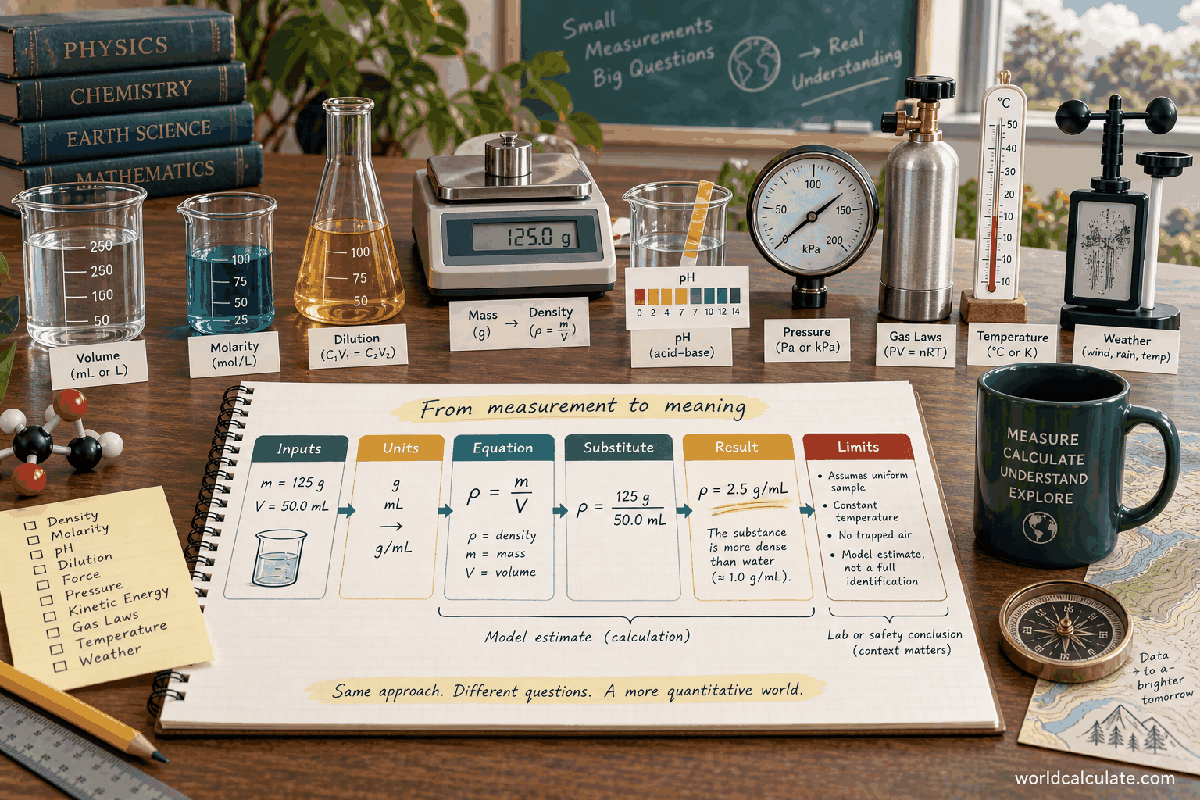
A protein concentration result is only as trustworthy as the absorbance method, coefficient, dilution record, and unit labels behind it. This calculator keeps those pieces visible so a visitor can reproduce the A280 arithmetic instead of copying a concentration without its measurement context.
The page converts a corrected absorbance reading into an estimated protein mass concentration and, when a molecular weight is supplied, a molar concentration.
It is a calculation worksheet, not a laboratory instrument and not a replacement for the assay method validated for the sample.
The mass-concentration equation is corrected A280 × dilution factor ÷ (A280 of 1 mg/mL × path length). The coefficient is protein-specific; it is not a universal constant for every protein or buffer.
A 1 cm path length leaves the common classroom form visible, while a different path length is handled explicitly rather than silently ignored.
Subtract the blank measured under the same optical conditions before applying the dilution factor. If the blank is larger than the measured reading, the corrected absorbance is not a usable positive concentration for this contract.
Blank subtraction is not a general contaminant correction. A sample can still contain nucleic acids, scattering particles, or other chromophores after a blank is removed.
With A280 = 0.7, blank = 0, dilution factor = 10, path = 1 cm, and a coefficient of 1.4 per mg/mL, the concentration is 0.7 × 10 ÷ 1.4 = 5 mg/mL.
Because 1 mg/mL equals 1 g/L numerically, a 5 mg/mL result is also 5 g/L. With a 150,000 Da molecular weight, 5 ÷ 150,000 mol/L is about 33.333 μM.
The spectrometer often sees a diluted aliquot rather than the original material. If the original was diluted tenfold, the original concentration is ten times the concentration represented by the measured diluted sample under the same coefficient.
Do not multiply by a dilution factor twice. Record whether the coefficient or the absorbance was already corrected for a dilution before entering it.
The extinction value belongs to the protein and the chosen definition. It may come from a sequence-based estimate, a validated standard, or a method document that states the units and path-length convention.
Using a convenient default for a different protein can create a precise-looking but inaccurate result. The page makes the coefficient an input so that the source remains visible.
Mass concentration answers how many milligrams are present per millilitre. Molarity answers how many moles are present per litre, so it additionally needs molecular weight.
A protein with a larger molecular weight has fewer moles at the same mass concentration. Keeping both outputs labeled avoids treating mg/mL and μM as interchangeable.
A280 methods rely on a usable linear optical range. High absorbance, turbidity, aggregation, nucleic-acid carryover, and inappropriate blanks can all make the simple model misleading.
If the sample is outside the validated range, dilute or remeasure according to the laboratory method, then enter the new measurement and the complete dilution record.
Do not enter a wavelength other than the A280 reading, use a path length in millimetres without converting, or enter molecular weight in kDa when the field expects daltons.
Do not treat A280 as a concentration by itself. The coefficient, path length, blank, and dilution factor are part of the calculation contract.
Can the calculator identify the protein? No. It only applies the coefficient and molecular weight supplied by the visitor.
Is the result suitable for a drug, clinical, or manufacturing release decision? Not by itself. Use the validated method, controls, acceptance criteria, and qualified review required for that setting.
Estimate protein concentration from a corrected 280 nm absorbance, path length, dilution factor, and protein-specific 0.1% extinction coefficient.
Corrected A280 = measured A280 − blank A280. Concentration in mg/mL = corrected A280 × dilution factor ÷ (extinction value for 1 mg/mL × path length). g/L has the same numerical value as mg/mL. Molarity in μM = concentration in g/L ÷ molecular weight in g/mol × 1,000,000. The A280 method is a transparent absorbance calculation whose coefficient depends on the protein and measurement conditions. The page requires the visitor to provide the protein-specific coefficient rather than pretending that one coefficient is universal.
Enter Measured A280, A280 blank correction, Dilution factor, Optical path length, A280 of 1 mg/mL protein, Protein molecular weight, then choose Calculate.
A280 and the blank are measured at the same wavelength and under the same optical conditions. The blank is subtracted once before the dilution correction is applied. The entered extinction value describes the absorbance of 1 mg/mL of this protein under the stated path-length convention. The dilution factor is the ratio that converts the measured diluted sample back to the original sample. The path length is measured in centimetres and is included linearly. Molecular weight in daltons is used numerically as grams per mole for the molarity conversion. The sample obeys the linear absorbance relationship over the measured range. Scattering, contaminants, aggregation, nucleic-acid interference, and instrument saturation are not corrected automatically. The page does not select an assay, standard curve, buffer, wavelength, or safety procedure. Laboratory quality control and the method validated for the specific sample control the final reported concentration.
This calculator is part of the WorldCalculate library. Its formula, example, assumptions, input bounds, and output formatting follow the official methodology.
These WorldCalculate collections connect this tool with related questions while keeping each calculation separate and transparent.