
Goal
Interpolate a NIST table of saturated-liquid ethylene molar density from 105 K to 160 K and convert it to an approximate mass density.
Worldwide context
Saved once here, used across the site.
Currency changes display only. Country selection guides tax input; no tax rate is guessed.
Interpolate a NIST table of saturated-liquid ethylene molar density from 105 K to 160 K and convert it to an approximate mass density.
Molar density is linearly interpolated between the tabulated saturated-liquid ethylene values at 5 K intervals from 105 K through 160 K. Mass density in kg/m³ = molar density in mol/L × 28.05316 g/mol, because 1 g/L = 1 kg/m³.A clearer path to an answer
This page keeps the calculation transparent: define the goal, enter the matching values, inspect the method, and decide what the result means in your situation.
Interpolate a NIST table of saturated-liquid ethylene molar density from 105 K to 160 K and convert it to an approximate mass density.
Temperature on saturation line
Molar density is linearly interpolated between the tabulated saturated-liquid ethylene values at 5 K intervals from 105 K through 160 K. Mass density in kg/m³ = molar density in mol/L × 28.05316 g/mol, because 1 g/L = 1 kg/m³.
Calculate, review the assumptions below, then compare a related tool when the decision needs more context.
Interpolate a NIST table of saturated-liquid ethylene molar density from 105 K to 160 K and convert it to an approximate mass density.
Open the Saturated Liquid Ethylene Density Calculator pageMore science tools
Download PDFDownload Word (.doc)
Enter your values above and choose Calculate to see the result here.
Calculation map
Molar density is linearly interpolated between the tabulated saturated-liquid ethylene values at 5 K intervals from 105 K through 160 K. Mass density in kg/m³ = molar density in mol/L × 28.05316 g/mol, because 1 g/L = 1 kg/m³.
Bounded, transparent calculation
Your recent runs stay in this browser session only.
Formula: Molar density is linearly interpolated between the tabulated saturated-liquid ethylene values at 5 K intervals from 105 K through 160 K. Mass density in kg/m³ = molar density in mol/L × 28.05316 g/mol, because 1 g/L = 1 kg/m³.
The page is a bounded property-table interpolation for saturated liquid ethylene, not a general equation of state. The saturation-line condition and temperature range are part of the result and must remain attached to any engineering note.
Worked example: At 120 K, the table value is 22.572 mol/L; the corresponding mass-density conversion is about 633.2 kg/m³ under the stated saturated-liquid convention.
The displayed limits are checked before the handler runs. Model-specific domain checks may also reject impossible or non-finite inputs.
Methodology: This calculator follows the WorldCalculate input, formula, precision, and boundary policy. Read the official methodology.
Calculator usage statistics
This section counts anonymous successful Calculate submissions, not unique visitors. Counts and top tools appear only when trusted aggregate data is available; country analysis is shown only under the same condition and reporting threshold.
Answer-first guide
Interpolate a NIST table of saturated-liquid ethylene molar density from 105 K to 160 K and convert it to an approximate mass density. Start with one clearly defined goal, enter values in the units shown, and keep the result attached to the assumptions below.
This tool is useful when your question includes liquid ethylene density, ethylene density calculator, C2H4 density. It returns the outputs declared in the calculator contract rather than a live quote, approval, diagnosis, or professional sign-off.
Temperature on saturation line. Keep the same time period, unit system, and currency wherever the form requires comparable values.
Run the worked example first, compare its output with the page's example, then change one input at a time. This makes an unexpected result easier to trace to a unit, boundary, or assumption.
Need a wider view? Browse Science Calculators or compare the related tools below. The WorldCalculate methodology explains how formulas, examples, limits, and revisions are reviewed.
Molar density is linearly interpolated between the tabulated saturated-liquid ethylene values at 5 K intervals from 105 K through 160 K. Mass density in kg/m³ = molar density in mol/L × 28.05316 g/mol, because 1 g/L = 1 kg/m³.
The page is a bounded property-table interpolation for saturated liquid ethylene, not a general equation of state. The saturation-line condition and temperature range are part of the result and must remain attached to any engineering note.
At 120 K, the table value is 22.572 mol/L; the corresponding mass-density conversion is about 633.2 kg/m³ under the stated saturated-liquid convention.
Context and background
Science calculators define a system, choose an equation, apply units and constants, and show the substitution. Effects outside that model remain outside the result.
Introductory science problem solving builds from measured quantities and idealized relationships. Those models are valuable for learning and first-pass estimates, while experiments and engineering decisions need additional evidence.
Research and review
Researched by Hassan ALRowaie, Founder and editorial researcher at WorldCalculate.
This guide follows the live calculator's declared inputs, formula, worked example, assumptions, validation boundaries, and source-backed methodology. The review date describes editorial review of the calculator explanation; it is not a promise that external facts or rates remain current.
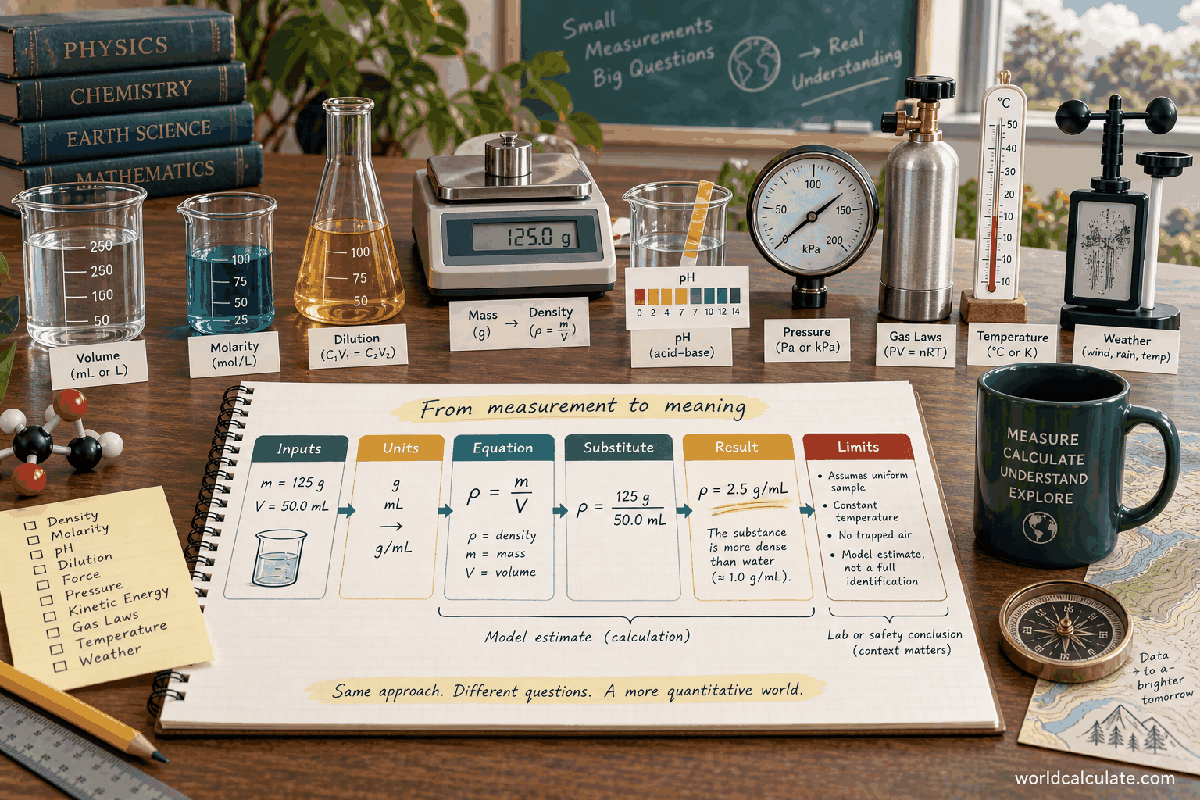
Ethylene density changes strongly with temperature, and a liquid-property value is meaningful only when its phase and pressure condition are named. This calculator uses a small, bounded table of saturated-liquid molar densities and interpolates only within the published temperature range.
Enter a temperature in kelvins between 105 K and 160 K. The page returns an interpolated molar density and a mass-density conversion in kg/m³.
The result is specifically for saturated liquid ethylene. It is not a universal density for ethylene at any pressure or phase.
On a saturation line, liquid and vapor conditions are linked by temperature and saturation pressure. Because pressure is not an independent input here, a value from this page must be labeled as saturated-liquid data.
A pressurized storage system, a supercritical state, or a two-phase line condition may require a different property model.
The handler stores reference values at 5 K intervals and uses a straight line between the two surrounding entries. At an exact table temperature, it returns that table value.
Interpolation is a convenient way to estimate between source rows. It is not a claim that the underlying thermodynamic relation is exactly linear over every interval.
At 120 K, the reference molar density is 22.572 mol/L. Multiplying by 28.05316 g/mol gives about 633.2 g/L, numerically equal to about 633.2 kg/m³.
The result should be reported with the temperature, phase condition, source table, and interpolation rule, not as a bare density number.
Molar density counts moles per litre. Mass density measures mass per volume. Multiplication by molar mass connects them: mol/L × g/mol = g/L.
Since 1 g/L has the same numerical magnitude as 1 kg/m³, the page can display the converted mass density without an additional numerical scale factor.
The source table and the chosen interpolation contract cover 105 K through 160 K. Below or above that range, another source row or an equation of state would be needed.
Rejecting out-of-range values is safer than extending a property curve silently, especially near a phase boundary or critical region.
The calculator does not output saturation pressure, pipe pressure drop, vessel rating, relief setting, or pump performance. Density is only one property in an engineering design.
Ethylene is flammable and cryogenic in this range. Follow site procedures, applicable regulations, material compatibility rules, and qualified engineering review.
Do not enter degrees Celsius in the kelvin field, confuse ethylene with ethylene glycol, or use a vapor density as a liquid value.
Do not round the temperature before interpolation if the source scenario requires a precise value. Keep the source range and phase beside the output.
Linear interpolation may not capture all curvature in the reference data, and the source table itself has measurement and correlation limits. The displayed digits are not a guarantee of that many significant figures.
The page does not include impurities, mixtures, non-equilibrium effects, or high-pressure corrections.
Can I use this for ethylene glycol? No. Ethylene and ethylene glycol are different substances with different properties.
Can I extrapolate to 170 K? No. Use a property source that covers the new temperature and phase condition, rather than extending this bounded table.
Interpolate a NIST table of saturated-liquid ethylene molar density from 105 K to 160 K and convert it to an approximate mass density.
Molar density is linearly interpolated between the tabulated saturated-liquid ethylene values at 5 K intervals from 105 K through 160 K. Mass density in kg/m³ = molar density in mol/L × 28.05316 g/mol, because 1 g/L = 1 kg/m³. The page is a bounded property-table interpolation for saturated liquid ethylene, not a general equation of state. The saturation-line condition and temperature range are part of the result and must remain attached to any engineering note.
Enter Temperature on saturation line, then choose Calculate.
The fluid is ethylene, C2H4, on its saturated-liquid line. Temperature is absolute temperature in kelvins and is within the tabulated 105–160 K range. Linear interpolation is used between neighboring 5 K reference points. The interpolation is not extrapolated below 105 K or above 160 K. The molar mass used for conversion is 28.05316 g/mol. Pressure is the saturation pressure corresponding to the entered temperature, not an independent input. The result does not describe compressed liquid ethylene away from saturation. It does not calculate vapor density, enthalpy, pressure, phase stability, or equipment limits. Cryogenic and flammable-fluid handling requires appropriate procedures and qualified review. The displayed precision should not be treated as a measurement uncertainty or design tolerance.
This calculator is part of the WorldCalculate library. Its formula, example, assumptions, input bounds, and output formatting follow the official methodology.
These WorldCalculate collections connect this tool with related questions while keeping each calculation separate and transparent.