
Goal
Map a bird's chronological age onto a user-supplied human reference lifespan while keeping the species lifespan assumption visible.
Worldwide context
Saved once here, used across the site.
Currency changes display only. Country selection guides tax input; no tax rate is guessed.
Map a bird's chronological age onto a user-supplied human reference lifespan while keeping the species lifespan assumption visible.
Human-equivalent age = bird age × human reference lifespan ÷ reference bird lifespan. Life lived percentage = bird age ÷ reference bird lifespan × 100. Human years per bird year = human reference lifespan ÷ reference bird lifespan.A clearer path to an answer
This page keeps the calculation transparent: define the goal, enter the matching values, inspect the method, and decide what the result means in your situation.
Map a bird's chronological age onto a user-supplied human reference lifespan while keeping the species lifespan assumption visible.
Bird age · Reference bird lifespan · Human reference lifespan
Human-equivalent age = bird age × human reference lifespan ÷ reference bird lifespan. Life lived percentage = bird age ÷ reference bird lifespan × 100. Human years per bird year = human reference lifespan ÷ reference bird lifespan.
Calculate, review the assumptions below, then compare a related tool when the decision needs more context.
Map a bird's chronological age onto a user-supplied human reference lifespan while keeping the species lifespan assumption visible.
Open the Bird Age to Human-Equivalent Years Calculator pageMore science tools
Download PDFDownload Word (.doc)
Enter your values above and choose Calculate to see the result here.
Calculation map
Human-equivalent age = bird age × human reference lifespan ÷ reference bird lifespan. Life lived percentage = bird age ÷ reference bird lifespan × 100. Human years per bird year = human reference lifespan ÷ reference bird lifespan.
Bounded, transparent calculation
Your recent runs stay in this browser session only.
Formula: Human-equivalent age = bird age × human reference lifespan ÷ reference bird lifespan. Life lived percentage = bird age ÷ reference bird lifespan × 100. Human years per bird year = human reference lifespan ÷ reference bird lifespan.
Birds vary widely in lifespan, so this page uses the visitor's documented or chosen species reference instead of pretending that one multiplier applies to every bird. The result is a proportional comparison, not a biological age, veterinary stage, or prediction of remaining life.
Worked example: A 4-year-old bird maps to 20 human-equivalent years under a 16-year bird lifespan and an 80-year human reference; the entered age is 25% of the bird reference.
The displayed limits are checked before the handler runs. Model-specific domain checks may also reject impossible or non-finite inputs.
Methodology: This calculator follows the WorldCalculate input, formula, precision, and boundary policy. Read the official methodology.
Calculator usage statistics
This section counts anonymous successful Calculate submissions, not unique visitors. Counts and top tools appear only when trusted aggregate data is available; country analysis is shown only under the same condition and reporting threshold.
Answer-first guide
Map a bird's chronological age onto a user-supplied human reference lifespan while keeping the species lifespan assumption visible. Start with one clearly defined goal, enter values in the units shown, and keep the result attached to the assumptions below.
This tool is useful when your question includes bird age calculator, bird years to human years, parrot age calculator. It returns the outputs declared in the calculator contract rather than a live quote, approval, diagnosis, or professional sign-off.
Bird age · Reference bird lifespan · Human reference lifespan. Keep the same time period, unit system, and currency wherever the form requires comparable values.
Run the worked example first, compare its output with the page's example, then change one input at a time. This makes an unexpected result easier to trace to a unit, boundary, or assumption.
Need a wider view? Browse Science Calculators or compare the related tools below. The WorldCalculate methodology explains how formulas, examples, limits, and revisions are reviewed.
Human-equivalent age = bird age × human reference lifespan ÷ reference bird lifespan. Life lived percentage = bird age ÷ reference bird lifespan × 100. Human years per bird year = human reference lifespan ÷ reference bird lifespan.
Birds vary widely in lifespan, so this page uses the visitor's documented or chosen species reference instead of pretending that one multiplier applies to every bird. The result is a proportional comparison, not a biological age, veterinary stage, or prediction of remaining life.
A 4-year-old bird maps to 20 human-equivalent years under a 16-year bird lifespan and an 80-year human reference; the entered age is 25% of the bird reference.
Context and background
Science calculators define a system, choose an equation, apply units and constants, and show the substitution. Effects outside that model remain outside the result.
Introductory science problem solving builds from measured quantities and idealized relationships. Those models are valuable for learning and first-pass estimates, while experiments and engineering decisions need additional evidence.
Research and review
Researched by Hassan ALRowaie, Founder and editorial researcher at WorldCalculate.
This guide follows the live calculator's declared inputs, formula, worked example, assumptions, validation boundaries, and source-backed methodology. The review date describes editorial review of the calculator explanation; it is not a promise that external facts or rates remain current.
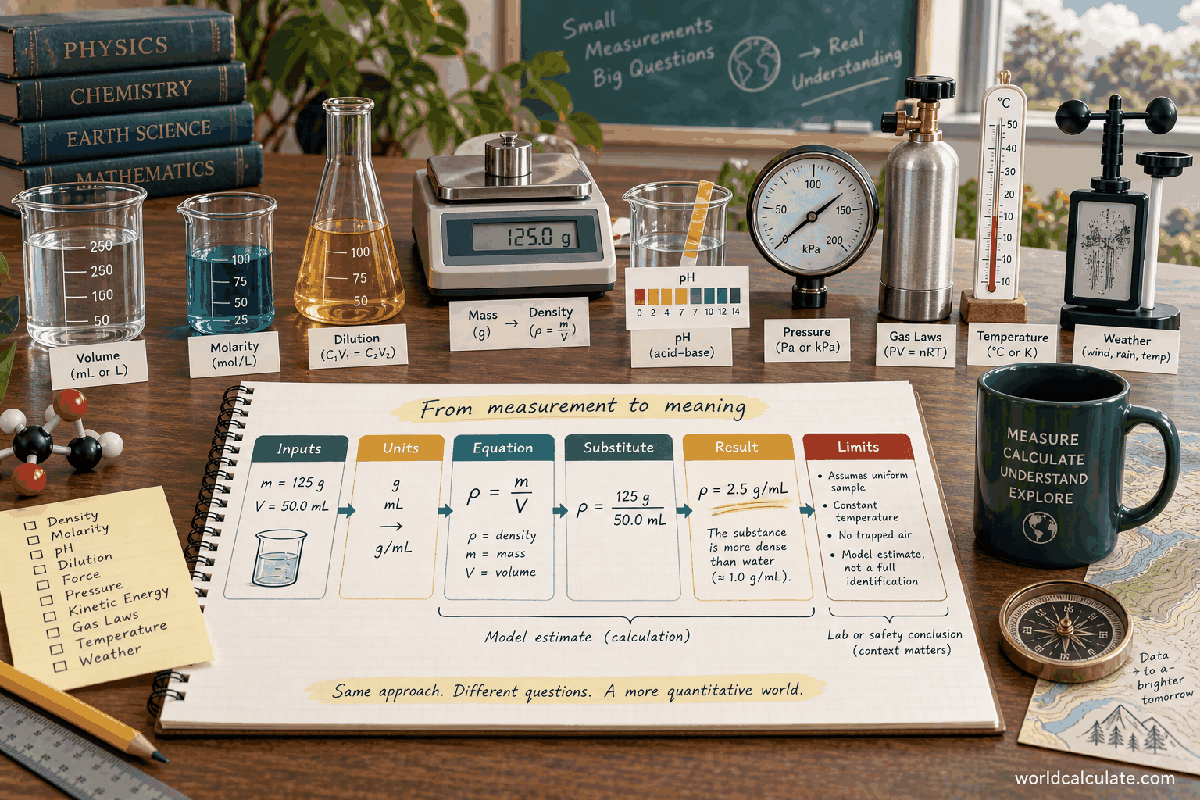
A bird's age cannot be interpreted with the same fixed multiplier used in a simple dog-year rule. A budgerigar, cockatiel, macaw, or other bird may have a very different lifespan, so this calculator makes the lifespan assumption an input and shows exactly how the comparison is produced.
Enter the bird's chronological age, a reference lifespan for the bird species, and a human reference lifespan. The page maps the same fraction of the reference lifespan onto the human scale.
The output is a communication estimate. It does not determine the bird's physical maturity, health, intelligence, or care needs.
Pet birds are not one biological group with one aging pace. Small companion birds and large parrots can have very different expected lifespans, which changes the ratio used by this worksheet.
The page therefore avoids hiding a species choice inside a preset. A visitor can use a documented range midpoint, a source-specific figure, or a clearly labeled planning value.
The arithmetic is human-equivalent age = bird age × human reference lifespan ÷ bird reference lifespan. With 4 bird years, 16 bird-reference years, and an 80-year human reference, the result is 4 × 80 ÷ 16 = 20.
The ratio is a scale conversion, not a claim that a bird experiences time like a human. It is useful because it keeps the comparison reproducible and exposes the assumptions.
Suppose a cockatiel is recorded as four years old and the chosen reference lifespan is sixteen years. An 80-year human reference gives four human-equivalent years per bird year, so the displayed comparison is twenty years.
If the lifespan assumption changes to twenty years, the same bird age maps to sixteen human-equivalent years. The changing result is a reminder to cite the lifespan assumption beside any comparison.
The life-lived percentage is bird age divided by the entered reference lifespan. In the default example, 4 ÷ 16 × 100 = 25%. This is not a survival probability and does not say that the bird has exactly 75% of its life remaining.
Exceptional longevity, illness, unknown age, and differences between wild and captive records can make a reference percentage a poor description of one individual.
Keep the hatch date, adoption record, banding record, or other evidence of chronological age with the result. The human-equivalent number should never replace the actual age in a veterinary or welfare record.
If the age is uncertain, calculate a lower and upper scenario rather than creating false precision from one guessed birthday.
Do not enter a maximum longevity record as if it were an average lifespan, or use a human age in the bird-lifespan field. Keep all three values in years.
Do not compare two birds using different human reference lifespans without labeling the change. Different scales cannot be compared as if they came from one convention.
The calculator cannot tell whether a bird is juvenile, adult, geriatric, ill, underweight, or behaviorally changed. Those questions require species-specific knowledge and professional observation.
It also does not recommend diet, cage size, breeding, medication, or quarantine. A bird that appears unwell should be assessed by a veterinarian experienced with birds.
The result can help a family explain why two birds of the same chronological age may be at different points on their lifespan scale. It can also support a personal care record when the source and date are preserved.
For public writing, state the bird species, reference lifespan, human reference lifespan, and that the model is proportional. A bare number invites readers to mistake a convention for a fact.
Is the human-equivalent age scientifically exact? No. It is a linear comparison chosen for communication.
What lifespan should I enter? Use a documented species-appropriate reference and keep its source visible. Can the percentage exceed 100? Yes; that means the individual is older than the chosen reference, not that the calculator has proved a biological impossibility.
Map a bird's chronological age onto a user-supplied human reference lifespan while keeping the species lifespan assumption visible.
Human-equivalent age = bird age × human reference lifespan ÷ reference bird lifespan. Life lived percentage = bird age ÷ reference bird lifespan × 100. Human years per bird year = human reference lifespan ÷ reference bird lifespan. Birds vary widely in lifespan, so this page uses the visitor's documented or chosen species reference instead of pretending that one multiplier applies to every bird. The result is a proportional comparison, not a biological age, veterinary stage, or prediction of remaining life.
Enter Bird age, Reference bird lifespan, Human reference lifespan, then choose Calculate.
Bird age is chronological age in completed or fractional years. The reference lifespan is appropriate to the species, care setting, and population being discussed. The human reference lifespan is a comparison scale selected by the visitor, not a universal legal or medical standard. The proportional mapping is linear and deliberately does not model faster maturity in early life. A bird can live beyond the entered reference lifespan; the percentage then reports more than 100 percent of that reference. Wild, captive, historical, and exceptional longevity records are not interchangeable. Sex, genetics, nutrition, disease, husbandry, and veterinary care are not inputs. The result should not be used to decide food, medication, breeding, or end-of-life care. A species lifespan should be documented separately from the arithmetic result. An avian veterinarian is the appropriate source for health or life-stage concerns.
This calculator is part of the WorldCalculate library. Its formula, example, assumptions, input bounds, and output formatting follow the official methodology.
These WorldCalculate collections connect this tool with related questions while keeping each calculation separate and transparent.