
Goal
Calculate average axial normal stress from an applied force and loaded cross-sectional area.
Worldwide context
Saved once here, used across the site.
Currency changes display only. Country selection guides tax input; no tax rate is guessed.
Calculate average axial normal stress from an applied force and loaded cross-sectional area.
Average normal stress σ = axial force F ÷ cross-sectional area A. With area entered in mm², σ(MPa) = F(N) ÷ A(mm²).A clearer path to an answer
This page keeps the calculation transparent: define the goal, enter the matching values, inspect the method, and decide what the result means in your situation.
Calculate average axial normal stress from an applied force and loaded cross-sectional area.
Axial force · Loaded cross-sectional area
Average normal stress σ = axial force F ÷ cross-sectional area A. With area entered in mm², σ(MPa) = F(N) ÷ A(mm²).
Calculate, review the assumptions below, then compare a related tool when the decision needs more context.
Calculate average axial normal stress from an applied force and loaded cross-sectional area.
Open the Normal Stress Calculator pageMore science tools
Download PDFDownload Word (.doc)
Enter your values above and choose Calculate to see the result here.
Calculation map
Average normal stress σ = axial force F ÷ cross-sectional area A. With area entered in mm², σ(MPa) = F(N) ÷ A(mm²).
Bounded, transparent calculation
Your recent runs stay in this browser session only.
Formula: Average normal stress σ = axial force F ÷ cross-sectional area A. With area entered in mm², σ(MPa) = F(N) ÷ A(mm²).
The sign of the entered force is preserved so a positive or negative convention can represent tension or compression. The page reports average axial stress and does not replace a detailed stress analysis.
Worked example: Average normal stress = 10,000 ÷ 100 = 100 MPa.
The displayed limits are checked before the handler runs. Model-specific domain checks may also reject impossible or non-finite inputs.
Methodology: This calculator follows the WorldCalculate input, formula, precision, and boundary policy. Read the official methodology.
Calculator usage statistics
This section counts anonymous successful Calculate submissions, not unique visitors. Counts and top tools appear only when trusted aggregate data is available; country analysis is shown only under the same condition and reporting threshold.
Answer-first guide
Calculate average axial normal stress from an applied force and loaded cross-sectional area. Start with one clearly defined goal, enter values in the units shown, and keep the result attached to the assumptions below.
This tool is useful when your question includes stress calculator, normal stress, force over area. It returns the outputs declared in the calculator contract rather than a live quote, approval, diagnosis, or professional sign-off.
Axial force · Loaded cross-sectional area. Keep the same time period, unit system, and currency wherever the form requires comparable values.
Run the worked example first, compare its output with the page's example, then change one input at a time. This makes an unexpected result easier to trace to a unit, boundary, or assumption.
Need a wider view? Browse Science Calculators or compare the related tools below. The WorldCalculate methodology explains how formulas, examples, limits, and revisions are reviewed.
Average normal stress σ = axial force F ÷ cross-sectional area A. With area entered in mm², σ(MPa) = F(N) ÷ A(mm²).
The sign of the entered force is preserved so a positive or negative convention can represent tension or compression. The page reports average axial stress and does not replace a detailed stress analysis.
Average normal stress = 10,000 ÷ 100 = 100 MPa.
Context and background
Science calculators define a system, choose an equation, apply units and constants, and show the substitution. Effects outside that model remain outside the result.
Introductory science problem solving builds from measured quantities and idealized relationships. Those models are valuable for learning and first-pass estimates, while experiments and engineering decisions need additional evidence.
Research and review
Researched by Hassan ALRowaie, Founder and editorial researcher at WorldCalculate.
This guide follows the live calculator's declared inputs, formula, worked example, assumptions, validation boundaries, and source-backed methodology. The review date describes editorial review of the calculator explanation; it is not a promise that external facts or rates remain current.

Stress is a way to relate an applied force to the area carrying it. A small cross-section can experience a larger average stress under the same load, but a force-over-area result is only the start of a real materials decision. WorldCalculate exposes the units, sign, and limits of that first-pass model.
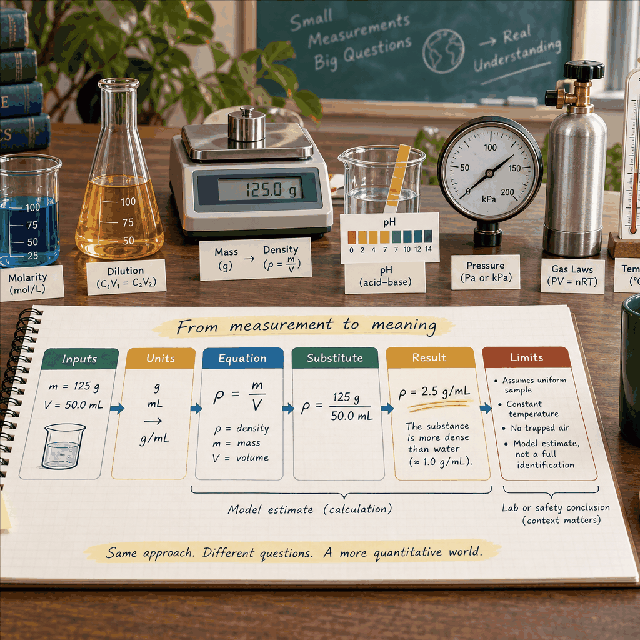
Normal stress is the component of force acting perpendicular to a cross-section divided by the area carrying it. In an axial member, the force may be described as tension or compression depending on the sign convention.
The calculator reports an average value. It does not say that every point in a real component experiences exactly that value.
The relationship is σ = F/A. With force in newtons and area in square millimetres, the numerical result is conveniently expressed in megapascals because one N/mm² equals one MPa.
For 10,000 N over 100 mm², divide 10,000 by 100 to obtain 100 MPa. Keeping the area unit visible prevents a metre-to-millimetre square conversion error.
A project may choose tension as positive and compression as negative, or use the opposite convention. The page preserves the sign of the entered force rather than guessing the convention from a title.
The magnitude can be useful for comparison, but a signed result should be carried into the drawing or report with a sentence explaining the convention.
At a fixed force, doubling the loaded area halves the average stress. At a fixed area, doubling the force doubles it. This inverse relationship is often the first intuition students need before studying deformation and failure.
The area must be the section that actually carries the load. A nominal outside dimension may not equal the net section around a hole, thread, slot, or joint.
Real parts can have stress concentrations at holes, sharp corners, notches, welds, threads, and changes in shape. Those local peaks are not represented by a uniform force divided by area.
Material properties, temperature, loading cycles, corrosion, manufacturing defects, and load eccentricity can also change the engineering decision. The simple result should not be read as an allowable limit.
One pascal is one newton per square metre. Because a square millimetre is much smaller than a square metre, N/mm² is numerically equal to MPa and is convenient for many mechanical worksheets.
Report the force, area, sign convention, calculated stress, material, and loading condition together. A bare MPa value is difficult to audit later.
Stress is the force intensity that loads a material. Strain describes deformation relative to an original length. A stress result does not by itself provide elongation, stiffness, or a material response.
To calculate strain or elastic deformation, additional information such as length and an appropriate modulus is required, and real behaviour may leave the elastic range.
The force-per-area idea helped mechanics connect external loading to internal material response. It now appears across civil, mechanical, aerospace, biomedical, and manufacturing contexts, with specialized forms for different load states.
That wide use is also why naming the stress model matters: axial normal stress, shear stress, bending stress, and contact stress are related concepts but not interchangeable pages.
Before dividing force by area, identify which section carries the axial load and how the force reaches it. A cross-section through a hole, a threaded region, a weld, or a joint may not carry the same net area as an uninterrupted bar.
The calculator answers an average axial normal-stress question. Defining the load path first prevents the common error of using a convenient outside dimension that does not represent the loaded section.
Normal stress uses the component of force perpendicular to the cross-sectional plane. A force at an angle may have both normal and shear components, so its full magnitude is not automatically the normal force for this page.
Resolve angled loading with a free-body diagram before entering the axial component. If bending, torsion, or shear dominates, select the model that matches the actual loading rather than forcing every problem into F/A.
One pascal is one newton per square metre. Since a square metre contains one million square millimetres, one N/mm² is one million pascals, or one MPa. This is why the page can divide force in N by area in mm² and label the result MPa.
The equivalence is numerical, not a reason to forget the area unit. Entering an area in m² while reading it as mm² creates a million-fold scale error.
A force of 10,000 N over 100 mm² gives 100 N/mm², which is 100 MPa. The same 100 mm² is 0.0001 m², and 10,000 N divided by 0.0001 m² gives 100,000,000 Pa, also 100 MPa.
Showing both paths is a useful student check. It proves that the short N/mm² convention is a unit conversion, not a different stress formula.
A member pulled along its axis is commonly described as being in tension; a member pushed along its axis is in compression. The page preserves the sign of force so a chosen convention can communicate that distinction.
The sign alone does not establish whether a component will yield, buckle, crack, or remain elastic. Those outcomes require material, geometry, imperfections, boundary conditions, and a suitable design method.
Dividing total axial force by loaded area assumes an average over that area. Real stress can vary around holes, notches, fillets, welds, threads, contact edges, and abrupt geometry changes.
If a local peak controls the problem, a concentration factor, numerical analysis, test, or code method may be needed. Do not compare the average result directly with a material limit without checking the applicable method.
Gross area is the full section before openings or material removal. Net area is the remaining load-carrying section in the relevant failure path. Which area belongs in a first-pass calculation depends on the connection and the failure mode.
The page does not infer net area from a drawing. Enter the area that your stated model defines, and write whether it is gross, net, effective, or another documented section quantity.
If the force does not pass through the section centroid, it can create a bending moment in addition to axial normal stress. The simple F/A average may then miss a stress gradient across the section.
Use the axial result only as the uniform component when the load is centered enough for that assumption. Add bending stress with the relevant section geometry and moment if eccentricity matters.
At a fixed axial force, stress is inversely proportional to area. Doubling area halves the average stress; reducing area by half doubles it. This relationship explains why a small net section around an opening can matter quickly.
At a fixed area, doubling force doubles average stress. Use these proportional checks to predict the direction of a revised result before calculating, then inspect whether the changed area still represents the real load path.
Suppose a centered tensile force is 24,000 N and the loaded area is 300 mm². The average normal stress is 24,000 ÷ 300 = 80 MPa. If the same force acts over 200 mm², it becomes 120 MPa.
The material has not changed in this comparison; only the idealized area changed. Whether 80 or 120 MPa is acceptable cannot be answered without material properties, loading history, temperature, and the governing design criteria.
Stress describes force intensity. Strain describes relative deformation, such as change in length divided by original length. A stress result cannot be turned into a deformation result without a material relationship and the required geometry.
In a simple elastic bar, modulus and length may connect stress to strain and elongation, but that relationship has its own assumptions. Plasticity, creep, temperature, and composite behaviour need other models.
The calculated stress is a demand from the supplied load and area. Strength is a material or system capacity measured or specified under a defined condition. Comparing them requires the right failure mode, direction, temperature, duration, and safety factors.
Do not treat a familiar MPa number as a universal safe limit. A yield value, ultimate value, fatigue limit, bearing limit, or buckling capacity answers a different question.
A short, well-supported compression member may be discussed with average compressive stress, but a slender member can buckle before the material reaches a simple compressive limit. Length, end conditions, stiffness, and imperfections then become central.
This page does not calculate buckling. Use the F/A result as a possible average term only when the structural model supports it, and select a buckling method for slender members.
Stress response depends on material, temperature, manufacturing process, moisture, corrosion, and loading rate. Two parts with the same average stress can have very different deformation or failure behaviour.
Keep the material and condition beside the output in an engineering note. The calculator intentionally does not guess a material property or attach an allowable stress to the number.
A single static stress value does not describe fatigue. Repeated cycles, mean stress, amplitude, surface finish, weld detail, and defects may control a design even when the peak average stress seems modest.
If the load varies, record the range and cycle pattern and use an appropriate fatigue or durability method. Do not use one quotient as a lifetime prediction.
Choose a convention such as tension positive and compression negative, then state it. The page keeps the force sign in the result, which makes a series of load cases easier to compare.
When only magnitude is needed, report the absolute size with a separate tension or compression label. Avoid silently deleting a negative sign if direction affects the design interpretation.
Confirm that the force is axial, the area is the loaded section, the force is in newtons, and the area is in square millimetres. Check whether the value is a total force, one share of a multi-member load, or a force already resolved into an axial component.
Estimate the scale. 10,000 N over 100 mm² should be near 100 MPa. A result near 0.1 or 100,000,000 likely signals a unit mismatch or a misplaced decimal.
Recompute the quotient from the displayed force and area. Then state the sign convention, the average-stress assumption, and the area definition. This three-part record lets another reader reproduce the number and see what it does not cover.
If the result is surprising, inspect the section and units before changing the input. Do not round the area early when an opening or thin wall makes the result sensitive.
A notch or hole can amplify local stress relative to the average. The amplification depends on geometry, loading, material behaviour, and whether the feature is smooth, sharp, threaded, welded, or damaged.
The calculator cannot see a drawing. If a feature may control, use a documented concentration method or analysis and keep the simple average as a clearly labelled baseline rather than the final answer.
Start with 10,000 N and 100 mm², predict that the average is 100 MPa, and reproduce it by hand. Change only the force, then only the area, and explain why each result moves in its direction.
Next draw a section with a hole and discuss whether gross or net area belongs in the chosen model. The exercise connects arithmetic to the physical meaning of the area rather than treating F/A as a button with no context.
A useful worksheet records load case, force direction, force value and unit, gross or net area, stress sign, average-stress assumption, result, and excluded effects. Add the material and applicable standard in the surrounding design record.
This structure makes the result useful for review without claiming that a first pass is a complete design. It also helps identify the next calculation when bending, buckling, fatigue, or local stress may matter.
The result cannot approve a bridge, beam, bolt, weld, pressure vessel, medical device, aircraft part, or building connection. Safety depends on the complete load path, uncertainty, failure modes, code requirements, inspection, and qualified review.
For a real structure or component, follow the applicable professional design process. Use this worksheet to explain a defined relationship, not to replace a stamped calculation or safety decision.
Enter the axial force in newtons, enter the loaded area in square millimetres, and divide force by area. The result is average normal stress in MPa. Keep the sign if it communicates tension or compression.
Then ask whether the load is centered, the section is correct, and local effects or buckling could matter. If any answer is uncertain, treat the number as a first-pass estimate and continue with the appropriate model.
Is N/mm² the same as MPa? Yes. Does this include a safety factor? No. Does it calculate bending stress? No; bending needs geometry and moment distribution. Can I use a negative force? Yes, when the sign is meaningful in your chosen convention. Does it calculate yield or failure? No; material properties and a complete design method are required.
Calculate average axial normal stress from an applied force and loaded cross-sectional area.
Average normal stress σ = axial force F ÷ cross-sectional area A. With area entered in mm², σ(MPa) = F(N) ÷ A(mm²). The sign of the entered force is preserved so a positive or negative convention can represent tension or compression. The page reports average axial stress and does not replace a detailed stress analysis.
Enter Axial force, Loaded cross-sectional area, then choose Calculate.
Force is axial and is entered in newtons. Area is the loaded cross-sectional area in square millimetres. The stress is treated as an average over the stated area. The member is idealized as straight and the load direction is known. Local stress concentrations, holes, threads, welds, bends, and contact effects are not modeled. Material strength, yield, fatigue, fracture, buckling, and safety factors are not inferred. A positive or negative sign follows the visitor's stated force convention. The page does not certify a structure, component, or allowable stress. Use a qualified design method and applicable code for real safety decisions.
This calculator is part of the WorldCalculate library. Its formula, example, assumptions, input bounds, and output formatting follow the official methodology.
These WorldCalculate collections connect this tool with related questions while keeping each calculation separate and transparent.