
Goal
Pressure from an applied force over a piston area, in pascals and kilopascals.
Worldwide context
Saved once here, used across the site.
Currency changes display only. Country selection guides tax input; no tax rate is guessed.
Pressure from an applied force over a piston area, in pascals and kilopascals.
P = F/A; kPa = Pa / 1000.A clearer path to an answer
This page keeps the calculation transparent: define the goal, enter the matching values, inspect the method, and decide what the result means in your situation.
Pressure from an applied force over a piston area, in pascals and kilopascals.
Force · Area
P = F/A; kPa = Pa / 1000.
Calculate, review the assumptions below, then compare a related tool when the decision needs more context.
Pressure from an applied force over a piston area, in pascals and kilopascals.
Open the Hydraulic Pressure pageMore science tools
Download PDFDownload Word (.doc)
Enter your values above and choose Calculate to see the result here.
Calculation map
P = F/A; kPa = Pa / 1000.
Bounded, transparent calculation
Your recent runs stay in this browser session only.
Formula: P = F/A; kPa = Pa / 1000.
Pressure concentrates force: the same push over a smaller piston gives higher pressure — the principle behind hydraulic lifts.
Worked example: Pressure 10000 Pa (10 kPa).
The displayed limits are checked before the handler runs. Model-specific domain checks may also reject impossible or non-finite inputs.
Methodology: This calculator follows the WorldCalculate input, formula, precision, and boundary policy. Read the official methodology.
Calculator usage statistics
This section counts anonymous successful Calculate submissions, not unique visitors. Counts and top tools appear only when trusted aggregate data is available; country analysis is shown only under the same condition and reporting threshold.
Answer-first guide
Pressure from an applied force over a piston area, in pascals and kilopascals. Start with one clearly defined goal, enter values in the units shown, and keep the result attached to the assumptions below.
This tool is useful when your question includes hydraulic pressure, pascal, force over area. It returns the outputs declared in the calculator contract rather than a live quote, approval, diagnosis, or professional sign-off.
Force · Area. Keep the same time period, unit system, and currency wherever the form requires comparable values.
Run the worked example first, compare its output with the page's example, then change one input at a time. This makes an unexpected result easier to trace to a unit, boundary, or assumption.
Need a wider view? Browse Science Calculators or compare the related tools below. The WorldCalculate methodology explains how formulas, examples, limits, and revisions are reviewed.
P = F/A; kPa = Pa / 1000.
Pressure concentrates force: the same push over a smaller piston gives higher pressure — the principle behind hydraulic lifts.
Pressure 10000 Pa (10 kPa).
Context and background
Science calculators define a system, choose an equation, apply units and constants, and show the substitution. Effects outside that model remain outside the result.
Introductory science problem solving builds from measured quantities and idealized relationships. Those models are valuable for learning and first-pass estimates, while experiments and engineering decisions need additional evidence.
Research and review
Researched by Hassan ALRowaie, Founder and editorial researcher at WorldCalculate.
This guide follows the live calculator's declared inputs, formula, worked example, assumptions, validation boundaries, and source-backed methodology. The review date describes editorial review of the calculator explanation; it is not a promise that external facts or rates remain current.

Pressure describes how a specified force is distributed over a specified area. This calculator uses the exact contract P = F/A: enter force F in newtons and area A in square meters, with area strictly greater than zero. The force is treated as uniform across the area and perpendicular to it, so the result is a scalar pressure in pascals. The corresponding kilopascal value is obtained by kPa = Pa/1000. The model is static and assumes an incompressible fluid, which makes the result useful for a clear local hydraulic-pressure estimate. It does not ask for a second piston, fluid flow, pipe dimensions, elevation, temperature, leakage, efficiency, or a safety factor. Those omissions are deliberate. The guide explains the arithmetic, units, piston geometry, Pascal principle, force multiplication as context, gauge and absolute pressure concepts, the default 500 N example, sensitivity, validation, practical meaning, model limits, safety boundaries, troubleshooting, and a final check before a number is reused.
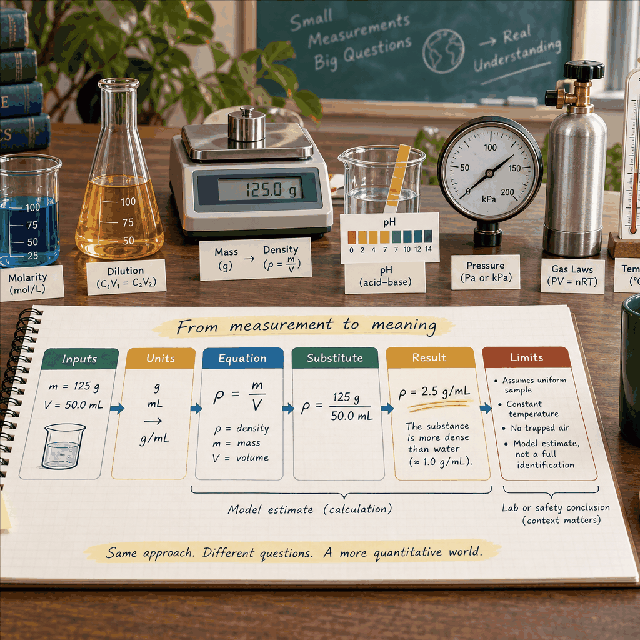
The page answers one focused question: what pressure follows when a known force is spread uniformly over a known perpendicular area? The force field supplies F in newtons, and the area field supplies A in square meters. The calculation divides the first quantity by the second. Because the input contract describes force and area as magnitudes, a zero force produces zero pressure, while a negative force is not entered as a signed direction. The area must be strictly positive so that the division represents an actual surface over which the force is applied.
The result has two pressure units that describe the same value. The base SI result is pressure in pascals, written Pa. The page also reports the corresponding value in kilopascals, written kPa, using kPa = Pa/1000. A pascal is a newton per square meter, so the output is an intensity of loading rather than a second force. Keeping both units visible makes small and ordinary hydraulic values easier to read without changing the underlying calculation.
The page does not determine the force from a mass, select a piston, calculate a piston diameter, or solve an entire hydraulic circuit. It does not model a pump, a reservoir, a valve, a hose, a seal, a moving ram, or a pressure transient. Those details can matter greatly in a real installation. This record supplies only the local force-over-area result under the stated static idealization, and its usefulness depends on preserving that narrow meaning when the number is discussed or recorded.
The central equation is P = F/A. In this expression, P is pressure, F is the applied force, and A is the area receiving that force. The equation is exact for the simplified relationship being used here: pressure equals a uniformly distributed normal force divided by the area over which it acts. It is not a hidden empirical correction and it does not include any additional coefficient. Every physical qualification belongs to the assumptions about the force, area, and state of the fluid.
The force must be entered in newtons. If a source gives a force in kilonewtons, convert it to newtons before entry by multiplying by 1000. If a source gives mass rather than force, mass cannot be entered directly; a separate mechanics step would be needed to determine the relevant force. The area must be entered in m^2, not as a length, diameter, radius, or unconverted square-unit value. The calculator treats the entered area as the final area for the division.
After the division, convert pascals to kilopascals by dividing by 1000. Thus a result of 10000 Pa is 10 kPa, and a result of 2500 Pa is 2.5 kPa. The conversion changes only the numerical label and scale; it does not change the physical pressure. Writing the conversion explicitly is valuable because a factor of 1000 can otherwise be lost when a result is copied into a report, spreadsheet, or hand calculation.
The contract also requires a uniform, perpendicular force distribution. A total force may be known while its local distribution is not. If the force is tilted, only its perpendicular component contributes to the normal pressure in this simple interpretation. If force varies across the surface, the quotient of total force and total area is an average pressure rather than a complete local pressure map. The calculator uses the ideal uniform case and does not return a distribution.
Force is the total push or pull applied to an object or surface, measured in newtons. Pressure describes how concentrated that force is over an area. Two cases can have the same force and different pressures if their contact areas differ. A broad piston face spreads a load, while a smaller face applies the same total load more intensely. The calculator reports the second idea, so its number should not be read as another way of naming the entered force.
The distinction becomes clear by holding F fixed. If 500 N acts over 0.05 m^2, the pressure is 10000 Pa. If the same 500 N acts over an area half as large, the pressure doubles. If the area doubles, the pressure halves. Nothing about the total force changed in those comparisons; only its spatial concentration changed. This is why area must be treated as a squared measurement and why an area conversion error can dominate the result.
Pressure is also different from energy, power, and stress, even though those quantities can appear in related engineering discussions. Energy describes a capacity to do work, power describes a rate of energy transfer, and stress describes internal force intensity in a material. A hydraulic pressure estimate may be used alongside those quantities in a larger analysis, but this page returns neither them nor a statement about whether a component can safely carry the load.
Area A should describe the surface over which the modeled force is actually transmitted. For a simple piston, that is normally the effective face area bounded by the seal or pressure boundary. The word effective matters because a drawing may show a circular plate while the pressure-bearing region is defined by a different diameter. Use the area that matches the force and pressure interface in the problem, not a convenient outside dimension that belongs to a different part.
The calculator accepts the final area directly. If the geometry is known by dimensions, calculate the appropriate area in a separate step and then convert it to m^2 before entering it. For a circular face, a radius r would lead to A = pi*r^2; for a rectangle, length multiplied by width would be the basic area. Those are geometry relationships used to prepare an input, not additional calculator outputs or fields on this page. Record which dimensions produced the entered area so the choice can be audited later.
The area must be strictly positive. A zero area would make the quotient undefined and would not describe a usable pressure-bearing region. A negative area is not a physical magnitude. A very small positive area can produce a very large pressure for an otherwise modest force, so a mathematically allowed input still deserves a physical check. Confirm that the chosen surface exists, remains engaged, and is the same surface to which the perpendicular force is being attributed.
An area unit is squared, so length conversions must be squared as well. One centimeter is 0.01 meter, which means one square centimeter is 0.0001 m^2. One millimeter is 0.001 meter, which means one square millimeter is 0.000001 m^2. Converting a numerical area as though it were a single length would introduce a large error. The safe practice is to convert the length first and square it, or use a verified square-unit factor directly.
Force units also need a consistent base. One kilonewton is 1000 N. If a calculation begins with 0.5 kN, the value entered for F is 500 N. Once F is in newtons and A is in m^2, the quotient is in Pa because Pa equals N/m^2. Only after that result is obtained should the pressure be restated in kPa by dividing by 1000. Converting at the wrong stage can make a correct formula produce a wrong number.
A useful conversion check is to estimate the direction of the change. Replacing cm^2 with m^2 makes the numerical area much smaller because a square meter contains many square centimeters. For the same force, the numerical pressure in Pa therefore becomes much larger than a calculation that mistakenly leaves the cm^2 number unchanged. If a unit conversion makes the pressure move in the opposite direction from that expectation, stop and inspect the squared factor.
Do not rely on a unit label alone when reviewing a saved result. Write the converted values beside the formula, such as F = 500 N and A = 0.05 m^2, then show P = 500/0.05 N/m^2. This makes the path from the original measurement to the entered contract visible. It also prevents a later reader from assuming that the calculator silently converted a diameter, a mass, an area in cm^2, or a force in kN.
Pressure in this record is based on the part of a force that acts normal to the surface. Normal means perpendicular. A force applied at an angle can be resolved into a perpendicular component and a tangential component. The perpendicular component presses on the area and belongs in the simple pressure relationship. The tangential component acts along the surface and may cause sliding, friction, or another interaction that is outside this calculator's two-input contract.
The word uniform adds a second condition. Even when the total force is perpendicular, it may be concentrated near an edge, transferred through a small contact patch, or distributed unevenly by a flexible plate. Dividing total force by total area then gives an average over the selected area, not the highest local pressure. This page assumes the average is also a useful representation of the local pressure because the force is treated as uniform across the area.
If the direction is uncertain, do not make a larger or smaller area compensate for it. Determine the force component and the true pressure-bearing surface from the physical arrangement first. A tilted actuator, misaligned plunger, or eccentric contact can change both the normal component and the distribution. The calculator can still perform the quotient for a supplied normal force and area, but it cannot detect whether the supplied pair came from a valid force decomposition.
The Pascal principle gives the familiar hydraulic setting for this relationship. In an enclosed fluid at rest, an applied pressure is transmitted through the fluid and acts on the boundaries of the fluid region. If the fluid is treated as incompressible and the system is static, pressure can be considered a shared state variable through connected portions at the same reference level, subject to the limits of the idealization. This is the physical reason force-over-area pressure is useful when discussing pistons.
The principle does not say that force is automatically the same everywhere. Force depends on the area on which the pressure acts. A given pressure on a larger receiving surface corresponds to a larger total force, while the same force on a smaller surface corresponds to a higher pressure. Pressure transmission and force transmission are therefore related but not interchangeable statements. The area at each interface must be considered separately in a system analysis.
This calculator uses the principle only as context for the local source pressure. It does not simulate pressure at multiple locations, compare heights, account for a fluid column, or determine how a real line responds. The user supplies one force and one area, and the page returns their quotient in Pa and kPa. The ideal principle helps explain the result, but it does not expand the record into a multi-component hydraulic solver.
When using the result in a larger exercise, label the page's contribution precisely. Say that the source force over the source area gives a modeled pressure of a stated number in Pa and kPa. Any later step involving another area, a force ratio, mechanical travel, or a real component should be shown as a separate equation with its own assumptions. That separation makes it clear which facts came from the calculator and which came from the surrounding hydraulic model.
A simple two-piston explanation shows why hydraulic devices can exchange a small input force for a larger output force. If a source piston creates pressure P and a receiving piston has a larger area, the pressure acting on that larger area corresponds to a larger force. In an ideal sketch, the relationship at the receiving surface would be described by force equal to pressure multiplied by receiving area. The area ratio explains the multiplication; it does not create energy for free.
The tradeoff is movement. In an ideal incompressible arrangement, moving a small piston through a longer distance displaces a volume that moves the larger piston through a shorter distance. Real mechanisms also have seal friction, fluid resistance, flexing parts, leakage, trapped gas, and other losses. A practical system therefore has efficiency and operating limits that cannot be inferred from one force and one area alone.
This page can provide the pressure associated with a chosen source force and source area, which is one ingredient in that conceptual explanation. It does not calculate a receiving-piston force, piston travel, flow, displacement, efficiency, lifting capacity, or system pressure drop. Mentioning force multiplication here is meant to explain the idea behind the word hydraulic, not to claim that those additional quantities are outputs of this record.
When using the result in a larger exercise, label the page's contribution precisely. Say that the source force over the source area gives a modeled pressure of a stated number in Pa and kPa. Any later step involving another area, a force ratio, mechanical travel, or a real component should be shown as a separate equation with its own assumptions. That separation makes it clear which facts came from the calculator and which came from the surrounding hydraulic model.
Pressure can be described relative to different reference levels. Gauge pressure compares a system pressure with the surrounding atmospheric pressure. Absolute pressure compares it with an ideal vacuum reference. The two values describe the same physical state using different zero points. A gauge reading of zero therefore does not mean that no molecules exert pressure; it means the measured pressure matches the chosen local atmosphere.
Conceptually, absolute pressure equals gauge pressure plus atmospheric pressure: P_abs = P_gauge + P_atm. A gauge pressure below zero is a vacuum relative to the atmosphere, while absolute pressure remains nonnegative in the ordinary thermodynamic sense. The relation is useful when translating between instrument readings and equations that require an absolute reference, but atmospheric pressure is not an input field in this record.
The pressure from this calculator is defined by the entered force and area. It does not ask whether the inputs came from a gauge reading, an absolute measurement, or a mechanical force calculation. Do not add atmospheric pressure automatically unless the larger problem specifically requires a change of reference. Adding it to every force-over-area result would mix two different questions and could make a valid local pressure estimate appear to have an unsupported offset.
When a result seems inconsistent with an instrument, first identify the instrument's reference. A pressure sensor may report gauge pressure, while a thermodynamic relation may expect absolute pressure. A piston force derived from a pressure difference may also involve pressures on both sides, not merely one absolute value. This page does not resolve those reference choices, so keep the reference label outside the two numeric outputs and make any conversion explicit.
The record's default force is 500 N and its default area is 0.05 m^2. Both values already match the input units, and the area is strictly positive. Apply the contract directly: P = F/A = 500 N/0.05 m^2. Dividing 500 by 0.05 gives 10000, and the unit quotient is N/m^2. Since one N/m^2 is one Pa, the pressure is 10000 Pa.
Now express the same result in kilopascals. Use kPa = Pa/1000, so 10000 Pa/1000 = 10 kPa. The complete default statement is therefore: a uniform perpendicular force of 500 N distributed over 0.05 m^2 gives a modeled pressure of 10000 Pa, or 10 kPa, under the static incompressible-fluid assumptions. The second number is not a second physical result; it is the same pressure in a larger unit.
The area explains the scale of the answer. Five hundred newtons is spread over one twentieth of a square meter, so each square meter in the equivalent uniform distribution corresponds to twenty times the force assigned to the entered patch. That is why the numerical pressure is 10000 in Pa rather than 500. The interpretation still depends on the force really being normal to the area and on the selected area being the pressure-bearing surface.
A useful written check keeps the units at every stage: P = 500 N/(0.05 m^2) = 10000 N/m^2 = 10000 Pa = 10 kPa. If a hand calculation gives 10 Pa, 10000000 Pa, or a result without pressure units, inspect the decimal placement and the area conversion first. The example verifies the arithmetic, but it does not certify a piston, fluid, seal, or hydraulic assembly.
Pressure scales directly with force when area is fixed. If F is doubled while A stays the same, P doubles. If F is reduced to one quarter while A is unchanged, P becomes one quarter. These are algebraic consequences of P = F/A and are useful for checking comparisons between load cases. They should not be confused with a guarantee that a real hydraulic component remains unchanged when a larger force changes seals, alignment, deformation, or fluid conditions.
Pressure scales inversely with area when force is fixed. Doubling A halves P, and reducing A by half doubles P. If both F and A are doubled, the pressure is unchanged because the two scale factors cancel. In ratio form, for two cases with positive areas, P2/P1 = (F2/F1)*(A1/A2). A ratio check is often safer than repeating several decimal divisions because it highlights whether the area belongs in the numerator or denominator.
For small changes around a nonzero force and positive area, a first-order sensitivity description is dP/P approximately equal to dF/F minus dA/A. This says that a one percent increase in force raises pressure by about one percent, while a one percent increase in area lowers it by about one percent. If force and area uncertainties are independent, their contributions still need to be considered separately; the calculator does not combine uncertainty or report a confidence interval.
Area errors deserve special attention because they act in the denominator. A ten percent area overestimate makes the calculated pressure lower than the value from the true area, while a ten percent area underestimate makes it higher. A force error changes the result in the same direction as the force error. Test low and high plausible inputs when a decision depends on a threshold, and keep the sensitivity work distinct from the page's single displayed quotient.
Dimensional analysis gives a compact proof that the output unit is pressure. The numerator is force in N and the denominator is area in m^2, so the quotient is N/m^2. The SI name for N/m^2 is pascal, Pa. This check does not depend on the particular numbers 500 and 0.05. It follows from the structure of the relationship and should remain true for every valid entry.
The units also expose common substitutions that are not allowed. Dividing a force by a length produces N/m, not Pa. Dividing a mass in kg by an area produces kg/m^2, not Pa. Dividing a pressure by an area would produce another quantity entirely. If the final line of a calculation does not reduce to N/m^2 before the kPa conversion, the inputs or the formula have been mixed incorrectly.
The kilopascal conversion is a scale conversion within the pressure dimension. Since 1 kPa is 1000 Pa, a numerical pressure expressed in kPa is one thousandth of its numerical value expressed in Pa. The physical state is unchanged. Dimensional analysis can verify the family of the unit, while the factor of 1000 verifies the chosen pressure scale. Both checks are needed when moving between a detailed calculation and a compact report.
The arithmetic can be exact for the entered decimal values while the physical inputs remain approximate. A force written as 500 N may represent a rounded reading, and an area written as 0.05 m^2 may have fewer meaningful digits than its trailing notation suggests. The result should not acquire more physical certainty merely because a calculator can display more digits. Preserve the precision supported by the measurements and by the geometry used to obtain the area.
The default example is intentionally stated as 10000 Pa and 10 kPa because those are the direct values from 500 divided by 0.05. In a technical record, a writer may choose scientific notation or a stated number of significant figures to show the intended precision. The key is consistency: do not round the area early, do not round the intermediate pascal value before converting, and do not present decorative decimal places as measurement evidence.
If the force and area came from separate instruments, their uncertainty may control the final reporting precision. A measured diameter can also carry uncertainty that becomes an area uncertainty after squaring. When the pressure is near a limit, retain the input provenance and calculate a plausible range outside this page. The calculator has no uncertainty field and does not select a significant-figure policy, so the final reporting decision belongs to the user or the governing procedure.
A clear report names the model as well as the number. For example, state the force, the area, the unit conversions, the pressure in Pa, the equivalent pressure in kPa, and that the force was treated as uniform and perpendicular in a static incompressible-fluid model. This is more useful than a long decimal with no conditions. A reader can then reproduce the quotient and judge whether its precision is appropriate.
Validation protects the mathematical domain before division. The force field is bounded by the record and permits a zero magnitude, while the area field is bounded and has a strictly positive lower limit. A zero force is a meaningful limiting case for this contract and gives P = 0 Pa, or 0 kPa. A zero area is not accepted because division by zero is undefined and because it would not describe a pressure-bearing surface.
Inputs should be finite numeric values in the displayed bounds. Missing values, text that is not a number, negative force magnitudes, negative areas, and values beyond the field limits do not satisfy the contract. Rejecting such data is preferable to displaying a plausible pressure that has no defined physical interpretation. Validation cannot determine whether a valid-looking area is the correct geometry or whether a valid-looking force is truly perpendicular; those checks remain physical responsibilities.
An extremely small positive area can be mathematically valid and still deserve scrutiny. Because area is in the denominator, it can create a large pressure from a modest force. Ask whether the area is a true effective contact area, whether the force is distributed over it, and whether the fluid or component can support the implied state. Do not clip an uncomfortable result by entering a larger area without a geometric reason.
When an error appears, correct the input rather than altering the formula. Verify that F is in N, A is in m^2, A is strictly positive, and the force is a uniform perpendicular quantity for the intended surface. If the data cannot be expressed under those conditions, this page is not the right contract for that case. A rejected calculation is an honest boundary, not a missing estimate to be filled by guesswork.
A pressure result can be read as the ideal normal load intensity over the selected surface. In a classroom problem, it connects a stated piston force to a pressure unit. In preliminary reasoning, it can compare how changing the source force or face area changes the intensity. In a record of a test, it can preserve the nominal pressure associated with a particular load and contact area. In each case, the number is useful because the force, area, and assumptions remain visible.
The pressure value should not be turned into a universal statement about every point in an assembly. A rigid, well-aligned piston with a stable seal may approximate the uniform model better than a flexible plate, an eccentric plunger, or a contact with a damaged surface. If the load is concentrated, the average quotient can be lower than the local maximum. The page gives the value for the supplied idealized pair, not a map of local stresses or a guarantee of even contact.
Comparisons are often more reliable than isolated numbers. Holding the same force and changing only area can show the pressure effect of a design change. Holding the same area and changing only force can show a load sensitivity. When comparing cases, keep the reference pressure convention, fluid state, geometry definition, and unit system consistent. Otherwise a difference may reflect a changed assumption rather than a real change in the hydraulic condition.
A practical note should distinguish what was measured from what was assumed. The force may be measured, the area may be calculated from a drawing, the perpendicularity may be judged from alignment, and the static fluid condition may be idealized. List those sources next to the pressure. This makes the result useful for review without giving it authority beyond the evidence that produced its inputs.
The record assumes a static fluid, meaning the calculation describes an equilibrium or steady condition rather than a changing pressure wave or flowing stream. The force is treated as established and the pressure is evaluated without modeling how quickly the load was applied. This is appropriate for a basic force-over-area relationship where the purpose is to identify the pressure associated with a settled load, not to predict startup, shutdown, or oscillation behavior.
The fluid is also treated as incompressible. In that idealization, pressure transmission does not require tracking a meaningful volume change of the fluid in response to the load. That assumption supports the familiar piston explanation and keeps the arithmetic focused on F and A. Real fluids and the surrounding hardware can still deform, contain dissolved or trapped gas, warm up, or respond elastically, but those effects are intentionally outside the selected model.
Static does not mean that every part of a real apparatus is risk-free or perfectly motionless. A system can appear settled while a seal creeps, a hose expands, a valve leaks, or a trapped pocket compresses. The calculator cannot observe those conditions. It reports the pressure implied by the entered force and area under the ideal assumption, so a user must decide whether the approximation is suitable for the duration, temperature, and consequence of the application.
The assumptions define a boundary rather than a promise of universal accuracy. If the problem is an introductory hydraulic relation, the model may be exactly the intended level. If the problem concerns rapid actuation, compressible gas, fluid transients, pressure waves, or changing volume, additional equations and measurements are needed. Keep the simple result as a transparent local calculation, not as a substitute for the missing dynamic model.
A real hydraulic system can lose pressure between the source and a downstream component. Narrow passages, valves, long lines, rough surfaces, bends, and restrictions can create pressure drops when fluid moves. The local pressure at one piston may therefore differ from the pressure available at another location. This calculator does not include a path, a flow rate, a line length, or a resistance term, so it cannot predict that difference.
Mechanical parts can also change the relationship between nominal pressure and useful force. Seals have friction, pistons can bind, cylinders can misalign, and plates can bend. The effective area may change with wear or position, and the force may not remain uniform across the face. A calculation using the nominal area can still be a helpful first estimate, but it should not be treated as a direct measurement of every internal load.
Fluid condition matters as well. Temperature can change viscosity and component dimensions. Entrained or trapped gas can make the response springy. Contamination can affect valves and seals. Leakage can prevent a pressure from being maintained. These effects may occur even when the fluid is described casually as incompressible. The calculator honors the ideal assumption supplied in the record and leaves diagnosis of real-fluid behavior to a separate system analysis.
The page also does not account for hydrostatic changes with height, acceleration of a fluid column, cavitation, boiling, or pressure pulses. It does not estimate flow, volume, time, energy loss, or component life. Those are not missing display labels; they are absent variables in the contract. If any of them controls the decision, the force-over-area result must be combined with a model that explicitly represents the relevant effect.
Pressure stores energy in fluid and in the parts that contain it. A failure can release a moving piston, rupture a line, eject a fitting, or create a crushing hazard. A small displayed area can make the calculated pressure appear high, while a large receiving area in a real mechanism can create a very large force. These consequences mean that a correct quotient is not by itself a safe operating limit or a permission to test an unverified assembly.
Do not use the page as a substitute for rated components, containment review, pressure testing, inspection, or a documented engineering design. Material strength, fatigue, seal compatibility, fastener loading, temperature, corrosion, and failure mode all need attention in a consequential system. A nominal pressure may be below a remembered material value while the actual arrangement still fails because of a local defect, stress concentration, impact, or incorrect effective area.
The calculator does not apply a safety factor, choose a conservative load case, verify a pressure rating, or identify a safe test procedure. If people, lifting, braking, medical equipment, aircraft, vehicles, or industrial machinery are involved, use the governing requirements and qualified review appropriate to that context. Keep hands and body parts away from pressurized mechanisms and never treat a numerical estimate as evidence that a component is ready for live pressure.
A responsible record states the source of F, the geometric basis for A, the unit conversions, the pressure reference if relevant, and the static incompressible assumption. It also records what the calculation does not cover and what independent checks were performed. That documentation helps prevent a low-risk educational estimate from being copied into a higher-risk application with its boundaries removed.
If the pressure is unexpectedly high, inspect the area first. Confirm that the entered number is in m^2 rather than cm^2 or mm^2, and confirm that a radius or diameter was converted into an area rather than entered as though it were one. Because area is in the denominator, a small unit or geometry mistake can raise the result by orders of magnitude. Recalculate the area independently and compare it with the physical size of the pressure-bearing surface.
If the pressure is unexpectedly low, inspect the force and the selected surface. A force in kN may have been entered as though it were N, or a broad outside plate may have been used instead of the effective piston area. Check whether the force is truly the normal component and whether it is distributed across the full area. A tangential component, a partial contact, or a load shared by several surfaces can make the chosen pair inappropriate for the simple uniform model.
If the number disagrees with an instrument, identify the reference and location of the measurement. The instrument may show gauge pressure while the calculation is being compared with an absolute value, or the sensor may be downstream of a restriction. The measured condition may also be dynamic while the calculator assumes a static state. Align the force, area, location, timing, and pressure reference before treating the difference as a numerical error.
If the result is zero, verify whether zero force was intentional. Under this contract, F = 0 gives P = 0, but a real system could still have ambient or residual pressure that is not represented by the entered force. If the page rejects the entry, check finiteness, bounds, and the strictly positive area requirement. Do not replace a rejected or surprising value with a preferred value merely to make it match an expectation.
Start by naming the interface and the question. Identify the piston face or other area over which the force is being idealized, and state whether the desired number is a local nominal pressure. Determine the force that acts normal to that surface, rather than using a total force whose direction has not been resolved. If the force is measured, record the measurement condition; if it is derived, keep the derivation separate from this two-input page.
Next prepare the units. Convert force to N and area to m^2, remembering that area conversions are squared. Confirm that A is strictly positive and that both values are finite and inside the displayed field bounds. Before entering the values, perform a rough magnitude check: a larger force should raise pressure, a larger area should lower it, and a very small area should not be accepted without a physical reason.
Enter F and A, calculate P = F/A, and retain the pascal result. Then calculate the corresponding kilopascal value with kPa = Pa/1000. Reproduce the division independently and check that the units reduce to N/m^2. If a larger hydraulic discussion follows, mark this pressure as the contribution from the selected force and area and write every additional system relationship separately.
Finish by documenting the interpretation. State that the force was treated as uniform and perpendicular, that the fluid model was static and incompressible, and that gauge or absolute reference was not silently changed. If the result affects a physical decision, add component ratings, uncertainty treatment, safety factors, testing, and qualified review outside the calculator. This workflow keeps a short formula traceable without asking it to answer an unmodeled question.
The page cannot decide whether the selected area is the correct effective piston area. That requires a drawing, dimensions, seals, contact boundaries, and an understanding of how the load is transferred. It cannot decide whether a force is uniform or perpendicular from the numeric value alone. A valid-looking pair of numbers can still describe a poor physical approximation if the surface is tilted, flexible, partially engaged, or loaded eccentrically.
The page cannot decide whether a pressure is gauge or absolute, whether a downstream pressure drop exists, or whether a connected fluid region is truly at static equilibrium. Those questions require a reference pressure, a location, a time condition, and often additional measurements. The calculator's Pa and kPa values are the result of the force and area supplied; they do not acquire an atmospheric offset or a system location automatically.
The page cannot determine a safe force, a safe pressure, a lifting result, a cylinder speed, or a component life. It also cannot tell whether a real fluid contains gas, whether a seal leaks, or whether an assembly will remain aligned. Those are system questions with different inputs and acceptance criteria. Treat the displayed pressure as one transparent calculation rather than a general-purpose hydraulic verdict.
The boundary is useful because it identifies what must be added next. A geometry review may be needed for A, a force balance may be needed for F, a reference measurement may be needed for pressure comparison, and a design or test review may be needed for safety. Naming the missing question is better than extending P = F/A until it appears to answer everything.
Before accepting a result, confirm the exact contract: P = F/A, F is in N, A is in m^2, A is strictly positive, and the force is uniform and perpendicular to the selected area. Confirm that the fluid situation is being treated as static and incompressible for the purpose of this estimate. If any of those statements is false, the number needs a different interpretation or a different model.
Then check the arithmetic and units: divide force by area to obtain Pa, divide Pa by 1000 to obtain kPa, and verify that the result behaves as expected when force or area is changed. For the defaults, 500 N/0.05 m^2 = 10000 Pa = 10 kPa. Keep the converted inputs and the effective-area reasoning visible so another reader can reproduce the calculation.
Finally, keep the boundary with the number. This page supplies a local force-over-area pressure estimate; it does not solve a full hydraulic system, settle gauge versus absolute reference, or certify safe operation. Record uncertainty and obtain the design, test, and safety review required by the application before using pressure in a consequential decision.
Pressure from an applied force over a piston area, in pascals and kilopascals.
P = F/A; kPa = Pa / 1000. Pressure concentrates force: the same push over a smaller piston gives higher pressure — the principle behind hydraulic lifts.
Enter Force, Area, then choose Calculate.
Force acts uniformly and perpendicular over the area. Area strictly positive; static incompressible fluid.
This calculator is part of the WorldCalculate library. Its formula, example, assumptions, input bounds, and output formatting follow the official methodology.
These WorldCalculate collections connect this tool with related questions while keeping each calculation separate and transparent.