
Goal
Convert a mass into gravitational force using an explicitly entered local gravitational acceleration.
Worldwide context
Saved once here, used across the site.
Currency changes display only. Country selection guides tax input; no tax rate is guessed.
Convert a mass into gravitational force using an explicitly entered local gravitational acceleration.
Weight force w = mass m × gravitational acceleration g. The output is in newtons because kg × m/s² = N.A clearer path to an answer
This page keeps the calculation transparent: define the goal, enter the matching values, inspect the method, and decide what the result means in your situation.
Convert a mass into gravitational force using an explicitly entered local gravitational acceleration.
Mass · Gravitational acceleration
Weight force w = mass m × gravitational acceleration g. The output is in newtons because kg × m/s² = N.
Calculate, review the assumptions below, then compare a related tool when the decision needs more context.
Convert a mass into gravitational force using an explicitly entered local gravitational acceleration.
Open the Kilograms to Newtons (Mass to Weight) Calculator pageMore science tools
Download PDFDownload Word (.doc)
Enter your values above and choose Calculate to see the result here.
Calculation map
Weight force w = mass m × gravitational acceleration g. The output is in newtons because kg × m/s² = N.
Bounded, transparent calculation
Your recent runs stay in this browser session only.
Formula: Weight force w = mass m × gravitational acceleration g. The output is in newtons because kg × m/s² = N.
This page separates mass from weight and lets the visitor state the gravity used for Earth, the Moon, another world, or a teaching scenario. It is a force calculation, not a mass-unit conversion or a scale calibration.
Worked example: Weight force = 70 × 9.80665 = 686.4655 N.
The displayed limits are checked before the handler runs. Model-specific domain checks may also reject impossible or non-finite inputs.
Methodology: This calculator follows the WorldCalculate input, formula, precision, and boundary policy. Read the official methodology.
Calculator usage statistics
This section counts anonymous successful Calculate submissions, not unique visitors. Counts and top tools appear only when trusted aggregate data is available; country analysis is shown only under the same condition and reporting threshold.
Answer-first guide
Convert a mass into gravitational force using an explicitly entered local gravitational acceleration. Start with one clearly defined goal, enter values in the units shown, and keep the result attached to the assumptions below.
This tool is useful when your question includes kg to newtons, mass to weight calculator, kilograms to force. It returns the outputs declared in the calculator contract rather than a live quote, approval, diagnosis, or professional sign-off.
Mass · Gravitational acceleration. Keep the same time period, unit system, and currency wherever the form requires comparable values.
Run the worked example first, compare its output with the page's example, then change one input at a time. This makes an unexpected result easier to trace to a unit, boundary, or assumption.
Need a wider view? Browse Science Calculators or compare the related tools below. The WorldCalculate methodology explains how formulas, examples, limits, and revisions are reviewed.
Weight force w = mass m × gravitational acceleration g. The output is in newtons because kg × m/s² = N.
This page separates mass from weight and lets the visitor state the gravity used for Earth, the Moon, another world, or a teaching scenario. It is a force calculation, not a mass-unit conversion or a scale calibration.
Weight force = 70 × 9.80665 = 686.4655 N.
Context and background
Science calculators define a system, choose an equation, apply units and constants, and show the substitution. Effects outside that model remain outside the result.
Introductory science problem solving builds from measured quantities and idealized relationships. Those models are valuable for learning and first-pass estimates, while experiments and engineering decisions need additional evidence.
Research and review
Researched by Hassan ALRowaie, Founder and editorial researcher at WorldCalculate.
This guide follows the live calculator's declared inputs, formula, worked example, assumptions, validation boundaries, and source-backed methodology. The review date describes editorial review of the calculator explanation; it is not a promise that external facts or rates remain current.

People often write a body’s weight in kilograms because household scales display mass-like numbers. Physics uses a different distinction: kilograms describe mass, while newtons describe the gravitational force acting on that mass. WorldCalculate keeps both quantities visible and lets you state the gravity used.
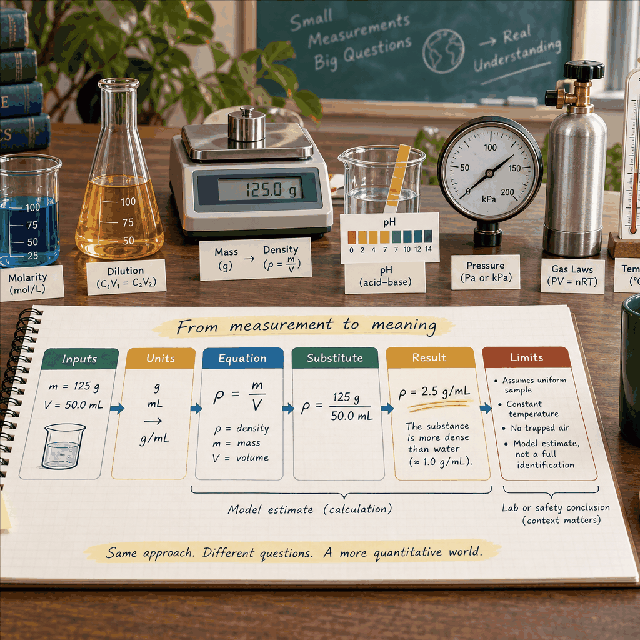
Mass describes how much matter an object contains and remains the same when the object moves from Earth to the Moon. Weight is a force caused by gravity, so its value changes when gravitational acceleration changes.
That distinction matters in classroom problems, lifting discussions, and comparisons between worlds. A number copied from a bathroom scale is not automatically a force in newtons.
The calculator uses w = mg. Multiply mass in kilograms by gravitational acceleration in metres per second squared, and the units become kg·m/s², which is the newton.
With 70 kg and 9.80665 m/s², the arithmetic is 70 × 9.80665 = 686.4655 N. The displayed rounding is presentation only; the input assumptions remain the important part.
Gravity is not identical everywhere. Standard Earth gravity is a useful reference, but altitude, latitude, location, another celestial body, or a deliberately simplified exercise can call for another value.
By making g editable, the page avoids hiding a location assumption. Record the value and its source whenever the result is used outside a simple learning example.
The same 70 kg mass produces a smaller gravitational force where g is smaller. Its mass has not changed; only the force from the selected gravitational field has changed.
This is why a person can have the same mass but a different weight on the Moon. The page does not contain a list of worlds so that a visitor can use a measured or specified gravity without confusing a reference table with a local measurement.
A scale measures a contact or normal force in its own situation. An accelerating elevator, a suspended object, a fluid, or free fall can make apparent weight differ from the simple gravitational term.
The result here is gravitational force m×g. Use a force diagram when the question is about cable load, support force, buoyancy, or acceleration rather than gravity alone.
Do not enter 70 as if it were 70 newtons when the field asks for kilograms. Do not multiply by a percentage, and do not use kilometres per hour as a gravity unit.
A quick dimensional check is useful: kg multiplied by m/s² must end as N. If a result is labelled kg, the calculation has answered a different question.
The force can be used as one term in a free-body diagram, such as an introductory tension or friction problem. It should travel with the mass, gravity value, sign convention, and any other force assumptions.
Do not turn the number into an equipment limit or a lifting instruction without the material, geometry, dynamic loads, safety factors, and applicable standard.
The distinction became especially important as mechanics developed a common unit system: force could be defined through mass and acceleration rather than through an object’s local scale reading.
Modern SI keeps the relationship clear. The newton is a derived force unit, while the kilogram is the SI base unit for mass, so the two labels communicate different physical ideas.
Before calculating, decide whether the question asks for mass, gravitational force, apparent weight, or the force in a support. These ideas can share a number in a quiet, static Earth example, but they separate as soon as location, acceleration, a fluid, or another force enters the picture.
The page answers one narrow question: what gravitational force follows from the entered mass and local gravitational acceleration in a simple Newtonian model? Naming that question first prevents a correct multiplication from being used as the wrong answer.
The relationship w = mg uses m in kilograms and g in metres per second squared. Multiplying kg by m/s² gives kg·m/s², the derived SI unit newton. The units are part of the reasoning, not a label added after the calculation.
For 70 kg and 9.80665 m/s², the result is 686.4655 kg·m/s², or 686.4655 N. Writing the units beside each input makes it harder to mistake a mass value for a force value.
The kilogram measures mass, a property used in the relationship between force and acceleration. The newton measures force. A mass can remain 70 kg while the gravitational force on it changes from one world to another.
Everyday scales often display kilograms because they infer mass from a local force and calibrate the display for familiar gravity. That convention is useful at home but does not change the physical distinction between mass and force.
The default 9.80665 m/s² is standard Earth gravity, a conventional reference used for clear comparisons and unit teaching. It is not a promise that every point on Earth has exactly that local measured acceleration.
For a classroom example, the standard value makes answers reproducible. For a measurement or engineering analysis, enter the stated local value and keep its source or reference condition with the result.
Use the same mass with two gravity values to see what changes. If the mass stays 70 kg and lunar gravity is entered as a smaller value, the calculated gravitational force is smaller. The mass field has not changed and no material has been removed.
This is a helpful way to explain why an astronaut’s mass is the same on Earth and the Moon while the person’s weight force differs. The comparison is only as precise as the selected gravity values.
Altitude, latitude, location, another planet, a laboratory approximation, or a problem statement can each supply a different g value. Making gravity editable means the calculation can follow the stated scenario instead of hiding one assumption in the page.
Do not choose a gravity value because it produces a familiar answer. Choose it because it represents the location or exercise being described, then record the value and unit beside the output.
The formula gives the gravitational term m×g. A scale or support often responds to a contact force, which can differ during elevator acceleration, free fall, vibration, or other motion. That contact force is sometimes called apparent weight.
If the problem asks what a scale reads or what a support carries, draw the forces and include acceleration. Do not quietly rename the gravitational force as a scale reading.
The kilograms-to-newtons page does not add a motion term. In a simple vertical model, acceleration can affect the net force or support force, but it must be defined with direction and included in a free-body equation.
For example, a hoist or elevator question is not solved completely by m×g if the mass is accelerating. Use the result as the gravitational term and build the rest of the model separately.
Draw the object, the downward gravitational force, and every contact, rope, thrust, drag, or buoyancy force that belongs to the scenario. The calculator supplies only the downward gravitational magnitude for the entered mass and g.
This simple diagram prevents a common mistake: treating the gravitational force as though it were automatically the tension in a cable or the force measured by a support. Those forces can equal weight only under particular conditions.
An object in a fluid experiences an upward buoyant force. The net force and the support force then depend on density, displaced volume, and the fluid as well as gravity. The gravitational force calculated here remains one term but is not the whole balance.
Do not use the result alone to decide whether an object floats, sinks, or loads a platform. Those questions need a buoyancy or equilibrium model with the relevant geometry and fluid properties.
If a report gives grams, tonnes, pounds, or another mass unit, convert to kilograms before using this page. A value of 70 g is 0.07 kg, while 70 kg is one thousand times larger. The field label is a deliberate guard against silent unit mixing.
Keep the original value and the converted value in a note when precision matters. This makes it possible to audit whether the numerical difference came from physics or from a mass-unit conversion.
At fixed gravity, the gravitational force changes linearly with mass. A 10% increase in mass produces a 10% increase in the calculated force. This direct relationship is why proportional reasoning works well for quick checks.
The relationship does not say that every object with the same mass creates the same support or lifting requirement. Geometry, acceleration, attachment, and other forces still belong to the larger physical situation.
At fixed mass, the result also changes linearly with g. Entering a gravity value that is 2% higher makes the gravitational-force result 2% higher. The calculator makes this assumption visible so the sensitivity is easy to inspect.
If two sources give slightly different local gravity values, keep both scenario labels rather than hiding the difference in rounding. The choice may be negligible for a lesson and important for a precise measurement.
Suppose a 12 kg mass is evaluated at 9.81 m/s². The gravitational force is 12 × 9.81 = 117.72 N. If the same mass is evaluated at 1.62 m/s² for a lunar scenario, the force is 19.44 N.
The two answers differ because g changed. The mass remains 12 kg in both rows. A clear comparison writes the location or scenario next to each gravity value so the answers are not accidentally combined.
The page may show a shorter answer such as 686.47 N even though the multiplication uses 9.80665. Rounding improves readability but does not turn a conventional gravity value into a measured local value.
Report enough digits for the purpose and keep the input precision sensible. Extra decimals in the output cannot compensate for an approximate mass, an uncertain g value, or a simplified model.
This page reports the magnitude of gravitational force for a positive mass and positive gravity input. A full force diagram may assign a downward negative sign to that vector, but the magnitude shown here is positive and easier to compare across scenarios.
If a later equation uses components or directions, add the sign from the coordinate convention there. Do not change the mass sign to represent downward direction; mass is not a directional vector in this model.
The page treats the field as locally uniform and uses one entered acceleration. It does not calculate how gravity varies across a tall structure, a planet, an orbit, or a nonuniform field.
That simplification is appropriate for many introductory and local calculations. If field variation matters, use a model that defines position, source bodies, geometry, and the required level of precision.
A common wrong answer is 70 N for a 70 kg mass, which confuses the input mass number with a force unit. Another is multiplying by 9.80665 twice, or treating 9.80665 as a percentage. Dimensional analysis catches both errors.
Another mistake is using the gravitational result as the cable load during acceleration. Check the wording of the problem and draw a free-body diagram before deciding which force is required.
A reproducible entry includes mass, mass unit, gravity value, gravity unit, scenario or location, calculated force, rounding rule, and any forces deliberately excluded. This is more useful than writing only “weight = 686 N.”
For a component, platform, or lifting question, add geometry, acceleration, dynamic effects, connection details, and the applicable safety method. The calculator is a first-principles term, not a certification.
The output does not certify a scale, rope, crane, shelf, vehicle, pressure vessel, or lifting plan. A safe working load may depend on material strength, buckling, fatigue, shock, attachment, redundancy, environment, and a required safety factor.
Use rated equipment and qualified practice for real loads. The simple force calculation can support a design worksheet, but it cannot replace inspection, code compliance, or professional judgment.
Start with 70 kg at standard Earth gravity and reproduce the example by hand. Next keep the mass fixed and change only gravity. Finally keep gravity fixed and change only mass. Predict whether each answer rises or falls before pressing calculate.
Finish by writing one sentence that distinguishes mass, gravitational force, and apparent weight. If the sentence is clear, the numbers are more likely to be used in the right physical context.
To convert a mass into gravitational force, enter kilograms and multiply by the selected gravitational acceleration. The output is in newtons. Under standard Earth gravity, one kilogram corresponds to about 9.80665 N of gravitational force.
For a different world or a precise local scenario, replace g with the stated value. If the question involves motion, a scale, a cable, or a fluid, treat this result as one force term and use the matching mechanics model.
How many newtons is one kilogram? Under standard Earth gravity, about 9.80665 N. Is kg a force unit? No. Can I use Moon gravity? Yes, if you enter the stated lunar value. Does this give apparent weight in an elevator? No; acceleration and support forces need a different model. Does it calculate a safe lifting load? No; real lifting requires rated equipment, geometry, dynamic-load review, and competent practice.
Convert a mass into gravitational force using an explicitly entered local gravitational acceleration.
Weight force w = mass m × gravitational acceleration g. The output is in newtons because kg × m/s² = N. This page separates mass from weight and lets the visitor state the gravity used for Earth, the Moon, another world, or a teaching scenario. It is a force calculation, not a mass-unit conversion or a scale calibration.
Enter Mass, Gravitational acceleration, then choose Calculate.
Mass is entered in kilograms and is not changed by location in this Newtonian model. Gravity is entered in metres per second squared and represents the selected scenario. The result is the magnitude of gravitational force, not the contact force shown by every scale. The body is treated as a point-like mass in a locally uniform gravitational field. Air resistance, lift, buoyancy, acceleration of a support, and rope tension are not added. The default gravity is standard Earth gravity, while a local measured value may differ slightly. A kilogram is a unit of mass; a newton is a unit of force. The output does not certify a load rating, weighing instrument, or lifting plan. Use a free-body diagram when other forces or acceleration affect the situation.
This calculator is part of the WorldCalculate library. Its formula, example, assumptions, input bounds, and output formatting follow the official methodology.
These WorldCalculate collections connect this tool with related questions while keeping each calculation separate and transparent.