
Goal
Estimate the number of double-stranded DNA molecules from mass and a safe whole-number base-pair length.
Worldwide context
Saved once here, used across the site.
Currency changes display only. Country selection guides tax input; no tax rate is guessed.
Estimate the number of double-stranded DNA molecules from mass and a safe whole-number base-pair length.
Average molecular mass = lengthBp x 660 g/mol; copies = massNg x 1e-9 g x 6.02214076e23 / average molecular mass.A clearer path to an answer
This page keeps the calculation transparent: define the goal, enter the matching values, inspect the method, and decide what the result means in your situation.
Estimate the number of double-stranded DNA molecules from mass and a safe whole-number base-pair length.
DNA mass · DNA length
Average molecular mass = lengthBp x 660 g/mol; copies = massNg x 1e-9 g x 6.02214076e23 / average molecular mass.
Calculate, review the assumptions below, then compare a related tool when the decision needs more context.
Estimate the number of double-stranded DNA molecules from mass and a safe whole-number base-pair length.
Open the DNA Copy Number From Mass pageMore science tools
Download PDFDownload Word (.doc)
Enter your values above and choose Calculate to see the result here.
Calculation map
Average molecular mass = lengthBp x 660 g/mol; copies = massNg x 1e-9 g x 6.02214076e23 / average molecular mass.
Bounded, transparent calculation
Your recent runs stay in this browser session only.
Formula: Average molecular mass = lengthBp x 660 g/mol; copies = massNg x 1e-9 g x 6.02214076e23 / average molecular mass.
Estimate average double-stranded DNA molecular mass and molecule count from mass and a safe whole-number length. The 660 g/mol per base-pair coefficient and exact Avogadro constant are explicit; sequence composition, topology, end effects, sample loss, and exact molecule counting are not modeled.
Worked example: A 1 ng, 1,000 bp double-stranded DNA sample has an average molecular mass of 660,000 g/mol and about 9.12446e8 copies.
The displayed limits are checked before the handler runs. Model-specific domain checks may also reject impossible or non-finite inputs.
Methodology: This calculator follows the WorldCalculate input, formula, precision, and boundary policy. Read the official methodology.
Calculator usage statistics
This section counts anonymous successful Calculate submissions, not unique visitors. Counts and top tools appear only when trusted aggregate data is available; country analysis is shown only under the same condition and reporting threshold.
Answer-first guide
Estimate the number of double-stranded DNA molecules from mass and a safe whole-number base-pair length. Start with one clearly defined goal, enter values in the units shown, and keep the result attached to the assumptions below.
This tool is useful when your question includes DNA copy number, molecules from DNA mass, base pair molecular mass. It returns the outputs declared in the calculator contract rather than a live quote, approval, diagnosis, or professional sign-off.
DNA mass · DNA length. Keep the same time period, unit system, and currency wherever the form requires comparable values.
Run the worked example first, compare its output with the page's example, then change one input at a time. This makes an unexpected result easier to trace to a unit, boundary, or assumption.
Need a wider view? Browse Science Calculators or compare the related tools below. The WorldCalculate methodology explains how formulas, examples, limits, and revisions are reviewed.
Average molecular mass = lengthBp x 660 g/mol; copies = massNg x 1e-9 g x 6.02214076e23 / average molecular mass.
Estimate average double-stranded DNA molecular mass and molecule count from mass and a safe whole-number length. The 660 g/mol per base-pair coefficient and exact Avogadro constant are explicit; sequence composition, topology, end effects, sample loss, and exact molecule counting are not modeled.
A 1 ng, 1,000 bp double-stranded DNA sample has an average molecular mass of 660,000 g/mol and about 9.12446e8 copies.
Context and background
Science calculators define a system, choose an equation, apply units and constants, and show the substitution. Effects outside that model remain outside the result.
Introductory science problem solving builds from measured quantities and idealized relationships. Those models are valuable for learning and first-pass estimates, while experiments and engineering decisions need additional evidence.
Research and review
Researched by Hassan ALRowaie, Founder and editorial researcher at WorldCalculate.
This guide follows the live calculator's declared inputs, formula, worked example, assumptions, validation boundaries, and source-backed methodology. The review date describes editorial review of the calculator explanation; it is not a promise that external facts or rates remain current.
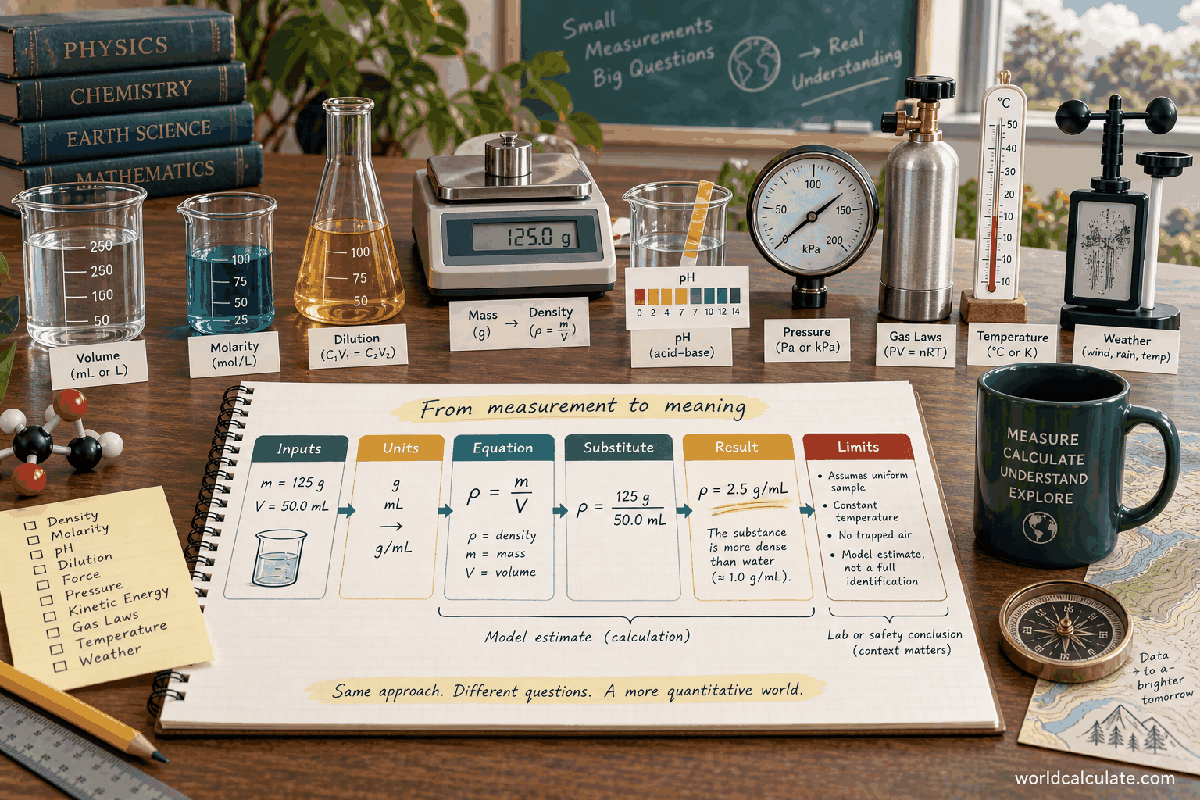
A DNA copy-number estimate connects a measured mass with an assumed average molecular mass. This calculator accepts a positive DNA mass in nanograms and a positive safe whole-number length in base pairs. It returns the average molecular mass in grams per mole and an estimated number of DNA copies. The calculation uses 660 grams per mole per base pair for double-stranded DNA and the exact Avogadro constant 6.02214076e23 entities per mole. Those constants make the arithmetic explicit, but the result remains an estimate. Sequence composition, topology, end effects, sample loss, mixture composition, and exact molecule counting are outside the two-field model. The sections below derive the unit path, work through an example, explain scaling and validation, and show why a precise-looking copy number should not be treated as a direct observation of individual molecules.
The result estimates how many double-stranded DNA molecules would correspond to the entered mass if every molecule had the entered length and the average molecular mass coefficient applied. It is a mass-to-entity conversion. The calculator does not count molecules one by one, inspect a sequence, or identify whether a tube contains one uniform fragment. Its output is therefore best read as an expected or estimated copy count under the stated average model.
The length field matters because a longer molecule has a larger average molar mass. For a fixed mass, more mass per molecule means fewer molecules. For a fixed length, increasing the total mass means more molecules. These inverse and direct relationships follow from the formula, but they do not describe concentration, purity, amplification success, or biological activity. Those are separate quantities that require their own observations and models.
The length field is a count of base pairs, abbreviated bp. It must be a positive safe whole number because a molecule length is represented here as an exact count of paired bases. The catalog limits length to 1 through 1,000,000,000 bp. The upper limit keeps multiplication bounded and prevents the browser from accepting an arbitrary integer that might have already lost digits in JavaScript. The safe-integer check is enforced in the engine even if the visible form declares a step of one.
The page assumes double-stranded DNA. A single-stranded sequence, an RNA molecule, a duplex with mismatches, or a mixture of fragment lengths would need a different coefficient or a mixture calculation. The handler does not infer strand state from a sequence because it accepts no sequence field. State the strand convention beside a reported result so a reader does not apply the double-stranded estimate to a different molecular form without review.
The model assigns 660 grams per mole to each base pair. For a length L in base pairs, the average molecular mass is W = 660 x L grams per mole. If L is 1,000 bp, W is 660,000 g/mol. The coefficient is an average approximation that makes a length-only calculation possible. It is not a sequence-specific molecular weight and does not claim that every base pair has identical mass in every actual molecule.
The units provide a useful check. Base pairs are a count, and the coefficient supplies grams per mole per base pair. Multiplying by the base-pair count leaves grams per mole. If a result is labeled grams, kilograms, or copies at this stage, the unit path has been interrupted. Keeping molecular mass separate from the later entity conversion makes it easier to find whether an error arose in length, the coefficient, or the mass-to-moles step.
The entered mass is in nanograms, so the handler converts it to grams by multiplying by 1e-9. Moles are then mass in grams divided by molecular mass in grams per mole. Finally, multiplying moles by 6.02214076e23 entities per mole gives the estimated number of molecules. Combining those steps gives copies = (massNg x 1e-9 x 6.02214076e23) / (660 x lengthBp). The exact constant is written explicitly so the result does not depend on a rounded replacement hidden in a helper.
The word copies here means the estimated count of molecules represented by the mass under the model. It does not mean copies of a gene in a cell, copies observed after an amplification cycle, or a genomic copy-number variant. Those uses have different meanings and may involve cells, genomes, targets, or assay calibration. The calculator uses molecule count language only for the mass-to-molecular-entity conversion described by its two inputs.
For 1 ng and 1,000 bp, the average molecular mass is 1,000 x 660 = 660,000 g/mol. The mass is 1e-9 grams. The amount in moles is 1e-9 / 660,000, and multiplying by 6.02214076e23 gives approximately 9.12446e8 copies. The displayed value is a finite numeric estimate. Multiplying that copy estimate by the average molecular mass and converting entities per mole back through the constant returns approximately the entered gram mass, subject to ordinary floating-point rounding.
The example is an order-of-magnitude check as well as a known answer. A thousand-base-pair molecule is much heavier per molecule than a one-base-pair abstract unit, so one nanogram corresponds to hundreds of millions rather than trillions of those molecules under this model. The number should not be read as a direct instrument count. It expresses what the entered mass would represent if the fragment length and average coefficient are the chosen premises.
At fixed length, doubling the DNA mass doubles the estimated copy number because the numerator doubles. At fixed mass, doubling the length doubles the average molecular mass and halves the estimated copy number because the denominator doubles. These relationships are often more useful than memorizing one result. They let a reader check whether a changed input moved the output in the expected direction without claiming that the underlying sample composition stayed constant.
The same scaling applies to the molecular-mass output in a simpler way. Doubling length doubles grams per mole, regardless of the entered mass. Changing mass does not change the average molecular mass because that value is based only on the selected length and coefficient. If a hand calculation changes molecular mass when only massNg changes, it has mixed the two output concepts. Separate the physical size assumption from the amount of material.
The 660 g/mol per base-pair value is an average. Actual molecular mass can vary with base composition and the exact sequence, especially when a precise mass rather than an estimate is required. This calculator has no sequence field and no composition calculation, so it cannot produce a sequence-specific mass. If a sample contains fragments of different lengths, one single length is also only a summary assumption; a mixture-weighted calculation would need the fraction and mass contribution of each class.
Average does not mean arbitrary. It is a stated approximation that is useful for many order-of-magnitude conversions when the input scope is appropriate. The right question is whether the uncertainty from the approximation matters for the intended use. If it does, use a method that accepts the sequence or fragment distribution and documents its molecular-weight convention. Do not add false precision to the output simply because the constant and calculator display many digits.
The formula uses length and average molecular mass only. It does not add or subtract mass for linear ends, circular topology, supercoiling, nicking, chemical modifications, bound molecules, or other sample features. Those effects may matter in a specialized molecular-weight calculation, but they cannot be inferred from a mass and a base-pair count alone. The output should therefore be described as an average double-stranded DNA estimate rather than an exact molecular inventory.
A sample can also contain more than the intended DNA species. If the entered mass comes from a measurement that includes contaminants or a mixture, the copy estimate inherits that ambiguity. The calculator does not assess purity or separate target from background. A clean-looking copy number can still be based on a mass that is not exclusively the assumed molecule. Keep assay, preparation, and composition evidence beside the arithmetic rather than allowing the result label to imply it.
A base-pair length is a discrete count, so the handler requires Number.isSafeInteger in addition to ordinary finite and range checks. This matters because JavaScript numbers cannot represent every integer above the safe range exactly. A fractional length, zero, negative value, infinity, or value beyond the catalog maximum is rejected. The visible field uses a step of one, but direct handler calls receive the same strict checks and cannot bypass the count contract.
The maximum supported length is 1,000,000,000 bp. Multiplying it by 660 gives 660,000,000,000 g/mol, which is finite. The mass range and Avogadro multiplication also remain finite, and the handler checks both outputs before returning them. It does not round a large length to a nearby safe integer or return an exact integer claim for copies. A rejected input is more honest than a copy estimate based on digits that were lost before calculation.
A sample-level estimate does not need to be an integer even though an individual molecule count is discrete. The quotient represents an expected number implied by a continuous mass measurement and an average molecular mass. A result such as 912,446,000.3 copies should not be interpreted as observing a fractional molecule. It is a numeric estimate whose fractional part has no separate physical observation behind it. The renderer may show a readable number of digits, but the model remains approximate.
The same distinction appears when the mass is measured with limited precision. A long decimal output can be mathematically reproducible while being more precise than the measurement that supplied the mass. Report the mass, length, coefficient, Avogadro constant, and intended rounding rule when the estimate is used in another calculation. If exact molecule counting or a validated assay is needed, this conversion cannot substitute for it.
The most serious manual error is forgetting to convert nanograms to grams. Since one nanogram is 1e-9 grams, omitting that factor inflates the estimate by one billion. Another error is using base count where base-pair count is required, or applying a single-stranded coefficient to a double-stranded contract. A third is treating 660 as a mass in grams rather than a molar-mass coefficient per base pair. Write the units beside every intermediate value so each operation has a visible dimension.
A reverse check starts with the estimated copies, multiplies by the average molecular mass to obtain estimated grams per mole times entities, and divides by Avogadro's constant to recover grams. Convert that result to nanograms and compare it with massNg within display rounding. Separately multiply lengthBp by 660 and confirm the molecular-mass output. These checks do not prove the sample matches the model, but they can expose a misplaced conversion or an incorrect denominator.
This tool does not measure concentration, purity, integrity, amplification efficiency, transfection success, cellular copy number, or genomic variation. It does not identify a sequence, determine whether a fragment is present, or establish that a mass belongs to one target. It also does not make a clinical, diagnostic, ancestry, or treatment recommendation. The word copy is limited to estimated molecular entities represented by the entered mass under the average length model.
The calculator is useful for a worksheet, an order-of-magnitude check, a preparation record, or a lesson connecting molar mass to particles. It becomes misleading when its output is copied into a protocol or report without the assumptions. State double-stranded DNA, the average 660 g/mol per base-pair coefficient, the exact Avogadro constant, the length, and the mass. If any assumption is not appropriate, stop at the boundary and use a method designed for the actual sample.
The formula can produce many decimal places because JavaScript evaluates ordinary finite arithmetic, but the output precision should match the input evidence. If mass is recorded to the nearest nanogram and length is known only to a stated base-pair resolution, reporting a long string of copy digits does not create new molecular information. The handler retains a numeric result for downstream rendering, while the article recommends rounding at presentation time and preserving the original inputs for reproducibility.
The same principle applies to the 660 coefficient and the Avogadro constant. The constant is written with its exact defining digits for the conversion contract, but using an exact constant does not make the average DNA mass coefficient sequence-specific. A copy estimate can be internally consistent and still carry approximation uncertainty from composition, fragment length, topology, or sample mixture. Precision is a property of the calculation representation; accuracy depends on whether the premises describe the material.
Scientific notation is often the clearest way to read very large or very small estimates. It avoids a long sequence of zeros and makes order of magnitude visible. The page's numeric renderer can present finite values in a readable form, but a report should state its own rounding rule if another person will compare values. Do not round the base-pair length to a convenient value merely to make the result simpler; validate the integer length first and describe any summary assumption explicitly.
A useful report therefore includes massNg, lengthBp, the average coefficient, the Avogadro constant, the molecular-mass result, the copy estimate, and the intended precision. If the sample contains a length distribution, replace the single-length premise with a reviewed mixture method rather than adding a hidden correction. If the copy number is being used to make an experimental or clinical decision, consult the method that defines the relevant evidence. This calculator supplies a transparent conversion, not a decision threshold.
A copy-number result can be reproduced from a small set of recorded facts. Write the DNA mass in nanograms, the length in base pairs, the strand convention, the 660 g/mol per base-pair coefficient, and the Avogadro constant. Then record the calculated average molecular mass and estimated copies. This trail lets another reader repeat the unit conversion without guessing whether the mass was entered in grams, whether the length was a base count, or whether a different molecular-weight convention was used.
The audit trail should also state what the mass represents. Is it a measured amount, an amount inferred from concentration and volume, or a nominal preparation target? Is the length one known fragment, a representative length, or a summary of a mixture? The handler cannot answer these questions. They determine how much confidence a reader should place in the estimate even when the arithmetic itself is error-free.
For a known uniform fragment, the single-length approximation may be a useful compact conversion. For a mixture, one representative length can hide the fact that short and long molecules contribute different copy counts per unit mass. A richer calculation would list length classes and their masses, calculate each class, and add the estimated entities. That extension is outside this page by design. Do not imply that the two-field result separated the mixture when it did not.
When the result is used beside concentration or assay data, keep the quantities separate. Concentration describes mass per volume, while this page converts mass and length into estimated molecular entities. A sample can have a high concentration and a low copy estimate if its molecules are very long, or a lower concentration and a higher copy estimate if its molecules are short. Comparing those outputs requires a shared sample definition and an explicit purpose, not a single generic quality label.
The final question is whether an average molecular estimate is sufficient for the decision at hand. It is often suitable for a lesson, a rough planning calculation, or a consistency check. It is not sufficient to claim exact molecule counting, sequence identity, amplification success, cellular dosage, or clinical meaning. Carry the assumptions with the result and replace the method when the intended conclusion needs evidence that these two inputs cannot provide.
Estimate the number of double-stranded DNA molecules from mass and a safe whole-number base-pair length.
Average molecular mass = lengthBp x 660 g/mol; copies = massNg x 1e-9 g x 6.02214076e23 / average molecular mass. Estimate average double-stranded DNA molecular mass and molecule count from mass and a safe whole-number length. The 660 g/mol per base-pair coefficient and exact Avogadro constant are explicit; sequence composition, topology, end effects, sample loss, and exact molecule counting are not modeled.
Enter DNA mass, DNA length, then choose Calculate.
The DNA is represented as a double-stranded molecule with a positive safe whole-number length in base pairs. Average molecular mass is approximated as 660 g/mol per base pair and the entered nanogram mass is converted to grams before using the Avogadro constant. The copy result is an estimated number based on average composition and does not claim exact integer molecule counting or account for sequence composition, topology, ends, or sample loss.
This calculator is part of the WorldCalculate library. Its formula, example, assumptions, input bounds, and output formatting follow the official methodology.
These WorldCalculate collections connect this tool with related questions while keeping each calculation separate and transparent.