
Goal
Calculate DNA mass concentration from an entered mass and sample volume, with equivalent ng/uL and ug/mL outputs.
Worldwide context
Saved once here, used across the site.
Currency changes display only. Country selection guides tax input; no tax rate is guessed.
Calculate DNA mass concentration from an entered mass and sample volume, with equivalent ng/uL and ug/mL outputs.
DNA concentration = dnaMassNg / volumeUl in ng/uL; the numeric value is equal to ug/mL.A clearer path to an answer
This page keeps the calculation transparent: define the goal, enter the matching values, inspect the method, and decide what the result means in your situation.
Calculate DNA mass concentration from an entered mass and sample volume, with equivalent ng/uL and ug/mL outputs.
DNA mass · Sample volume
DNA concentration = dnaMassNg / volumeUl in ng/uL; the numeric value is equal to ug/mL.
Calculate, review the assumptions below, then compare a related tool when the decision needs more context.
Calculate DNA mass concentration from an entered mass and sample volume, with equivalent ng/uL and ug/mL outputs.
Open the DNA Concentration pageMore science tools
Download PDFDownload Word (.doc)
Enter your values above and choose Calculate to see the result here.
Calculation map
DNA concentration = dnaMassNg / volumeUl in ng/uL; the numeric value is equal to ug/mL.
Bounded, transparent calculation
Your recent runs stay in this browser session only.
Formula: DNA concentration = dnaMassNg / volumeUl in ng/uL; the numeric value is equal to ug/mL.
This mass-per-volume calculation divides entered DNA mass by entered sample volume and reports equivalent ng/uL and ug/mL values. It is arithmetic for a measured or prepared sample only and does not assess purity, integrity, sequencing quality, suitability, or diagnosis.
Worked example: DNA concentration is 5 ng/uL, numerically equal to 5 ug/mL.
The displayed limits are checked before the handler runs. Model-specific domain checks may also reject impossible or non-finite inputs.
Methodology: This calculator follows the WorldCalculate input, formula, precision, and boundary policy. Read the official methodology.
Calculator usage statistics
This section counts anonymous successful Calculate submissions, not unique visitors. Counts and top tools appear only when trusted aggregate data is available; country analysis is shown only under the same condition and reporting threshold.
Answer-first guide
Calculate DNA mass concentration from an entered mass and sample volume, with equivalent ng/uL and ug/mL outputs. Start with one clearly defined goal, enter values in the units shown, and keep the result attached to the assumptions below.
This tool is useful when your question includes DNA concentration, ng per microliter, microgram per milliliter. It returns the outputs declared in the calculator contract rather than a live quote, approval, diagnosis, or professional sign-off.
DNA mass · Sample volume. Keep the same time period, unit system, and currency wherever the form requires comparable values.
Run the worked example first, compare its output with the page's example, then change one input at a time. This makes an unexpected result easier to trace to a unit, boundary, or assumption.
Need a wider view? Browse Science Calculators or compare the related tools below. The WorldCalculate methodology explains how formulas, examples, limits, and revisions are reviewed.
DNA concentration = dnaMassNg / volumeUl in ng/uL; the numeric value is equal to ug/mL.
This mass-per-volume calculation divides entered DNA mass by entered sample volume and reports equivalent ng/uL and ug/mL values. It is arithmetic for a measured or prepared sample only and does not assess purity, integrity, sequencing quality, suitability, or diagnosis.
DNA concentration is 5 ng/uL, numerically equal to 5 ug/mL.
Context and background
Science calculators define a system, choose an equation, apply units and constants, and show the substitution. Effects outside that model remain outside the result.
Introductory science problem solving builds from measured quantities and idealized relationships. Those models are valuable for learning and first-pass estimates, while experiments and engineering decisions need additional evidence.
Research and review
Researched by Hassan ALRowaie, Founder and editorial researcher at WorldCalculate.
This guide follows the live calculator's declared inputs, formula, worked example, assumptions, validation boundaries, and source-backed methodology. The review date describes editorial review of the calculator explanation; it is not a promise that external facts or rates remain current.
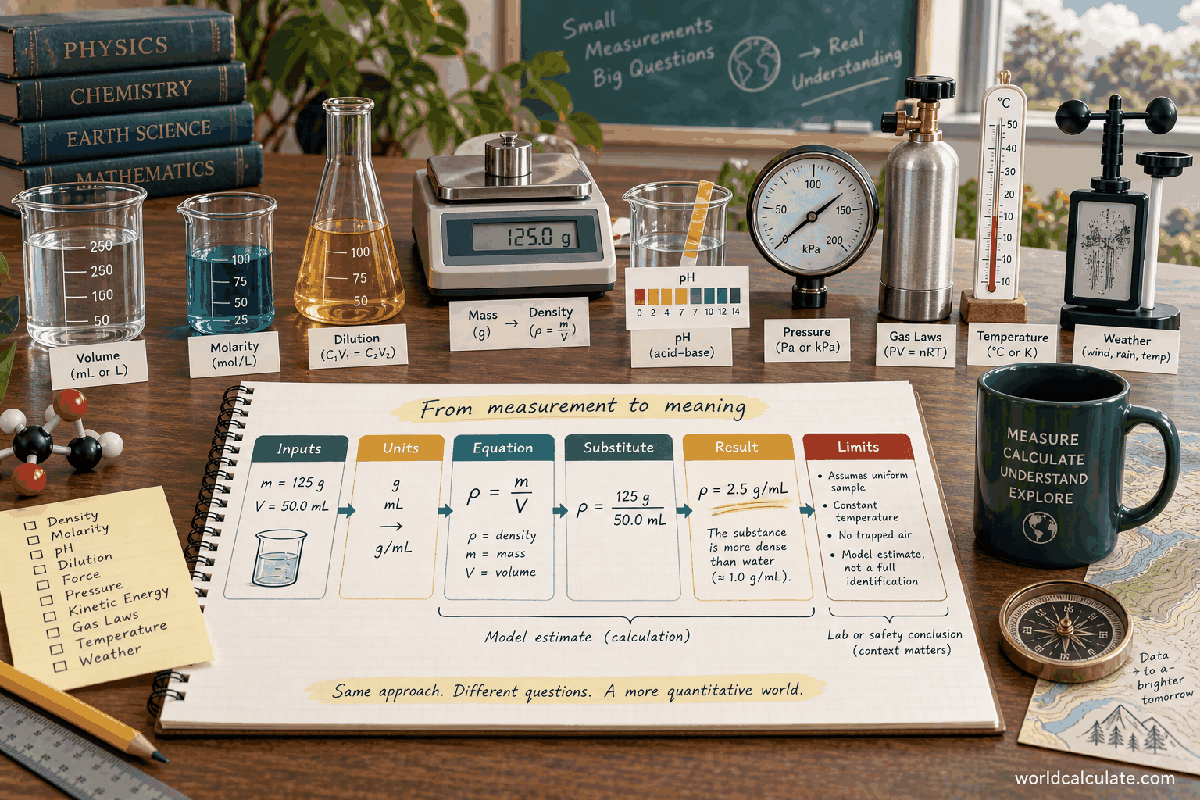
DNA concentration is a mass-per-volume quantity. This calculator divides an entered DNA mass in nanograms by an entered sample volume in microliters, then displays the result in ng/uL and in the numerically equivalent unit ug/mL. The arithmetic is intentionally small and explicit. It can help check a measured sample record or a preparation calculation, but it does not decide whether a sample is pure, intact, suitable for a protocol, good for sequencing, or relevant to a diagnosis. Those questions require measurements and standards that are not represented by two fields. The sections below explain the unit relationship, the formula, worked examples, boundary cases, measurement context, comparison habits, and the reasons concentration should not be confused with broader DNA quality or biological conclusions.
Concentration describes how much of a quantity is associated with a specified volume. Here the quantity is DNA mass and the volume is the volume of the sample that contains that mass. If a sample contains 250 nanograms in 50 microliters, the quotient is 5 nanograms per microliter. The calculator does not inspect a tube, measure an absorbance, or determine which molecular species contributed to the entered mass. It treats the supplied mass and volume as the complete premises for one arithmetic result.
The word DNA can describe different sample compositions in different contexts. A preparation may contain one molecule type, a mixture of fragments, genomic material, plasmid material, or other components alongside DNA. This page does not identify composition. It only preserves the mass-per-volume relationship chosen by the user. Keeping the scope narrow makes the result reproducible and prevents a concentration number from being mistaken for a claim about the identity or performance of the sample.
The DNA mass field is entered in nanograms. A nanogram is a mass unit, so the field should contain the mass value after any instrument conversion or preparation calculation the user has chosen. Zero is allowed as an arithmetic boundary. A negative mass is rejected because the page represents an amount of DNA, not a signed difference between two samples. The maximum bound keeps direct browser calculations finite and prevents the field from becoming an unbounded storage for unrelated quantities.
The handler does not parse a suffix from free-form text. Enter 250 for 250 ng, not a sentence or a value with a hidden unit conversion. If the source is in another mass unit, convert it before entering the number and keep the conversion in the record. A value can be numerically correct and still be semantically wrong if a microgram was entered as though it were a nanogram. Unit discipline belongs at the boundary of the calculation.
The volume field is entered in microliters. It must be positive because concentration divides by volume. A fractional microliter can be meaningful in a preparation record, so the field accepts decimal values. The lower bound is 0.000001 uL, which prevents an effectively zero denominator while remaining broad enough for ordinary numeric exercises. The upper bound is a computational scope limit, not a statement about every laboratory container or sample workflow.
Volume must describe the same sample portion as the entered mass. If a mass was measured for an entire tube but a volume refers to a small aliquot, the quotient does not describe either quantity correctly unless a recovery or dilution relationship has been established separately. The calculator does not infer that relationship. It accepts one mass and one volume as paired values and leaves aliquot identity, dilution history, and preparation timing to the surrounding record.
Let M be DNA mass in nanograms and V be sample volume in microliters. Concentration C = M / V, with units ng/uL. The handler performs this one division after validating both fields and then checks that the result is finite. No absorbance coefficient, purity correction, dilution factor, recovery percentage, or protocol target is hidden in the formula. If such a factor is needed for a particular workflow, it belongs in a separately documented calculation whose inputs and assumptions can be reviewed.
The numeric value in ng/uL is equal to the numeric value in ug/mL. The reason is that 1 ug = 1,000 ng and 1 mL = 1,000 uL, so both numerator and denominator scale by the same factor. For example, 5 ng/uL becomes 5 ug/mL. The units change while the number stays the same. This equality is useful, but it should not be generalized to unrelated unit pairs where numerator and denominator do not scale together.
Use 250 ng and 50 uL. Divide mass by volume: 250 / 50 = 5. The primary result is 5 ng/uL. Because the nanogram-to-microliter and microgram-to-milliliter factors cancel, the equivalent result is 5 ug/mL. Reverse the calculation by multiplying 5 ng/uL by 50 uL; the recovered mass is 250 ng. This check confirms that the volume was used as a divisor and that the unit relationship was preserved.
The example does not say that the concentration is appropriate for a downstream protocol. A protocol may use a target range, a minimum mass, a maximum volume, or a separate quality threshold. None of those choices is universal, and none is present in the two-field contract. The example is therefore a reproducible arithmetic demonstration. A laboratory note should add the measurement method, sample identity, dilution history, and timing if those facts matter to the use of the result.
Zero DNA mass with a positive volume returns zero concentration. That boundary can represent a blank arithmetic case or a measurement that recorded no detectable mass, but the calculator does not decide which interpretation is warranted. A very small positive mass can produce a very small concentration, and a fixed mass divided by a smaller positive volume produces a larger concentration. Those are direct consequences of the quotient, not evidence that a sample became more biologically concentrated in any other sense.
At fixed volume, doubling the entered mass doubles the concentration. At fixed mass, doubling the volume halves the concentration. These relationships are useful for checking dilution arithmetic, but only when the mass and volume definitions remain consistent. A real dilution may change volume without changing total DNA mass, or may involve transfer loss. This page does not model that process; it reports the quotient for the final pair of values supplied.
The same arithmetic can summarize a measured sample or a prepared mixture, but the surrounding evidence differs. A measured mass may be an instrument estimate, while a prepared mass may be derived from a stock concentration and an intended volume. In either case, the calculator assumes the entered mass and volume already represent the same sample portion. It does not reconstruct a preparation history, test pipette accuracy, or decide whether an instrument signal is specific to DNA.
If a preparation uses an aliquot, dilution, concentration step, or resuspension, write the sequence separately. The final mass and final volume can be entered when those are the intended quantities, but a result from an intermediate portion should not be silently applied to the entire preparation. Clear sample identifiers and step labels make concentration records much easier to audit. The engine remains intentionally independent of any laboratory device or external data source.
A mass-per-volume result does not reveal what fraction of the mass is the intended DNA, what contaminants are present, or whether the molecules are intact. Purity is a different measurement concept, and integrity concerns fragment length or structural condition rather than only total mass. The calculator has no optical ratios, electrophoretic observations, fragment distributions, or composition fields. It therefore cannot label a sample pure, impure, intact, degraded, or suitable based on the concentration number alone.
The distinction matters because two samples can have the same calculated concentration while differing in composition or integrity. Conversely, two samples with different concentrations can both be useful for different purposes. The arithmetic remains valid for the supplied mass and volume, but the decision about what the sample can support belongs to a validated method and its acceptance criteria. Use the concentration result as one recorded quantity, not as a substitute for a quality assessment.
The calculator does not determine sequencing quality. Sequencing performance can depend on library construction, fragment distribution, adapters, contaminants, instrument conditions, and other protocol-specific facts. A concentration may be one input to a laboratory workflow, but no universal threshold can be inferred from this page. The handler deliberately avoids recommending a volume, accepting a sample, or approving a run because those decisions need a separate validated context.
It also does not diagnose a person, identify a variant, establish identity, or interpret a biological result. A DNA concentration is a sample quantity, not a clinical conclusion. Even if a value is measured accurately, it says nothing by itself about a disease, ancestry, treatment, or health status. If a question concerns a person or a clinical decision, use the appropriate professional and validated process rather than extending this two-field quotient beyond its scope.
The engine validates type, finiteness, and bounds for both inputs. It accepts zero mass but requires a positive volume. It rejects malformed values, NaN, infinities, negatives, zero volume, and values outside the catalog contract. These checks occur in the pure handler rather than relying only on input attributes in the page. Direct callers and future interfaces therefore receive the same domain behavior as the current browser form.
The largest supported mass divided by the smallest supported volume produces 1e15 ng/uL, which is finite. The result is still checked after division and again for the equivalent unit output. A finite guard protects against later changes to bounds and makes a failure explicit if arithmetic ever leaves the supported number range. The handler does not round or clip an input to make a result appear valid, because doing so would change the sample record.
The most common manual error is mixing nanograms with microliters after a conversion has been performed in only one part of the record. Another is using a total tube volume with an aliquot mass or using a stock mass with a final volume. A third is adding an extra factor of 1,000 when converting from ng/uL to ug/mL even though the two factors cancel. Write the original units next to each source value, perform conversions explicitly, and enter the paired final mass and volume.
A report should include the mass, volume, concentration, unit pair, sample identifier, measurement or preparation context, and any relevant dilution step. Round for display only after the quotient is calculated. Extra decimal places do not guarantee extra measurement accuracy. If a downstream reader needs to reproduce the value, the two input quantities are more useful than a rounded concentration copied without its units.
The calculator is appropriate for a transparent mass-per-volume check, a classroom exercise, a preparation note, or a comparison in which sample identity and units are controlled. It can show how mass and volume scale the result and can catch a denominator or unit mistake. It is not a complete laboratory information system and does not maintain chain of custody, calibration records, replicate statistics, or acceptance criteria.
Questions about purity, integrity, sequencing quality, protocol suitability, identity, clinical relevance, or diagnosis remain open because they require data absent from the two fields. The honest workflow is to record the concentration beside those independent measurements rather than asking the quotient to stand in for them. The result is useful precisely because its scope is simple: entered DNA mass divided by entered sample volume, reported in two equivalent unit systems.
A concentration value is most useful when the sample identity and preparation stage are explicit. A stock tube, an aliquot, a diluted portion, and a final resuspension are not interchangeable records even when they share a label. The calculator can evaluate each paired mass and volume, but it cannot know whether the values came from the same stage. Add a stage name and sample identifier outside the page, then use the result as the derived concentration for that stage rather than as a universal property of every tube made from it.
When comparing two stages, distinguish a change in concentration from a change in total mass. A preparation can have a lower concentration because its volume increased while its total DNA mass stayed constant. It can also have a lower total mass because material was lost during transfer. The two-field quotient reports only the final ratio. If the purpose is to account for recovery or dilution, calculate those relationships separately and retain the original masses and volumes so the concentration result is not asked to explain a process it does not model.
Replicates add another layer of interpretation. Several concentration readings may differ because of instrument repeatability, sampling, mixing, or rounding. This page returns the quotient for one entered pair and does not calculate a mean, spread, confidence interval, or detection limit. A summary across replicates should state the aggregation rule and the measurement context. An average of concentrations is not automatically the same as total mass divided by total volume when the volumes differ, so preserve the underlying pairs before summarizing.
The same care applies to a preparation made from a stock solution. If a stock concentration is used to calculate an intended mass, that calculated mass is a premise for this page, not an observation that the page verifies. If the final volume is nominal rather than measured, say so. The result can still be a useful planning arithmetic value, but it should be labeled as prepared or intended rather than presented as a measured concentration. Clear labels keep a simple quotient from acquiring unsupported certainty.
A final review should ask whether the mass and volume refer to the same physical portion, whether both units are correct, and whether any hidden correction has been applied elsewhere. Then record the output with enough precision for the intended use and with a note that purity, integrity, sequencing quality, suitability, and diagnosis are outside scope. This discipline supports reproducible records without turning concentration into a proxy for every property a DNA sample might have.
The equal numeric relationship between ng/uL and ug/mL is convenient, but it should not encourage careless mixing of other units. If the mass is given in micrograms and the volume in milliliters, the quotient is already in ug/mL. To enter the same values in this calculator, convert micrograms to nanograms and milliliters to microliters, multiplying both values by 1,000. The quotient stays unchanged. Writing both conversions makes it clear why the numeric value does not change rather than making the equality look like a memorized exception.
If only one part is converted, the result changes by a factor of 1,000. For example, treating 2 ug as 2 ng while leaving 4 mL as 4 uL does not describe the same sample and produces a misleading number. The handler cannot detect this semantic mistake because it sees only the final numeric fields. The input note and sample record should carry the original units and any conversion path, especially when values were copied from an instrument or a preparation worksheet.
Volume notation also deserves care. A microliter is one millionth of a liter, and a milliliter is one thousandth of a liter. The page uses uL in its field key and unit label to keep the browser text simple, but the underlying relationship is the ordinary metric relationship. Do not enter a literal text suffix, a comma-formatted sentence, or a hidden conversion expression. Convert first, then supply finite numbers within the displayed bounds.
After conversion, perform a dimensional check before trusting the result. The numerator must be a mass, the denominator must be a volume, and the two must refer to the same sample portion. The output must carry mass-per-volume units rather than total mass, volume, or a percentage. This check catches errors that a plausible-looking decimal cannot catch. It also keeps concentration arithmetic distinct from purity ratios, recovery percentages, and protocol-specific target values.
A concise audit note might say: original mass and volume, conversions applied, final entered mass and volume, calculated ng/uL, equivalent ug/mL, and measurement stage. Add the method-specific quality information separately. The calculator can then be reused consistently across records without pretending that a unit conversion validates the sample or guarantees a downstream result.
Calculate DNA mass concentration from an entered mass and sample volume, with equivalent ng/uL and ug/mL outputs.
DNA concentration = dnaMassNg / volumeUl in ng/uL; the numeric value is equal to ug/mL. This mass-per-volume calculation divides entered DNA mass by entered sample volume and reports equivalent ng/uL and ug/mL values. It is arithmetic for a measured or prepared sample only and does not assess purity, integrity, sequencing quality, suitability, or diagnosis.
Enter DNA mass, Sample volume, then choose Calculate.
DNA mass is a finite nonnegative quantity in nanograms and sample volume is a finite positive quantity in microliters. The mass and volume refer to the same measured or prepared sample and no hidden dilution or recovery factor is applied. The result is concentration arithmetic only; purity, integrity, sequencing quality, sample suitability, and diagnosis require other measurements and decisions.
This calculator is part of the WorldCalculate library. Its formula, example, assumptions, input bounds, and output formatting follow the official methodology.
These WorldCalculate collections connect this tool with related questions while keeping each calculation separate and transparent.