
Goal
All three interior angles of a triangle from its side lengths a, b, c.
Worldwide context
Saved once here, used across the site.
Currency changes display only. Country selection guides tax input; no tax rate is guessed.
All three interior angles of a triangle from its side lengths a, b, c.
A = arccos((b² + c² − a²) / 2bc), cyclically; angles in degrees sum to 180°.A clearer path to an answer
This page keeps the calculation transparent: define the goal, enter the matching values, inspect the method, and decide what the result means in your situation.
All three interior angles of a triangle from its side lengths a, b, c.
Side a · Side b · Side c
A = arccos((b² + c² − a²) / 2bc), cyclically; angles in degrees sum to 180°.
Calculate, review the assumptions below, then compare a related tool when the decision needs more context.
All three interior angles of a triangle from its side lengths a, b, c.
Open the Triangle Angles from Three Sides (Law of Cosines) pageMore math tools
Download PDFDownload Word (.doc)
Enter your values above and choose Calculate to see the result here.
Calculation map
A = arccos((b² + c² − a²) / 2bc), cyclically; angles in degrees sum to 180°.
Bounded, transparent calculation
Your recent runs stay in this browser session only.
Formula: A = arccos((b² + c² − a²) / 2bc), cyclically; angles in degrees sum to 180°.
The law of cosines inverts SSS congruence: each angle follows from the three sides. Inputs failing the strict triangle inequality are rejected instead of producing NaN angles.
Worked example: A = 36.87°, B = 53.13°, C = 90°; largest side c.
The displayed limits are checked before the handler runs. Model-specific domain checks may also reject impossible or non-finite inputs.
Methodology: This calculator follows the WorldCalculate input, formula, precision, and boundary policy. Read the official methodology.
Calculator usage statistics
This section counts anonymous successful Calculate submissions, not unique visitors. Counts and top tools appear only when trusted aggregate data is available; country analysis is shown only under the same condition and reporting threshold.
Answer-first guide
All three interior angles of a triangle from its side lengths a, b, c. Start with one clearly defined goal, enter values in the units shown, and keep the result attached to the assumptions below.
This tool is useful when your question includes law of cosines, SSS triangle, triangle angles. It returns the outputs declared in the calculator contract rather than a live quote, approval, diagnosis, or professional sign-off.
Side a · Side b · Side c. Keep the same time period, unit system, and currency wherever the form requires comparable values.
Run the worked example first, compare its output with the page's example, then change one input at a time. This makes an unexpected result easier to trace to a unit, boundary, or assumption.
Need a wider view? Browse Math Calculators or compare the related tools below. The WorldCalculate methodology explains how formulas, examples, limits, and revisions are reviewed.
A = arccos((b² + c² − a²) / 2bc), cyclically; angles in degrees sum to 180°.
The law of cosines inverts SSS congruence: each angle follows from the three sides. Inputs failing the strict triangle inequality are rejected instead of producing NaN angles.
A = 36.87°, B = 53.13°, C = 90°; largest side c.
Context and background
Math calculators move from named quantities to a relation, then to a result that can be checked with substitution, units, or an alternate form.
Arithmetic, algebra, geometry, trigonometry, and number theory provide reusable structures for classroom work and everyday reasoning. Each page narrows that structure to one declared problem.
Research and review
Researched by Hassan ALRowaie, Founder and editorial researcher at WorldCalculate.
This guide follows the live calculator's declared inputs, formula, worked example, assumptions, validation boundaries, and source-backed methodology. The review date describes editorial review of the calculator explanation; it is not a promise that external facts or rates remain current.
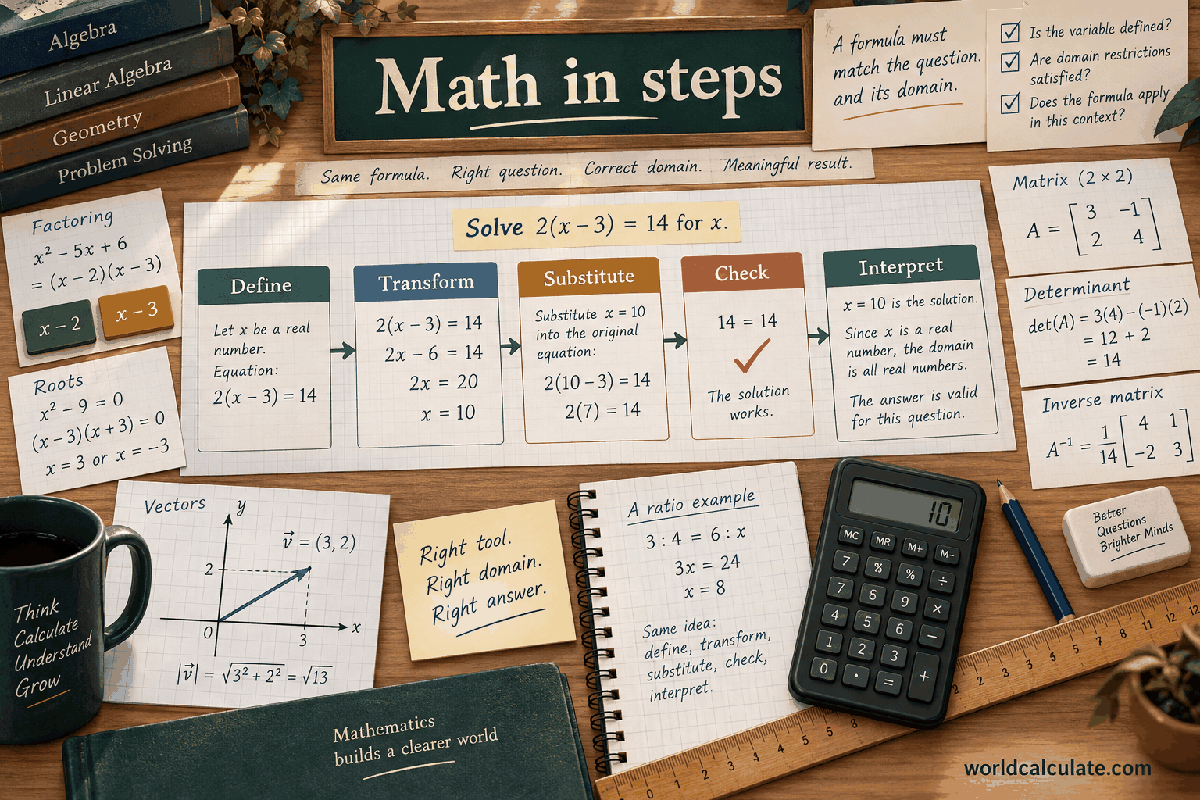
When the three side lengths of a triangle are known, the law of cosines turns those lengths into the three interior angles. This is the SSS case: side a is opposite angle A, side b is opposite angle B, and side c is opposite angle C. Enter positive side lengths in one consistent unit and this calculator checks whether they can form a genuine Euclidean triangle before reporting angles in degrees. The guide below explains why the formula works, how the strict triangle inequality protects the result, how to match sides with their opposite angles, and how to read ordinary, nearly degenerate, and ambiguous-looking cases. The worked examples are detailed enough to reproduce by hand. They also show why a numerical result should be treated as a checked geometric calculation, not as a substitute for sound measurements or professional judgment.
A triangle-angle problem can be described by the information supplied about its sides and angles. In this record, all three side lengths are supplied and no angle is supplied. That combination is called SSS, short for side-side-side. The calculator uses the three lengths to find angle A, angle B, and angle C. It does not ask where the triangle sits on a page, which direction it points, or which side should be drawn first. Those choices change the position or orientation of a drawing, but not the three interior angle measures.
The result is a geometric description of a valid triangle up to congruence and reflection. If two drawings have the same three side lengths, one can be moved, rotated, or reflected to match the other. Their corresponding angles are the same. This is why the tool can work from lengths alone. It is not estimating an unknown shape from a statistical sample, and it is not inferring a scale from a picture. It applies a deterministic relationship to the values entered in the three side fields.
The calculator also performs a gate before the trigonometry. Every side must be a finite positive number inside the displayed field bounds, and every pair of sides must have a sum greater than the remaining side. A failure at that stage means there is no non-degenerate Euclidean triangle for the requested lengths. Rejecting the input is more informative than returning a missing angle, a complex value, or a misleading result from an invalid drawing.
Keep the question narrow when interpreting the output. The page finds angles from side lengths in a flat Euclidean triangle. It does not calculate area, perimeter, coordinates, elevation, uncertainty, material loads, or a complete survey adjustment. Those may be useful follow-up calculations, but they require information that is not part of this SSS angle contract.
An SSS triangle is one for which the lengths of all three sides are known. The three measurements cannot be arbitrary. If one side is too long compared with the other two, the shorter sides cannot meet at both endpoints. If one side is exactly the sum of the other two, the three segments can lie in a straight line but do not enclose a proper triangle. Only when every pair sums to more than the third can the segments close into a nonzero-area triangle.
Once that closure condition holds, the three side lengths determine the triangle's shape. Imagine fixing side c as a base. A point representing the third vertex must be a distance b from one endpoint and a distance a from the other. The intersection of those two distance circles gives two mirror-image positions when the lengths are valid. The mirror images have the same angles. This construction explains both the uniqueness of SSS and the need for the triangle inequality.
Three side lengths determine more than a rough family of shapes. They fix the ratios of the sides and therefore fix the angles. Enlarging every side by the same positive factor produces a similar triangle with exactly the same angles. For example, sides 3, 4, and 5 and sides 30, 40, and 50 have identical angle measures even though their perimeters and areas differ. The law of cosines reflects this scale independence because its numerator and denominator scale by the same square factor.
SSS is different from information that leaves a free choice. Knowing only two sides does not fix the third side. Knowing three angles without a length fixes shape but not size. Knowing three valid side lengths fixes both the shape and the scale, although it still does not tell the calculator where to place the triangle in a coordinate system.
The lowercase and uppercase labels are paired by opposition, not by visual proximity. Side a lies opposite angle A, side b lies opposite angle B, and side c lies opposite angle C. In the usual vertex notation, angle A is at the vertex named A, while side a is the segment joining the other two vertices. The same pattern applies cyclically. A side does not have to touch the angle carrying its matching letter; it is the side across from that angle.
This correspondence controls the formula. To find A, the calculator uses b and c as the two sides that meet at angle A, while a is the side across from A. The expression is A = arccos((b^2 + c^2 - a^2) / (2bc)). To find B, replace the roles cyclically: B = arccos((a^2 + c^2 - b^2) / (2ac)). The remaining expression is C = arccos((a^2 + b^2 - c^2) / (2ab)), although the implementation obtains C from the angle sum after finding A and B.
A quick size check catches many label errors. In every non-degenerate triangle, the largest side is opposite the largest angle, and the smallest side is opposite the smallest angle. Equal sides face equal angles. If your input has c as the largest side but the reported C is not the largest angle, inspect the labels or the arithmetic before using the result. This ordering rule is a consequence of the same cosine relationship, not an extra assumption about the drawing.
Do not infer opposition from the order in which the fields appear on screen. The fields are named a, b, and c so the formula can be followed consistently. If your source labels the sides differently, relabel the measurements before entry or map them explicitly. Swapping values without also swapping the labels changes which angle each value is opposite and can produce a set of numbers that looks plausible while answering a different question.
Focus on angle A, with sides b and c meeting at that angle and side a opposite it. If A were exactly 90 degrees, the Pythagorean theorem would give a^2 = b^2 + c^2. For a non-right angle, the part of one adjacent side that points along the other side changes the length of the opposite segment. The cosine of A measures that projection, and the correction term is 2bc cos(A). The general identity is a^2 = b^2 + c^2 - 2bc cos(A).
Rearranging the identity isolates the cosine of the unknown angle: cos(A) = (b^2 + c^2 - a^2) / (2bc). Applying inverse cosine gives A = arccos((b^2 + c^2 - a^2) / (2bc)). The same reasoning works at the other two vertices. The law is therefore not a memorized collection of unrelated formulas; it is one relationship applied with each side-angle pair taking its turn.
The sign of the cosine explains the angle type. For an acute A, cos(A) is positive, so the correction is subtracted and a^2 is less than b^2 + c^2. For a right A, the cosine is zero and the familiar Pythagorean equality returns. For an obtuse A, the cosine is negative, so subtracting it increases the result and a^2 is greater than b^2 + c^2. This provides a useful independent classification after the side lengths are validated.
The denominator is 2bc because b and c are the two sides that form the included angle A. Positive side validation ensures that this denominator is not zero. For B the denominator is 2ac, and for C it is 2ab. A common mistake is to put the opposite side in the denominator or to use the wrong squared side in the numerator. Writing the matching side in the final negative term is a reliable way to avoid that error.
Inverse cosine returns an angle according to the angle unit used by the underlying mathematical function. In many programming and scientific environments, that raw result is in radians. A radian is defined by arc length on a unit circle, while a degree divides a full turn into 360 equal parts. One full turn is 2 pi radians, so the conversion used for this page is degrees = radians x 180 / pi.
The calculator applies that conversion before displaying each result. You do not need to enter an angle or choose a degree-versus-radian mode because the only inputs are lengths and the output contract is fixed: A, B, and C are reported in degrees. This matters when checking the result by hand. If a separate tool shows 1.5708 for a right angle, it is using radians; this page shows approximately 90 for the same angle.
The three internal angles of a flat triangle sum to 180 degrees. The implementation calculates A and B from inverse cosine and obtains C from C = 180 - A - B. That approach makes the angle-sum relationship explicit and avoids treating the third answer as an unrelated calculation. The displayed values are rounded to two decimal places, so adding the displayed values can show a tiny rounding difference in some cases even when the unrounded values satisfy the sum.
Degrees describe the angle measure only; they do not describe a heading, compass bearing, slope percentage, or three-dimensional rotation. If you use an angle in a later calculation, confirm what that later calculation expects. Converting a triangle angle to a bearing or an inclination requires a reference direction and possibly a coordinate convention that this page does not know.
Positive side lengths are necessary but not sufficient. The strict triangle inequality requires a + b > c, a + c > b, and b + c > a. It is equivalent to saying that the longest side is shorter than the sum of the other two. Each comparison matters because any of the three sides could be the longest. Checking only one inequality is safe only after you have deliberately identified the maximum and know the values are positive.
Consider a = 1, b = 2, and c = 3. The first two lengths add exactly to the third. The segments can form a straight line, but they enclose no area and have no three ordinary interior angles. This boundary is rejected. If c is 4 instead, the longest segment is longer than the other two combined, so the endpoints cannot be joined by both shorter segments. That arrangement is impossible as a triangle and is also rejected.
The record's fields accept finite numbers from 0.000001 through 1000000000 for each side. Zero, a negative value, a missing value, infinity, a not-a-number value, and a value outside those limits fail the field contract. The bounds keep calculations practical and make the intended domain clear. They do not claim that every physical measurement in the world fits those ranges; they define the range this page is prepared to evaluate.
Validation should happen before inverse cosine. For a valid mathematical triangle, each cosine ratio lies between -1 and 1. Invalid side combinations can push the ratio outside that interval, where inverse cosine would not describe a real angle. A robust numerical implementation also protects against a tiny floating-point overshoot at a valid boundary by limiting a computed cosine to the legal interval. That protection cannot turn an impossible set of sides into a valid triangle, because the strict inequality is checked first.
A near-boundary case deserves more care than a comfortably shaped triangle. If the sum of two measured sides is only barely greater than the third, a small measurement error could move the real situation across the boundary. The calculator evaluates the entered numbers, not their uncertainty. Record the original measurements and their precision, and do not treat a barely valid result as proof that a physical triangle can be assembled without tolerance analysis.
The three fields are numeric side lengths, not labels with automatic unit parsing. Enter the number in the unit you have chosen, then use that same unit for all three fields. All values in centimeters, all values in meters, or all values in feet are each valid examples. A mixture such as a in meters, b in centimeters, and c in feet is not valid input until the values have been converted to one common unit. The angles do not carry length units, but they depend on correct length ratios.
Because the law of cosines uses squared lengths in both the numerator and denominator, a common scale factor cancels. If every length is converted from meters to centimeters, each length is multiplied by 100 and every squared term is multiplied by 10000. The cosine ratios therefore remain unchanged. This does not mean unit choice is irrelevant: converting only one side changes the ratios and can create a completely different triangle or an invalid one.
Decimal measurements are appropriate when they represent the precision of the source. Do not add artificial digits merely because the output displays two decimal places. A length recorded as 2.4 does not become a physically exact 2.400000 just because arithmetic accepts more decimals. Conversely, do not round an input aggressively if the triangle is close to a right-angle or inequality boundary. Keep the most defensible measurements in the fields and describe any rounding when you record the result.
Before pressing calculate, check the role and scale of each value. Ask whether a field contains a full side rather than a radius, half-width, height, or coordinate difference. If the measurements came from a drawing, verify that the drawing's scale is not being confused with a side length. The calculator cannot detect a semantically wrong but numerically valid number.
After validation, the calculation begins with the cosine ratio for A: (b x b + c x c - a x a) / (2 x b x c). The calculator then applies inverse cosine and converts the result to degrees. It repeats the same role-based process for B using (a x a + c x c - b x b) / (2 x a x c). The displayed formula may use superscript notation, but the meaning is ordinary squaring and multiplication of the three entered lengths.
The third angle is formed from the interior-angle sum: C = 180 - A - B. If the input is valid, this produces the same geometric angle as the direct cyclic law-of-cosines expression, subject to normal finite-precision arithmetic. Computing the remainder from the sum also gives a simple check: a reported C that is negative, zero, or 180 before rounding would signal invalid geometry or a numerical problem rather than a normal triangle angle.
The result labels state the correspondence explicitly: Angle A is opposite side a, Angle B is opposite side b, and Angle C is opposite side c. The note also identifies the largest entered side and its opposite angle. Read that note as a consistency check, not as a recommendation. If two sides tie for largest, the corresponding angles should tie as well, although a rounded display can hide a very small difference caused by input precision.
The formula has useful direction checks. Increasing side a while holding b and c fixed makes angle A larger as long as the new sides remain valid. Increasing an adjacent side while holding the other values fixed can change several angles at once, so do not apply a one-variable intuition to every output. Scaling all three sides together leaves all three angles unchanged. These checks help distinguish a calculation mistake from an expected geometric response.
Take a = 3, b = 4, and c = 5. These values pass the strict inequality because 3 + 4 is greater than 5, and the other two pairings are also greater. The side lengths are in the familiar right-triangle relationship, but the calculator does not assume that relationship from the labels. It verifies the lengths and lets the law of cosines reveal the angles.
For A, substitute the side opposite A in the negative square: cos(A) = (4^2 + 5^2 - 3^2) / (2 x 4 x 5) = (16 + 25 - 9) / 40 = 32 / 40 = 0.8. Therefore A = arccos(0.8), which is approximately 36.8699 degrees. The displayed result rounds this to 36.87 degrees.
For B, cos(B) = (3^2 + 5^2 - 4^2) / (2 x 3 x 5) = (9 + 25 - 16) / 30 = 18 / 30 = 0.6. This gives B approximately 53.1301 degrees, displayed as 53.13 degrees. The remaining angle is C = 180 - 36.8699 - 53.1301 = 90 degrees. The result is therefore A = 36.87, B = 53.13, and C = 90.00 degrees.
The side-angle check agrees. Side c is 5, the largest side, and C is 90 degrees, the largest angle. The right-angle classification can also be checked without inverse cosine: 5^2 = 3^2 + 4^2. This example illustrates how the law of cosines contains the Pythagorean theorem as a special case and how the calculator's angle-sum step completes the result.
Now use a = 5, b = 6, and c = 7. The triangle is valid because 5 + 6 > 7, 5 + 7 > 6, and 6 + 7 > 5. No two sides are equal, so this is a scalene triangle. It is also a useful example because none of its angles is an obvious special angle, which makes the role of inverse cosine clear.
For A, the cosine ratio is (6^2 + 7^2 - 5^2) / (2 x 6 x 7) = (36 + 49 - 25) / 84 = 60 / 84 = 5 / 7. Inverse cosine gives A approximately 44.4153 degrees. For B, the ratio is (5^2 + 7^2 - 6^2) / (2 x 5 x 7) = (25 + 49 - 36) / 70 = 38 / 70, giving B approximately 57.1217 degrees.
The remaining angle is C = 180 - A - B, approximately 78.4630 degrees. Rounded to two decimal places, the result is A = 44.42, B = 57.12, and C = 78.46 degrees. The unrounded values sum to 180 degrees, and the rounded values sum to 180.00 degrees in this example. The largest side is c = 7, and its opposite angle C is indeed the largest.
The classification test gives another perspective. Since c is the largest side, compare c^2 with a^2 + b^2: 49 is less than 25 + 36, which equals 61. Therefore C is acute. The same kind of comparison can be made for the other angles after selecting their opposite sides. Combining an exact relationship with the numerical output is a good habit when learning or checking work.
Choose a = 5, b = 5, and c = 8. The two equal sides imply equal opposite angles, so A and B should match. The strict inequality is satisfied because 5 + 5 > 8. This is an isosceles triangle, but it is not a right triangle. Its longest side is c, so any obtuse angle, if present, must be C.
For A, the cosine ratio is (5^2 + 8^2 - 5^2) / (2 x 5 x 8) = 64 / 80 = 0.8. Thus A is approximately 36.87 degrees. By symmetry B is also approximately 36.87 degrees. Subtracting from 180 gives C approximately 106.26 degrees. The two smaller angles are equal and the angle opposite the longest side is obtuse, as the side-angle rule predicts.
The side comparison makes the reason especially visible: c^2 = 64, while a^2 + b^2 = 25 + 25 = 50. Since 64 is greater than 50, C is obtuse. The negative cosine for C is not an error; an obtuse angle has a negative cosine. A frequent mistake is to expect every triangle angle from positive side data to be acute. Valid triangles can contain one obtuse angle, but they cannot contain two obtuse interior angles because their sum would exceed 180 degrees.
This example also shows why the largest-side note is valuable. If a manual calculation produced an obtuse A while c remained the longest side, the result would contradict the geometry. Check the negative square, denominator, and side labels before accepting such an output.
The formulas are exact in geometry, but a calculator evaluates finite representations of the entered decimals. Most ordinary triangles have ample distance from a boundary and behave as expected. Trouble is more likely when two sides nearly sum to the third, when one side is extremely small compared with another, or when a result is classified from a value displayed after rounding. A number such as 90.00 degrees can represent an angle that is slightly acute or slightly obtuse before display rounding.
Near degeneracy is the clearest edge case. Suppose two sides are 2 and 3 and the third is just under 5, such as 4.999999 within the allowed field range. The input is technically valid, but the triangle has a very thin shape. The angle opposite the nearly longest side is close to 180 degrees, while the other two angles are close to zero. Small changes in the last digits can create large changes in those small angles, and measurement error can make the inequality fail altogether.
At the exact equality boundary, do not rely on inverse cosine to decide what happened. The input is rejected before angle calculation because a + b = c describes a straight-line limit, not a proper triangle. If an entered pair is only barely above the boundary, the output is mathematically defined for the entered numbers, but it may not be meaningful to the same number of decimal places as the input. Report the condition honestly rather than presenting extra digits as physical certainty.
Inverse cosine expects a ratio from -1 through 1. Algebra guarantees that interval for valid ideal side lengths, while floating-point rounding can create a tiny overshoot such as 1 plus a very small error. The calculator protects its inverse-cosine step by constraining the computed ratio to the legal interval. That is a numerical safeguard for representation error, not permission to ignore invalid sides. A materially out-of-range ratio usually indicates an input, label, or formula problem.
Very different scales deserve a unit and precision check. The field range allows values from 1e-6 to 1e9, but arithmetic accuracy is not identical across every possible ratio. Squared values can lose meaningful low-order digits when they are combined with much larger squared values. If the result is important, rescale all three sides by a common factor into a more moderate range, retain sufficient significant digits, and compare the result with an independent calculation. Common scaling leaves the exact angles unchanged while sometimes making numerical reasoning easier.
Finally, distinguish display precision from input certainty. The page formats the angle results to two decimal places, which is useful for ordinary educational and planning checks. It does not promise that the last displayed hundredth is supported by the side measurements. In a measured application, propagate measurement uncertainty or use a domain-specific tolerance method before making a decision near a boundary.
SSS is often taught beside the ambiguous case, but the two situations should not be mixed. In SSS, all three sides are known, so the shape is fixed before any angle is calculated. There is one set of angle measures for the valid side lengths, apart from the mirror-image drawing. No second noncongruent triangle can use the same three side lengths.
The ambiguous case is usually called SSA: two sides and a non-included angle are known. A side-angle relationship can then allow zero, one, or two possible triangles. Geometrically, a known side and a known angle can leave a vertex that intersects a circle in two positions, one position, or none. The two possible positions can lead to different remaining angles. That is why a solver for SSA needs a branch check rather than blindly selecting one inverse-trigonometric value.
This calculator is not an SSA solver. Its three fields are all lengths and are named side a, side b, and side c. Do not enter an angle such as 40 into one of the side fields and expect the page to understand that it is an angle. A numerically valid-looking set of three values is still an SSS request; the calculator will treat all three as lengths in the same unit and validate them as such.
SAS is another distinct case. If two sides and the angle between them are known, the law of cosines can first find the missing opposite side, after which an SSS-style calculation can find the other angles. That workflow requires an included angle input and is outside this record. Keeping SSS, SAS, and SSA separate prevents a correct formula from being applied to the wrong information pattern.
When reading a worksheet, start by listing exactly what is known and where each known value sits in the triangle. If all three are side lengths, this page is appropriate. If an angle is present, identify whether the case is SAS, ASA, AAS, or SSA and use a method that represents that case. The issue is not merely naming; the number of possible triangles depends on the information pattern.
The most common mistake is a side-angle mismatch. A person may calculate angle A with a^2 as a positive term or use a in the denominator simply because the field is named a. Write the geometric sentence first: side a is across from A, while b and c touch A. Then use the negative square for the opposite side and the product of the two adjacent sides in the denominator. Repeat that pattern for each angle rather than memorizing three unrelated lines.
A second mistake is mixing units or entering a derived dimension. If one side came from a measurement in millimeters and another from a measurement in meters, the values can still pass a numerical inequality while describing a nonsensical shape. Likewise, a diameter entered where a radius was intended may be numerically valid but semantically wrong. Convert and label the source values before using the fields.
A third mistake is ignoring the strict inequality because a drawing appears triangular. A sketch can be not to scale, and a rounded list can conceal equality. Compute the three pair sums or compare the longest side with the sum of the other two. If validation fails, do not repair the input by silently changing a side. Determine whether the source measurement, unit conversion, or transcription is responsible.
If the result seems surprising, use three independent checks. First, verify that all angles are positive and that their unrounded sum is 180 degrees. Second, compare side and angle order: longer sides must face larger angles. Third, classify the largest angle with the squared-side comparison. If all three checks agree, an unusual acute or obtuse result may simply be the correct geometry.
In education, the calculator is useful for checking a law-of-cosines exercise after writing the symbolic setup by hand. A learner can compare the side-angle correspondence, reproduce one cosine ratio, and then use the result to practice classifying an acute, right, or obtuse triangle. Because the inputs and steps are visible, the page supports explanation rather than only supplying a final number.
In planning and layout, three distances can describe a triangular arrangement of points. The resulting angles can help someone sketch a diagram, check whether a proposed layout is geometrically plausible, or prepare a later coordinate construction. The angle output is local to the triangle. It does not by itself provide a compass direction, a coordinate position, or a transformation into a site reference frame.
In engineering, robotics, graphics, and other technical work, SSS angle recovery can be one small stage in a larger model. A system may use the angles to describe a linkage, a polygon corner, a camera arrangement, or a geometric constraint. In each case, the downstream model must define its own coordinate conventions, tolerances, units, and physical assumptions. A mathematically valid triangle is not automatically a valid mechanical assembly or an approved design.
For measured work, use the page as a transparent check rather than as the only record. Keep the three original distances, their units, how they were obtained, the date or context of measurement, and the precision reported by the measuring method. If several measurements are inconsistent, calculate each plausible set separately and investigate the disagreement instead of selecting the most convenient angle. Reproducibility is more useful than an unexplained single result.
A practical workflow is to validate the measurements, enter the common-unit values, record the three inputs and outputs, and then perform an independent side-angle and angle-sum check. If the triangle is close to degenerate or a decision has safety consequences, add a tolerance analysis and qualified review. The calculator can make the arithmetic clear, but it cannot supply the context that makes a technical decision responsible.
The law of cosines assumes a Euclidean plane with straight line segments. It does not model curvature of the Earth, spherical triangles, curved surfaces, folded material, or three-dimensional points whose distances are interpreted under a different geometry. If the distances belong to a coordinate system with projection distortion or a non-flat reference surface, the plain SSS result may not be the right model even when the arithmetic is flawless.
The calculator also treats each entered side as an exact number for the purpose of its computation. It has no uncertainty field, outlier detection, weighted adjustment, confidence interval, or repeat-measurement model. It cannot know whether a distance was measured with a ruler, derived from coordinates, rounded from a report, or copied from a drawing. The two-decimal display is formatting, not a guarantee of two-decimal physical accuracy.
No area, perimeter, altitude, coordinates, orientation, or missing measurement is inferred by the article or the handler. The result does not prove that a triangle can be assembled from flexible or imperfect materials, and it does not check whether angles satisfy a separate design code, clearance rule, accessibility requirement, or operating limit. If a later task needs those facts, obtain the needed inputs and use a method designed for that task.
For safety-critical, regulated, structural, surveying, navigation, or high-cost decisions, do not use this page as the sole approval step. Preserve the raw observations, confirm the geometry with an independent calculation or instrument, account for uncertainty and tolerances, and ask a qualified professional to review the result when the consequences warrant it. Responsible use means matching the confidence of the conclusion to the quality of the evidence, not merely trusting a neatly formatted angle.
The formula remains valuable within its boundary. It gives a compact, auditable connection between three compatible side lengths and three interior angles. Its limitations do not weaken that purpose; they define when the result is a useful geometric answer and when another model, more data, or expert review is needed.
Start by naming the triangle and writing the opposite pairs: a with A, b with B, and c with C. List the three side measurements with their units. If the values came from different sources, convert them to one unit before entering them. This preparation takes little time and prevents a surprising number of errors because it separates geometry from transcription.
Next, test the data before interpreting any angle. Confirm that each value is finite, positive, and inside the field range. Check all three strict inequalities. If the longest side equals or exceeds the sum of the other two, stop and investigate. Do not use a rounded drawing or a forced inverse-cosine result to override the validation boundary.
Then calculate one angle with the matching formula and use the cyclic pattern for the others. Check the units of the output, remember that the page reports degrees, and inspect the largest-side note. Finally, verify that the angles sum to 180 degrees, that their order matches the side order, and that the squared-side comparison gives the expected acute, right, or obtuse classification.
Record the result with the original side values, not just the final angles. If the result will guide a physical or consequential decision, add the measurement uncertainty, a tolerance or sensitivity check, and an independent review. This workflow keeps the calculator in its proper role: a clear arithmetic and geometry aid whose conclusions are only as reliable as the data and assumptions supplied to it.
All three interior angles of a triangle from its side lengths a, b, c.
A = arccos((b² + c² − a²) / 2bc), cyclically; angles in degrees sum to 180°. The law of cosines inverts SSS congruence: each angle follows from the three sides. Inputs failing the strict triangle inequality are rejected instead of producing NaN angles.
Enter Side a, Side b, Side c, then choose Calculate.
Euclidean plane triangle; all sides use the same length unit. Strict triangle inequality: each pair of sides sums above the third.
This calculator is part of the WorldCalculate library. Its formula, example, assumptions, input bounds, and output formatting follow the official methodology.
These WorldCalculate collections connect this tool with related questions while keeping each calculation separate and transparent.