
Goal
Solves |ax + b| = c by splitting into the positive and negative cases.
Worldwide context
Saved once here, used across the site.
Currency changes display only. Country selection guides tax input; no tax rate is guessed.
Solves |ax + b| = c by splitting into the positive and negative cases.
|ax + b| = c gives ax + b = c or ax + b = -c.A clearer path to an answer
This page keeps the calculation transparent: define the goal, enter the matching values, inspect the method, and decide what the result means in your situation.
Solves |ax + b| = c by splitting into the positive and negative cases.
Coefficient a · Constant b · Constant c
|ax + b| = c gives ax + b = c or ax + b = -c.
Calculate, review the assumptions below, then compare a related tool when the decision needs more context.
Solves |ax + b| = c by splitting into the positive and negative cases.
Open the Absolute Value Equation Solver pageMore math tools
Download PDFDownload Word (.doc)
Enter your values above and choose Calculate to see the result here.
Calculation map
|ax + b| = c gives ax + b = c or ax + b = -c.
Bounded, transparent calculation
Your recent runs stay in this browser session only.
Formula: |ax + b| = c gives ax + b = c or ax + b = -c.
Split the absolute value into its two linear cases and solve each. A zero c yields one solution; a negative c has no solution.
Worked example: Solutions x = 5, x = 1.
The displayed limits are checked before the handler runs. Model-specific domain checks may also reject impossible or non-finite inputs.
Methodology: This calculator follows the WorldCalculate input, formula, precision, and boundary policy. Read the official methodology.
Calculator usage statistics
This section counts anonymous successful Calculate submissions, not unique visitors. Counts and top tools appear only when trusted aggregate data is available; country analysis is shown only under the same condition and reporting threshold.
Answer-first guide
Solves |ax + b| = c by splitting into the positive and negative cases. Start with one clearly defined goal, enter values in the units shown, and keep the result attached to the assumptions below.
This tool is useful when your question includes absolute value equation, solve absolute, two solutions. It returns the outputs declared in the calculator contract rather than a live quote, approval, diagnosis, or professional sign-off.
Coefficient a · Constant b · Constant c. Keep the same time period, unit system, and currency wherever the form requires comparable values.
Run the worked example first, compare its output with the page's example, then change one input at a time. This makes an unexpected result easier to trace to a unit, boundary, or assumption.
Need a wider view? Browse Math Calculators or compare the related tools below. The WorldCalculate methodology explains how formulas, examples, limits, and revisions are reviewed.
|ax + b| = c gives ax + b = c or ax + b = -c.
Split the absolute value into its two linear cases and solve each. A zero c yields one solution; a negative c has no solution.
Solutions x = 5, x = 1.
Context and background
Math calculators move from named quantities to a relation, then to a result that can be checked with substitution, units, or an alternate form.
Arithmetic, algebra, geometry, trigonometry, and number theory provide reusable structures for classroom work and everyday reasoning. Each page narrows that structure to one declared problem.
Research and review
Researched by Hassan ALRowaie, Founder and editorial researcher at WorldCalculate.
This guide follows the live calculator's declared inputs, formula, worked example, assumptions, validation boundaries, and source-backed methodology. The review date describes editorial review of the calculator explanation; it is not a promise that external facts or rates remain current.

An absolute value equation measures how far a linear expression is from zero. In the form |ax + b| = c, the coefficient a, constant b, and nonnegative target c determine which real values of x place ax + b exactly c units away from zero. Because a is nonzero, the expression changes with x and the equation can be solved by splitting it into two ordinary linear equations: ax + b = c and ax + b = -c. A positive c normally gives two distinct real solutions, c = 0 gives one repeated solution, and a negative c gives no real solution because a distance cannot be negative. This calculator accepts finite numeric coefficients in its stated bounds, checks those domain rules, and reports the resulting numeric values. The guide below explains the distance idea, the input contract, the two-case derivation, signs and zero cases, graph and interval views, verification, related inequalities, unit and domain restrictions, precision limits, common mistakes, and decisions that remain outside the calculator. The central habit is to preserve the absolute-value bars until the two cases have been written explicitly.
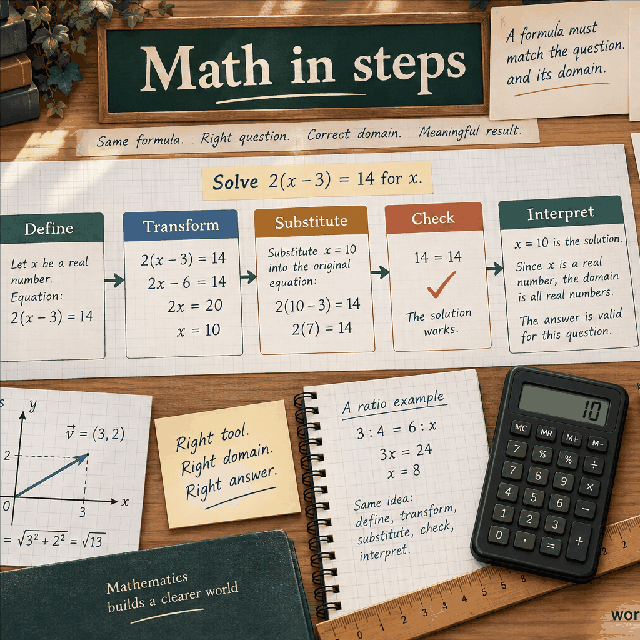
The equation |ax + b| = c asks for every real x that makes the complete expression inside the bars have magnitude c. The bars apply to ax + b as one unit. They do not mean that only a, only x, or only b should be made positive. First evaluate ax + b, then measure its distance from zero. The answer is a set of x-values, not necessarily one value. When c is positive, the expression can reach the target from either side of zero: it may equal c or it may equal -c. Those two possibilities are the source of the two solutions.
This is different from an ordinary equation such as ax + b = c, which asks for one signed value of the expression. An absolute value equation forgets the sign after measuring the magnitude. For example, both 4 and -4 have absolute value 4. If the expression ax + b can take both signs as x changes, the same distance from zero can occur at two locations. The nonzero condition on a guarantees that the linear expression is not constant, so moving x can actually change its value.
The calculator is deliberately narrow. It solves one real equation with one linear expression inside absolute-value bars. It does not choose a model, parse a longer expression, or infer additional constraints from a story problem. Its result should be read together with the entered coefficients and the assumptions that x is real. The displayed solutions answer the stated equation; they do not automatically answer a different question about integer values, positive values, or a physical quantity.
For any real number u, |u| is the distance between u and zero on the number line. Distance has two important properties here: it is never negative, and two points can be the same distance from zero, one on each side. Thus |u| = c with c greater than zero means u is located at c or at -c. When c is zero, the only point at distance zero from zero is zero itself. When c is negative, there is no point at a negative distance.
Apply that interpretation to u = ax + b. The equation says that the value of the linear expression must land exactly c units from zero. Solving for x is therefore a reverse-distance problem. Find the x that makes the expression c, then find the x that makes the expression -c. The two x-values are usually different because they correspond to the two sides of the target distance.
The same idea can be expressed directly in terms of x. Since ax + b = a(x + b/a), the equation can be rewritten as |a| times |x + b/a| = c. With a nonzero, this becomes |x - (-b/a)| = c/|a|. The center is -b/a and the radius in x-space is c/|a|. This shows before doing any arithmetic that positive c produces two points symmetric around the center, while zero c collapses both points to the center.
The calculator has three numeric fields. Enter the coefficient a that multiplies x, the constant b that is added inside the bars, and the right-hand constant c. Each field is bounded between -1,000,000,000 and 1,000,000,000 and must be a finite number. Decimal coefficients are allowed because the fields accept any numeric step. A written equation should be simplified before entry so that the values really occupy these three roles.
The coefficient a must be nonzero. If a equals zero, the expression becomes b and no longer depends on x. Dividing by a would then be division by zero, and the problem would be a constant statement rather than the linear absolute-value equation handled here. The calculator rejects that case instead of pretending that a single pair of formulas still applies.
The target c must be at least zero. The numeric bounds permit the field to be represented within the general range, but a negative target violates the mathematical contract and is rejected with a no-solution error. This rejection is consistent with the real-number fact that an absolute value cannot be negative. It is useful to distinguish an invalid calculation request from an accepted input whose answer happens to be empty.
There is no automatic unit or domain selector in this record. The arithmetic treats the values as real numbers in a consistent system. If x represents a length, time, amount, or another measured quantity, decide the units before entering the coefficients. If the original problem restricts x to integers, positive numbers, or an interval, solve the real equation first and then filter the candidates using that separate restriction.
The defining rule for a nonnegative c is |u| = c if and only if u = c or u = -c. Substitute u = ax + b. The absolute-value equation therefore becomes two branches: ax + b = c and ax + b = -c. These are not two arbitrary guesses. They are the complete list of signed values whose distance from zero is c.
Solve both branches separately and retain both results until they have been checked. From the first branch, subtract b and divide by a. From the second branch, subtract b and divide by a in the same way. The coefficient may be negative, but an equation can be divided by a negative number without reversing anything because equality preserves under multiplication or division by every nonzero number. The sign-reversal rule belongs to inequalities, not to these equalities.
A frequent incomplete method solves only ax + b = c. That finds the solution on the positive side of zero but misses the solution on the negative side when c is positive. A second frequent method writes ax + b = plus or minus c without actually carrying both equations through the algebra. Writing the two lines separately prevents a hidden sign from being lost and makes the one-solution case easy to recognize when the results coincide.
Start with the positive branch ax + b = c. Subtract b from both sides to obtain ax = c - b. Since a is nonzero, divide by a and get x = (c - b)/a. This is the candidate produced when the inside expression is positive or zero at the target level. The sign of a belongs in the denominator exactly as entered; replacing it with its absolute value would change the signed location of the candidate.
Now use the negative branch ax + b = -c. Subtract b to obtain ax = -c - b, then divide by a. The second candidate is x = (-c - b)/a. Together, the formulas are x1 = (c - b)/a and x2 = (-c - b)/a. For c greater than zero, the two numerators differ by 2c, and because a is nonzero the resulting x-values cannot be equal.
The distance form gives the same formulas from a different angle. The center is h = -b/a and the radius is r = c/|a|. The two points are h - r and h + r. If a is positive, the negative-expression branch appears on the left and the positive-expression branch on the right. If a is negative, the labels from the algebraic branches swap left and right, but the unordered solution set remains the same.
The formulas also explain the effect of each input. Changing b moves the center because it changes -b/a. Changing c increases or decreases the separation from the center. Changing the magnitude of a changes the x-distance needed to produce the same expression value. A larger |a| makes the two x-solutions closer together for a fixed positive c; a smaller nonzero |a| makes them farther apart.
Use the default-style values a = 2, b = -6, and c = 4. The equation is |2x - 6| = 4. The center is -b/a = 6/2 = 3, and the x-radius is c/|a| = 4/2 = 2. The distance picture already predicts two points, three units at the center and two units in either direction, so the candidates should be 1 and 5.
The split calculation confirms that prediction. The first branch is 2x - 6 = 4. Adding 6 gives 2x = 10, so x = 5. The second branch is 2x - 6 = -4. Adding 6 gives 2x = 2, so x = 1. The calculator reports the two numeric results in branch order; when presenting them on a number line, it is often clearer to sort them as 1 and 5.
Substitution checks both values in the original equation. At x = 5, the inside is 10 - 6 = 4 and |4| = 4. At x = 1, the inside is 2 - 6 = -4 and |-4| = 4. Each candidate works for a different signed branch, which is precisely why both must be included.
Consider a = 5, b = -15, and c = 0. The equation is |5x - 15| = 0. An absolute value equals zero only when its inside is exactly zero, so solve 5x - 15 = 0. Adding 15 and dividing by 5 gives x = 3. There is no second distinct location because zero distance has only one point.
The two-case method reaches the same conclusion. The positive branch is 5x - 15 = 0 and the negative branch is also 5x - 15 = -0, which is the same equation. The formulas give x1 = (0 - (-15))/5 = 3 and x2 = (-0 - (-15))/5 = 3. A result list should contain one solution rather than listing the same value twice.
Graphically, the V-shaped curve y = |5x - 15| touches the horizontal axis at its vertex and does not cross it at a second point. The center is -b/a = 3 and the radius c/|a| is zero. This repeated algebraic candidate is not evidence of two distinct solutions; it is one solution with two identical case descriptions.
For a no-solution example, consider |3x + 2| = -1. The left side is an absolute value, so it is at least zero for every real x. It cannot equal -1. The real solution set is empty. This is a conclusion about the equation, not a matter of failing to find a clever value of x.
The negative target is outside this calculator's accepted contract. Entering c = -1 is rejected rather than evaluated as an ordinary valid case, and the error explains that an absolute value cannot be negative. That behavior protects the distinction between a valid input with a result and an input that asks for an impossible distance. If a problem statement supplies a negative target, record no real solutions before attempting the calculator, or correct the statement if the sign was entered accidentally.
The two-case rule also shows the contradiction. For c = -1, the branches would be 3x + 2 = -1 and 3x + 2 = 1. Solving those equations would produce numbers, but they are not solutions of the original absolute equation because the branch rule |u| = c requires c to be nonnegative. Squaring or blindly applying the formulas to a negative c would therefore obscure the domain condition rather than solve the stated problem.
The sign of a affects the orientation of the linear expression but not the basic count rule. With a positive, ax + b grows as x grows. With a negative, it falls as x grows. The absolute value folds negative expression values upward, so the graph still forms an upward V and positive c still gives two intersections. The formulas keep the sign of a in the denominator, which places the values correctly on the x-axis.
For example, take a = -2, b = 6, and c = 2. The equation is |-2x + 6| = 2. The branches are -2x + 6 = 2 and -2x + 6 = -2. The first gives x = 2, and the second gives x = 4. The branch order is 2 then 4 in this example, but in other negative-a examples the first branch may be the right-hand point. Sorting is a presentation choice, not a change to the algebra.
If b is zero, the equation is |ax| = c. Since |ax| = |a||x|, the solutions are x = -c/|a| and x = c/|a|. The raw formulas c/a and -c/a produce the same set even when a is negative. If b has the same magnitude as c, x = 0 may be one of the solutions because |b| = c. These zero checks can expose a sign error quickly.
There are three distinct target regimes. If c is positive, the radius c/|a| is positive and two distinct real solutions exist. If c is zero, the radius vanishes and one solution remains. If c is negative, the real equation has no solution and the calculator rejects the input. The sign of b changes the location of the center, but it cannot by itself change this count classification.
Define f(x) = |ax + b| and graph y = f(x). Because a is nonzero, the graph is a V-shaped piecewise-linear curve. Its vertex is at x = -b/a and y = 0. The equation |ax + b| = c asks where this graph meets the horizontal line y = c. The number of intersections is therefore visible before any detailed arithmetic: two above the axis, one on the axis, and none below the axis.
The vertex location comes from making the inside zero. On the left and right of the vertex, the graph rises with a slope whose magnitude is |a|. A large |a| makes the V narrow and steep; a small nonzero |a| makes it broad. The sign of a changes which un-folded linear branch has which algebraic sign, but after applying the absolute value the upward V has the same slope magnitudes.
For c greater than zero, the horizontal line lies above the vertex and cuts both arms. The x-coordinates of the intersections are the two formulas already derived. For c = 0, the line is the x-axis and touches the vertex. For c less than zero, the line lies below the graph, so no real intersection exists. This graph view is a useful independent check on a result that seems to have the wrong number of values.
The graph also explains symmetry. Reflecting an intersection across the vertical line x = -b/a preserves its distance from the vertex and produces the other solution. The equation is not generally symmetric around x = 0; it is symmetric around the vertex determined by a and b. Assuming the solutions should be opposites is only valid in special cases such as b = 0.
An equation uses equality, so its solution set usually consists of isolated points. For c > 0, write the result as a two-point set such as {1, 5}; every value between 1 and 5 fails the equation because the absolute value is smaller than 4 there, and every value outside the pair gives a larger value. For c = 0, the set is a singleton such as {3}. For a negative target, the set is empty.
It is important not to turn the equation into an interval merely because the two roots are endpoints of a visible span. The interval between the roots is associated with an inequality such as |ax + b| <= c, not with the equality itself. The outside rays are associated with |ax + b| >= c. The equation selects the boundary points where the magnitude is exactly the target.
If another domain restriction is supplied, intersect that domain with the point set. Suppose the real solutions are 1 and 5 but x must be a whole number between 2 and 4. Neither candidate remains, so the restricted answer is empty. If x must be at least 4, only 5 remains. The calculator reports the unrestricted real candidates and does not silently apply these later filters.
When two solutions are very close, the set interpretation is still discrete even if the display rounds both values similarly. Keep the formula or full-precision values available when deciding whether the candidates are distinct. A rounded visual label is not a license to merge two mathematically different roots.
Substitution into the original absolute equation is the strongest short check. For x1 = (c - b)/a, the inside expression becomes a times (c - b)/a plus b, which simplifies to c. Therefore its absolute value is |c|, equal to c under the accepted condition c >= 0. For x2 = (-c - b)/a, the inside becomes -c and its absolute value is also c. The derivation itself contains a proof that both candidates work.
A numerical check should still be performed after arithmetic or data entry. Use the unrounded candidate when possible, calculate ax + b, and compare its absolute value with c. With the example |2x - 6| = 4, x = 5 produces 4 inside the bars and x = 1 produces -4 inside the bars. Both absolute values are 4, so both pass.
Check the boundary cases separately. At c = 0, substitute the single candidate and confirm that ax + b is zero. At a negative target, substitution cannot rescue the equation because the left side is always nonnegative. If a result appears to violate the expected count, check the target sign and the coefficient before suspecting the formula.
Near a rounded boundary, compare with a tolerance appropriate to the input precision rather than demanding that a formatted decimal reproduce c exactly. A displayed value may be six places long while the underlying ratio is repeating. Verification should use the underlying numeric calculation, and any practical decision should acknowledge the precision of the original measurements.
The two equation roots are also the boundaries of two common inequalities. For c >= 0, |ax + b| <= c means that the expression lies between -c and c, so -c <= ax + b <= c. The equality solutions are the endpoints of that allowed region. In x-space, the allowed interval lies between the two sorted roots. The precise algebraic direction changes with the sign of a, but sorting the final endpoints gives the same geometric interval.
Likewise, |ax + b| >= c means that the expression is at least c units from zero. It is equivalent to ax + b <= -c or ax + b >= c. In x-space, the result consists of the two outside rays beginning at the equality roots. The equality equation itself includes only the boundary points, not the interval or the rays around them.
Strict inequalities change the endpoint inclusion. Values satisfying |ax + b| < c lie strictly between the roots when c is positive, while |ax + b| > c lies strictly outside them. The equation with equality identifies the transition points. This makes the absolute equation useful as a boundary calculation even when the final question asks for a tolerance band or an exceedance condition.
The zero target needs special care in this comparison. The statement |ax + b| <= 0 has only the center solution, while |ax + b| >= 0 is true for every real x. These results are not interchangeable with |ax + b| = 0, which has one solution. The calculator solves the equality only; use the related rules explicitly if the original problem uses an inequality sign.
The expression inside absolute-value bars must have one consistent unit if the symbols represent measurements. If x is a time, a has the units needed to turn time into the unit of ax, while b and c must have that same expression unit. If x is a length and c is an amount of length after the linear expression is formed, the coefficient and constant must be compatible with that interpretation. The calculator sees only numbers, so it cannot detect an omitted conversion or an incompatible addition.
Absolute value does not remove restrictions that came from the original problem. The real-number solution formulas may produce a negative time, a fractional item count, or a length outside a permitted range. Those values are valid real solutions of the entered equation but may be inadmissible in context. Solve the equation first, then keep only candidates satisfying the stated domain.
For an integer domain, test whether each numeric candidate is exactly an integer before retaining it. For a positive domain, discard zero and negative candidates if the problem requires x > 0. For a closed interval, compare both endpoints using the original unrounded values. If the problem says x is nonzero, remove a candidate equal to zero even though the absolute equation itself may allow it.
Additional operations in a larger original expression can introduce restrictions that are absent from this simple form. A denominator cannot be zero, a square-root radicand may need to be nonnegative, and a logarithm argument may need to be positive. Rearrange such a problem only after tracking those conditions. This calculator assumes the expression has already been reduced to ax + b inside the bars.
The fields accept finite numbers in the range from -1,000,000,000 through 1,000,000,000. The equation still depends on the ratio formulas, so a small nonzero a can produce a very large solution even when b and c are modest. A large result may be mathematically expected, but if the arithmetic produces a nonfinite value the calculation cannot be represented as a usable numeric result. The finite-result guard prevents an overflow from being presented as a solution.
The output precision is set to six decimal places for these numeric results, and the step text formats non-integer values to a readable six-place maximum. A fraction such as one third is therefore displayed as a rounded decimal rather than an exact terminating value. The input ratio remains the more reliable description of the result when exactness matters. Keep the original a, b, and c instead of copying only a formatted label into a later calculation.
Rounding can matter in two ways. First, two distinct solutions can appear identical if their separation is smaller than the displayed precision. Second, a candidate close to a domain boundary can move from one side of that boundary to the other when rounded. For a practical threshold, use more precision in the source data than in the presentation and state the measurement resolution. Do not infer certainty beyond the least precise input.
A coefficient with a very small magnitude also amplifies input uncertainty. Since each solution divides by a, a small error in a can create a much larger change in x. This is a numerical sensitivity issue, not a failure of the absolute-value method. If a result is unusually large or unstable, rescale the equation when possible, retain full precision, and verify the substituted expression before relying on the displayed value.
The most common mistake is solving only ax + b = c. That discards the negative branch and turns a two-solution problem into a one-solution answer. Write both equations before isolating x. A second mistake is changing the sign of b incorrectly. From ax + b = c, subtract b to get ax = c - b; do not use c + b unless the original constant was already negative and you have simplified it carefully.
Another mistake is dividing by c instead of a. The coefficient of x is the quantity that must be removed, so a is the denominator in both formulas. If c is zero, division by c would be especially meaningless even though the equation has a valid center solution. Similarly, replacing a with |a| in the formula can move a solution to the wrong side; use |a| only in the distance-radius interpretation.
Some solvers square both sides immediately. For an accepted c >= 0, squaring produces an equivalent equation (ax + b)^2 = c^2, but expanding it hides the simple two-case structure and can make sign checks harder. If c is negative, squaring can tempt someone to compute candidates even though the original absolute equation has no real solution. Check the target domain before any squaring.
Parentheses are also essential when the absolute value contains more than one term. The expression |ax + b| is not the same as a|x| + b. The constant b is inside the bars and is folded along with ax. Entering the coefficients from the wrong grouping solves a different equation. Finally, do not assume the two answers must be opposites; their midpoint is -b/a, which is zero only when b is zero.
The calculator does not decide whether ax + b is the right model for the situation. It evaluates the supplied coefficients exactly as numeric inputs and applies the absolute-value equation rules. A result can be algebraically correct while the coefficients came from a bad measurement, an incorrect unit conversion, or an oversimplified relationship. Model selection and data quality remain separate tasks.
It also does not choose a domain beyond real numbers. It will not know that a count must be an integer, that a duration cannot be negative, that a physical length has a maximum, or that a candidate violates a policy limit. It reports real candidates under the contract. Use the context to filter them and document the reason for every discarded candidate.
The page does not solve an absolute-value inequality, a system of several absolute equations, a nested absolute value, or an equation with a different expression structure. Such problems may require more cases, intersections or unions of sets, or additional domain analysis. Do not paste a more complicated equation into the three fields and assume that the returned pair represents the original problem.
Finally, the result is not an uncertainty analysis or a decision recommendation. The displayed decimals summarize finite numeric computation, but they do not establish measurement accuracy, safety, eligibility, or feasibility. When a solution is used near a cutoff, preserve the assumptions, units, source precision, and domain rules alongside the numeric answer.
Begin by simplifying the original statement until the absolute-value portion is exactly |ax + b| and the right side is c. Confirm that a is not zero, c is nonnegative, and all three values are finite and within the allowed bounds. If the source problem carries units or a restricted domain, write those conditions beside the equation before calculating.
Next, use the distance meaning to anticipate the answer count. A positive c should create two distinct real candidates, c = 0 should create one, and a negative c should create none. Then write the two cases ax + b = c and ax + b = -c, solve them as equalities, and retain the sign of a in the denominator. Sort the candidates only after both branches have been evaluated.
Finish by substituting every candidate into the original bars, checking the expected count, and applying any external domain restriction. Interpret the roots as points rather than an interval, unless a related inequality is the real question. Preserve enough precision for the intended use, especially when a is small or a candidate is close to a boundary. This sequence is short, transparent, and resistant to the most common sign and grouping errors.
Solves |ax + b| = c by splitting into the positive and negative cases.
|ax + b| = c gives ax + b = c or ax + b = -c. Split the absolute value into its two linear cases and solve each. A zero c yields one solution; a negative c has no solution.
Enter Coefficient a, Constant b, Constant c, then choose Calculate.
a is nonzero, so each case is a linear equation. Real solutions only; c must be nonnegative.
This calculator is part of the WorldCalculate library. Its formula, example, assumptions, input bounds, and output formatting follow the official methodology.
These WorldCalculate collections connect this tool with related questions while keeping each calculation separate and transparent.