
Goal
Estimate sodium from a salt mass and sodium-chloride purity using reference atomic weights, with outputs for sodium, chloride, and sodium per 100 grams of product.
Worldwide context
Saved once here, used across the site.
Currency changes display only. Country selection guides tax input; no tax rate is guessed.
Estimate sodium from a salt mass and sodium-chloride purity using reference atomic weights, with outputs for sodium, chloride, and sodium per 100 grams of product.
Product mass in grams = entered mass × unit conversion; NaCl mass = product mass × purity; sodium = NaCl mass × 22.98976928 ÷ 58.443; chloride = NaCl mass × 35.453 ÷ 58.443.A clearer path to an answer
This page keeps the calculation transparent: define the goal, enter the matching values, inspect the method, and decide what the result means in your situation.
Estimate sodium from a salt mass and sodium-chloride purity using reference atomic weights, with outputs for sodium, chloride, and sodium per 100 grams of product.
Salt product mass · Mass unit · Sodium-chloride purity
Product mass in grams = entered mass × unit conversion; NaCl mass = product mass × purity; sodium = NaCl mass × 22.98976928 ÷ 58.443; chloride = NaCl mass × 35.453 ÷ 58.443.
Calculate, review the assumptions below, then compare a related tool when the decision needs more context.
Estimate sodium from a salt mass and sodium-chloride purity using reference atomic weights, with outputs for sodium, chloride, and sodium per 100 grams of product.
Open the Sodium in Salt Calculator pageMore food tools
Download PDFDownload Word (.doc)
Enter your values above and choose Calculate to see the result here.
Calculation map
Product mass in grams = entered mass × unit conversion; NaCl mass = product mass × purity; sodium = NaCl mass × 22.98976928 ÷ 58.443; chloride = NaCl mass × 35.453 ÷ 58.443.
Bounded, transparent calculation
Your recent runs stay in this browser session only.
Formula: Product mass in grams = entered mass × unit conversion; NaCl mass = product mass × purity; sodium = NaCl mass × 22.98976928 ÷ 58.443; chloride = NaCl mass × 35.453 ÷ 58.443.
The calculator separates product mass from the portion treated as sodium chloride. It uses reference atomic and molecular weights to estimate elemental sodium, then presents both grams and milligrams so the result can be compared with a nutrition label.
Worked example: Ten grams of pure NaCl contains about 3.934 g, or 3,934 mg, of elemental sodium.
The displayed limits are checked before the handler runs. Model-specific domain checks may also reject impossible or non-finite inputs.
Methodology: This calculator follows the WorldCalculate input, formula, precision, and boundary policy. Read the official methodology.
Calculator usage statistics
This section counts anonymous successful Calculate submissions, not unique visitors. Counts and top tools appear only when trusted aggregate data is available; country analysis is shown only under the same condition and reporting threshold.
Answer-first guide
Estimate sodium from a salt mass and sodium-chloride purity using reference atomic weights, with outputs for sodium, chloride, and sodium per 100 grams of product. Start with one clearly defined goal, enter values in the units shown, and keep the result attached to the assumptions below.
This tool is useful when your question includes sodium in salt calculator, salt to sodium converter, NaCl sodium percentage. It returns the outputs declared in the calculator contract rather than a live quote, approval, diagnosis, or professional sign-off.
Salt product mass · Mass unit · Sodium-chloride purity. Keep the same time period, unit system, and currency wherever the form requires comparable values.
Run the worked example first, compare its output with the page's example, then change one input at a time. This makes an unexpected result easier to trace to a unit, boundary, or assumption.
Need a wider view? Browse Food & Recipe Calculators or compare the related tools below. The WorldCalculate methodology explains how formulas, examples, limits, and revisions are reviewed.
Product mass in grams = entered mass × unit conversion; NaCl mass = product mass × purity; sodium = NaCl mass × 22.98976928 ÷ 58.443; chloride = NaCl mass × 35.453 ÷ 58.443.
The calculator separates product mass from the portion treated as sodium chloride. It uses reference atomic and molecular weights to estimate elemental sodium, then presents both grams and milligrams so the result can be compared with a nutrition label.
Ten grams of pure NaCl contains about 3.934 g, or 3,934 mg, of elemental sodium.
Context and background
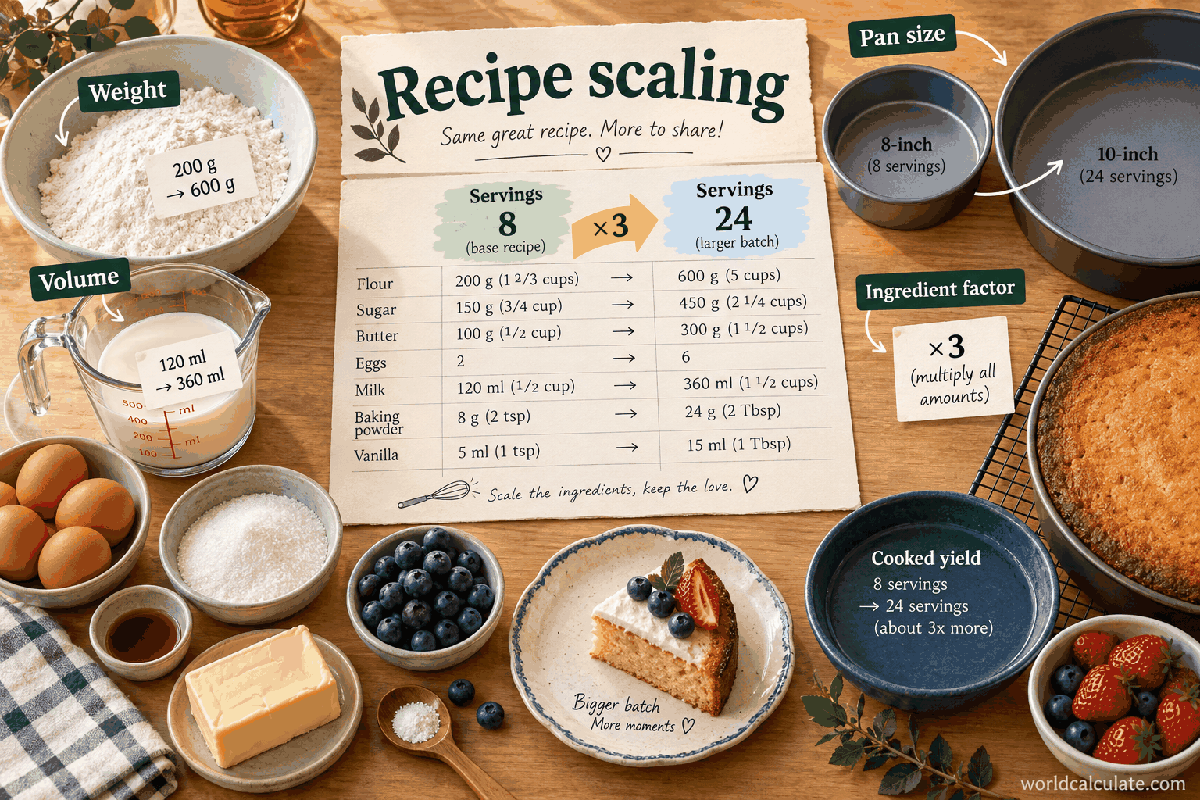
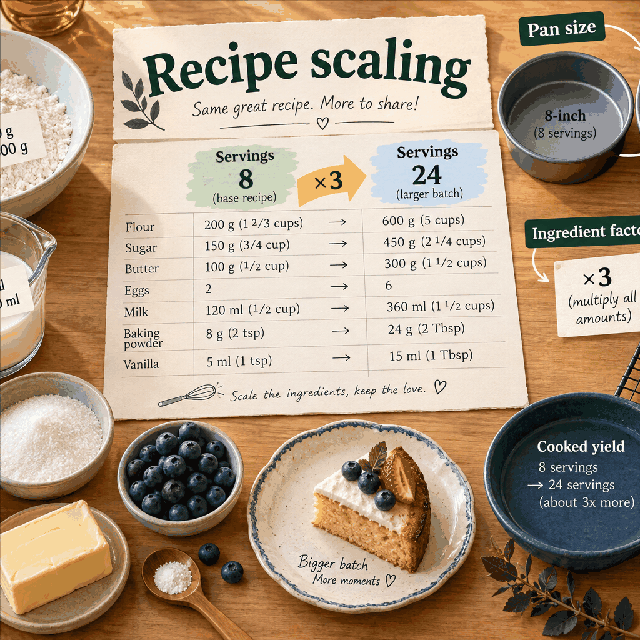
Recipe scaling uses a serving ratio, then keeps the ingredient unit visible. Cooking chemistry, pan size, heat, texture, and safety can require adjustments beyond linear arithmetic.
Scaling a recipe is a familiar applied ratio problem. The useful calculation is the transparent factor; the cooking result still depends on the ingredient and method.
Research and review
Researched by Hassan ALRowaie, Founder and editorial researcher at WorldCalculate.
This guide follows the live calculator's declared inputs, formula, worked example, assumptions, validation boundaries, and source-backed methodology. The review date describes editorial review of the calculator explanation; it is not a promise that external facts or rates remain current.
A spoonful of salt and the sodium printed on a label describe related but different masses. Salt is mainly sodium chloride, while sodium is only one element inside that compound. This page makes the distinction visible and lets the visitor adjust for a stated product purity instead of pretending every salt product has identical composition.
Common salt is often discussed as sodium chloride, NaCl. Sodium is one part of that compound and chloride is the other major part, so the mass of sodium is lower than the mass of the whole salt compound.
The calculator begins with the product mass, estimates how much of it is NaCl, and then applies the sodium share of the NaCl formula mass.
A laboratory-grade or refined sample may be treated as nearly pure NaCl for a chemistry exercise, while a food product can contain iodide, anti-caking agents, water, or naturally occurring minerals. The purity field keeps that assumption visible.
If the package gives a product-specific sodium value, that label is normally the better source for eating decisions. Do not use a guessed purity to override a regulated label.
For grams, product mass is already in the working unit. For ounces, the page multiplies by the international avoirdupois conversion to obtain grams before continuing.
The NaCl portion is product grams multiplied by purity divided by 100. At 10 g and 100% purity, the NaCl mass is 10 g; at 95% purity, it is 9.5 g.
The sodium fraction is the reference atomic weight of sodium divided by the reference formula mass of sodium chloride. Using 22.98976928 and 58.443 gives about 0.39337, or roughly 39.3% sodium by mass in pure NaCl.
That fraction is applied to the NaCl portion, not blindly to every gram of a mixed salt product. The result is shown in grams and milligrams for easier comparison.
The normalized result divides estimated sodium milligrams by product grams and multiplies by 100. It is useful for comparing products on a common mass basis when the product mass is known.
It is not automatically the same as sodium per serving. Serving size, moisture, preparation, and the manufacturer’s analytical method can change the label value that a consumer sees.
A real food may not be dry pure NaCl, and a label may be rounded according to local nutrition rules. Iodized salt adds a very small ingredient that is not represented by this simple compound model, while specialty salts may contain other minerals.
Treat the calculator as a transparent estimate or classroom tool. Keep the package label, serving size, and local dietary guidance primary when the number affects a health plan.
Weigh the salt if precision matters, choose the correct mass unit, and enter the product purity only when you have a defensible basis for it. Then compare the estimate with the product’s nutrition information rather than assuming the two must match exactly.
For a recipe, multiply the per-gram estimate by the amount used and divide across the number of servings only after accounting for the actual product and preparation.
Is one gram of salt one gram of sodium? No. Sodium is an element within sodium chloride. Does sea salt automatically have less sodium? Not necessarily; check the product label. Can I use this for a medically restricted diet? Use the exact label and advice from a qualified professional instead of relying on a generic estimate.
Estimate sodium from a salt mass and sodium-chloride purity using reference atomic weights, with outputs for sodium, chloride, and sodium per 100 grams of product.
Product mass in grams = entered mass × unit conversion; NaCl mass = product mass × purity; sodium = NaCl mass × 22.98976928 ÷ 58.443; chloride = NaCl mass × 35.453 ÷ 58.443. The calculator separates product mass from the portion treated as sodium chloride. It uses reference atomic and molecular weights to estimate elemental sodium, then presents both grams and milligrams so the result can be compared with a nutrition label.
Enter Salt product mass, Mass unit, Sodium-chloride purity, then choose Calculate.
The entered mass is the total salt product mass, not the mass of sodium alone. Ounces are avoirdupois ounces converted with 28.349523125 grams per ounce. The entered purity is the percentage of product treated as sodium chloride for this estimate. Sodium is estimated from the reference formula mass of NaCl and the reference atomic weight of sodium. The estimate does not identify iodide, anti-caking ingredients, moisture, minerals, or other compounds in a real product. Sodium per 100 grams is a mass-normalized estimate and is zero when product mass is zero. Nutrition labels and dietary guidance may use product-specific analytical values and serving conventions. Use the package label or qualified nutrition advice for dietary decisions, medical diets, or sodium restrictions.
This calculator is part of the WorldCalculate library. Its formula, example, assumptions, input bounds, and output formatting follow the official methodology.
These WorldCalculate collections connect this tool with related questions while keeping each calculation separate and transparent.