
Goal
Estimate pizza bake time from dough thickness, oven temperature, baking surface, and a transparent topping-water allowance.
Worldwide context
Saved once here, used across the site.
Currency changes display only. Country selection guides tax input; no tax rate is guessed.
Estimate pizza bake time from dough thickness, oven temperature, baking surface, and a transparent topping-water allowance.
Solve a₁t + a₂√t = thickness × (1 + 0.6 × topping-water percentage/100) × reference surface temperature ÷ oven temperature; brick uses a₁=0.02, a₂=0.30, reference=330 °C and steel uses a₁=0.035, a₂=0.42, reference=230 °C.A clearer path to an answer
This page keeps the calculation transparent: define the goal, enter the matching values, inspect the method, and decide what the result means in your situation.
Estimate pizza bake time from dough thickness, oven temperature, baking surface, and a transparent topping-water allowance.
Pizza thickness · Oven temperature · Baking surface model · Topping-water allowance
Solve a₁t + a₂√t = thickness × (1 + 0.6 × topping-water percentage/100) × reference surface temperature ÷ oven temperature; brick uses a₁=0.02, a₂=0.30, reference=330 °C and steel uses a₁=0.035, a₂=0.42, reference=230 °C.
Calculate, review the assumptions below, then compare a related tool when the decision needs more context.
Estimate pizza bake time from dough thickness, oven temperature, baking surface, and a transparent topping-water allowance.
Open the Pizza Bake-Time Physics Calculator pageMore food tools
Download PDFDownload Word (.doc)
Enter your values above and choose Calculate to see the result here.
Calculation map
Solve a₁t + a₂√t = thickness × (1 + 0.6 × topping-water percentage/100) × reference surface temperature ÷ oven temperature; brick uses a₁=0.02, a₂=0.30, reference=330 °C and steel uses a₁=0.035, a₂=0.42, reference=230 °C.
Bounded, transparent calculation
Your recent runs stay in this browser session only.
Formula: Solve a₁t + a₂√t = thickness × (1 + 0.6 × topping-water percentage/100) × reference surface temperature ÷ oven temperature; brick uses a₁=0.02, a₂=0.30, reference=330 °C and steel uses a₁=0.035, a₂=0.42, reference=230 °C.
Pizza heating combines a term that grows with time and a term that grows with the square root of time. This page solves a bounded, calibrated scenario so thickness, oven setting, surface model, and wetter toppings remain visible instead of returning a hidden lookup-table number.
Worked example: The brick-deck scenario estimates about 2.55 minutes, or about 153 seconds, for a 0.5 cm pizza with a 10% topping-water allowance.
The displayed limits are checked before the handler runs. Model-specific domain checks may also reject impossible or non-finite inputs.
Methodology: This calculator follows the WorldCalculate input, formula, precision, and boundary policy. Read the official methodology.
Calculator usage statistics
This section counts anonymous successful Calculate submissions, not unique visitors. Counts and top tools appear only when trusted aggregate data is available; country analysis is shown only under the same condition and reporting threshold.
Answer-first guide
Estimate pizza bake time from dough thickness, oven temperature, baking surface, and a transparent topping-water allowance. Start with one clearly defined goal, enter values in the units shown, and keep the result attached to the assumptions below.
This tool is useful when your question includes pizza baking time calculator, perfect pizza calculator, pizza oven temperature. It returns the outputs declared in the calculator contract rather than a live quote, approval, diagnosis, or professional sign-off.
Pizza thickness · Oven temperature · Baking surface model · Topping-water allowance. Keep the same time period, unit system, and currency wherever the form requires comparable values.
Run the worked example first, compare its output with the page's example, then change one input at a time. This makes an unexpected result easier to trace to a unit, boundary, or assumption.
Need a wider view? Browse Food & Recipe Calculators or compare the related tools below. The WorldCalculate methodology explains how formulas, examples, limits, and revisions are reviewed.
Solve a₁t + a₂√t = thickness × (1 + 0.6 × topping-water percentage/100) × reference surface temperature ÷ oven temperature; brick uses a₁=0.02, a₂=0.30, reference=330 °C and steel uses a₁=0.035, a₂=0.42, reference=230 °C.
Pizza heating combines a term that grows with time and a term that grows with the square root of time. This page solves a bounded, calibrated scenario so thickness, oven setting, surface model, and wetter toppings remain visible instead of returning a hidden lookup-table number.
The brick-deck scenario estimates about 2.55 minutes, or about 153 seconds, for a 0.5 cm pizza with a 10% topping-water allowance.
Context and background
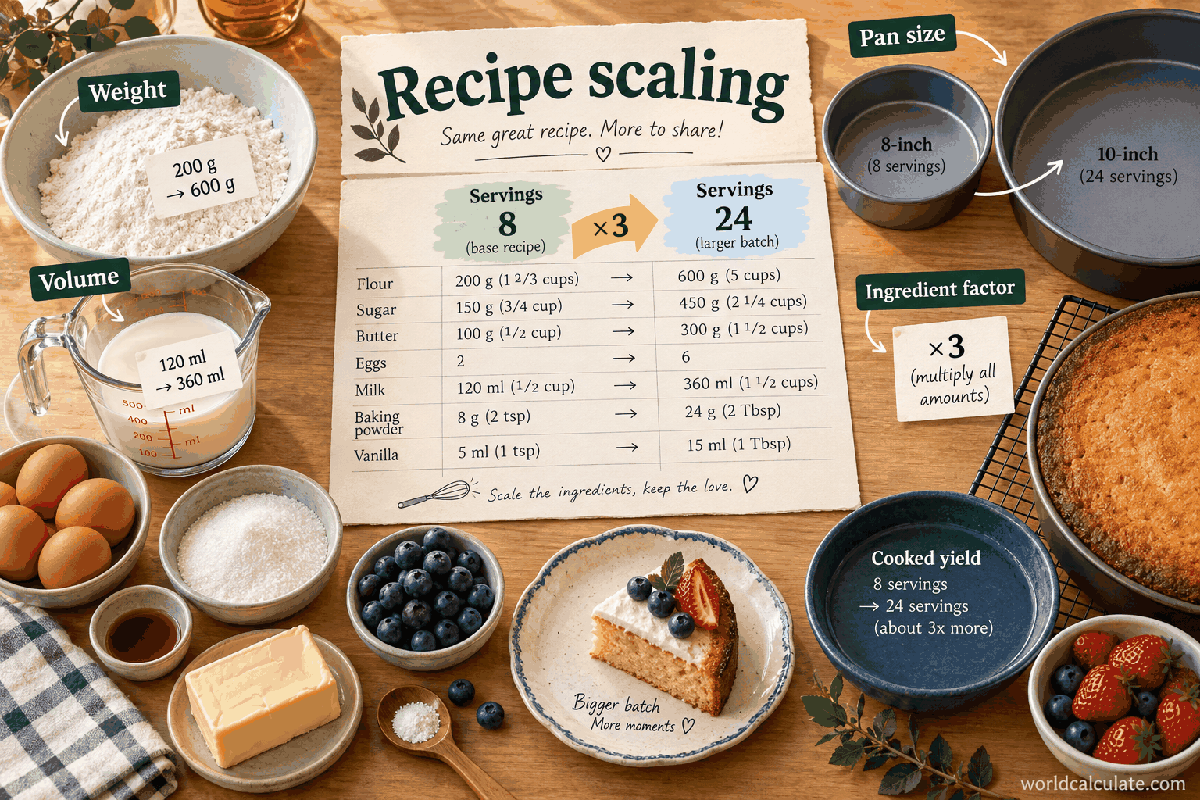
Recipe scaling uses a serving ratio, then keeps the ingredient unit visible. Cooking chemistry, pan size, heat, texture, and safety can require adjustments beyond linear arithmetic.
Scaling a recipe is a familiar applied ratio problem. The useful calculation is the transparent factor; the cooking result still depends on the ingredient and method.
Research and review
Researched by Hassan ALRowaie, Founder and editorial researcher at WorldCalculate.
This guide follows the live calculator's declared inputs, formula, worked example, assumptions, validation boundaries, and source-backed methodology. The review date describes editorial review of the calculator explanation; it is not a promise that external facts or rates remain current.
Pizza timing is a heat-transfer problem with a kitchen result at the end. WorldCalculate uses a visible thickness-and-surface model to compare scenarios, while making clear that one equation cannot calibrate every oven, dough, topping, or preference.
The page estimates the time needed for a pizza of a chosen thickness under a selected oven and surface scenario. It solves an equation with a time term and a square-root-of-time term.
This is more transparent than a single universal minute value, but it is still a model. Use the result to choose a first check time, not to stop watching the pizza.
A thicker pizza has more material to heat and more water to move through the crust. The model therefore increases its heat-demand term with thickness.
Measure the baked or planned dough thickness consistently. A very thin stretched center and a thick rim are not represented by one perfect number.
Brick or stone and steel transfer heat differently at the base. The presets use different model coefficients and reference temperatures so the chosen surface affects the result.
The presets do not inspect a stone’s actual temperature or a steel’s heat storage. Preheating and recovery are practical variables outside the equation.
Wet toppings can require more energy and time to heat and evaporate water. The topping-water allowance is an editable scenario, not a database of every vegetable, sauce, or cheese.
Use a higher value for a visibly wet load only as a comparison and adjust from the first bake. Do not use the field to claim a precise moisture measurement.
Let x be the square root of time. The equation becomes a quadratic in x: a₁x² + a₂x − demand = 0. The handler keeps the positive root and squares it to recover minutes.
This structure makes the arithmetic inspectable and avoids an iterative black box for the bounded inputs accepted by the form.
For 0.5 cm thickness, a 330 °C oven, a brick deck, and a 10% topping-water allowance, the demand term is about 0.53 in the model units.
The positive root produces a time close to 2.1 minutes. Start checking before the displayed endpoint if your oven runs hot or the dough is especially thin.
Record the thickness, surface, oven setting, preheat time, toppings, and observed base and top color. Change one assumption in the next run rather than changing everything at once.
A model becomes more useful when the visitor knows which local conditions make it run early or late.
Does the result guarantee a perfect pizza? No. It is a physics-based starting estimate and does not measure the oven or the dough.
Why can a wetter pizza need more time? More water and a different topping distribution can increase the heat demand and delay the target state in this simplified model.
Estimate pizza bake time from dough thickness, oven temperature, baking surface, and a transparent topping-water allowance.
Solve a₁t + a₂√t = thickness × (1 + 0.6 × topping-water percentage/100) × reference surface temperature ÷ oven temperature; brick uses a₁=0.02, a₂=0.30, reference=330 °C and steel uses a₁=0.035, a₂=0.42, reference=230 °C. Pizza heating combines a term that grows with time and a term that grows with the square root of time. This page solves a bounded, calibrated scenario so thickness, oven setting, surface model, and wetter toppings remain visible instead of returning a hidden lookup-table number.
Enter Pizza thickness, Oven temperature, Baking surface model, Topping-water allowance, then choose Calculate.
The pizza is represented by a single thickness and a representative topping-water allowance. The coefficients are illustrative model parameters tied to the selected surface preset, not a measurement of the visitor's oven. The oven and baking surface are preheated and the pizza is placed into the stated thermal environment. The model ignores oven recovery, airflow, dough hydration details, topping mass distribution, and local browning preferences. The reference temperatures are scenario anchors for the selected deck model, not a universal recommendation for every oven. The output is a starting bake-time estimate and should be checked against the actual crust, base, and topping result. Food safety, ingredient quality, and doneness still require normal kitchen judgment.
This calculator is part of the WorldCalculate library. Its formula, example, assumptions, input bounds, and output formatting follow the official methodology.
These WorldCalculate collections connect this tool with related questions while keeping each calculation separate and transparent.