
Goal
Estimate caffeine, added sugar, milk, creamer, and total drink calories from a coffee recipe using visitor-supplied label values.
Worldwide context
Saved once here, used across the site.
Currency changes display only. Country selection guides tax input; no tax rate is guessed.
Estimate caffeine, added sugar, milk, creamer, and total drink calories from a coffee recipe using visitor-supplied label values.
Total caffeine = cups × caffeine per cup; total sugar = cups × sugar per cup; milk calories = cups × milk mL per cup × milk kcal per 100 mL ÷ 100; total drink calories = cups × base coffee calories + milk calories + cups × creamer calories + total sugar × sugar calories per gram.A clearer path to an answer
This page keeps the calculation transparent: define the goal, enter the matching values, inspect the method, and decide what the result means in your situation.
Estimate caffeine, added sugar, milk, creamer, and total drink calories from a coffee recipe using visitor-supplied label values.
Cups per day · Caffeine per cup · Added sugar per cup · Milk per cup · Milk calories per 100 mL · Creamer calories per cup · Sugar calories per gram · Coffee calories before add-ons · Daily caffeine comparison limit
Total caffeine = cups × caffeine per cup; total sugar = cups × sugar per cup; milk calories = cups × milk mL per cup × milk kcal per 100 mL ÷ 100; total drink calories = cups × base coffee calories + milk calories + cups × creamer calories + total sugar × sugar calories per gram.
Calculate, review the assumptions below, then compare a related tool when the decision needs more context.
Estimate caffeine, added sugar, milk, creamer, and total drink calories from a coffee recipe using visitor-supplied label values.
Open the Coffee Add-On Nutrition Scenario Calculator pageMore food tools
Download PDFDownload Word (.doc)
Enter your values above and choose Calculate to see the result here.
Calculation map
Total caffeine = cups × caffeine per cup; total sugar = cups × sugar per cup; milk calories = cups × milk mL per cup × milk kcal per 100 mL ÷ 100; total drink calories = cups × base coffee calories + milk calories + cups × creamer calories + total sugar × sugar calories per gram.
Bounded, transparent calculation
Your recent runs stay in this browser session only.
Formula: Total caffeine = cups × caffeine per cup; total sugar = cups × sugar per cup; milk calories = cups × milk mL per cup × milk kcal per 100 mL ÷ 100; total drink calories = cups × base coffee calories + milk calories + cups × creamer calories + total sugar × sugar calories per gram.
The word healthy should not hide a score or a universal rule. This calculator instead separates the measurable parts of a coffee recipe, allowing a visitor to compare a label or home recipe without turning the output into medical advice.
Worked example: Three cups contain 285 mg caffeine and 24 g added sugar; the modeled drink total is 177 kcal, leaving 115 mg against the entered caffeine comparison limit.
The displayed limits are checked before the handler runs. Model-specific domain checks may also reject impossible or non-finite inputs.
Methodology: This calculator follows the WorldCalculate input, formula, precision, and boundary policy. Read the official methodology.
Calculator usage statistics
This section counts anonymous successful Calculate submissions, not unique visitors. Counts and top tools appear only when trusted aggregate data is available; country analysis is shown only under the same condition and reporting threshold.
Answer-first guide
Estimate caffeine, added sugar, milk, creamer, and total drink calories from a coffee recipe using visitor-supplied label values. Start with one clearly defined goal, enter values in the units shown, and keep the result attached to the assumptions below.
This tool is useful when your question includes healthy coffee calculator, coffee calories calculator, coffee sugar calculator. It returns the outputs declared in the calculator contract rather than a live quote, approval, diagnosis, or professional sign-off.
Cups per day · Caffeine per cup · Added sugar per cup · Milk per cup · Milk calories per 100 mL · Creamer calories per cup · Sugar calories per gram · Coffee calories before add-ons · Daily caffeine comparison limit. Keep the same time period, unit system, and currency wherever the form requires comparable values.
Run the worked example first, compare its output with the page's example, then change one input at a time. This makes an unexpected result easier to trace to a unit, boundary, or assumption.
Need a wider view? Browse Food & Recipe Calculators or compare the related tools below. The WorldCalculate methodology explains how formulas, examples, limits, and revisions are reviewed.
Total caffeine = cups × caffeine per cup; total sugar = cups × sugar per cup; milk calories = cups × milk mL per cup × milk kcal per 100 mL ÷ 100; total drink calories = cups × base coffee calories + milk calories + cups × creamer calories + total sugar × sugar calories per gram.
The word healthy should not hide a score or a universal rule. This calculator instead separates the measurable parts of a coffee recipe, allowing a visitor to compare a label or home recipe without turning the output into medical advice.
Three cups contain 285 mg caffeine and 24 g added sugar; the modeled drink total is 177 kcal, leaving 115 mg against the entered caffeine comparison limit.
Context and background
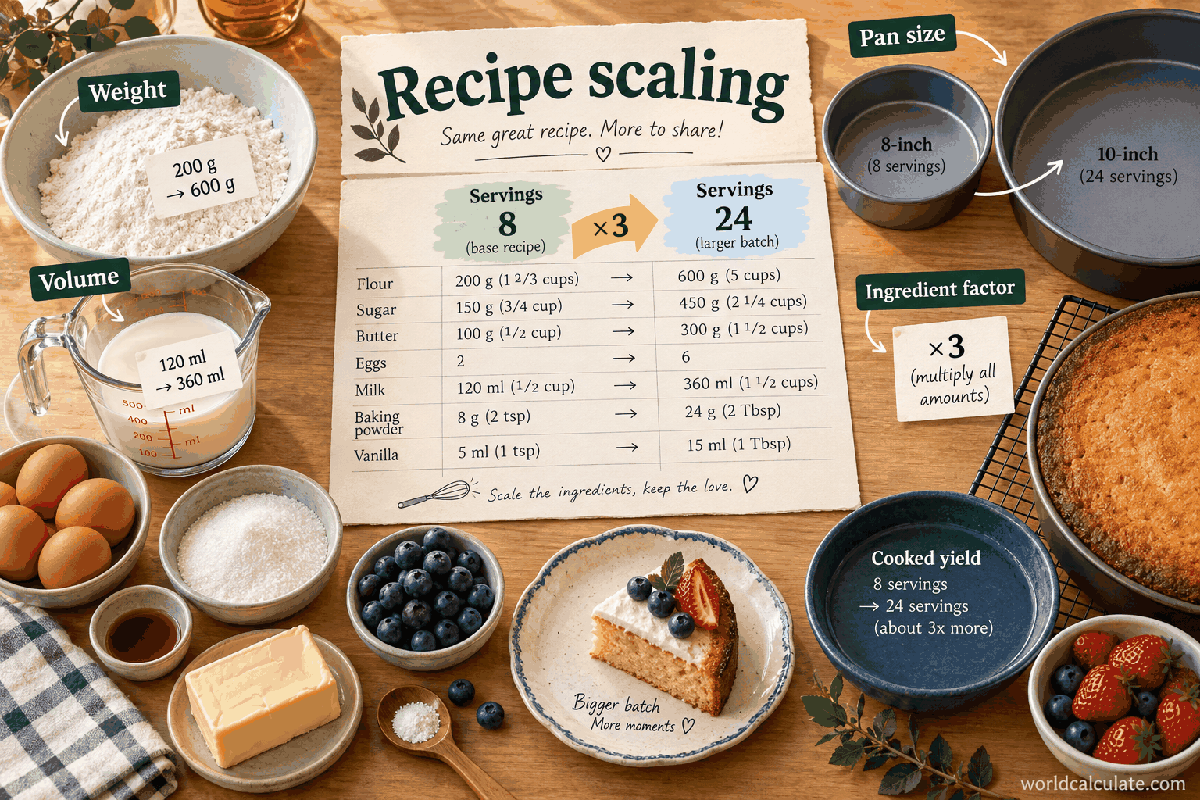
Recipe scaling uses a serving ratio, then keeps the ingredient unit visible. Cooking chemistry, pan size, heat, texture, and safety can require adjustments beyond linear arithmetic.
Scaling a recipe is a familiar applied ratio problem. The useful calculation is the transparent factor; the cooking result still depends on the ingredient and method.
Research and review
Researched by Hassan ALRowaie, Founder and editorial researcher at WorldCalculate.
This guide follows the live calculator's declared inputs, formula, worked example, assumptions, validation boundaries, and source-backed methodology. The review date describes editorial review of the calculator explanation; it is not a promise that external facts or rates remain current.
A coffee habit can change through caffeine, sugar, milk, creamer, serving size, or all of them at once. This worksheet keeps those contributions separate so a visitor can compare a recipe without receiving a vague healthy or unhealthy score.
Start with the cup size and label values for the coffee, milk, creamer, and sweetener in the recipe. The same word such as cup or spoon can describe very different amounts in different kitchens.
If the drink is bought from a café, use its published nutrition information when available and write down whether the number is for the whole drink or one serving.
Caffeine total is cups multiplied by caffeine per cup. It is deliberately not converted into a calorie value, because stimulation and energy content are different measurements.
The comparison margin uses the entered daily limit only as a visible scenario. It does not evaluate symptoms, medication, age, pregnancy, or personal risk.
If each cup contains the same amount of added sugar, multiplying by the number of cups gives the daily recipe total. A syrup label may express its serving differently, so convert the label to the selected per-cup unit first.
A visitor can enter zero for unsweetened coffee, but the result should still retain the actual milk, creamer, and base coffee values.
Milk is modeled from volume and calories per 100 mL. Creamer is modeled as a direct calorie amount per cup because different products can use different serving densities and portions.
Keeping them separate prevents a visitor from accidentally applying a milk label to a concentrated creamer or a powdered product.
Three cups at 95 mg caffeine and 8 g sugar per cup give 285 mg caffeine and 24 g sugar. Thirty millilitres of 50 kcal-per-100 mL milk contributes 45 kcal across the three cups.
Adding 30 kcal of creamer, 96 kcal from sugar, and 6 kcal of base coffee gives 177 modeled kcal. The page shows each part so the total can be checked.
Product labels are the best starting point for a branded drink. A food-composition database can help with generic ingredients, but the visitor should preserve the food description, serving basis, and date alongside the result.
Do not combine values from different serving sizes without converting them first.
A single score would hide important context. The same coffee may be reasonable in one person’s plan and unsuitable in another because caffeine, sugar, total energy, and medical circumstances are not one variable.
This page reports arithmetic and invites comparison; it does not prescribe a diet or diagnose a problem.
Can I use tea or an energy drink? Yes, if the fields are relabeled in your notes and the entered values match that drink; the formula is not limited to coffee chemistry.
Does black coffee always have zero calories? No. Use the label or a documented database value rather than assuming zero.
Estimate caffeine, added sugar, milk, creamer, and total drink calories from a coffee recipe using visitor-supplied label values.
Total caffeine = cups × caffeine per cup; total sugar = cups × sugar per cup; milk calories = cups × milk mL per cup × milk kcal per 100 mL ÷ 100; total drink calories = cups × base coffee calories + milk calories + cups × creamer calories + total sugar × sugar calories per gram. The word healthy should not hide a score or a universal rule. This calculator instead separates the measurable parts of a coffee recipe, allowing a visitor to compare a label or home recipe without turning the output into medical advice.
Enter Cups per day, Caffeine per cup, Added sugar per cup, Milk per cup, Milk calories per 100 mL, Creamer calories per cup, Sugar calories per gram, Coffee calories before add-ons, Daily caffeine comparison limit, then choose Calculate.
Every per-cup value is applied to the entered number of cups. Caffeine and calorie values should come from the actual product label or a documented recipe. Milk calories use the entered value per 100 mL and assume the entered volume is consumed. Sugar calories use a visitor-entered energy factor so a different label convention can be documented. The page does not estimate protein, fat, micronutrients, glycemic response, or the effect of coffee preparation on health. The daily caffeine field is a comparison limit, not a personal medical recommendation. Black coffee can still have a product-specific calorie and caffeine value; do not assume zero unless the label supports it.
This calculator is part of the WorldCalculate library. Its formula, example, assumptions, input bounds, and output formatting follow the official methodology.
These WorldCalculate collections connect this tool with related questions while keeping each calculation separate and transparent.