
Goal
Balance an annual plastic input against recycled, incinerated, landfilled, and leaked flows, then show recycling, leakage, and unaccounted shares.
Worldwide context
Saved once here, used across the site.
Currency changes display only. Country selection guides tax input; no tax rate is guessed.
Balance an annual plastic input against recycled, incinerated, landfilled, and leaked flows, then show recycling, leakage, and unaccounted shares.
Accounted flow = recycled + incinerated + landfilled + leaked; unaccounted balance = annual input − accounted flow; each flow rate = flow ÷ annual input × 100.A clearer path to an answer
This page keeps the calculation transparent: define the goal, enter the matching values, inspect the method, and decide what the result means in your situation.
Balance an annual plastic input against recycled, incinerated, landfilled, and leaked flows, then show recycling, leakage, and unaccounted shares.
Annual plastic input · Recycled flow · Incinerated flow · Landfilled flow · Leaked or mismanaged flow
Accounted flow = recycled + incinerated + landfilled + leaked; unaccounted balance = annual input − accounted flow; each flow rate = flow ÷ annual input × 100.
Calculate, review the assumptions below, then compare a related tool when the decision needs more context.
Balance an annual plastic input against recycled, incinerated, landfilled, and leaked flows, then show recycling, leakage, and unaccounted shares.
Open the Plastic Flow Mass-Balance Calculator pageMore ecology tools
Download PDFDownload Word (.doc)
Enter your values above and choose Calculate to see the result here.
Calculation map
Accounted flow = recycled + incinerated + landfilled + leaked; unaccounted balance = annual input − accounted flow; each flow rate = flow ÷ annual input × 100.
Bounded, transparent calculation
Your recent runs stay in this browser session only.
Formula: Accounted flow = recycled + incinerated + landfilled + leaked; unaccounted balance = annual input − accounted flow; each flow rate = flow ÷ annual input × 100.
A policy or research discussion needs a clear system boundary before it needs a percentage. This worksheet starts with one annual input and assigns reported mass to four named outcomes. It flags impossible totals, reports the remaining balance, and makes recycling and leakage rates comparable to the same input rather than mixing denominators.
Worked example: The listed flows account for 95,000 tonnes, leaving 5,000 tonnes unaccounted; recycling is 30% and leakage is 5% of input.
The displayed limits are checked before the handler runs. Model-specific domain checks may also reject impossible or non-finite inputs.
Methodology: This calculator follows the WorldCalculate input, formula, precision, and boundary policy. Read the official methodology.
Calculator usage statistics
This section counts anonymous successful Calculate submissions, not unique visitors. Counts and top tools appear only when trusted aggregate data is available; country analysis is shown only under the same condition and reporting threshold.
Answer-first guide
Balance an annual plastic input against recycled, incinerated, landfilled, and leaked flows, then show recycling, leakage, and unaccounted shares. Start with one clearly defined goal, enter values in the units shown, and keep the result attached to the assumptions below.
This tool is useful when your question includes plastic flow calculator, plastic recycling rate, plastic leakage rate. It returns the outputs declared in the calculator contract rather than a live quote, approval, diagnosis, or professional sign-off.
Annual plastic input · Recycled flow · Incinerated flow · Landfilled flow · Leaked or mismanaged flow. Keep the same time period, unit system, and currency wherever the form requires comparable values.
Run the worked example first, compare its output with the page's example, then change one input at a time. This makes an unexpected result easier to trace to a unit, boundary, or assumption.
Need a wider view? Browse Ecology & Sustainability Calculators or compare the related tools below. The WorldCalculate methodology explains how formulas, examples, limits, and revisions are reviewed.
Accounted flow = recycled + incinerated + landfilled + leaked; unaccounted balance = annual input − accounted flow; each flow rate = flow ÷ annual input × 100.
A policy or research discussion needs a clear system boundary before it needs a percentage. This worksheet starts with one annual input and assigns reported mass to four named outcomes. It flags impossible totals, reports the remaining balance, and makes recycling and leakage rates comparable to the same input rather than mixing denominators.
The listed flows account for 95,000 tonnes, leaving 5,000 tonnes unaccounted; recycling is 30% and leakage is 5% of input.
Context and background
Ecology and sustainability scenarios depend on geography, technology, lifecycle boundary, season, measurement method, and the factor supplied by the visitor.
Environmental analysis became more actionable as systems were described by flows, stocks, boundaries, and time periods. A transparent scenario is more useful than a universal-looking number with hidden assumptions.
Research and review
Researched by Hassan ALRowaie, Founder and editorial researcher at WorldCalculate.
This guide follows the live calculator's declared inputs, formula, worked example, assumptions, validation boundaries, and source-backed methodology. The review date describes editorial review of the calculator explanation; it is not a promise that external facts or rates remain current.
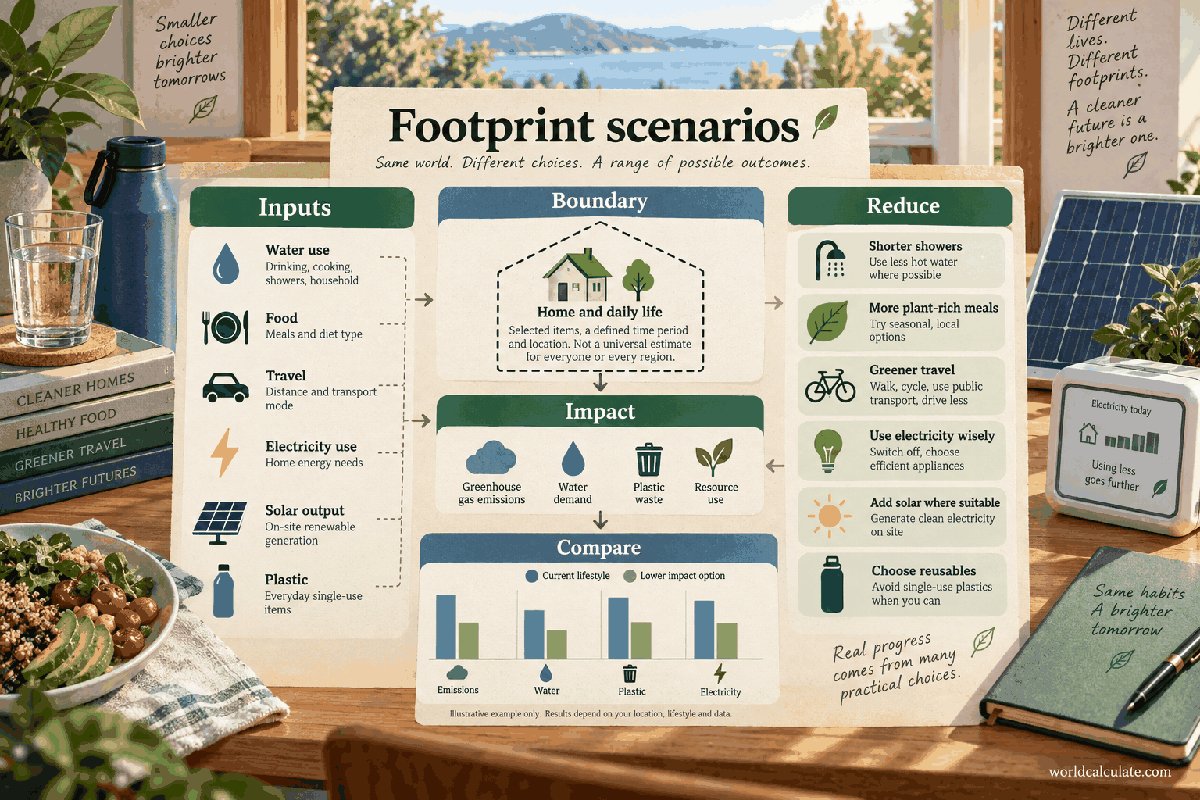
Plastic statistics often look precise while combining different denominators, years, and system boundaries. A mass balance is a useful first discipline: start with a defined annual input, assign reported flows, and keep the remainder visible. This calculator is a worksheet for that accounting step, not a claim that one simple balance captures every legal or policy definition.
The central question is where an annual mass goes after it enters the defined system. The page asks for one input and four outcome flows: recycled, incinerated, landfilled, and leaked or mismanaged. Adding the four produces the accounted flow. Subtracting that from the input produces the unaccounted balance.
That remainder is deliberately not labeled as leakage. A gap may represent exports, stock changes, unmeasured informal activity, data errors, or a category left out of the worksheet. Keeping it visible is more useful than silently assigning every tonne to the most alarming category.
A recycling percentage can be calculated against plastic placed on the market, plastic waste generated, collected waste, or another denominator. Those percentages answer different questions. This page labels its denominator as the annual plastic input and uses it consistently for recycling, leakage, and total accounted shares.
When comparing the result with a report, copy the report’s definition into the project notes. If the report uses post-consumer waste and the calculator uses total production, the numbers should not be presented as a direct comparison. The arithmetic may be correct in both places while the interpretation is not.
Define the geography, year, material scope, and life-cycle stage before entering numbers. A city boundary, a national economy, and a global supply chain will have different imports, exports, and stock changes. Likewise, packaging only and all plastic products are not interchangeable scopes.
A good worksheet record names the input source, flow definitions, time period, and whether the values are measured, modeled, or estimated. The calculator cannot infer those choices from tonnes alone. It can, however, prevent the listed flows from exceeding the selected input and make a missing balance obvious.
If the input is 100,000 tonnes and the listed outputs total 95,000, the remaining 5,000 tonnes is an accounting balance. It is a prompt for investigation. It is not proof that 5% leaked into the environment. The same remainder can arise from an omitted export or a stock change in a material-use inventory.
If the listed outputs exceed the input, the worksheet stops with an error. That does not prove the source data are wrong; it means they cannot coexist under the current boundary without overlap, different years, conversion problems, or a missing input. Resolve that issue before reporting percentages.
The recycling rate shown here is recycled mass divided by input mass. It does not distinguish collection, sorting, reprocessing, product substitution, yield loss, or the quality and destination of the recycled material. A high rate in this worksheet does not automatically mean high circularity or low environmental impact.
Use the rate as a transparent starting metric. If the source defines mechanical recycling, chemical recycling, reuse, or recovery differently, preserve those categories instead of collapsing them without explanation. Separate outputs are often more informative than a single headline percentage.
The leakage field is an entered flow, not a value guessed by the calculator. It can represent the specific category used by the source, such as unmanaged disposal or environmental release, but the definition must be documented. Do not combine a modeled river-emission estimate with a measured litter count if they overlap.
A leakage rate is sensitive to the input denominator. It is also sensitive to the geographic boundary: material may leave one boundary and appear in another. Report the unit, time period, and boundary beside the percentage so a reader does not mistake it for a universal global rate.
Because the tool is fast, it is useful for scenarios. Change only the recycling flow and keep the other inputs fixed to see how the balance changes. Then test a lower-bound and upper-bound input if the source provides a range. The output table shows whether an apparent improvement simply moved mass into an unaccounted category.
Avoid displaying more decimal places than the source supports. A modeled estimate rounded to the nearest thousand tonnes should not be presented as though the final percentage were measured to six decimal places. Precision in the interface cannot create precision in the data.
Before publishing a balance, record the input definition, outcome definitions, units, year, geography, conversion factors, and treatment of stock changes and exports. Confirm that the flow categories are mutually exclusive. Recalculate the sum independently and explain any residual.
Then distinguish the arithmetic result from the policy judgment. This page can say that 30% of the entered input is assigned to the recycling flow. It cannot say that a country complies with a treaty or that a policy is effective without the relevant legal definitions, baselines, and evidence.
Balance an annual plastic input against recycled, incinerated, landfilled, and leaked flows, then show recycling, leakage, and unaccounted shares.
Accounted flow = recycled + incinerated + landfilled + leaked; unaccounted balance = annual input − accounted flow; each flow rate = flow ÷ annual input × 100. A policy or research discussion needs a clear system boundary before it needs a percentage. This worksheet starts with one annual input and assigns reported mass to four named outcomes. It flags impossible totals, reports the remaining balance, and makes recycling and leakage rates comparable to the same input rather than mixing denominators.
Enter Annual plastic input, Recycled flow, Incinerated flow, Landfilled flow, Leaked or mismanaged flow, then choose Calculate.
All flows use the same mass unit, time period, geography, and system boundary. The four listed outputs are mutually exclusive for this worksheet; double counting must be removed before entry. An unaccounted balance is not automatically leakage; it may represent stock change, exports, data gaps, or another omitted flow. Incineration is reported as a flow category and is not treated as recycling or material recovery. A recycling rate is calculated against the annual input supplied by the user, not against a different waste denominator. The page does not assess treaty compliance, national policy performance, or legal definitions.
This calculator is part of the WorldCalculate library. Its formula, example, assumptions, input bounds, and output formatting follow the official methodology.
These WorldCalculate collections connect this tool with related questions while keeping each calculation separate and transparent.