
Goal
Calculate kinetic energy from mass and speed as a fraction of the speed of light using the Lorentz factor.
Worldwide context
Saved once here, used across the site.
Currency changes display only. Country selection guides tax input; no tax rate is guessed.
Calculate kinetic energy from mass and speed as a fraction of the speed of light using the Lorentz factor.
Relativistic kinetic energy KE = (gamma - 1) m c^2, where gamma = 1 / sqrt(1 - beta^2), beta is speed divided by c, and c = 299792458 m/s.A clearer path to an answer
This page keeps the calculation transparent: define the goal, enter the matching values, inspect the method, and decide what the result means in your situation.
Calculate kinetic energy from mass and speed as a fraction of the speed of light using the Lorentz factor.
Mass · Speed as a fraction of c
Relativistic kinetic energy KE = (gamma - 1) m c^2, where gamma = 1 / sqrt(1 - beta^2), beta is speed divided by c, and c = 299792458 m/s.
Calculate, review the assumptions below, then compare a related tool when the decision needs more context.
Calculate kinetic energy from mass and speed as a fraction of the speed of light using the Lorentz factor.
Open the Relativistic Kinetic Energy pageMore science tools
Download PDFDownload Word (.doc)
Enter your values above and choose Calculate to see the result here.
Calculation map
Relativistic kinetic energy KE = (gamma - 1) m c^2, where gamma = 1 / sqrt(1 - beta^2), beta is speed divided by c, and c = 299792458 m/s.
Bounded, transparent calculation
Your recent runs stay in this browser session only.
Formula: Relativistic kinetic energy KE = (gamma - 1) m c^2, where gamma = 1 / sqrt(1 - beta^2), beta is speed divided by c, and c = 299792458 m/s.
This calculator uses the special-relativistic Lorentz factor to calculate kinetic energy from invariant rest mass and a subluminal speed fraction. It returns joules and exajoules and does not model acceleration, radiation, collisions, or propulsion.
Worked example: A 1 kg mass at 0.6c has relativistic kinetic energy of about 2.2468879468e16 J.
The displayed limits are checked before the handler runs. Model-specific domain checks may also reject impossible or non-finite inputs.
Methodology: This calculator follows the WorldCalculate input, formula, precision, and boundary policy. Read the official methodology.
Calculator usage statistics
This section counts anonymous successful Calculate submissions, not unique visitors. Counts and top tools appear only when trusted aggregate data is available; country analysis is shown only under the same condition and reporting threshold.
Answer-first guide
Calculate kinetic energy from mass and speed as a fraction of the speed of light using the Lorentz factor. Start with one clearly defined goal, enter values in the units shown, and keep the result attached to the assumptions below.
This tool is useful when your question includes relativistic kinetic energy, lorentz factor, gamma factor. It returns the outputs declared in the calculator contract rather than a live quote, approval, diagnosis, or professional sign-off.
Mass · Speed as a fraction of c. Keep the same time period, unit system, and currency wherever the form requires comparable values.
Run the worked example first, compare its output with the page's example, then change one input at a time. This makes an unexpected result easier to trace to a unit, boundary, or assumption.
Need a wider view? Browse Science Calculators or compare the related tools below. The WorldCalculate methodology explains how formulas, examples, limits, and revisions are reviewed.
Relativistic kinetic energy KE = (gamma - 1) m c^2, where gamma = 1 / sqrt(1 - beta^2), beta is speed divided by c, and c = 299792458 m/s.
This calculator uses the special-relativistic Lorentz factor to calculate kinetic energy from invariant rest mass and a subluminal speed fraction. It returns joules and exajoules and does not model acceleration, radiation, collisions, or propulsion.
A 1 kg mass at 0.6c has relativistic kinetic energy of about 2.2468879468e16 J.
Context and background
Science calculators define a system, choose an equation, apply units and constants, and show the substitution. Effects outside that model remain outside the result.
Introductory science problem solving builds from measured quantities and idealized relationships. Those models are valuable for learning and first-pass estimates, while experiments and engineering decisions need additional evidence.
Research and review
Researched by Hassan ALRowaie, Founder and editorial researcher at WorldCalculate.
This guide follows the live calculator's declared inputs, formula, worked example, assumptions, validation boundaries, and source-backed methodology. The review date describes editorial review of the calculator explanation; it is not a promise that external facts or rates remain current.
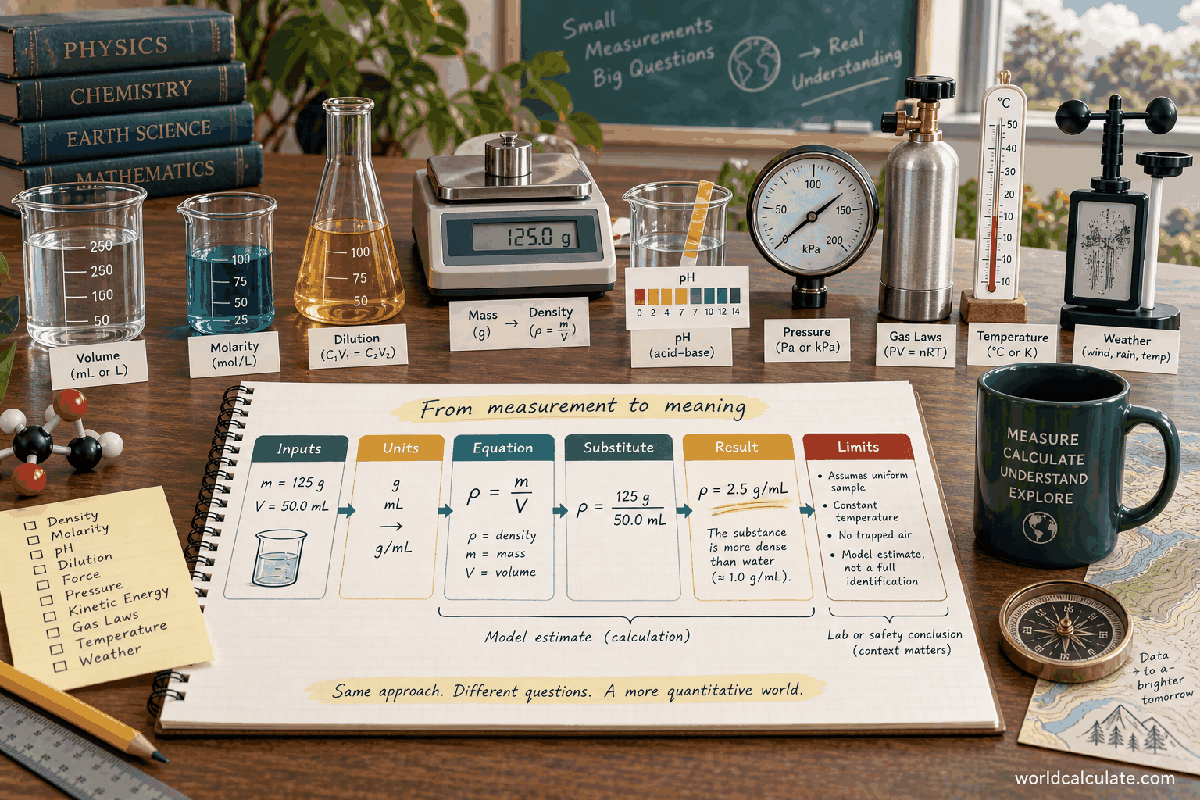
Classical kinetic energy is often written as one half of mass times speed squared, but that approximation becomes inadequate as speed approaches the speed of light. This calculator uses the special-relativistic expression KE = (gamma - 1)mc^2. It accepts invariant rest mass in kilograms and speed as a fraction of c, then reports kinetic energy in joules and exajoules. The result is an ideal inertial-model calculation, not a propulsion estimate, collision forecast, radiation budget, or equipment recommendation. The sections below explain beta, gamma, the formula, examples, limits, numerical behavior, units, comparisons, and the boundary of the model.
The page answers a specific energy question: what kinetic-energy value follows from an entered invariant rest mass and a supplied speed fraction below c? The handler converts the fraction into beta, computes the Lorentz factor, subtracts one from gamma, and multiplies by mc squared. It does not measure the object, choose a reference frame from an experiment, reconstruct how the object was accelerated, or identify a force. Those choices are part of the physical setup outside the two fields.
The result describes motion energy in the special-relativistic inertial model. It does not include rest energy as a second displayed result, even though rest energy appears inside the formula used to scale kinetic energy. This separation helps distinguish the energy due to motion from the energy associated with mass itself. A visitor should not add the output to a practical fuel or battery estimate without defining the system, frame, transfer process, and losses that the page intentionally omits.
The symbol beta represents speed divided by the speed of light. This page asks for beta directly as speedFraction, so a value of 0.6 means a speed equal to sixty percent of c. The field is dimensionless even though its unit display is c to remind the visitor what the fraction references. A value of zero means no motion in the selected inertial frame, while a positive value approaches but never reaches one under the supported contract.
Using a fraction keeps the input contract stable and makes the relativistic boundary visible. The handler does not ask for metres per second and then silently divide by a constant. Instead, the visitor enters the ratio that appears naturally in the Lorentz expression. If a source gives a speed in metres per second, the source value must be divided by the exact c value before entry. The calculator does not parse unit text or decide whether a source speed is measured consistently.
The Lorentz factor is gamma = 1 divided by the square root of 1 minus beta squared. At beta equal to zero, gamma is one. As beta increases, the denominator becomes smaller and gamma grows. The kinetic-energy formula uses gamma minus one, so the energy is zero at rest and rises increasingly quickly near the light-speed boundary. This nonlinear growth is the central difference between the relativistic expression and a low-speed approximation.
Gamma is dimensionless. It is not a speed, an energy, a force, or a percentage. It is a factor that relates quantities in different inertial descriptions and appears in several special-relativity equations. Here it is used only to obtain kinetic energy. The page does not calculate time dilation, length contraction, momentum, or velocity transformation from gamma, even though those topics share the same physical framework.
The catalog example uses mass 1 kg and beta 0.6. The Lorentz factor is 1 divided by the square root of 1 minus 0.6 squared, which gives 1.25. Therefore gamma minus one is 0.25. Multiplying 0.25 by 1 kg and c squared gives approximately 2.2468879468 x 10^16 joules. The calculator also divides this result by 10^18 to provide the same energy in exajoules.
The example is an algebra and scale check. It does not claim that a one-kilogram object can be accelerated to 0.6c, that a particular accelerator can supply the energy, or that the energy can be recovered without losses. A clear report preserves the mass, beta, gamma, c value, and formula. It should also say that the displayed energy is kinetic energy in the chosen ideal inertial model, not the total rest-plus-kinetic energy of a practical system.
At speeds much smaller than c, the relativistic expression approaches the familiar classical result one half m v squared. This limiting behavior is useful because it shows that classical mechanics is an approximation within a broader relation, not a separate arbitrary rule. The present calculator does not switch formulas at a threshold; it evaluates the relativistic expression for every permitted beta, including values close to zero. A small beta therefore produces a small kinetic energy consistent with the low-speed limit.
The approximation should not be reversed carelessly. Seeing agreement at a small speed does not prove that the classical formula remains accurate near c. The difference becomes significant as beta increases because gamma minus one is no longer well approximated by one half beta squared. Use the relativistic result when the speed fraction is part of the stated problem, and label any classical comparison as a separate approximation rather than replacing the page's contract.
As beta approaches one, the square root in the denominator of gamma approaches zero. Gamma therefore grows without reaching a finite value at exactly c for a massive object. The catalog stops at 0.999999 to keep the input strictly subluminal and the browser calculation bounded. Even before that endpoint, a small change in beta can produce a large change in gamma and kinetic energy. The sensitivity is a mathematical consequence of the denominator, not a measurement of an accelerator's performance.
The upper bound is not a practical recommendation or a claim that an object can be brought to the chosen fraction. It is a finite input boundary for a pure calculation. The handler checks the squared speed fraction, the Lorentz factor, and the derived energy for finite values. A future caller that passes one or a nonfinite number receives an error rather than an infinite or misleading result.
The mass field represents invariant rest mass. The kinetic-energy result is the motion-dependent part of the relativistic energy expression, obtained by subtracting rest energy mc squared from total energy gamma mc squared. This subtraction explains the gamma minus one term. At zero speed, total energy equals rest energy and kinetic energy is zero. As speed increases, total energy grows while the invariant rest mass remains the same in the contract.
This distinction matters when interpreting a very large number. The page does not return total energy, and it does not say that the mass has increased because the kinetic energy is large. Older language sometimes described relativistic mass, but this calculator keeps invariant mass and kinetic energy separate so the input label remains precise. If a problem asks for total relativistic energy, rest energy and kinetic energy must be identified and combined using the problem's stated frame and accounting convention.
The mass is in kilograms and c is in metres per second. The factor mc squared therefore has joule units, and gamma minus one is dimensionless. The direct result is displayed in joules. The exajoule row divides by 10^18, just as a length can be shown in metres or kilometres. It is the same energy, not a second physical calculation. Multiplying the exajoule value by 10^18 provides a useful reverse check apart from display rounding.
Power is not included because no duration is entered. If a visitor divides kinetic energy by a time from an external scenario, the resulting watts belong to that larger scenario and should be labeled with its assumptions. The calculator also does not convert energy into mass, momentum, temperature, or fuel quantity. Each conversion needs a separate physical contract and may require information absent from these two fields.
A zero mass returns zero kinetic energy for every permitted speed fraction because mass is a multiplicative factor. A positive mass at zero speed also returns zero because gamma equals one. These endpoints are useful contract tests, but they should not be stretched into statements about massless particles or arbitrary reference-frame transformations. The result follows the declared rest-mass and speed inputs, not every possible relativistic situation.
Negative mass, negative speed fraction in this magnitude calculator, a speed fraction at or above one, text, NaN, infinity, and values outside the field bounds are rejected. The visible form and the pure handler both protect the domain. Rejecting invalid input is important near the speed boundary because clipping 1.2 to 0.999999 would change the visitor's scenario and create a result that was never requested.
The expression contains a subtraction from one inside the square root and a second subtraction of one from gamma. Near zero, those operations can be sensitive to floating-point rounding, while near one the Lorentz factor can become large. The chosen bounds and finite-result checks keep the supported calculation within a predictable numeric range. The displayed result is formatted for reading, so a long decimal should not be mistaken for measurement precision or an exact physical observation.
When a high-speed result is copied into another calculation, retain the beta value and the unrounded result if possible. Round only at the presentation boundary. A comparison of two formatted strings can hide a meaningful difference, while a comparison of raw values preserves the mathematical relation. The page does not propagate uncertainty in mass or speed, estimate significant figures, or model error in a speed measurement.
Kinetic energy at a stated speed is not the same as the energy required by a real propulsion system. A propulsion calculation could involve acceleration profile, payload, propellant, exhaust, efficiency, gravity, drag, structural constraints, and a mission trajectory. None of those inputs exists here. The calculator takes the speed fraction as an already defined scenario value and evaluates the energy relation. It does not say how the speed was achieved or whether it can be maintained.
The same boundary applies to an accelerator or beam problem. A particle's kinetic energy may be one term in a larger energy budget, but the larger budget needs particle count, beam current, duty cycle, losses, and equipment data. Multiplying the single-particle result by an unentered count would create a new calculation with new assumptions. Keep this page's output labeled as per-entered-mass relativistic kinetic energy unless a separate reviewed model defines the aggregation.
A complete report should state the invariant mass, beta, the exact c convention, the Lorentz factor, the equation, and the output unit. It should say whether the result is kinetic energy for one object, one particle, or another explicitly defined mass. If the mass came from a measurement, preserve its uncertainty and reference frame outside the calculator. If the speed came from a source in metres per second, record the conversion to beta before presenting the result.
The report should also repeat the boundary: this is a special-relativistic inertial-model calculation. It does not assess acceleration, radiation, collisions, equipment, propulsion, mission feasibility, or safety. Such wording is not an apology for the formula. It is the information that prevents a correct energy number from being used as evidence for a different claim.
A useful comparison holds mass constant and changes beta. At low beta, the energy changes roughly with the square of speed, while at higher beta the gamma factor adds a stronger nonlinear effect. Another comparison holds beta constant and changes mass; the result then scales linearly. These comparisons are mathematical sensitivity checks. They do not establish that an object can independently change speed or mass without forces, energy input, and physical consequences outside the page.
Common mistakes include entering speed in metres per second even though the field expects a fraction, using total energy as if it were kinetic energy, and treating c as an attainable endpoint for a massive object. Another mistake is calling the result a power or a fuel requirement. Check the field units, compute beta explicitly, retain the gamma step, and keep the model boundary beside the final number.
Before using the result, verify that mass means invariant rest mass in kilograms and that speedFraction is a nonnegative fraction below one. Confirm the gamma formula, the gamma minus one term, the c squared factor, and the joule conversion. Check zero-mass and zero-speed cases when validating an implementation. Confirm that any exajoule value is only a scaled presentation and that the result remains tied to the selected inertial model.
Finally, ask whether the next question needs acceleration, momentum, total energy, radiation, a collision, or an engineering system. If it does, stop at this calculator's boundary and define that next model separately. The honest conclusion is that relativistic kinetic energy was evaluated for the entered mass and beta. No trajectory, device, recovery method, mission, or safety decision was produced.
Kinetic energy is frame-dependent, so a complete physical statement must identify the inertial frame in which the speed is defined. This page receives speedFraction as a value that already belongs to the selected frame. It does not ask the visitor to name that frame, compare two observers, or transform the speed from another coordinate system. Two observers can assign different kinetic energies to the same object while agreeing on its invariant rest mass. The formula is therefore exact only after the speed and frame convention have been established outside the field.
A measured speed also has an uncertainty and a method. Near c, a small uncertainty in beta can produce a larger uncertainty in gamma and kinetic energy because the relation is steep. The calculator reports the central entered value and does not propagate an interval. A careful scientific record should preserve the instrument, calibration, timing, frame, and uncertainty, then use a separate uncertainty analysis if the result supports a quantitative conclusion. Formatting more decimal places does not create more measurement information.
A moving object can be part of a larger energy account that includes rest energy, kinetic energy, internal energy, field energy, radiation, and energy exchanged with an environment. This page returns only the kinetic term for the entered invariant mass and speed in the selected frame. It does not decide whether a source should include the object's rest energy, whether a container is part of the system, or how energy crosses the system boundary. Those choices must be explicit before comparing an input and output state.
The distinction is especially important when a result is multiplied by a count or placed in a power budget. A beam, stream, or collection of particles needs a defined number, timing, distribution, and interaction model. Multiplying one result by an unentered count is not a hidden feature of this calculator. Likewise, dividing the result by a guessed duration does not create a validated power estimate. Use the page as one reproducible energy term, then define aggregation and transfer assumptions in a separate reviewed calculation. Keep the frame and system boundary with the final figure.
Calculate kinetic energy from mass and speed as a fraction of the speed of light using the Lorentz factor.
Relativistic kinetic energy KE = (gamma - 1) m c^2, where gamma = 1 / sqrt(1 - beta^2), beta is speed divided by c, and c = 299792458 m/s. This calculator uses the special-relativistic Lorentz factor to calculate kinetic energy from invariant rest mass and a subluminal speed fraction. It returns joules and exajoules and does not model acceleration, radiation, collisions, or propulsion.
Enter Mass, Speed as a fraction of c, then choose Calculate.
Mass is a finite nonnegative invariant rest mass in kilograms, and speedFraction is a finite nonnegative ratio below one. The motion is represented by one speed magnitude in an inertial special-relativity model; beta is speed divided by the exact vacuum speed of light. The result is kinetic energy only. Acceleration history, radiation, collisions, fields, energy recovery, and equipment or mission advice are outside the calculation.
This calculator is part of the WorldCalculate library. Its formula, example, assumptions, input bounds, and output formatting follow the official methodology.
These WorldCalculate collections connect this tool with related questions while keeping each calculation separate and transparent.