
Goal
Calculate the rest energy represented by a mass using the special-relativity equivalence E0 = mc^2.
Worldwide context
Saved once here, used across the site.
Currency changes display only. Country selection guides tax input; no tax rate is guessed.
Calculate the rest energy represented by a mass using the special-relativity equivalence E0 = mc^2.
Rest energy E0 = m c^2, where m is mass in kilograms and c = 299792458 m/s is the exact SI speed of light in vacuum.A clearer path to an answer
This page keeps the calculation transparent: define the goal, enter the matching values, inspect the method, and decide what the result means in your situation.
Calculate the rest energy represented by a mass using the special-relativity equivalence E0 = mc^2.
Mass
Rest energy E0 = m c^2, where m is mass in kilograms and c = 299792458 m/s is the exact SI speed of light in vacuum.
Calculate, review the assumptions below, then compare a related tool when the decision needs more context.
Calculate the rest energy represented by a mass using the special-relativity equivalence E0 = mc^2.
Open the Mass-Energy Equivalence (E=mc^2) pageMore science tools
Download PDFDownload Word (.doc)
Enter your values above and choose Calculate to see the result here.
Calculation map
Rest energy E0 = m c^2, where m is mass in kilograms and c = 299792458 m/s is the exact SI speed of light in vacuum.
Bounded, transparent calculation
Your recent runs stay in this browser session only.
Formula: Rest energy E0 = m c^2, where m is mass in kilograms and c = 299792458 m/s is the exact SI speed of light in vacuum.
This calculator evaluates the rest-energy equivalence for an entered mass. It returns joules and exajoules as an ideal physical equivalence, not a prediction that the mass can be completely converted, stored, released, or safely used as energy.
Worked example: A mass of 0.001 kg has an ideal rest-energy equivalent of about 8.987551787e13 J.
The displayed limits are checked before the handler runs. Model-specific domain checks may also reject impossible or non-finite inputs.
Methodology: This calculator follows the WorldCalculate input, formula, precision, and boundary policy. Read the official methodology.
Calculator usage statistics
This section counts anonymous successful Calculate submissions, not unique visitors. Counts and top tools appear only when trusted aggregate data is available; country analysis is shown only under the same condition and reporting threshold.
Answer-first guide
Calculate the rest energy represented by a mass using the special-relativity equivalence E0 = mc^2. Start with one clearly defined goal, enter values in the units shown, and keep the result attached to the assumptions below.
This tool is useful when your question includes e=mc2, mass energy equivalence, rest energy. It returns the outputs declared in the calculator contract rather than a live quote, approval, diagnosis, or professional sign-off.
Mass. Keep the same time period, unit system, and currency wherever the form requires comparable values.
Run the worked example first, compare its output with the page's example, then change one input at a time. This makes an unexpected result easier to trace to a unit, boundary, or assumption.
Need a wider view? Browse Science Calculators or compare the related tools below. The WorldCalculate methodology explains how formulas, examples, limits, and revisions are reviewed.
Rest energy E0 = m c^2, where m is mass in kilograms and c = 299792458 m/s is the exact SI speed of light in vacuum.
This calculator evaluates the rest-energy equivalence for an entered mass. It returns joules and exajoules as an ideal physical equivalence, not a prediction that the mass can be completely converted, stored, released, or safely used as energy.
A mass of 0.001 kg has an ideal rest-energy equivalent of about 8.987551787e13 J.
Context and background
Science calculators define a system, choose an equation, apply units and constants, and show the substitution. Effects outside that model remain outside the result.
Introductory science problem solving builds from measured quantities and idealized relationships. Those models are valuable for learning and first-pass estimates, while experiments and engineering decisions need additional evidence.
Research and review
Researched by Hassan ALRowaie, Founder and editorial researcher at WorldCalculate.
This guide follows the live calculator's declared inputs, formula, worked example, assumptions, validation boundaries, and source-backed methodology. The review date describes editorial review of the calculator explanation; it is not a promise that external facts or rates remain current.
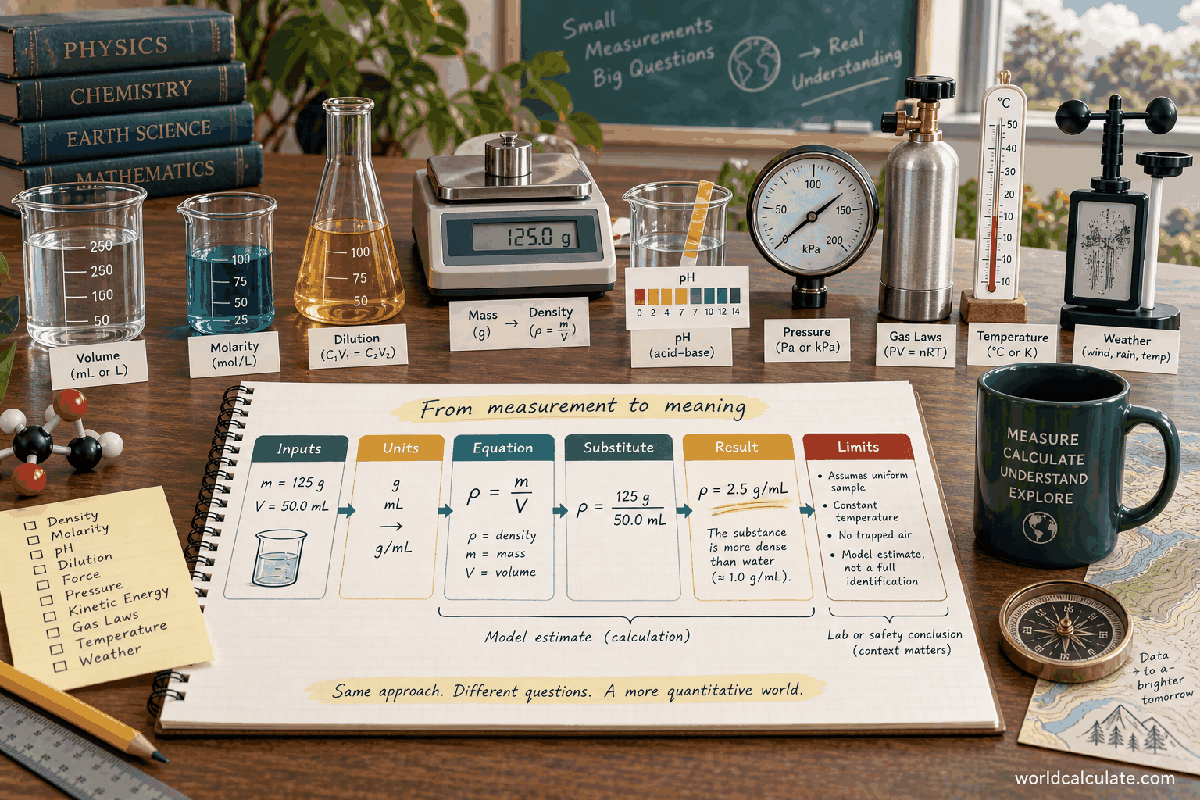
The expression E = mc^2 connects mass with an equivalent amount of rest energy. This calculator applies that relation to one entered mass in kilograms and uses the exact SI speed of light in vacuum, 299792458 metres per second. The result is reported in joules and exajoules. The number is an equivalence in a physical model, not a promise that the mass can be fully converted into usable energy or that a conversion device exists. The guide below explains rest mass, the constant c, units, scale, examples, zero and validation behavior, energy interpretation, numerical precision, and the boundary between a textbook relation and a real energy system.

The page answers one carefully bounded question: what rest-energy equivalent follows from the mass value entered by the visitor? The handler multiplies the mass in kilograms by the square of the speed of light in vacuum. It does not identify the material, inspect its chemical or nuclear composition, measure its mass, or determine whether any physical process could release the calculated amount. Those distinctions matter because a mathematical equivalence can be exact within the model while the route from a real object to usable energy is entirely different.
The result is therefore best read as a scale calculation. It shows why a small amount of mass can correspond to a very large energy number when the conversion factor is the square of a very large speed. It does not calculate an electricity bill, a fuel yield, a weapon effect, a reactor output, a battery capacity, or a time-dependent power level. Keeping the question narrow protects the simple relation from carrying assumptions that are not present in the one-field input contract.
The field is labeled mass because the formula uses mass rather than weight. Mass is the quantity entered in kilograms, while weight is a force that depends on a gravitational field and is measured in newtons. A one-kilogram mass can have different weights in different locations, but the mass value in this calculator remains the same for the stated scenario. Substituting a weight into the field would mix different physical quantities and would produce a number with no valid interpretation under E = mc^2.
The calculator treats the entered value as invariant rest mass for a rest-energy calculation. It does not add kinetic mass, thermal mass, chemical energy, or a changing mass history. In a complete physical system, energy accounting may distinguish rest mass, internal energy, binding energy, and energy carried by radiation or particles. Those details can be important in experiments, but the page deliberately supplies one transparent relation so the input and output can be checked without guessing a composition or process.
The conversion factor is c squared, not c. The constant c is 299792458 metres per second, and squaring it gives 89875517873681764 in units of metres squared per second squared. Multiplying kilograms by that factor produces kilogram-metres squared per second squared, which is the joule. The square is the reason the numerical scale grows so quickly: a speed already close to three hundred million metres per second becomes a factor close to nine times ten to the sixteenth after squaring.
The constant is exact in the SI system because the metre is defined through the fixed value of the speed of light. The calculator does not ask the visitor to type c, so a rounded classroom value cannot introduce an avoidable difference. This design also makes the result reproducible across routes and sessions. The fixed constant is a convention of the input and unit contract, not a measurement made by the browser or a claim that light travels at that value in every material medium.
The catalog example uses 0.001 kg, which is one gram expressed in kilograms. Applying the relation gives E0 = 0.001 x 299792458^2. The resulting value is 89875517873681764 joules, or about 8.987551787 x 10^13 joules when written with a compact scientific scale. The second result expresses the same quantity in exajoules by dividing by 10^18, so the exajoule number is much smaller than one while the joule number remains very large.
This example is a unit and scale check, not an energy-release scenario. It does not say that one gram of a named substance will produce the displayed energy, that the energy is available to a machine, or that a conversion can be performed without losses or hazards. A reproducible note should preserve the mass, the exact c value, the squared factor, and the unit conversion. That record makes the arithmetic auditable without implying a technology that the calculator does not model.
A joule is the SI unit used for energy. The direct result keeps the full calculated value in joules, while the second result divides by one quintillion to express the same quantity in exajoules. The conversion is a display convenience and does not alter the underlying result. If a visitor compares the two rows, multiplying the exajoule value by 10^18 should return the joule value apart from ordinary display rounding. Writing both units helps readers see the scale without forcing one number into a crowded string of digits.
Energy and power must not be confused. Energy is an amount, while power is energy per unit time. This calculator has no time field, so it cannot say how quickly the equivalent energy would be transferred. A very large energy value could correspond to a low power over a long interval or a high power over a short interval, depending on a process that is not described here. Do not divide by an invented duration and call the result a power output.
Rest energy is the energy associated with an object's rest mass in the equivalence relation. Kinetic energy is associated with motion and depends on speed. An object can have rest energy even when it is stationary, and it can also have kinetic energy when moving. The present page intentionally does not ask for speed, so it returns only the rest-energy term. The related relativistic kinetic-energy calculator uses a separate field and a Lorentz factor because motion changes the energy accounting question.
This distinction prevents double counting. If a visitor uses this result in a larger calculation, the mass term should be identified as rest energy and any motion term should be represented by its own formula. Adding unrelated energy values is meaningful only when they refer to the same defined system and accounting convention. The calculator does not decide whether a supplied mass already includes a particular internal or kinetic contribution; it applies the declared one-field contract.
The formula says how much energy is equivalent to a mass under the relativistic relation. It does not provide an efficiency percentage for turning an object into a useful output. Real processes can preserve energy while distributing it among radiation, particle motion, heat, binding changes, waste streams, or other forms. A visitor who wants usable electricity would need a process model, a conversion path, losses, containment, timing, and safety constraints. None of those variables is represented by the mass field.
A common mistake is to multiply the result by an invented efficiency and treat the product as a general answer. An efficiency can be meaningful only when it belongs to a specified mechanism and operating range. The page intentionally does not select a mechanism or suggest that complete mass conversion is ordinary. Its boundary is more useful when it is stated plainly: the output is an ideal rest-energy equivalence, not a forecast of recoverable energy or a recommendation for handling matter.
Zero is an allowed mass and returns zero rest energy. This is the direct algebraic consequence of multiplying zero by c squared. It does not describe the behavior of a massless particle in every relativistic context, because the page is defined around a nonnegative rest-mass input and the rest-energy expression. The safe interpretation of the zero result is simply that the entered rest-mass value contributes no rest-energy amount under this contract.
The field accepts values from zero through one billion kilograms. Those bounds keep direct browser and handler calls finite and predictable. They are not a scientific claim about the largest mass that can exist, a laboratory range, a storage limit, or a safe amount for a real system. The handler rejects negative, nonfinite, text, and out-of-range values rather than changing them to a nearby valid number. Validation preserves the visitor's stated scenario.
The result can become large even for a small mass, but the selected upper bound remains within the finite range of the JavaScript number type. The handler still checks the derived value with a finite-result guard. This makes the failure behavior explicit if a future catalog change increases the bound or if a direct caller bypasses the visible form. A finite result is not the same as unlimited precision; the displayed formatting is a readable presentation of a floating-point calculation.
For scale comparisons, scientific notation is often clearer than a long integer. A reader should distinguish the stored numerical value from the rounded text shown in a result row. If a downstream calculation needs exact decimal accounting or an uncertainty interval, it should retain the input and use a suitable numeric representation outside this page. The calculator does not claim metrological precision for a measured mass, and it does not infer significant figures from an arbitrary number of typed digits.
Because the relation is linear in mass, doubling the entered mass doubles the rest-energy equivalent. Halving the mass halves both displayed energy rows. This proportional behavior is useful for checking a calculator implementation and for comparing hypothetical values. It does not mean that two real objects can be combined or separated without changing their internal energy, binding state, or other physical properties. The scaling statement applies to the mathematical input contract, not to an unexamined laboratory operation.
The same linearity also helps locate arithmetic errors. If a result changes by a factor of one thousand when mass changes by a factor of one thousand, the relation has been applied consistently. If an apparent change also includes a unit conversion, that conversion must be recorded separately. A gram-to-kilogram mistake changes the mass by a factor of one thousand before c squared is applied. The page cannot identify a mislabeled source measurement, so unit discipline remains part of the user's setup.
The result says that the entered rest mass corresponds to the displayed energy amount under the special-relativity equivalence. It does not say where the energy is located, how it could be extracted, whether it is available as heat or electricity, or whether a real object can undergo a complete conversion. It also does not identify a reaction, decay, collision, annihilation event, or power plant. Those are different questions with additional conservation, interaction, and engineering details.
Careful wording is especially important when a very large number looks like a practical promise. A good report says ideal rest-energy equivalent, gives the mass and units, and repeats that conversion efficiency and physical release are not modeled. Avoid phrases such as guaranteed output, available energy, or safe yield unless a separately reviewed process model supports them. The calculator's value is the transparent relation and its explicit stopping point.
The pure handler requires a JavaScript number that is finite and within the inclusive mass range. Numeric strings, missing values, NaN, positive or negative infinity, negative mass, and values above the maximum are rejected. The visible number control helps ordinary visitors, but direct callers can bypass browser constraints, so the engine repeats the validation. The result is finite-checked before it is returned. This layered behavior keeps the catalog metadata and the executable contract aligned.
A reproducible report should include the mass in kilograms, the constant c used by the contract, the equation E0 = mc^2, the joule result, and any exajoule conversion. It should label the value as rest-energy equivalent and state that no conversion efficiency, timing, storage, radiation, or safety analysis was performed. Another reader can then reproduce the arithmetic and understand its limits. A number without its mass unit and model boundary is not a complete report.
This calculator is useful in an introductory relativity lesson, a unit-analysis exercise, or a scale comparison. It can demonstrate that mass and energy are connected without requiring a multi-step motion problem. A teacher can compare a gram, a kilogram, and a larger hypothetical mass while asking students to predict the factor change before calculating. The fixed constant and simple field also make it a clear example of a pure function with a visible numerical contract.
In a scientific discussion, the page can serve as one arithmetic component beside a defined physical model. A researcher or student may need to specify a system boundary, rest frame, measured uncertainty, reaction channel, and conservation accounting before drawing a conclusion. The calculator does not supply those choices. It should therefore be used to clarify one relation, then handed off to the domain method that supports the actual claim.
The most common mistake is entering weight in newtons instead of mass in kilograms. Another is using c rather than c squared, which changes the scale by an enormous factor. A third is confusing joules with watts by treating the energy value as an output rate. A fourth is reading the result as recoverable electricity without specifying a process. Each mistake comes from adding or changing a physical meaning that the field labels and formula do not support.
A second set of mistakes concerns units and notation. A gram must be entered as 0.001 kilograms, not 1 with a kilogram label. Exponents should be read carefully: c squared is close to 9e16, while c is close to 3e8. Finally, do not compare a rounded display string as if it were an exact measurement. Preserve the raw input, the equation, and the unit conversion when a result is copied into a worksheet or article.
Before accepting the result, confirm that the input is a mass in kilograms, not a weight or a volume. Check that the value is finite and within the displayed range. Verify that the relation uses the exact speed of light in vacuum and that the square is applied. Confirm that the direct result is labeled joules and that the exajoule row is only a scaled presentation. These checks establish arithmetic consistency and do not validate a physical conversion scenario.
Finally, state what the page did not calculate. It did not identify a material, process, reaction, power rate, efficiency, storage system, radiation field, or safety procedure. The honest conclusion is that E0 = mc^2 was evaluated for the entered rest mass and the result was displayed in two energy units. Keeping that conclusion beside the number makes the calculator useful for education while preventing an ideal equivalence from becoming an unsupported engineering or operational claim.
Energy bookkeeping becomes more complicated when the calculator is placed beside a real process. A system may exchange heat, work, radiation, particles, or mass with its surroundings, and the choice of system boundary changes which quantities are counted inside it. This page does not choose a boundary. It uses the entered mass as a rest-mass quantity and calculates the corresponding E0 term. It does not decide whether a container, fuel, reaction product, emitted photon, or waste stream belongs to the same accounting system. Those choices must be written down before a larger energy balance can be interpreted.
The distinction also matters when comparing before and after states. A difference in rest-energy equivalents can be meaningful only when the masses are defined in a compatible way and the missing energy channels are accounted for. Subtracting two large rounded display values can obscure a smaller physical difference, while comparing raw values with a stated uncertainty can preserve the intended scale. The calculator is a reliable relation for each entered mass, but it does not perform conservation-law bookkeeping, choose a reference process, or validate that two measurements describe the same system.
Calculate the rest energy represented by a mass using the special-relativity equivalence E0 = mc^2.
Rest energy E0 = m c^2, where m is mass in kilograms and c = 299792458 m/s is the exact SI speed of light in vacuum. This calculator evaluates the rest-energy equivalence for an entered mass. It returns joules and exajoules as an ideal physical equivalence, not a prediction that the mass can be completely converted, stored, released, or safely used as energy.
Enter Mass, then choose Calculate.
Mass is a finite nonnegative quantity measured in kilograms and is treated as the invariant rest mass in the narrow equivalence calculation. The speed of light in vacuum is fixed at the exact SI value 299792458 metres per second, so c^2 is a fixed conversion factor in the formula. The result describes equivalent rest energy only. Conversion pathway, binding energy, radiation, containment, efficiency, and engineering or safety decisions are outside the calculation.
This calculator is part of the WorldCalculate library. Its formula, example, assumptions, input bounds, and output formatting follow the official methodology.
These WorldCalculate collections connect this tool with related questions while keeping each calculation separate and transparent.