
Goal
Weight/weight or weight/volume percent from solute and total solution.
Worldwide context
Saved once here, used across the site.
Currency changes display only. Country selection guides tax input; no tax rate is guessed.
Weight/weight or weight/volume percent from solute and total solution.
percent = solute / solution x 100.A clearer path to an answer
This page keeps the calculation transparent: define the goal, enter the matching values, inspect the method, and decide what the result means in your situation.
Weight/weight or weight/volume percent from solute and total solution.
Solute · Solution (mass in g, or volume in mL for w/v) · Basis
percent = solute / solution x 100.
Calculate, review the assumptions below, then compare a related tool when the decision needs more context.
Weight/weight or weight/volume percent from solute and total solution.
Open the Percent Concentration (w/w, w/v) pageMore science tools
Download PDFDownload Word (.doc)
Enter your values above and choose Calculate to see the result here.
Calculation map
percent = solute / solution x 100.
Bounded, transparent calculation
Your recent runs stay in this browser session only.
Formula: percent = solute / solution x 100.
Divide solute by total solution and multiply by 100. Weight/weight reads grams per 100 g; weight/volume assumes grams per 100 mL.
Worked example: 5% w/w.
The displayed limits are checked before the handler runs. Model-specific domain checks may also reject impossible or non-finite inputs.
Methodology: This calculator follows the WorldCalculate input, formula, precision, and boundary policy. Read the official methodology.
Calculator usage statistics
This section counts anonymous successful Calculate submissions, not unique visitors. Counts and top tools appear only when trusted aggregate data is available; country analysis is shown only under the same condition and reporting threshold.
Answer-first guide
Weight/weight or weight/volume percent from solute and total solution. Start with one clearly defined goal, enter values in the units shown, and keep the result attached to the assumptions below.
This tool is useful when your question includes percent concentration, w/w, w/v. It returns the outputs declared in the calculator contract rather than a live quote, approval, diagnosis, or professional sign-off.
Solute · Solution (mass in g, or volume in mL for w/v) · Basis. Keep the same time period, unit system, and currency wherever the form requires comparable values.
Run the worked example first, compare its output with the page's example, then change one input at a time. This makes an unexpected result easier to trace to a unit, boundary, or assumption.
Need a wider view? Browse Science Calculators or compare the related tools below. The WorldCalculate methodology explains how formulas, examples, limits, and revisions are reviewed.
percent = solute / solution x 100.
Divide solute by total solution and multiply by 100. Weight/weight reads grams per 100 g; weight/volume assumes grams per 100 mL.
5% w/w.
Context and background
Science calculators define a system, choose an equation, apply units and constants, and show the substitution. Effects outside that model remain outside the result.
Introductory science problem solving builds from measured quantities and idealized relationships. Those models are valuable for learning and first-pass estimates, while experiments and engineering decisions need additional evidence.
Research and review
Researched by Hassan ALRowaie, Founder and editorial researcher at WorldCalculate.
This guide follows the live calculator's declared inputs, formula, worked example, assumptions, validation boundaries, and source-backed methodology. The review date describes editorial review of the calculator explanation; it is not a promise that external facts or rates remain current.
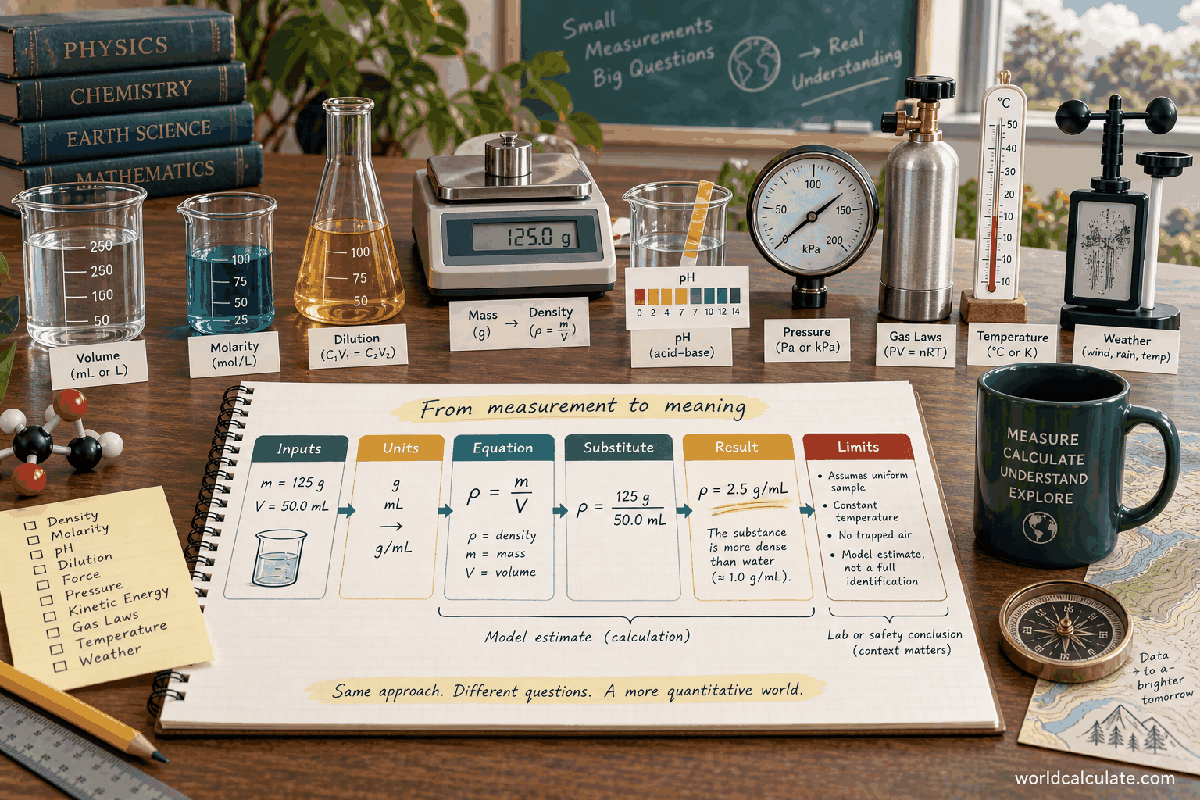
Percent concentration is a compact way to describe how much of a chosen solute is present relative to a defined amount of solution. The number is only meaningful when the basis and denominator are clear. This calculator supports two common conventions: weight/weight, written w/w, and weight/volume, written w/v. In w/w, both the solute and the total solution are treated as masses. In w/v, the solute is a mass and the final solution is a volume. The same numerical inputs can therefore produce different meanings when you change the basis. This guide explains how to choose the mode, keep units consistent, distinguish total solution from solvent, reason about preparation and dilution, report rounded results honestly, and recognize the laboratory limits of a simple ratio. Use the result as a transparent calculation, not as automatic evidence that a mixture is safe, sterile, stable, effective, or suitable for a particular person or process.
The calculator takes a solute amount, a solution amount, and a basis. It divides the first value by the second and multiplies by 100. The displayed percent is therefore a ratio expressed on a per-hundred basis. A result of 5 means five parts of the selected solute for every one hundred parts of the selected denominator, according to the mode you chose. The number is not a universal description of concentration until the denominator is named. Five grams per 100 grams and five grams per 100 milliliters can share the number 5 while describing different physical quantities.
The Solute field is the amount of the material being tracked. The Solution field is deliberately labeled differently for the two modes: enter a mass in grams for w/w, or a final volume in milliliters for w/v. The calculator does not identify a chemical, inspect a container, or decide whether your entry is a solvent, active ingredient, mixture, or sample. You must define what solute means for your situation and make sure that the denominator describes the finished solution rather than a convenient but incorrect starting amount.
A percentage result is best read together with its basis. Say 5% w/w or 5% w/v, not simply 5% when the distinction matters. If you are recording a result for another person, include the solute identity, the basis, the inputs, and any rounding. That small amount of context prevents a mass fraction from being mistaken for a mass-per-volume specification and makes a later check possible. The calculator reports arithmetic; interpretation still depends on your measurements and purpose.
Weight/weight concentration is more precisely described as mass/mass concentration. The w/w percentage is the mass of solute divided by the total mass of the solution, multiplied by 100. A 5% w/w solution contains 5 grams of the specified solute in every 100 grams of finished solution. The remaining 95 grams may be solvent or other components, depending on what the formulation contains. The denominator is the mass of the finished mixture, not automatically the mass of the liquid that was added first.
Mass units cancel in the ratio, so grams per gram, kilograms per kilogram, and milligrams per milligram produce the same percentage when both values use the same unit. The calculator interface asks for grams, which gives a simple operational rule: convert both masses to grams before entering them. Do not enter a solute in grams and a solution mass in milliliters under w/w. That creates a mass divided by volume ratio while labeling it as a mass fraction.
The w/w basis is useful when the final batch is weighed, when volume changes with temperature or mixing, or when a specification is defined by mass. It can also be useful for solids, pastes, concentrated liquids, and mixtures whose density is not close to that of water. Because the denominator includes the solute, a physically ordinary w/w solution with nonnegative components should not exceed 100%. A value above 100% usually signals that the denominator was not the total solution mass or that the entries describe incompatible quantities.
Weight/volume concentration uses a mass numerator and a volume denominator. In this calculator, the w/v percentage is grams of solute per 100 milliliters of final solution. Thus 5% w/v means 5 grams in a final volume of 100 milliliters. The volume is the volume occupied by the completed solution after the solute has been dissolved or otherwise incorporated according to the relevant procedure. It is not automatically the amount of liquid poured into the vessel at the beginning.
The w/v convention is convenient when a solution is measured, dispensed, or specified by volume. It is common to see the same idea written as grams per 100 mL, with the percent label serving as shorthand. The numerator remains a mass even though the name contains volume. For this mode, enter grams in the Solute field and milliliters in the Solution field. The calculator does not use density to convert either value, so a density measurement cannot be silently substituted for the required final volume.
The catalog includes a limited aqueous approximation: one milliliter of a dilute aqueous solution may be treated as about one gram for rough reasoning. This is not a universal conversion and it is not needed to perform the direct w/v ratio. Dense, concentrated, nonaqueous, heated, or compositionally unusual solutions may differ substantially. If a specification is based on mass, use w/w. If it is based on final volume, measure or establish that final volume and use w/v rather than inferring it from mass.
Most concentration errors come from selecting a denominator that is easy to measure instead of the denominator named by the specification. For w/w, write down the total mass of the finished solution. For w/v, write down the final volume of the finished solution. The word total or final is important because dissolving a solute can change the mass or volume relationship. The calculator cannot tell whether a number represents solvent alone, solution as a whole, or a container reading, so make that decision before entering it.
Consider 5 grams of solute mixed with 95 grams of solvent. The finished mass is 100 grams, so the w/w concentration is 5%. If the same 5 grams is mixed with 100 grams of solvent, the finished mass is approximately 105 grams when there is no loss, and the w/w concentration is 5 divided by 105 times 100, or about 4.7619%. Using 100 grams as the denominator in the second case would report the amount relative to solvent, not the stated w/w concentration of the solution.
For w/v, suppose 5 grams of solute is dissolved and the mixture is brought to a final volume of 100 milliliters. The result is 5% w/v. Starting with 100 milliliters of water and then adding 5 grams does not prove that the final solution volume is 100 milliliters. Dissolved material can change the volume, and volumes of mixed liquids are not always additive. If the instruction says final volume, use a suitable volume measurement rather than reusing the starting solvent reading.
For w/w, the two entries must be masses in matching units. If a record gives 2.4 kilograms of solute in a 30 kilogram batch, convert both to grams or use the equivalent kilogram values consistently: 2400 grams and 30000 grams produce the same ratio. If you enter 2.4 in a grams field, however, the calculator reads it as 2.4 grams, not 2.4 kilograms. The unit label is part of the input, so a correct numerical ratio can still represent the wrong physical amount if the unit conversion is skipped.
For w/v, use grams and milliliters as the page specifies. Convert liters to milliliters before entering them: 0.75 liters is 750 milliliters, and 1.2 grams in 750 milliliters gives 0.16% w/v. You may also reason from equivalent expressions after the calculation. A value of 1% w/v is 1 gram per 100 milliliters, or 10 grams per liter, but the calculator's direct entry still expects the denominator in milliliters.
Do not mix a w/w unit with a w/v unit merely because both inputs happen to contain the letter g or mL. A mass fraction has units of mass over mass before the units cancel. A w/v result retains the idea of grams per volume even though the number is displayed as a percent. Keep separate notes for concentration basis, unit conversion, density, and any molecular conversion. Percent concentration is not automatically molarity, molality, ppm, volume/volume percent, or a dose.
Let s represent the solute amount and d represent the solution amount in the appropriate unit. The calculator evaluates percent = s divided by d, multiplied by 100. In w/w, s and d are masses. In w/v, s is a mass in grams and d is a final volume in milliliters. Multiplication by 100 changes a fraction such as 0.05 into the percent number 5. If you already have a percent and convert it to a fraction for another calculation, divide by 100; do not multiply twice.
The Solute field accepts zero or more grams up to the catalog maximum. A zero solute amount gives 0% for either basis, provided the denominator is positive. The Solution field must be positive, because a zero denominator has no concentration ratio. The page also applies finite numeric bounds so that blank, nonnumeric, infinite, or out-of-range entries cannot masquerade as a meaningful result. A bound is an input contract, not a claim that every real mixture near the bound is practical.
The arithmetic itself does not enforce that the solute mass is less than or equal to the solution mass in w/w, nor does it check solubility for w/v. That is intentional: the handler calculates the supplied ratio, while physical validation requires information the fields do not contain. If the number looks surprising, first recheck the basis, units, and denominator. A mathematical result can be internally correct while the entered quantities fail to describe the solution you intended.
The default-style example uses 5 grams of solute and 100 grams of total solution. Enter w/w and calculate 5 divided by 100 times 100. The result is 5% w/w. The statement behind the number is that each 100 grams of this finished solution contains 5 grams of the specified solute. It does not say that 5 grams was mixed with 100 grams of solvent. If 100 grams refers to solvent alone, the denominator must be reconsidered before the result is labeled w/w.
For a second example, suppose a finished batch weighs 120 grams and contains 18 grams of the solute. The calculation is 18 divided by 120 times 100, which equals 15% w/w. The other 102 grams can include solvent and other components. If instead the notes say 18 grams of solute was added to 120 grams of solvent and no material was lost, the finished mass is 138 grams, so the w/w result is about 13.0435%. The two stories have different denominators and therefore different answers.
A unit-conversion example starts with 2.4 kilograms of solute in a 30 kilogram finished batch. Both values can be converted to grams, giving 2400 divided by 30000 times 100 = 8% w/w. A preparation target can be checked in reverse: 8% of a 500 gram final batch is 0.08 times 500, or 40 grams of solute. Under the simple no-loss assumption, the remaining 460 grams belong to the other components. Weigh the final batch if the specification is mass-based.
For the direct w/v example, enter 5 grams of solute and a final solution volume of 100 milliliters. The calculation is 5 divided by 100 times 100, giving 5% w/v. This means 5 grams per 100 milliliters of final solution. If the same 5 grams is present in a final volume of 250 milliliters, the result is 2%, because 5 divided by 250 times 100 equals 2. The solute amount stayed the same, but the denominator changed.
Suppose a measured sample contains 0.75 grams of solute in 150 milliliters of final solution. The result is 0.75 divided by 150 times 100 = 0.5% w/v. For 12 grams in 750 milliliters, the result is 1.6% w/v. These examples show why the volume unit must be milliliters in the page's field. Entering 0.75 as though it meant 0.75 liters would make the denominator one thousand times too small and would inflate the reported percentage.
To check a volume-based entry, write the equivalent grams per 100 milliliters after calculating. A result of 0.5% w/v is 0.5 grams per 100 milliliters, and 0.75 grams in 150 milliliters is consistent because 150 milliliters is one and a half 100 milliliter portions. This check is a unit interpretation check, not a test of solubility or stability. A solution can satisfy the ratio and still require a separate assessment of whether the solute can remain dissolved at the stated temperature and composition.
When the target is w/w, start with the desired percent as a fraction and multiply by the desired total mass. The solute mass is target percent divided by 100 times final solution mass. For example, to reason about a 6% w/w, 250 gram final batch, calculate 0.06 times 250 = 15 grams of solute. If the only other component is a compatible solvent and there is no loss, the remaining mass is 235 grams. The defining check is the final total mass of 250 grams, not the mass of solvent alone.
This reverse calculation is useful for planning and for checking a measured batch, but it does not replace the procedure for a particular material. A weighed commercial material may not be pure solute. If it is 80% active by mass, weighing 15 grams of that material supplies only about 12 grams of active solute under a simple purity assumption. The required adjustment depends on the specification and material certificate. Do not silently treat the total mass of an impure reagent as the active solute mass.
For a real preparation, record the target basis, target total mass, calculated solute mass, other component masses, balance resolution, and any losses. If evaporation, reaction, gas release, or transfer loss can occur, the simple subtraction check may not describe the final batch. A final reweigh can reveal whether the mass target was reached, but it cannot identify which component was lost. Keep the concentration calculation separate from process controls and acceptance testing.
For a target w/v percentage, multiply the target percent fraction by the desired final volume in milliliters. A 2% w/v target at 500 milliliters corresponds to 0.02 times 500 = 10 grams of solute, assuming the named solute is the material being weighed. The volume in that calculation is the final solution volume. It is not a promise that 500 milliliters of starting solvent plus the solute will occupy 500 milliliters.
The phrase bring to final volume captures the key preparation reasoning. The solute is incorporated, and compatible vehicle is adjusted until the completed solution reaches the specified volume. Dissolution can change volume, and a concentrated solution can have a density that differs greatly from water. Therefore, do not infer the final volume from the mass of the solution unless a validated density relationship applies to that exact composition and temperature.
Purity and assay matter here as they do for w/w. If the weighed material is not entirely the named solute, the active mass may be lower than the scale reading. If the material contains other dissolved substances, the calculator's single-solute label may not describe the entire formulation. Use a documented method that specifies identity, purity, temperature, vessel, mixing, and final-volume measurement when the result will be used beyond a rough educational estimate.
Dilution reasoning begins with conservation of the named solute. If no solute is removed or lost, the amount of solute taken from a stock equals the amount of solute in the diluted result. For w/v concentrations expressed in the same percent convention, the familiar relationship is P1 x V1 = P2 x V2, where P1 is stock percent, V1 is stock volume used, P2 is target percent, and V2 is final volume. The volumes must be in the same unit, and the stock and target must use the same solute and basis.
For example, a 10% w/v stock used to make 250 milliliters of a 2% w/v target requires V1 = 2 x 250 divided by 10 = 50 milliliters of stock. The remaining vehicle is added as needed to reach a final volume of 250 milliliters, not simply assumed to be 200 milliliters if the mixing process changes volume. This is a calculation of quantities, not a complete handling instruction. The stock identity, compatibility, temperature, and validated method still control the preparation.
The analogous mass-based relationship for w/w is P1 x M1 = P2 x M2 when P values use the same w/w definition, M1 is the mass of stock solution used, and M2 is the final mass. A 25% w/w stock for a 5% w/w, 200 gram final batch requires 5 x 200 divided by 25 = 40 grams of stock. Under a simple no-loss, compatible-vehicle assumption, the other added mass is 160 grams. Do not use a volume dilution equation for a mass-based specification without a justified mass-to-volume conversion.
The ratio should be calculated from the most precise valid inputs available, then rounded for communication. For 5 grams divided by 105 grams times 100, the unrounded value is approximately 4.76190476%. Reporting 4.76% may be reasonable when the measurements support two decimal places. Reporting 4.76190476% can suggest more measurement precision than the balance or volume reading actually provided. More displayed digits do not create more information.
Use the least precise relevant measurement as a practical guide to reporting precision. A balance reading recorded only to the nearest gram should not normally support a result with many decimal places. A volume read from a coarse container should not be described with the same precision as a calibrated volumetric measurement. If the calculator output is used in a record, keep the original inputs, mode, unrounded calculation if needed, rounded result, and reason for the chosen rounding together.
Round only after selecting the correct denominator and carrying out the calculation. Early rounding can move a result across a comparison threshold or compound an error in a preparation calculation. For example, do not round a stock percentage before solving a dilution equation if the unrounded value is available. When a result is close to a specification limit, retain guard digits in the calculation and have the method define how compliance, tolerance, and uncertainty are decided.
The calculator assumes that the named solute amount and solution denominator describe the same finished, homogeneous material. A sample taken from a well-mixed solution is more likely to represent the stated ratio than a sample containing settled solids or separated layers. The arithmetic does not detect incomplete dissolution, precipitation, phase separation, evaporation, adsorption to a container, or loss during transfer. Those effects can make the physical concentration differ from the value calculated from nominal entries.
The page also assumes that the user has identified the solute correctly. In a mixture with several active ingredients, one selected solute may be only one component of the total. If the weighed material is a solution, concentrate, hydrate, salt, or impure reagent, its total mass is not automatically the mass of the desired active species. Converting between a material amount and an active amount may require an assay, molecular information, or a product-specific specification that is outside the three calculator fields.
For w/v, the denominator is treated as a measured final volume. For rough comparisons involving dilute aqueous solutions, the catalog notes that one milliliter is about one gram, but that approximation has limited scope. It should not be extended to every liquid, concentration, temperature, or pressure. For w/w, no density estimate is needed because both inputs are masses. The page deliberately avoids claiming that one basis can be converted to the other without additional physical information.
A frequent mistake is using solvent as the denominator for w/w. If the specification says 5% w/w, the denominator is 100 grams of final solution, not 100 grams of solvent. Another is entering an initial solvent volume for w/v when the specification requires final volume. Write the intended finished state in words before entering numbers. If the sentence says grams per 100 grams, choose w/w. If it says grams per 100 milliliters, choose w/v.
Unit mixing is another silent error. Entering 5 grams and 100 milliliters under w/w does not create a valid mass fraction, and entering 5 grams with 0.1 liters under w/v does not meet the page's milliliter field contract. A related error is treating 5 as a fraction when the calculator expects raw amounts, or multiplying a value already written as a percent by 100 a second time. Keep the units and the percent-versus-fraction distinction visible in your notes.
People also sometimes use a volume dilution equation for a w/w problem, assume all volumes add exactly, or round the denominator before calculating. Other mistakes include counting the container mass as solution mass, forgetting reagent purity, and assuming a plausible-looking percentage proves that the mixture is safe. A result that looks tidy can still be based on the wrong story. Re-read the label, identify the basis, and check the final mass or volume definition before trusting the number.
A very small result is not automatically an error. If 0.1 grams is present in 1000 milliliters, the w/v result is 0.01%. If 0.1 grams is present in a 100 gram final batch, the w/w result is 0.1%. Small values often arise from trace components or dilute samples, but the significance depends on detection limits, measurement uncertainty, and the purpose of the calculation. The page reports the ratio without deciding whether the instruments were sensitive enough to support it.
A w/w result above 100% deserves immediate review because the solute mass is part of the total solution mass in the ordinary definition. Check whether the denominator was accidentally entered as solvent, whether units were mixed, or whether the two values came from different samples. A w/v result above 100% is a large mass per 100 milliliters and may be mathematically valid for some dense systems, but it can also indicate an impossible or insoluble target. Check material properties and the governing method rather than imposing a universal cap from this calculator.
A result of 0% can mean that the solute amount is genuinely zero, but it can also reflect a rounded measurement or an omitted component. A result close to a target does not prove exact compliance. When the percentage affects a release decision, exposure, quality limit, or process setting, compare the unrounded result and measurement uncertainty with the authorized specification. The calculator is a screening and reasoning aid, not a substitute for an acceptance test.
Percent w/w and percent w/v are not interchangeable labels. Converting between them requires density and a clear definition of which solution state is being compared. Even with density, temperature and composition can matter. The calculator does not ask for density, so it cannot turn 5% w/w into a rigorously equivalent 5% w/v value. The rough dilute aqueous approximation in the catalog is only a context aid and should not be used as a universal conversion rule.
The result is not molarity because molarity requires moles of solute per liter of solution and therefore needs molecular or formula information. It is not molality because molality uses moles per kilogram of solvent. It is not ppm, which depends on a defined mass or volume basis and scale, and it is not volume/volume percent, which has a volume numerator. It is also not a dose, activity, potency, osmolarity, pH, or measure of biological effect.
The page does not calculate solubility, saturation, density, viscosity, thermal expansion, volume contraction, vapor loss, chemical reaction, shelf life, sterility, or compatibility. It also does not determine how to label a regulated product or how to dispose of a material. If a requested quantity belongs to one of those domains, use the validated formula and procedure for that domain. Do not force a different concentration definition into the w/w or w/v fields simply because the interface accepts numeric values.
In a laboratory, the quality of a percentage cannot exceed the quality of the measurements behind it. A balance should be appropriate for the mass range and checked according to local practice. A volume device should be suitable for establishing the required final volume, and the temperature should be considered when the method or material is temperature-sensitive. Record tare, sample identity, units, mode, final mass or volume, and any observations about dissolution or separation. These records make a simple calculation auditable.
Safety belongs outside the arithmetic but must remain part of responsible use. Read the applicable hazard information, wear the required protective equipment, use ventilation when required, and confirm that the container and materials are compatible. Some dissolutions release heat, produce gas, or change volume. Some substances are toxic, corrosive, reactive, sensitizing, flammable, or environmentally hazardous. The percentage result does not reveal any of those properties, and a lower percentage is not automatically harmless.
For sterile, therapeutic, diagnostic, food, environmental, or regulated work, follow the approved procedure and qualified supervision for that setting. Do not use this page to improvise a medicine, disinfectant, culture medium, injectable, or other safety-critical preparation. A professional method may require identity checks, purity correction, order of addition, filtration, sterility assurance, validated mixing, in-process testing, and controlled labeling. If any of those controls matter, the calculator can support the arithmetic only after the responsible procedure defines the inputs.
A short checklist prevents most avoidable errors. First, name the solute and decide whether the specification is w/w or w/v. Second, identify the finished denominator: total mass for w/w or final volume for w/v. Third, convert units to grams and grams or milliliters as required by the mode. Fourth, confirm that the sample or batch is the same material described by both inputs and that the solution field is positive. Only then enter the values and calculate.
After the result appears, restate it in words. For example, 0.75 grams in 150 milliliters gives 0.5% w/v, which is 0.5 grams per 100 milliliters of final solution. For a mass example, 18 grams in 120 grams gives 15% w/w, which is 15 grams per 100 grams of finished solution. If you cannot write an equivalent sentence without changing the denominator, stop and resolve the input definition before using the result.
Finally, review whether the result is physically and procedurally appropriate. Check for a surprising magnitude, a w/w value above 100%, an assumed density, excessive rounding, reagent purity, incomplete dissolution, and the intended use. If the number controls a safety or quality decision, have a qualified person independently check the calculation and the underlying measurements. A second calculation can catch arithmetic mistakes, but only domain review can catch a wrong formula, unsafe material, or invalid procedure.
This calculator is most useful when it makes an existing measurement or planning question easier to inspect. It can help a student distinguish a mass fraction from a mass-per-volume convention, help a technician check a documented ratio, or help a reader reason through a dilution equation. Its value comes from exposing the denominator and showing the arithmetic, not from replacing the method that defines the material, measurement, tolerance, or safe handling conditions.
Before sharing a result, include the calculator basis, solute identity, input units, final mass or volume definition, numerical result, rounding rule, and any important assumptions. If the result came from a stock dilution, record the stock basis and the final target. If it came from a real measurement, retain the instrument reading and sample context. A bare percentage can be copied into a new context and misunderstood; a labeled percentage carries the information needed to interpret it responsibly.
The central rule is simple: choose the denominator that the concentration definition actually names. Use total solution mass for w/w and final solution volume for w/v. Keep units consistent, calculate before rounding, and treat physical feasibility and safety as separate questions. When the intended use involves a person, a hazardous substance, a regulated product, sterility, environmental release, or a quality decision, stop at the arithmetic and consult the responsible professional procedure. A transparent limitation is safer than a confident number used outside its meaning.
Weight/weight or weight/volume percent from solute and total solution.
percent = solute / solution x 100. Divide solute by total solution and multiply by 100. Weight/weight reads grams per 100 g; weight/volume assumes grams per 100 mL.
Enter Solute, Solution (mass in g, or volume in mL for w/v), Basis, then choose Calculate.
Fully dissolved solute; matching units on both inputs. Weight/volume treats 1 mL of dilute aqueous solution as about 1 g.
This calculator is part of the WorldCalculate library. Its formula, example, assumptions, input bounds, and output formatting follow the official methodology.
These WorldCalculate collections connect this tool with related questions while keeping each calculation separate and transparent.