
Goal
Litres and molecule count for moles of ideal gas at STP.
Worldwide context
Saved once here, used across the site.
Currency changes display only. Country selection guides tax input; no tax rate is guessed.
Litres and molecule count for moles of ideal gas at STP.
V = n x 22.4 L/mol; molecules = n x 6.02214076e23.A clearer path to an answer
This page keeps the calculation transparent: define the goal, enter the matching values, inspect the method, and decide what the result means in your situation.
Litres and molecule count for moles of ideal gas at STP.
Moles of gas
V = n x 22.4 L/mol; molecules = n x 6.02214076e23.
Calculate, review the assumptions below, then compare a related tool when the decision needs more context.
Litres and molecule count for moles of ideal gas at STP.
Open the Gas Volume at STP pageMore science tools
Download PDFDownload Word (.doc)
Enter your values above and choose Calculate to see the result here.
Calculation map
V = n x 22.4 L/mol; molecules = n x 6.02214076e23.
Bounded, transparent calculation
Your recent runs stay in this browser session only.
Formula: V = n x 22.4 L/mol; molecules = n x 6.02214076e23.
One mole of ideal gas fills 22.4 L at STP (0 C, 1 atm). Multiply moles by Avogadro's number for the molecule count.
Worked example: 44.8 L at STP (about 1.2044e24 molecules).
The displayed limits are checked before the handler runs. Model-specific domain checks may also reject impossible or non-finite inputs.
Methodology: This calculator follows the WorldCalculate input, formula, precision, and boundary policy. Read the official methodology.
Calculator usage statistics
This section counts anonymous successful Calculate submissions, not unique visitors. Counts and top tools appear only when trusted aggregate data is available; country analysis is shown only under the same condition and reporting threshold.
Answer-first guide
Litres and molecule count for moles of ideal gas at STP. Start with one clearly defined goal, enter values in the units shown, and keep the result attached to the assumptions below.
This tool is useful when your question includes STP, molar volume, 22.4. It returns the outputs declared in the calculator contract rather than a live quote, approval, diagnosis, or professional sign-off.
Moles of gas. Keep the same time period, unit system, and currency wherever the form requires comparable values.
Run the worked example first, compare its output with the page's example, then change one input at a time. This makes an unexpected result easier to trace to a unit, boundary, or assumption.
Need a wider view? Browse Science Calculators or compare the related tools below. The WorldCalculate methodology explains how formulas, examples, limits, and revisions are reviewed.
V = n x 22.4 L/mol; molecules = n x 6.02214076e23.
One mole of ideal gas fills 22.4 L at STP (0 C, 1 atm). Multiply moles by Avogadro's number for the molecule count.
44.8 L at STP (about 1.2044e24 molecules).
Context and background
Science calculators define a system, choose an equation, apply units and constants, and show the substitution. Effects outside that model remain outside the result.
Introductory science problem solving builds from measured quantities and idealized relationships. Those models are valuable for learning and first-pass estimates, while experiments and engineering decisions need additional evidence.
Research and review
Researched by Hassan ALRowaie, Founder and editorial researcher at WorldCalculate.
This guide follows the live calculator's declared inputs, formula, worked example, assumptions, validation boundaries, and source-backed methodology. The review date describes editorial review of the calculator explanation; it is not a promise that external facts or rates remain current.
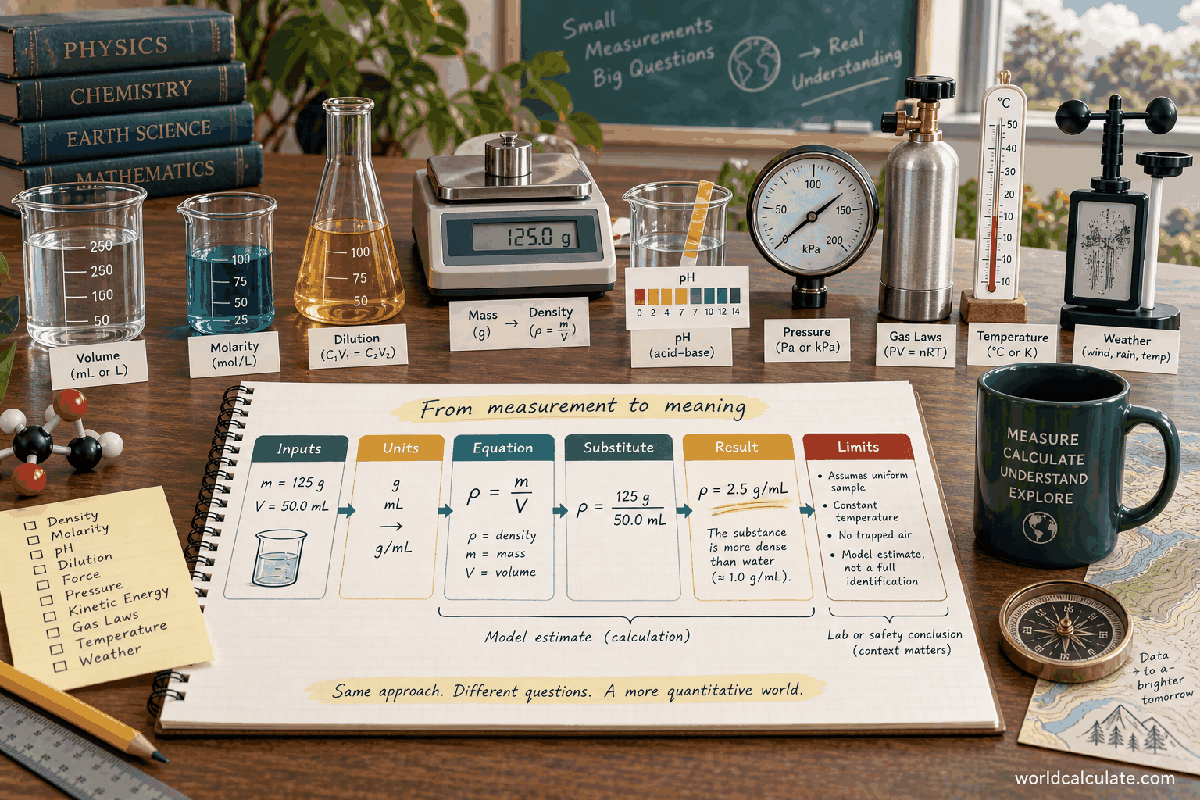
Gas volume at STP is a convenient way to connect an amount of gas in moles with the space that an idealized sample would occupy under a named reference condition. This calculator uses one clear convention: 0 C and 1 atm. Enter only the amount in moles. It returns a theoretical volume in liters using 22.4 L for each mole, along with the corresponding count of molecules using Avogadro's number, 6.02214076e23 per mole. That compact calculation is valuable for stoichiometry, classroom checks, and rough planning, but it is not a live measurement of a container and it is not a laboratory guarantee. The result depends on the stated convention and on the ideal-gas approximation. This guide explains the one-input contract, the meaning of every unit, the arithmetic behind both outputs, examples including zero, the effect of other conventions and conditions, real-gas limits, reporting precision, chemistry uses, and the safety boundaries that remain outside a simple calculation.
The page has one numeric input: Moles of gas. Its unit is mol, and the allowed value is zero or greater within the page's finite input range. The default is 2 mol. This is an amount-of-substance entry, not a volume entry. If your notes say 11.2 liters, do not put 11.2 in the field and expect the page to reverse the calculation. Convert the known amount into moles first, or use the relationship described here in the appropriate direction. Likewise, a mass in grams cannot be entered directly unless you have already divided by the molar mass of the gas.
The calculator always applies the same reference condition to the input. It does not ask which gas you have, what pressure is in a vessel, what temperature a room has, or whether the sample is wet or dry. Those omissions are deliberate parts of the contract. For an ideal gas at the selected STP convention, the identity of the gas does not change the ideal molar volume. In a real sample, identity and composition can affect non-ideal behavior, and those details are outside this page's one-field model.
The outputs answer two related but different questions. The volume result estimates how many liters the stated amount would occupy at 0 C and 1 atm under ideal-gas behavior. The molecule result estimates how many microscopic entities are represented by the stated number of moles. The second result is based on amount of substance and does not require the STP assumption. Read the labels together with the input and convention rather than treating either number as a universal property of the gas.
A visitor can therefore use the page as a transparent two-step conversion: moles to liters at the defined STP condition, and moles to molecules through Avogadro's number. The result does not identify a safe storage volume, predict a pressure in an unsealed container, or replace a gas-law calculation when conditions differ from the stated reference. It is an intentionally narrow calculator, not a general gas-handling model.
STP is an abbreviation for standard temperature and pressure, but the abbreviation does not have one perfectly universal numerical definition in every table, textbook, or laboratory document. This calculator makes its convention explicit so that the number is interpretable: standard temperature is 0 C, which is 273.15 K, and standard pressure is 1 atm. One atmosphere is 101325 Pa. Whenever you quote the result, keep the condition attached: for example, 1.00 mol gives about 22.4 L at 0 C and 1 atm under the ideal-gas model.
The temperature is an absolute thermodynamic temperature when it is used in a gas-law equation. Celsius is convenient for naming the reference point, but proportional gas calculations use kelvins. The conversion is K = C + 273.15, so 0 C becomes 273.15 K rather than zero in the equation. This distinction matters because a ratio such as 20 C divided by 0 C is not meaningful for gas-law scaling. Absolute temperature must be used when conditions change.
The pressure label is equally important. One atmosphere is close to ordinary sea-level pressure, but pressure varies with elevation, weather, equipment, and process conditions. A room described casually as being at normal pressure is not proof that a sample is exactly at 1 atm. STP is a chosen reference condition for a calculation. It should not be silently read as the condition in a particular room, bag, cylinder, reaction vessel, or gas collection bottle.
Using a named convention prevents a common communication problem: two people can use the word STP while using different reference pressures and then report slightly different molar volumes. The page avoids that ambiguity by fixing 0 C and 1 atm. If a procedure or data table specifies another convention, treat that specification as authoritative and do not relabel its result as the output of this page without explaining the difference.
The volume conversion comes from the ideal gas law, PV = nRT. Solving for volume gives V = nRT/P. At the calculator's fixed temperature and pressure, R, T, and P combine into one constant per mole. Substituting 273.15 K and 1 atm gives an ideal molar volume of about 22.414 L/mol. The catalog uses 22.4 L/mol, a sensible three-significant-figure form of that value. The displayed rule is therefore a rounded convention for ordinary educational and planning calculations, not a claim that the physical value has only three meaningful digits in every context.
The equation also shows why the result scales linearly with moles. If n is doubled while temperature and pressure stay fixed, V is doubled. If n is reduced to one quarter, V is reduced to one quarter. The calculator applies that proportionality directly: V in liters equals the entered moles multiplied by 22.4 L/mol. The mol unit cancels in the product, leaving liters. No separate conversion factor is needed for the volume output.
The number 22.4 is not a universal amount of space attached to a molecule or to a gas cylinder. It is the ideal molar volume for this particular temperature-pressure convention, rounded for the page. A liter is a unit of volume, so the output can be converted afterward if needed: 22.4 L is 22400 mL. The conversion from liters to milliliters changes the unit label and numerical scale, not the physical amount represented.
The relationship is most useful when the amount of gas is already known in moles, such as from a balanced reaction or a measured chemical amount. If the starting information is pressure, temperature, and a container volume, a general gas-law calculation may be needed to find moles first. This page intentionally does not reverse-engineer those missing quantities from an arbitrary set of conditions.
A mole is a counting unit for microscopic entities. It does not mean a particular mass or a particular volume by itself. One mole contains exactly 6.02214076e23 specified entities under the modern SI definition. The entities may be molecules, atoms, ions, formula units, or another clearly named kind of particle. This calculator labels the result as molecules because its gas-oriented use case commonly involves molecular gases, but the interpretation should follow the substance. For a monatomic gas, the same multiplication represents atoms or particles rather than molecules.
The molecule-count formula is N = n x NA, where N is the number of entities, n is the entered amount in mol, and NA is Avogadro's constant, 6.02214076e23 per mol. The mol unit cancels, leaving a pure count. Unlike the volume result, this count does not depend on 0 C or 1 atm. If the same sealed amount of gas is heated or compressed without adding or removing particles, the number of particles remains the same even though the volume or pressure changes.
For a fractional amount such as 0.5 mol, the output is 3.01107038e23 entities. That is not a suggestion that a single sample contains a fractional molecule. It is the macroscopic count represented by the measured or defined amount, usually reported as a large expected count with limited practical precision. Chemical equations use fractional moles routinely because moles are a scalable bookkeeping unit; the underlying particles are still discrete.
The calculator multiplies the input by the constant without needing a molar mass. Molar mass would be required to convert grams to moles or moles to grams, but it is not needed once the amount is already supplied in mol. Avoid inserting a mass value simply because the word gas makes a mass seem relevant. The page's count result is an amount conversion, not a composition analysis.
The input unit mol tells you how much substance is present. It is a count scaled to a convenient laboratory size, just as a dozen is a count of twelve items but on a vastly smaller scale. The number entered has to be interpreted with that unit. Entering 2 means 2 mol, not 2 grams, 2 liters, or two individual molecules. A numerical value without its unit is incomplete and can lead to a result that looks reasonable while describing the wrong quantity.
The volume unit L means liter. The factor 22.4 L/mol says that each mole contributes 22.4 liters under the stated STP convention in the ideal model. The slash is important: L/mol is a conversion factor, not a volume already waiting to be added. Multiplying mol by L/mol cancels mol and produces L. If you need milliliters, multiply the final liter value by 1000 after the page calculation, while preserving the condition label.
The molecule result is a count rather than a volume. Scientific notation makes it manageable: 1.2044e24 means 1.2044 times 10 raised to the 24th power. It is easy to mistake the e notation for an extra unit, but it only describes the size of the number. The condition label belongs to the volume result. The molecule count is determined by the amount, while the volume estimate is determined by amount plus the selected STP convention.
The condition units 0 C and atm are not input units on this page. They explain how to interpret the fixed conversion. If you need an answer at 25 C, at a measured pressure, or in a vacuum system, the page cannot accept those conditions. Use a general equation with temperature in kelvins and pressure in compatible units, or use a validated method for the instrument and application.
The default entry is 2 mol. For the volume, multiply the amount by the page's molar volume: 2 mol x 22.4 L/mol = 44.8 L. The mol units cancel, so the volume output is 44.8 L at 0 C and 1 atm under ideal-gas assumptions. The correct interpretation is not that every two-mole gas sample always occupies 44.8 liters. It is that the stated amount would occupy approximately that volume if the reference condition and model apply.
For the count, multiply 2 mol by 6.02214076e23 molecules/mol. The result is 1.204428152e24 molecules, commonly displayed or reported as about 1.2044e24 when a shorter scientific-notation form is appropriate. The molecule count and volume are generated from the same input, but they are not interchangeable. One describes microscopic amount; the other describes macroscopic space under a condition.
Suppose a chemistry exercise says a reaction produces 2 mol of a gas and asks for its STP volume. This calculator provides the direct idealized estimate, 44.8 L, if the exercise uses 0 C and 1 atm. If the exercise defines another standard condition or expects a real-gas correction, the written problem controls. The displayed number should be carried into the solution with the same convention rather than silently compared with an unlabeled table value.
For 1 mol, the calculation is 1 x 22.4 = 22.4 L and 1 x 6.02214076e23 = 6.02214076e23 entities. This is the simplest reference point because it exposes the two constants directly. For 0.5 mol, the volume is 0.5 x 22.4 = 11.2 L and the count is 3.01107038e23 entities. For 0.25 mol, the volume is 5.6 L. Halving the amount halves both outputs because each calculation is linear in moles.
The zero case is valid and useful as a boundary check. Entering 0 mol gives 0 L and 0 molecules. There is no gas amount in the idealized calculation, so both outputs are zero. The page accepts zero because a zero amount is defined, unlike a negative amount of gas in this contract. A zero result should not be confused with an instrument reading below detection, a leak, or an empty container. It means the supplied amount is exactly zero for the arithmetic being performed.
For a larger planning example, 10 mol gives 224 L under the same idealized condition, and the count is 6.02214076e24 entities. The large volume is a reminder that the output is not automatically a practical container recommendation. A real facility may use compression, a different temperature, a different pressure, a vessel rating, or a flow process. The page scales the mathematical relationship; it does not judge whether the resulting scale is convenient or safe.
A fractional value such as 0.003 mol is also legitimate if it is within the field range and represents the intended amount. Its theoretical volume is 0.0672 L, or 67.2 mL after conversion, at the page's reference condition. Whether that amount can be measured accurately depends on the sample, equipment, and method. Small numerical output does not automatically mean small uncertainty.
The volume formula treats the gas as ideal. In that model, individual particles occupy negligible volume compared with the container, particles move continuously and randomly, and intermolecular attractions or repulsions do not materially alter the pressure-volume-temperature relationship. The model also assumes the gas has reached a condition where a single temperature and pressure describe the sample. These assumptions make the molar volume depend on amount, temperature, and pressure rather than on a detailed molecular interaction model.
At 0 C and 1 atm, many gases are close enough to ideal for introductory stoichiometry and ordinary estimates. Close is not the same as exact. The extent of agreement depends on the substance, purity, pressure, temperature, and the precision required. A gas near condensation, a highly compressed gas, or a sample with a substantial vapor or contaminant may not follow the simple approximation closely enough for a decision that depends on tight tolerances.
The page does not calculate a compressibility factor, fugacity, phase equilibrium, humidity correction, or a mixture-specific equation of state. It also does not know whether a gas is flowing, confined, dissolved, reacting, or being collected over a liquid. Those are distinct physical situations. The ideal result can be a useful first estimate, but it should be replaced or checked with a more complete model when the operating conditions or consequence of error demand it.
The assumption is therefore a boundary statement, not a hidden promise. A result such as 22.4 L/mol is best read as an ideal reference value at a named condition. It is not a claim that a real sample will fill exactly that amount of space in a room, bag, cylinder, instrument line, or reaction vessel.
The word standard does not erase the pressure term in V = nRT/P. If the temperature remains 0 C but the reference pressure is changed from 1 atm to 1 bar, the ideal molar volume becomes about 22.7 L/mol rather than 22.4 L/mol. One bar is 100000 Pa, while one atmosphere is 101325 Pa, so the lower pressure produces a slightly larger volume at the same temperature. A table using 1 bar can therefore be internally correct even though its rounded number differs from this calculator.
Temperature conventions can change the value as well. At 1 atm and 25 C, the ideal molar volume is about 24.5 L/mol, not 22.4 L/mol, because 298.15 K is higher than 273.15 K. At 20 C it is about 24.0 L/mol. These figures are illustrations of the ideal gas law and are not alternate outputs of this one-input page. The page stays with 0 C and 1 atm so that its result has one stable interpretation.
When comparing answers, check all three labels: temperature, pressure, and gas model. A difference of a few tenths of a liter per mole can be expected from a pressure convention or rounding choice. A much larger difference may indicate a unit error, a different temperature, a compressed-gas condition, a wet-gas correction, or a mismatch between amount and volume. Do not resolve an unexplained mismatch by changing the input until you know which convention the other result used.
If a formal procedure specifies 0 C and 1 bar, report its result with that convention rather than calling it 1 atm STP. If a classroom exercise explicitly says 22.4 L/mol at STP, this calculator matches that stated convention. The useful habit is to preserve the condition in the answer instead of treating STP as an unlabeled universal constant.
For an ideal gas with a fixed amount, volume increases in direct proportion to absolute temperature when pressure is held constant. It decreases in inverse proportion to pressure when temperature is held constant. In symbols, V = nRT/P. This means heating a confined sample tends to increase its volume if it can expand, while compressing it tends to decrease its volume at the same temperature. If the container cannot expand, the pressure changes instead. The same physical relationship can appear as a change in volume, pressure, or both depending on the equipment.
These effects are not inputs on this page. The single moles field cannot tell the calculator whether the sample is at 25 C, under a vacuum, inside a pressurized cylinder, or exposed to an altitude-dependent ambient pressure. The page does not apply a hidden correction based on the visitor's location, device, weather, or current laboratory conditions. Its volume output remains tied to 0 C and 1 atm, even when the gas in front of you is not at those conditions.
For a different condition, use the ideal gas law with n, R, the absolute temperature in kelvins, and pressure in compatible units. If the gas is real or the process is safety-critical, the appropriate equation of state, instrument correction, and operating procedure may be needed. Do not multiply the page's output by an informal Celsius ratio, and do not treat a room thermometer reading as enough information to establish a controlled gas volume.
A useful mental separation is this: the molecule count follows the amount, the ideal volume follows amount plus condition, and a real measured volume follows amount, condition, equipment, composition, and measurement quality. The one-input calculator intentionally handles only the first two pieces in a fixed reference case.
Real gas particles occupy space and interact with one another. A common way to describe the departure from ideal behavior is the compressibility factor Z, where a more complete expression can be written as V = Z nRT/P. When Z is close to 1, the ideal result is a good approximation. When Z differs materially from 1, multiplying moles by 22.4 L/mol does not capture the actual volume at the condition of interest. The calculator does not ask for Z and always uses the idealized relation.
Non-ideal effects become more important as pressure rises, as the temperature approaches a condensation region, or as the gas's attractions and molecular size become important relative to the available space. A compressed cylinder is not simply a large STP volume folded into a metal container. The gas may be stored at a different temperature and pressure, and its behavior may need a property table or validated equation of state. A gas mixture may also require composition-specific treatment.
Measurement introduces another layer. A real volume reading can be influenced by thermometer and pressure-sensor accuracy, calibration, dead volume, leaks, water vapor, dissolved gas, thermal gradients, line restrictions, and whether the sample has equilibrated. A collection over liquid can carry vapor-pressure corrections. A flow measurement can depend on whether the instrument reports actual, standard, or normalized volume. None of those details are present in the one-input contract.
For that reason, the page's result should be described as an ideal reference volume at 0 C and 1 atm. It should not be presented as the volume currently occupied by a gas, the amount a container can safely hold, or a guaranteed reading from a laboratory instrument. When a real measurement matters, record the actual conditions and use an appropriate method alongside the calculation.
The factor 22.4 L/mol is written to three significant figures. That suggests reporting a basic volume result to about three significant figures unless the surrounding method gives a reason to retain more guard digits. For example, 2 mol produces 44.8 L, while 0.5 mol produces 11.2 L. Writing a long string such as 44.800000000 L would imply a precision that the rounded molar-volume factor and the input may not support. Extra digits in a calculator display are not extra measurement information.
Avogadro's constant is defined exactly as 6.02214076e23 per mol, but the input amount still has measurement or definition limits. If the amount is known only to two significant figures, the molecule count should not be reported with ten meaningful digits merely because the constant contains them. The count is often best expressed in scientific notation with precision consistent with the moles entry and the purpose of the calculation.
Do not round the input before calculating if a more precise value is available. Calculate from the best justified value, then round the final volume and count for the report. If a result is close to a threshold, keep unrounded guard digits in the working record and apply the governing tolerance or uncertainty rule. This is particularly important when the volume will be compared with a capacity, a reaction yield, or a specification.
Zero is a special conceptual boundary: zero multiplied by either conversion factor is zero. It does not need artificial significant figures. For nonzero values, preserve the unit and condition with the rounded number. A statement such as 11.2 L at 0 C and 1 atm is more useful than 11.2 alone because it communicates what the number actually represents.
The most basic error is entering grams in the moles field. A gas mass must be divided by its molar mass before it becomes an amount in moles, and that molar mass depends on the substance. Entering 2 g when the intended quantity is 2 mol changes the problem by a potentially enormous factor. The page cannot detect that mistake because the number 2 is a valid numeric input. Unit discipline has to happen before the click.
Another error is entering a known volume and reading the output as though the page had converted it. The input is not liters. If a worksheet gives 44.8 L at the page's STP convention, the corresponding ideal amount is 2 mol, but the visitor must perform that reverse reasoning rather than treating 44.8 as an input field. Similarly, do not enter 22.4 because 22.4 is the molar-volume factor, not the amount of gas.
It is also common to use 22.4 L/mol at a different condition without labeling the change. A gas at 25 C and 1 atm does not have the same ideal molar volume as at 0 C and 1 atm. A gas under several atmospheres does not have the same ideal volume either. The page intentionally does not ask for these facts, so its output should not be copied into a pressure-vessel, flow, or room-volume calculation without a separate adjustment.
Finally, do not confuse molecule count with molecules physically visible or individually measured, and do not interpret a zero result as proof about a detection limit. Do not use a negative value to represent a shortage; a negative amount is not a valid gas amount for this contract. If the result seems surprising, stop and check the unit, sign, STP convention, gas model, and source of the moles before changing the number.
The most familiar use is gas stoichiometry. A balanced chemical equation relates amounts of reactants and products in moles. Once a problem determines that a reaction produces, consumes, or requires a particular number of moles of gas, the page can translate that amount into an ideal STP volume. This gives students and practitioners a quick scale check: a fractional mole should produce a fractional share of 22.4 L, while a whole-number multiple should scale accordingly.
The molecule output is useful when a question moves from macroscopic amount to microscopic count. A reaction may be described in moles but ask how many molecules are involved, or a particle-level explanation may need to be connected to a measured batch. Multiplying by Avogadro's constant makes that bridge explicit. Remember that the correct entity may be a molecule, atom, ion, or formula unit depending on what the chemical amount represents.
The calculation can also support rough gas-collection planning, theoretical yield comparisons, and classroom demonstrations of proportionality. If a calculation predicts 0.1 mol, the page shows an ideal reference volume of 2.24 L at the fixed condition. That can help a visitor recognize that a small mole amount can still correspond to a visibly large gas volume. The result may also reveal a unit mistake when a proposed volume is many orders of magnitude away from the expected scale.
In professional chemistry, the page is a preliminary arithmetic aid rather than a complete procedure. Reaction yield, gas purity, vapor contamination, collection-liquid pressure, temperature drift, equipment volume, and pressure control may all change the measured outcome. Use the result to understand the ideal baseline, then apply the method-specific corrections and safety controls required by the actual work.
A calculated volume does not tell you how to store, transfer, compress, mix, heat, cool, or release a gas. Some gases are flammable, oxidizing, toxic, corrosive, asphyxiating, reactive, or environmentally harmful. Pressure vessels and regulators have ratings, connection requirements, inspection rules, and failure modes that are not represented by a mole-to-liter conversion. Never choose a vessel or operating pressure from this page alone, and never assume that an ideal volume is a safe working volume.
Measurement quality also sets a limit. To compare a calculated volume with an observation, you need a defined temperature, pressure, gas composition, dryness or humidity condition, and measurement reference. Sensors need suitable range and calibration. Tubing and fittings can add dead volume or leak. A sample may not be at thermal equilibrium. A gas collected over a liquid may contain vapor from that liquid. These are not minor formatting details when the comparison has a tight tolerance.
A laboratory record should identify the source of the moles, the STP convention, the ideal or real-gas model, the input precision, and any corrections applied outside this page. If the value came from a reaction, note whether it is theoretical, expected, or measured. If the result is used to plan a collection, state the equipment capacity and the actual operating condition separately. A transparent record makes it clear which part came from arithmetic and which part came from observation or procedure.
For educational work, the page is appropriate for explaining the relationship and checking a result when the problem explicitly uses ideal-gas STP assumptions. For regulated, industrial, clinical, environmental, or safety-critical work, follow the responsible procedure and have a qualified person review the inputs, model, equipment, and hazards. The calculator can support arithmetic, but it cannot certify a gas, a container, a measurement, or a process.
Q: Why does the page use 22.4 L instead of a more exact number? A: At 0 C and 1 atm, the ideal molar volume is about 22.414 L/mol. The page uses 22.4 L/mol as a compact three-significant-figure convention. If a method requires more precision, use its stated constant and document the convention rather than adding unsupported digits to this result.
Q: Can I enter the gas temperature or pressure? A: No. The calculator has one input, moles, and fixes the volume reference at 0 C and 1 atm. For another temperature or pressure, use V = nRT/P with temperature in kelvins and compatible pressure units, and consider real-gas behavior when appropriate.
Q: Does the gas identity matter? A: It does not change the ideal molar volume in the basic model at a given temperature and pressure, which is why no identity field is required. It can matter for real-gas corrections, mixtures, condensation, vapor pressure, purity, and safety. Those details are outside the one-input contract.
Q: What does 0 mol return? A: It returns 0 L and 0 molecules in the calculator's arithmetic. Zero is an allowed amount and is a useful boundary test. It is not a statement about an instrument's detection limit, a leak test, or the measured contents of a vessel.
Q: Is the molecule result always literally a molecule count? A: The multiplication gives the number of specified entities represented by the moles. For a molecular gas, calling them molecules is natural. For a monatomic gas, the entities are atoms; for an ionic or formula-unit amount, use the chemically correct particle name.
Q: Why does another source say about 22.7 L/mol at STP? A: That source may use 0 C and 1 bar rather than 0 C and 1 atm. The lower pressure produces a slightly larger ideal molar volume. Check the source's temperature, pressure, rounding, and gas model before deciding that the values conflict.
Q: Can I use the result for a gas cylinder? A: Not by itself. A cylinder calculation needs the actual pressure, temperature, cylinder water capacity or internal volume, gas identity, filling limits, equipment rating, and applicable procedure. The page's ideal STP reference volume is not a safe-fill recommendation or a live cylinder reading.
Q: Can I use the result for a wet gas collected over water? A: Only as an uncorrected ideal reference if that is what the exercise asks for. A wet sample has water vapor contributing to total pressure, so a formal measurement may require a vapor-pressure correction and controlled temperature. The page does not model that correction.
Q: Does the page convert grams to moles? A: No. The input must already be in moles. To convert a mass, you need the material's appropriate molar mass and a separate mass-to-amount calculation. Do not assume that one gram of every gas represents the same number of moles.
Q: Is the output a guarantee that a real gas will occupy that volume? A: No. It is a theoretical ideal-gas estimate at a stated reference condition. Real-gas behavior, pressure and temperature control, composition, moisture, leaks, and instrument limits can change an observed volume.
Before calculating, write the amount with its unit: for example, 0.75 mol of a named gas. Confirm that the value is an amount of substance rather than a mass, volume, pressure, or flow rate. Next, check the condition expected by the question or procedure. If it says 0 C and 1 atm, the page's volume convention matches. If it names 25 C, 1 bar, a measured pressure, or a real-gas correction, pause and use the appropriate method instead.
After calculating, restate both outputs in complete sentences. For 0.75 mol, the page gives 16.8 L at 0 C and 1 atm in the ideal model, and about 4.5166e23 entities. The first statement is condition-dependent; the second is an amount-based count. If you cannot say what the units and conditions mean, the number is not ready to share. Keep the input, formula, convention, and rounding together.
Finally, ask whether the result will be used as an estimate or as a decision. An educational estimate can use the simple ideal model when the problem permits it. A laboratory comparison needs actual conditions and uncertainty. A safety or operational decision needs hazard information, equipment limits, and qualified review. This last question prevents a clean arithmetic result from being mistaken for evidence that a physical system is safe, stable, or within specification.
This calculator is deliberately simple: one nonnegative mole input, one fixed STP convention, and two transparent conversions. Multiply by 22.4 L/mol to estimate ideal volume at 0 C and 1 atm. Multiply by 6.02214076e23 per mole to estimate the number of microscopic entities. The zero case is valid, fractional amounts scale normally, and the molecule count remains tied to amount even when a real system changes volume with pressure or temperature.
The important qualifier is that 22.4 L is a reference molar volume, not an always-live volume. A different STP convention, a different condition, a real gas, a wet sample, a mixture, a measuring instrument, or a pressure vessel can require additional information. The page is strongest when it makes an ideal baseline easy to inspect and compare, not when it is asked to answer a question that its one input cannot describe.
Use the result with its labels attached: the amount, the liters, the molecule or particle interpretation, the 0 C and 1 atm convention, the ideal-gas assumption, and the appropriate rounding. That habit keeps a useful chemistry conversion honest and makes clear where a general gas-law calculation, a property correction, a measurement record, or qualified safety procedure must take over.
Litres and molecule count for moles of ideal gas at STP.
V = n x 22.4 L/mol; molecules = n x 6.02214076e23. One mole of ideal gas fills 22.4 L at STP (0 C, 1 atm). Multiply moles by Avogadro's number for the molecule count.
Enter Moles of gas, then choose Calculate.
Ideal-gas behavior at STP (0 C, 1 atm). Non-negative moles; real gases deviate slightly.
This calculator is part of the WorldCalculate library. Its formula, example, assumptions, input bounds, and output formatting follow the official methodology.
These WorldCalculate collections connect this tool with related questions while keeping each calculation separate and transparent.