
Goal
Molar mass of a formula with per-element mass breakdown.
Worldwide context
Saved once here, used across the site.
Currency changes display only. Country selection guides tax input; no tax rate is guessed.
Molar mass of a formula with per-element mass breakdown.
M = Σ(count × atomic weight).A clearer path to an answer
This page keeps the calculation transparent: define the goal, enter the matching values, inspect the method, and decide what the result means in your situation.
Molar mass of a formula with per-element mass breakdown.
Chemical formula
M = Σ(count × atomic weight).
Calculate, review the assumptions below, then compare a related tool when the decision needs more context.
Molar mass of a formula with per-element mass breakdown.
Open the Molar Mass pageMore science tools
Download PDFDownload Word (.doc)
Enter your values above and choose Calculate to see the result here.
Calculation map
M = Σ(count × atomic weight).
Bounded, transparent calculation
Your recent runs stay in this browser session only.
Formula: M = Σ(count × atomic weight).
Element counts times standard atomic weights sum to the molar mass. One level of parentheses allowed, e.g. Ca(OH)2.
Worked example: 18.015 g/mol (H × 2: 2.016; O × 1: 15.999).
The displayed limits are checked before the handler runs. Model-specific domain checks may also reject impossible or non-finite inputs.
Methodology: This calculator follows the WorldCalculate input, formula, precision, and boundary policy. Read the official methodology.
Calculator usage statistics
This section counts anonymous successful Calculate submissions, not unique visitors. Counts and top tools appear only when trusted aggregate data is available; country analysis is shown only under the same condition and reporting threshold.
Answer-first guide
Molar mass of a formula with per-element mass breakdown. Start with one clearly defined goal, enter values in the units shown, and keep the result attached to the assumptions below.
This tool is useful when your question includes molar mass, molecular weight, formula mass. It returns the outputs declared in the calculator contract rather than a live quote, approval, diagnosis, or professional sign-off.
Chemical formula. Keep the same time period, unit system, and currency wherever the form requires comparable values.
Run the worked example first, compare its output with the page's example, then change one input at a time. This makes an unexpected result easier to trace to a unit, boundary, or assumption.
Need a wider view? Browse Science Calculators or compare the related tools below. The WorldCalculate methodology explains how formulas, examples, limits, and revisions are reviewed.
M = Σ(count × atomic weight).
Element counts times standard atomic weights sum to the molar mass. One level of parentheses allowed, e.g. Ca(OH)2.
18.015 g/mol (H × 2: 2.016; O × 1: 15.999).
Context and background
Science calculators define a system, choose an equation, apply units and constants, and show the substitution. Effects outside that model remain outside the result.
Introductory science problem solving builds from measured quantities and idealized relationships. Those models are valuable for learning and first-pass estimates, while experiments and engineering decisions need additional evidence.
Research and review
Researched by Hassan ALRowaie, Founder and editorial researcher at WorldCalculate.
This guide follows the live calculator's declared inputs, formula, worked example, assumptions, validation boundaries, and source-backed methodology. The review date describes editorial review of the calculator explanation; it is not a promise that external facts or rates remain current.
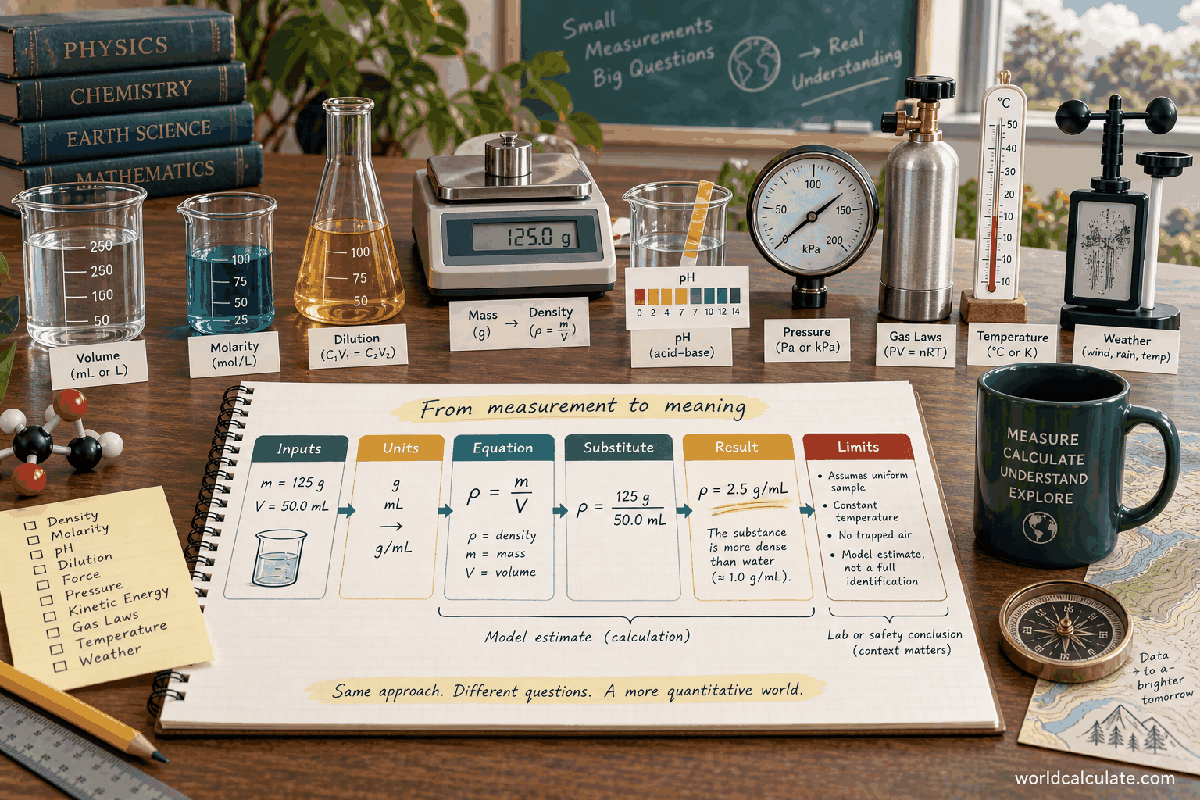
Molar mass connects a chemical formula to a usable mass for one mole of the substance. To calculate it, read the formula as a set of element symbols, determine how many atoms of each element are present, multiply each count by the appropriate standard atomic weight, and add the contributions. This calculator makes that process visible: you enter a formula such as H2O, and the result includes a total in grams per mole together with a per-element breakdown. The breakdown is useful because a plausible-looking total can still hide a capitalization or subscript mistake. A formula is not a measurement of how much material you have; it describes composition, while the unit mol adds an amount scale. This guide explains how atomic weights become molar mass, how ordinary digits and parentheses change atom counts, and how to interpret the result for molecules and formula units. It also sets out the exact input scope. The parser accepts element symbols, positive whole-number counts, and one level of round parentheses. It does not guess at hydrates, charges, decimal atom counts, isotope labels, nested groups, or elements outside its supported mass table. Read the notation carefully, reproduce the arithmetic in the displayed breakdown, and round the final answer to a precision that the inputs can support.
Molar mass is the mass of one mole of a specified substance. Its unit is grams per mole, written g/mol. The word specified matters: the substance is identified by its formula, and the formula determines the count of every element in one molecule, formula unit, or other stated entity. Once M is known, the ordinary relationship n = m / M converts a measured mass m into an amount n in moles. The reverse relationship m = n x M converts a chosen amount into a mass.
The calculation itself is a weighted count. If a formula contains two atoms of hydrogen and one atom of oxygen, the hydrogen contribution is 2 x 1.008 and the oxygen contribution is 1 x 15.999. The total is not found by averaging the symbols or by adding the element names. It is the sum of each atom count multiplied by its standard atomic weight. A subscript or a parenthetical multiplier can change the count before any multiplication is done.
The page asks for one chemical formula, not a mass, concentration, reaction equation, or quantity coefficient. Entering H2O describes the composition of water; it does not say whether you have 0.1 mol, 18.015 g, or one container. The output supplies the conversion factor that lets you use a separate mass or mole measurement. Keeping composition and amount separate prevents a common misunderstanding: 18.015 g/mol is not the mass of one water molecule and is not the mass of every sample of water.
An atomic weight is a relative mass assigned to an element, based on the masses and natural abundances of its isotopes under the standard reference convention. It is expressed as a number relative to a unified atomic mass unit, but the same numerical value is used as grams per mole when it is applied to one mole of atoms. For everyday formula calculations, this lets 1.008 for hydrogen act as 1.008 g/mol for a mole of hydrogen atoms and 15.999 for oxygen act as 15.999 g/mol for a mole of oxygen atoms.
The mass table used here includes values such as H = 1.008, C = 12.011, N = 14.007, O = 15.999, Na = 22.990, Cl = 35.450, and Ca = 40.078. These are reference values with a deliberate number of displayed digits, not atom counts and not the mass of a single atom in grams. When a formula contains three oxygen atoms, the contribution is three times the oxygen entry. When the formula contains no oxygen, there is no oxygen contribution, even if oxygen is common in other compounds.
Natural elements can have more than one isotope, so an atomic weight is generally an abundance-weighted value rather than the mass of one selected isotope. A sample with unusual isotope enrichment can have a different precise mass from the standard value. This calculator uses the standard entries in its supported table because that is the normal convention for introductory stoichiometry and routine formula-mass work. It does not infer isotope composition from an ordinary formula.
The supported table is finite. A chemically familiar symbol can still be rejected if it is not included in this calculator's mass table. That is a scope boundary, not evidence that the element is unreal or that the formula is misspelled. Check the capitalization first, then confirm that the page supports the symbol. The calculator does not silently substitute a nearby element or invent a mass, because an invented value would make the final total look precise while being chemically wrong.
Chemical formulas are read as a sequence of symbols and counts. An uppercase letter begins an element symbol. It may be followed by one lowercase letter, as in Na, Cl, or Ca. A lowercase letter cannot begin a new symbol in this input format. If no digit follows an element symbol, its count is one. Thus NaCl contains one sodium atom and one chlorine atom, not zero atoms for either symbol and not a single element named NaCl.
The ordinary text form uses normal keyboard letters and digits. In printed chemistry, a count is often shown as a small subscript, but the input should use the corresponding ordinary digit: H2O rather than a typographic subscript character. Whitespace is removed before the formula is read, so spaces do not separate tokens. Entering H 2 O is treated like H2O, and entering C a is treated like Ca. Do not use spaces as a visual separator when the intended symbols could change.
Capitalization is part of the formula's meaning. CO2 starts with C for carbon, followed by O for oxygen and a count of two. Co would be the symbol for cobalt, while CO is not a two-letter symbol. Na is sodium, but NA is not the same valid symbol. Cl is chlorine, but CL does not mean chlorine in this case. The parser checks the exact uppercase and lowercase pattern and reports a capitalization reminder when a symbol is unknown.
A formula also differs from a reaction coefficient. The leading 2 in 2H2O says there are two formula units of H2O in a written equation; it is not part of the composition of one water unit. This page calculates the mass for one formula unit or molecule, so a leading coefficient is outside the accepted formula notation. Multiply the finished molar mass by the reaction coefficient separately if a stoichiometric problem calls for it.
A digit immediately after an element symbol gives the number of atoms of that element in the formula unit. In CO2, the 2 belongs only to O. The carbon count is one because C has no digit, and the oxygen count is two because O is followed by 2. In C6H12O6, the counts are six carbon atoms, twelve hydrogen atoms, and six oxygen atoms. Each count is applied before the corresponding atomic weight is multiplied.
A missing digit is never a count of zero. H2O therefore has two H atoms and one O atom. H2O2 has two H atoms and two O atoms, so it is a different composition with a different molar mass. Likewise, CaOH2 has one Ca, one O, and two H under the parser's left-to-right rules; it is not the same written formula as Ca(OH)2, which has two O and two H because of the group multiplier.
This input scope requires counts to be positive whole numbers. A zero count has no useful chemical meaning in a formula and is rejected. Decimal counts such as C1.5 or O0.5 are not accepted, because the parser treats formula subscripts as atom counts rather than as mixture proportions. Fractional amounts belong to a separate stoichiometric calculation after the formula's molar mass has been determined.
If a symbol appears more than once in a syntactically accepted formula, its contributions are accumulated. Ordinary chemical writing usually combines repeated occurrences into one symbol with one subscript, so a normalized formula is easier to read and audit. The safest habit is to write each element once where practical, use the smallest clear integer subscripts, and then compare the resulting counts with the intended composition.
Round parentheses let a formula treat several element symbols as one group. A digit after the closing parenthesis multiplies every element inside that pair. In Ca(OH)2, the group OH occurs twice. The calcium symbol is outside the parentheses and remains present once. The group is not a new element and the 2 does not multiply calcium merely because calcium appears nearby.
A reliable reading method is to pause at the opening parenthesis, list the symbols inside, find the multiplier after the closing parenthesis, and multiply each internal count by that number. The group OH has one O and one H before multiplication. After the 2 is applied, the group contributes O2 and H2. Together with Ca1 outside the group, the complete count is Ca1, O2, H2.
The same rule works when an element inside the group already has a subscript. For Al2(SO4)3, the outside aluminum count is two. Inside the group, S has count one and O has count four. The group multiplier changes those counts to S3 and O12. The expanded count is therefore Al2S3O12. The mass contributions using the page's entries are Al: 2 x 26.982 = 53.964, S: 3 x 32.060 = 96.180, and O: 12 x 15.999 = 191.988 g/mol, for a total of 342.132 g/mol.
The calculator supports one level of round parentheses. A group may contain element symbols and their integer counts, but another opening parenthesis inside it is not accepted. A multiplier of one may be omitted, so Mg(OH)2 is clear while Mg(OH)1 is syntactically unnecessary. A multiplier after a closing parenthesis must also be a positive whole number. These restrictions keep the count rules visible instead of making the page guess at complicated notation.
The parser removes whitespace, then reads the remaining text from left to right. It accepts an uppercase letter followed by an optional lowercase letter for a supported element, an optional run of decimal digits for a positive whole-number count, and round parentheses for one-level groups. It checks that all characters belong to this small grammar and that each element symbol exists in the supported mass table. This is intentionally a transparent formula reader, not a general chemistry notation interpreter.
One level means that a top-level formula can contain a group such as (OH)2, but that group cannot contain another group. Ca(OH)2, Al2(SO4)3, and (NH4)2SO4 fit this boundary because the material inside each pair is made only from element symbols and counts. A nested expression such as K4(Fe(CN)6) contains a second opening parenthesis inside the first group and is rejected. Square brackets are not a workaround; they are unsupported characters in this input.
The parser also protects numerical sanity. Counts must be safe integers and the complete text is bounded in length. Empty input, a closing parenthesis without a matching opening parenthesis, an empty group, a missing closing parenthesis, a count of zero, and a malformed symbol all produce an error rather than a partial total. A formula that is syntactically accepted can still be chemically unusual, because the parser does not check valence, charge balance, phase, stability, or whether a named compound is normally isolated.
This scope explains why several familiar forms must not be forced into the field. 2H2O contains an outside coefficient, CuSO4.5H2O contains a hydrate separator and a second formula, NH4+ contains a charge, and C1.5 contains a decimal count. The correct response is to use a calculation method that understands that notation, not to delete characters until this page returns a number.
Start with H2O, the default-style example. Read the formula from left to right. H is a supported element symbol followed by the subscript 2, so the hydrogen count is two. O is another supported symbol with no subscript, so its count is one. There are no parentheses, no leading coefficient, and no charge. The complete atom count for one formula unit is H2O1, usually written simply as H2O.
Now calculate each contribution with the page's standard entries. Hydrogen contributes 2 x 1.008 = 2.016 g/mol. Oxygen contributes 1 x 15.999 = 15.999 g/mol. Add the two contributions: M = 2.016 + 15.999 = 18.015 g/mol. The result panel's breakdown should therefore show H x 2 as 2.016 and O x 1 as 15.999 before showing the total.
The order of the addition does not matter, but the count does. If the 2 were accidentally attached to oxygen, the formula would describe HO2 and the result would change. If the 2 were omitted, the formula would describe HO and the result would also change. Writing the count list before doing the arithmetic is a fast protection against both mistakes: H = 2, O = 1, then multiply and sum.
Interpreted as a molecular substance, one molecule of H2O contains two hydrogen atoms and one oxygen atom. One mole of those molecules has a mass of 18.015 g under the standard atomic-weight convention used here. A sample of 0.250 mol would therefore have a calculated mass of 0.250 x 18.015 = 4.50375 g before a sensible final rounding choice. The formula calculation supplies the factor; the sample amount supplies the 0.250 mol.
Ca(OH)2 is the clearest example of why parentheses matter. First read the calcium outside the group: Ca has no subscript, so Ca = 1. Next inspect the group OH. It contains one O and one H, and the subscript after the closing parenthesis is 2. Multiply both internal counts by 2. The expanded count is Ca1, O2, H2. The 2 never applies to Ca because Ca is outside the parentheses.
Use the atomic weights one element at a time. Calcium contributes 1 x 40.078 = 40.078 g/mol. Oxygen contributes 2 x 15.999 = 31.998 g/mol. Hydrogen contributes 2 x 1.008 = 2.016 g/mol. Adding them gives M = 40.078 + 31.998 + 2.016 = 74.092 g/mol. A display rounded to two decimal places would show 74.09 g/mol, while this calculator's three-decimal result is 74.092 g/mol from its stored entries.
Several plausible-looking shortcuts are wrong. Ignoring the group multiplier would count Ca1, O1, H1 and give 57.085 g/mol, which is the mass of a different composition. Multiplying calcium as well would count Ca2, O2, H2 and double the calcium contribution without any notation supporting that change. Writing CaOH2 removes the parentheses and means Ca1, O1, H2 under ordinary left-to-right notation, also a different composition. The punctuation is carrying chemical information.
For interpretation, calcium hydroxide is commonly treated as an ionic solid, so its written composition is more accurately discussed as formula units rather than as separate Ca(OH)2 molecules in a molecular lattice. The molar-mass arithmetic is the same either way: one mole of formula units has a mass of about 74.092 g. The formula does not tell this page anything about solubility, concentration, purity, or how the material behaves in a particular mixture.
For CO2, the first symbol is C for carbon and the second is O for oxygen. The subscript 2 follows O, so the counts are C1 and O2. There is no parenthetical group. Carbon contributes 1 x 12.011 = 12.011 g/mol. Oxygen contributes 2 x 15.999 = 31.998 g/mol. The total is 12.011 + 31.998 = 44.009 g/mol.
The case pattern is essential. CO2 means carbon dioxide because C and O are two separate one-letter symbols. Co would begin a different two-letter element symbol, cobalt, and CoO would have a cobalt symbol followed by oxygen. A lowercase first letter such as co2 is not a valid way to write carbon dioxide. Even if a formula looks visually close, changing case changes how the text is divided into symbols and can change the element counts or cause an unknown-element error.
One mole of CO2 molecules has a calculated mass of 44.009 g. If a separate problem asks for the mass of 0.100 mol, the conversion is 0.100 x 44.009 = 4.4009 g before applying the significant-figure rule for the 0.100 input. The molar-mass page does not decide whether the gas is at a particular pressure, whether a sample is pure, or how much carbon dioxide a process produces; it supplies only the formula-based conversion factor.
The unit g/mol says how mass scales with chemical amount. If a substance has molar mass M, then every one mole of its specified entities corresponds to M grams under the chosen atomic-weight convention. For water, 1.000 mol corresponds to 18.015 g, 2.000 mol corresponds to 36.030 g, and 0.500 mol corresponds to 9.0075 g before rounding. These are amount-to-mass conversions, not additional formula parsing steps.
To convert a measured mass to moles, divide by molar mass: n = m / M. A 9.0 g water sample gives n = 9.0 / 18.015 = 0.49958... mol, which should normally be reported as 0.50 mol when the measured mass has two significant figures. To convert moles to grams, multiply: m = n x M. For 0.100 mol of CO2, m = 0.100 x 44.009 = 4.4009 g, subject to the precision of the amount and the chosen reporting convention.
The formula-derived factor must match the actual chemical form of the sample. If a label describes a hydrate, a salt with a counterion, an isotope-enriched material, or a mixture, using the bare parent formula may omit mass that belongs to the requested substance. Likewise, a purity percentage and a reaction yield belong in later calculations. Molar mass is necessary for those workflows, but it is not a substitute for checking the sample identity and units.
A useful dimensional check is that grams divided by grams per mole leave moles, while moles multiplied by grams per mole leave grams. If the result has an unexpected unit, inspect whether the input amount was actually in millimoles, kilograms, or another scale. The calculator returns g/mol; any prefix conversion or concentration equation must be handled explicitly outside this one-formula result.
The phrase one mole of the substance refers to a mole of the entities represented by the formula. For a covalent substance such as H2O or CO2, those entities are commonly called molecules. For an ionic solid such as Ca(OH)2 or NaCl, the formula expresses the simplest repeating ratio in a lattice, so formula unit is the more careful term. The arithmetic does not need a different mass rule: count the written elements, apply the atomic weights, and report g/mol.
A mole contains about 6.022 x 10^23 specified entities. Therefore, a molar mass can be used with either a macroscopic mass measurement or a particle-count calculation. The page itself does not count particles, identify a crystal lattice, or draw a structure. It only makes the composition-to-mass relationship available for whatever molecule or formula unit the input represents.
An empirical formula gives the simplest whole-number ratio, while a molecular formula can contain a whole-number multiple of that ratio. For example, CH2O has a calculated mass of 12.011 + 2.016 + 15.999 = 30.026 g/mol. C6H12O6 has six times each of those counts and a calculated mass of 180.156 g/mol. The second formula has six times the empirical-formula mass because it represents six CH2O ratios per molecule.
The same total can occur for substances with different arrangements of atoms. A formula does not show bonding, geometry, isomerism, hydration state, crystal structure, or physical phase. Two materials with the same elemental formula can still have different properties, while a formula-unit calculation remains the same under the standard atomic-weight convention. Use the result as a composition calculation, not as a complete description of chemical identity.
The calculation should keep the atomic-weight entries and intermediate products until the total is formed. Rounding every contribution too early can introduce a small avoidable error, especially in a formula with many atoms or a parenthetical multiplier. This calculator reports the molar-mass result to three decimal places and formats the displayed steps to the same practical level. The underlying arithmetic is still based on the stored entries rather than on a rounded whole-number total.
Decimal places and significant figures answer different questions. Decimal places count positions after the decimal point. Significant figures count meaningful digits from the first nonzero digit. The reference entries themselves have a stated precision, and an exact integer subscript does not add measurement uncertainty. If you are using the result with a measured mass of 9.0 g, the division 9.0 / 18.015 = 0.49958... should normally be reported as 0.50 mol because 9.0 has two significant figures. Reporting 0.49958 mol would imply more certainty than the mass measurement provides.
If the mass is recorded as 9.00 g, the same calculation can support 0.4996 mol to four significant figures, assuming the standard molar mass is suitable for the sample. If a classroom convention asks for two decimal places instead, follow that stated convention, but do not confuse a formatting rule with a claim about experimental precision. When comparing an answer with a label or worksheet, use the same atomic-weight table and rounding policy before deciding that two close totals disagree.
Rounding is best postponed until the final requested quantity. Keep guard digits while multiplying counts and while converting between grams and moles, then round once at the end. A formula with exact integer counts can still produce a decimal molar mass because atomic weights are reference values. Conversely, a long calculator display is not automatically more accurate: the meaningful result is limited by the mass convention, the sample identity, and the precision of any measured input used with it.
A hydrate formula includes water associated with a compound, often written with a dot, as in CuSO4.5H2O. The dot separates the parent formula from a specified number of water units; it is not ordinary punctuation that can be ignored. This parser rejects the dot and does not combine the two parts automatically. Removing the dot or typing CuSO45H2O would create a different sequence of symbols and counts, not a faithful hydrate calculation.
Charged formulas also use notation that this field does not accept. Examples include NH4+, SO4^2-, and bracketed complex ions. The plus, minus, caret, and square brackets are outside the accepted character set. Charge changes the electron count and is important for chemical interpretation, but the page does not attempt to represent an ion's charge or verify charge balance. A neutral-looking formula with the charge removed may be a different input contract, not a safe simplification.
Isotope-specific notation is another separate case. A label such as [13C] identifies a particular isotope, while the ordinary C entry represents the standard atomic-weight convention. The brackets and isotope digits are not recognized as ordinary formula syntax. A decimal atom count such as C1.5 is likewise rejected. Formula subscripts describe whole-number counts in one formula unit; fractional amounts belong to mixtures, averages, or stoichiometric coefficients outside this parser.
Nested parentheses and square-bracket coordination notation are also excluded. If a problem includes any of these forms, preserve the original notation and use a method that explicitly supports it. Do not drop a dot, charge, isotope marker, bracket, or decimal point just to obtain a result, because the returned number could be precise arithmetic for the wrong composition.
Capitalization mistakes are the most common failure. Typing co2, CO2 with a mistaken symbol boundary, or CL instead of Cl changes the parser's reading. Start each symbol with an uppercase letter, use one lowercase letter only when it belongs to a two-letter symbol, and check the case of every symbol before investigating the arithmetic. A rejection that names an unknown symbol often points directly to this issue.
Parentheses are another frequent source of an apparently reasonable but wrong total. In Ca(OH)2, multiply both O and H by two. Do not multiply Ca, and do not treat CaOH2 as an equivalent shorthand. The same check applies to a group containing an internal subscript: in Al2(SO4)3, the 3 multiplies both the one S and the four O inside the group, producing S3 and O12.
Do not add a reaction coefficient, state label, or charge to the formula field. Inputs such as 2H2O, H2O(l), NH4+, and CuSO4.5H2O represent more than one formula unit or use notation beyond this page's grammar. Do not type typographic subscripts such as H2O with special small characters if the input control expects ordinary text digits. The accepted form is plain element symbols, ordinary digits, and the supported round parentheses.
Remember that spaces are removed. A space does not make a visual boundary safe: C a becomes Ca, and H 2 O becomes H2O. Also remember that the element table is limited. If a correctly capitalized symbol is rejected, it may be outside the page's supported entries rather than a typo. Finally, inspect the breakdown after calculation. If the listed counts do not match the formula you intended, stop and correct the formula before using the total in another calculation.
Molar mass is a basic conversion factor in stoichiometry. Once a balanced reaction identifies how many moles of each substance are related, molar mass converts the required amount into a mass that can be weighed or the measured mass into moles that can be compared. The formula page handles the substance-specific part. It does not balance the reaction, identify the limiting reactant, or decide which product is expected.
For solution preparation, a common later relationship is mass = concentration x volume x molar mass when concentration is expressed in mol/L and volume in L. The molar-mass result supplies only the last factor. The chemist must still confirm the correct chemical form, concentration basis, final volume, purity, water content, and handling procedure. A correct molar mass cannot correct a mistaken unit, an incorrect bottle label, or an unsuitable preparation method.
The same factor appears in gravimetric analysis, precipitation calculations, combustion analysis, gas-sample interpretation, dilution planning, and educational laboratory worksheets. In each case, the formula should be written before the number is entered. If a solid is a hydrate, if an ion has a counterion, or if a reagent is sold at a stated purity, those facts must be included in the larger calculation even though they are outside this one-formula parser.
The page is also useful as a quick independent check. A student can compare the per-element breakdown with a hand calculation. A lab worker can verify that a bottle label's formula has been transcribed with the right case and parentheses before using a mass conversion. For regulated, hazardous, or high-consequence work, treat this result as arithmetic support and follow the applicable laboratory procedure, documentation, and review controls.
Begin with the exact formula for the substance you intend to calculate. Copy the element symbols with their original case, convert printed subscripts to ordinary digits, and leave any reaction coefficient outside the formula. If the formula has parentheses, mark which symbols are inside each pair and identify the multiplier after the closing parenthesis. This preparation is faster than debugging a total after the wrong composition has already been used.
Next make a count list. For H2O, write H = 2 and O = 1. For Ca(OH)2, write Ca = 1, O = 2, and H = 2 after expanding the group. For CO2, write C = 1 and O = 2. Multiply each count by the matching atomic weight, keep the intermediate digits, and add the results. The displayed breakdown should reproduce the same element order and contributions, making it an immediate second check.
Before using the total, inspect the scope and the unit. Confirm that the formula has no hydrate dot, charge, decimal count, nested group, unsupported bracket, or unlisted symbol. Then ask whether the intended entity is a molecule or a formula unit, and whether the standard atomic-weight convention is appropriate. Finally, choose the final rounding based on the purpose of the calculation and the precision of any measured mass or amount that will be combined with M.
For an extra hand check, estimate the size of the answer before adding. A formula with two oxygen atoms should have an oxygen contribution close to 32 g/mol; Ca(OH)2 should be greater than the calcium contribution alone by roughly 34 g/mol; CO2 should be a little above 44 g/mol. A rough estimate cannot replace the exact sum, but it can expose a missing multiplier or a misplaced decimal immediately.
This calculator is a formula-mass tool, not a full chemical identity service. It recognizes a bounded set of element symbols and applies the stored standard atomic weights. It does not know whether an arbitrary syntactically valid combination is a stable compound, whether the formula has a chemically reasonable valence pattern, or whether a material exists in the phase or purity assumed by a separate experiment. Acceptance means the notation can be counted, not that the substance has been certified.
The result also depends on the selected mass convention. Standard atomic weights are appropriate for many ordinary calculations, but isotope-enriched samples, narrowly specified isotope measurements, and materials with unusual natural isotope distributions can require a different basis. The page does not infer that basis from the symbol. It likewise does not add solvent, water of crystallization, counterions, impurities, or residual reagents unless they are represented in an accepted formula.
The parser's boundaries are deliberately conservative: one level of round parentheses, positive whole-number counts, plain supported symbols, and one formula unit at a time. Hydrates, charges, decimals, isotope labels, nested groups, square brackets, outside coefficients, and unsupported elements are not converted into an approximate answer. This protects against silent misinterpretation, but it means a visitor must choose another method for notation outside the contract.
Use the total and breakdown as transparent arithmetic evidence. Preserve the original formula, record the atomic-weight convention and rounding choice when the result matters, and have a qualified person review high-consequence work. The page cannot verify a label, measure a sample, calculate purity, predict a reaction, or replace a laboratory procedure. Its strength is narrower and useful: it shows how an accepted formula becomes a molar-mass number.
What is the difference between molecular weight and molar mass? Molecular weight is often used informally for the relative mass of a molecule, while molar mass attaches a mass unit to one mole of those molecules. This page reports molar mass in g/mol. The numerical sum of atomic-weight entries is the bridge between the two ideas, but the unit and the amount scale should be stated when a result is used in a calculation.
What does an omitted subscript mean? It means one atom of that element. H2O has one O, and CO2 has one C. It never means zero. A missing subscript is one of the reasons writing a count list is helpful: every symbol that appears contributes once unless a digit or group multiplier changes its count.
Why does Ca(OH)2 have two oxygen atoms and two hydrogen atoms? The 2 comes after the closing parenthesis, so it multiplies the complete OH group. Calcium is outside that group and remains at count one. Expanding the formula before adding masses gives Ca1, O2, H2 and prevents the common mistake of applying the multiplier only to the last symbol or to calcium as well.
Can I enter a coefficient such as 2H2O? No. A leading coefficient describes two formula units in a reaction or amount statement, not the composition of one formula unit. Calculate H2O first, then multiply its molar mass by two in the separate stoichiometric step if the problem requires two moles or two formula units.
Can I enter a hydrate or an ion with a charge? Not in this input contract. A hydrate dot, charge mark, caret, or square bracket is rejected because the parser handles one uncharged formula unit with one level of round parentheses. Removing those marks would change the composition, so preserve them and use a method designed for that notation.
Why was a familiar element symbol rejected? Check its capitalization and then check the page's supported element table. C and Ca, for example, are different symbols, and a lowercase first letter is not valid. Even a correctly capitalized element may not be included in this bounded calculator. The page reports the limitation instead of substituting an unverified atomic weight.
Should I report 74.092 or 74.09 for Ca(OH)2? Use the precision requested by the context. The stored entries give 74.092 g/mol, while two decimal places gives 74.09 g/mol. If you combine the value with a measured quantity, significant figures from that measurement may require still another final format. State the rounding rule when the number is being recorded for a lab or report.
Is 18.015 g/mol the mass of one water molecule? No. It is the mass associated with one mole of H2O molecules under the standard convention. A single molecule has a mass many orders of magnitude smaller. The molar unit is what makes the formula sum useful for weighing samples and converting between grams and moles.
Why does case matter in CO2? C and O are separate one-letter symbols, so CO2 is carbon dioxide. A two-letter symbol would begin with an uppercase letter and continue with a lowercase letter, such as Co. Changing the case changes the token boundaries. Always preserve the chemical formula's capitalization rather than using all uppercase letters for visual convenience.
Can I use a fractional subscript for a mixture? No. Formula subscripts in this page are positive whole-number atom counts. A fractional amount can describe a mixture ratio, an average composition, or a stoichiometric coefficient, but it does not belong in this formula parser. Determine the appropriate whole-number formula or use a method that explicitly models the mixture before calculating a mass.
Molar mass of a formula with per-element mass breakdown.
M = Σ(count × atomic weight). Element counts times standard atomic weights sum to the molar mass. One level of parentheses allowed, e.g. Ca(OH)2.
Enter Chemical formula, then choose Calculate.
Standard atomic weights; integer counts with one-level parentheses. Single formula unit; no hydrates with dots or charges.
This calculator is part of the WorldCalculate library. Its formula, example, assumptions, input bounds, and output formatting follow the official methodology.
These WorldCalculate collections connect this tool with related questions while keeping each calculation separate and transparent.