
Goal
Buffer pH from pKa and base/acid concentrations.
Worldwide context
Saved once here, used across the site.
Currency changes display only. Country selection guides tax input; no tax rate is guessed.
Buffer pH from pKa and base/acid concentrations.
pH = pKa + log10([base]/[acid]).A clearer path to an answer
This page keeps the calculation transparent: define the goal, enter the matching values, inspect the method, and decide what the result means in your situation.
Buffer pH from pKa and base/acid concentrations.
pKa · Base concentration · Acid concentration
pH = pKa + log10([base]/[acid]).
Calculate, review the assumptions below, then compare a related tool when the decision needs more context.
Buffer pH from pKa and base/acid concentrations.
Open the Buffer pH pageMore science tools
Download PDFDownload Word (.doc)
Enter your values above and choose Calculate to see the result here.
Calculation map
pH = pKa + log10([base]/[acid]).
Bounded, transparent calculation
Your recent runs stay in this browser session only.
Formula: pH = pKa + log10([base]/[acid]).
Henderson–Hasselbalch adds the log of the base-to-acid ratio to pKa. Equal concentrations give pH equal to pKa.
Worked example: pH 4.76.
The displayed limits are checked before the handler runs. Model-specific domain checks may also reject impossible or non-finite inputs.
Methodology: This calculator follows the WorldCalculate input, formula, precision, and boundary policy. Read the official methodology.
Calculator usage statistics
This section counts anonymous successful Calculate submissions, not unique visitors. Counts and top tools appear only when trusted aggregate data is available; country analysis is shown only under the same condition and reporting threshold.
Answer-first guide
Buffer pH from pKa and base/acid concentrations. Start with one clearly defined goal, enter values in the units shown, and keep the result attached to the assumptions below.
This tool is useful when your question includes buffer pH, Henderson-Hasselbalch, pKa. It returns the outputs declared in the calculator contract rather than a live quote, approval, diagnosis, or professional sign-off.
pKa · Base concentration · Acid concentration. Keep the same time period, unit system, and currency wherever the form requires comparable values.
Run the worked example first, compare its output with the page's example, then change one input at a time. This makes an unexpected result easier to trace to a unit, boundary, or assumption.
Need a wider view? Browse Science Calculators or compare the related tools below. The WorldCalculate methodology explains how formulas, examples, limits, and revisions are reviewed.
pH = pKa + log10([base]/[acid]).
Henderson–Hasselbalch adds the log of the base-to-acid ratio to pKa. Equal concentrations give pH equal to pKa.
pH 4.76.
Context and background
Science calculators define a system, choose an equation, apply units and constants, and show the substitution. Effects outside that model remain outside the result.
Introductory science problem solving builds from measured quantities and idealized relationships. Those models are valuable for learning and first-pass estimates, while experiments and engineering decisions need additional evidence.
Research and review
Researched by Hassan ALRowaie, Founder and editorial researcher at WorldCalculate.
This guide follows the live calculator's declared inputs, formula, worked example, assumptions, validation boundaries, and source-backed methodology. The review date describes editorial review of the calculator explanation; it is not a promise that external facts or rates remain current.
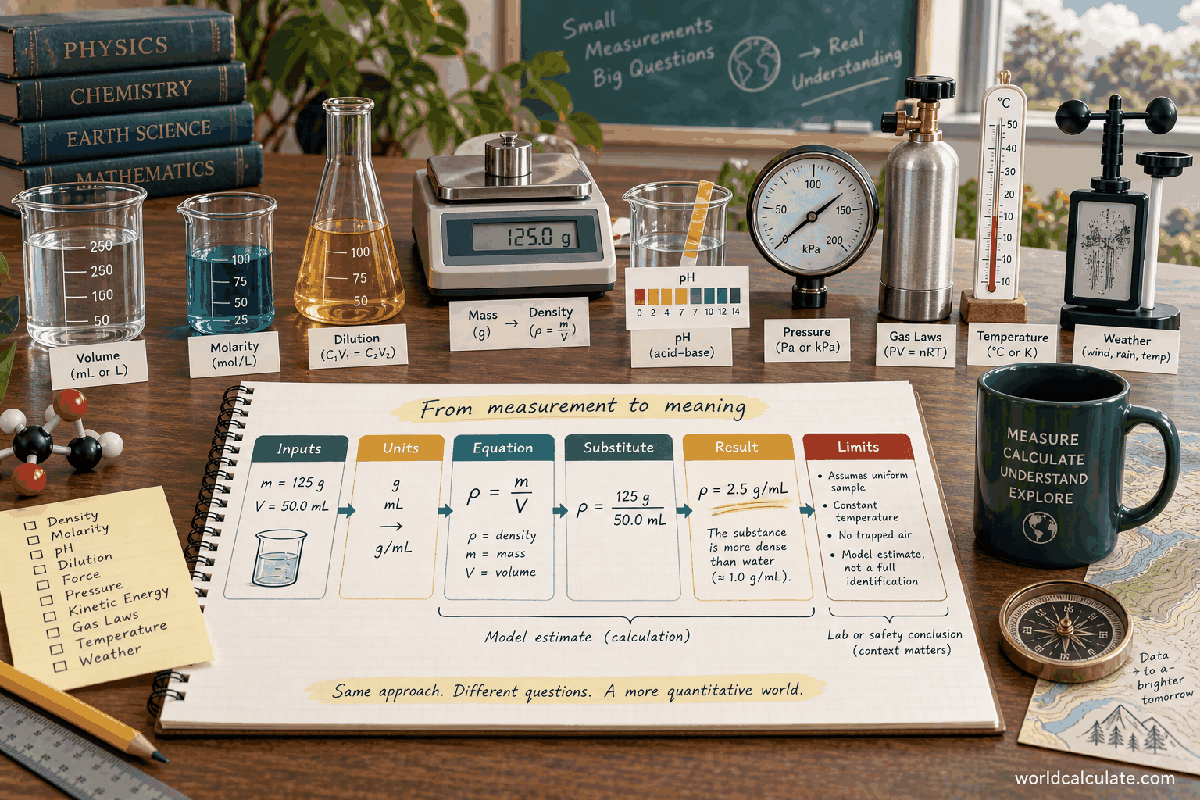
A buffer pH estimate compares the amount of a weak acid with the amount of its conjugate base. This calculator asks for pKa, the base concentration, and the acid concentration, then applies pH = pKa + log10(base/acid). The calculation is deliberately narrow: it describes a dilute, approximately ideal solution containing a conjugate acid-base pair near its buffer region. Equal concentrations give a pH equal to pKa because their ratio is one. The page does not simulate a titration, calculate buffer capacity, or correct for ionic activity. Its value is that the assumptions and the ratio are visible rather than hidden behind a generic pH number. This guide explains what each field means, how the numeric validation behaves, how to work through representative ratios, how the two-decimal display should be read, and why a realistic mixture may require a fuller equilibrium treatment.
A buffer is a solution arranged so that its pH changes less than it would in an unbuffered solution when a modest amount of acid or base is introduced. The usual pair is a weak acid, written HA, and its conjugate base, written A-. The weak acid can donate a proton, while the conjugate base can accept one. Because both forms are already present, a small disturbance is distributed between them instead of being represented only by free hydrogen ions.
The calculator does not model the disturbance itself. It starts with the concentrations of the two members of the pair and estimates the current pH. That makes the page useful for checking the relationship between composition and pH, but it does not answer how many moles of strong acid can be added before a target pH is crossed. That second question concerns buffer capacity and requires additional information such as total concentration, volume, and the added reagent.
The word buffer also has a boundary. A solution containing an arbitrary acid and an arbitrary base is not automatically a conjugate buffer pair. The formula used here is most defensible when the entered base and acid are the conjugate forms of one weak-acid system and both are present in meaningful amounts. If one form is absent or nearly absent, the approximation becomes poor and a different acid-base calculation is needed.
The pKa field is a dimensionless logarithmic acidity measure for the weak-acid system. The handler accepts a finite numeric pKa from -5 through 20. The range is intentionally broad enough for many educational and laboratory examples while still bounding the calculation. The field is not a text formula field and does not accept a chemical name from which a pKa might be looked up.
The Base concentration field is the concentration of the conjugate base, and Acid concentration is the concentration of the weak acid. Each must be a positive finite number from 1e-12 through 100 mol/L. The catalog labels both fields in mol/L. Use the same concentration unit for both values; mol/L is the displayed contract, and using different units would give a ratio with the wrong scale.
Only the ratio of base to acid enters the equation. If the two concentrations refer to equal volumes of the same solution, their ratio is also the ratio of amounts in moles because the common volume cancels. If the entries come from separate volumes, convert them to concentrations or amounts consistently before entering them. The calculator cannot identify a volume mismatch or a hidden dilution step.
For the equilibrium HA exchanging a proton with water to form H+ and A-, the acid dissociation constant relates the concentrations of the three species. Under the dilute ideal-solution approximation, rearranging that relationship gives pH = pKa + log10([A-]/[HA]). The calculator names [A-] Base concentration and [HA] Acid concentration, so the entered ratio is baseConc divided by acidConc.
The formula has a useful reference point. When baseConc equals acidConc, the ratio is one and log10(1) is zero. The pH is then pKa. If the base concentration is ten times the acid concentration, the logarithm adds one pH unit. If the base is one-tenth of the acid, the logarithm subtracts one pH unit. The logarithm turns multiplicative composition changes into additive pH changes.
The equation is not a universal definition of pH for every mixture. It is a rearranged equilibrium approximation that presumes the named concentrations can stand in for the relevant activities and that the pair is in the region where both forms matter. The page's note states that dilute ideal behavior near pKa is the intended scope, so treat the output as a model result rather than a direct measurement.
The pKa is the negative base-ten logarithm of the acid dissociation constant. A lower pKa corresponds, in the usual comparison sense, to an acid that gives up a proton more readily than one with a higher pKa. The calculator does not derive pKa from a structure or temperature. It treats the entered value as a property supplied for the particular acid-base system and conditions being considered.
At pH equal to pKa, the idealized equilibrium relationship places the acid and conjugate-base concentrations at equality. That is why pKa is the center of the most familiar buffer region. Moving one pH unit above pKa corresponds to a base-to-acid ratio of ten, while moving one pH unit below corresponds to a ratio of one-tenth. The composition changes by a factor of ten for each pH unit in this simplified relationship.
A pKa should not be treated as a universal constant independent of environment. Temperature, solvent, ionic strength, and the definition of the measured concentration can affect an experimentally relevant value. If a source gives a pKa under conditions different from the mixture being studied, entering that value may produce a neat number that is not appropriate for the actual system.
The handler receives three numeric values and checks each with the same finite-number boundary helper. A value must have JavaScript number type, must not be NaN or an infinity, and must fall inside the field's minimum and maximum. A numeric-looking text value is not silently parsed inside the handler. The surrounding form normally supplies numbers, but an integration that calls the handler directly must provide actual numeric values.
The concentration lower bound is 1e-12 mol/L, not zero. A zero acid or zero base would make the ratio zero or infinite, and the logarithm would not represent the intended two-component buffer relationship. Negative concentrations are rejected for the same reason. The upper bound of 100 mol/L is a guard against accidental extreme inputs; it is not a claim that every solution at that concentration behaves ideally.
The pKa range is checked independently from the concentrations. A pKa at either boundary is accepted if it is finite, and a concentration at either positive boundary is accepted. The handler then calculates the ratio, takes base-ten logarithm, and adds pKa. The bounded input ranges keep the ratio finite, so the returned pH is finite for every accepted combination. There is no separate chemical plausibility check for a chosen acid, base, temperature, or solvent.
Use the catalog example pKa = 4.76, Base concentration = 0.1 mol/L, and Acid concentration = 0.1 mol/L. The ratio is 0.1 divided by 0.1, which equals 1. The logarithm of 1 in base ten is 0, so pH = 4.76 + 0 = 4.76. This is the simplest way to see why a buffer with equal amounts of the two conjugate forms is centered at its pKa in the approximation.
The equality is about the two entered concentrations, not about the acidity of every substance in the vessel. It assumes the values refer to the same conjugate pair and use the same volume and concentration basis. If a preparation record says that equal molar amounts were mixed but the final volumes differ or a reaction changes one component, the final concentrations may not remain equal. Use the concentrations at the state being estimated, not the initial recipe alone.
The output is one result labeled Buffer pH. It carries numeric precision metadata of 2, so this example is displayed as 4.76. The pH is not displayed with a unit label. The internal calculation is not changed to two decimal places before the addition; the precision controls presentation after the formula has been evaluated.
Keep pKa = 4.76, enter Base concentration = 0.20 mol/L, and enter Acid concentration = 0.10 mol/L. The ratio is 2. The calculation is pH = 4.76 + log10(2). Since log10(2) is approximately 0.30103, the unrounded result is about 5.06103 and the displayed result is 5.06. Doubling the base does not add a full pH unit because a full unit requires a tenfold ratio.
The direction is as important as the decimal. More conjugate base relative to acid makes the logarithmic term positive, so the estimated pH is above pKa. If the entries were reversed, the ratio would be 0.5, log10(0.5) would be approximately -0.30103, and the estimate would be about 4.45897, displayed as 4.46. Swapping the two fields therefore reflects the chemistry of changing which form is more abundant.
This example is also a reminder to keep concentration units aligned. A base value of 0.20 mol/L and an acid value of 100 mmol/L describe equal concentrations after conversion, not a ratio of 2. The calculator does not convert prefixes or inspect unit text, so convert 100 mmol/L to 0.10 mol/L before entering it.
Now use pKa = 7.20, Base concentration = 0.025 mol/L, and Acid concentration = 0.100 mol/L. The ratio is 0.25. The logarithm is approximately -0.60206, so pH = 7.20 - 0.60206 = 6.59794. The page displays 6.60. The negative correction is expected because the acid form is four times as concentrated as the conjugate base.
If the base-to-acid ratio is one-tenth, the logarithmic term is -1 and the pH is one unit below pKa. If the ratio is one hundredth, the term is -2. Those examples illustrate both the usefulness and the limit of the formula: the pH shift is easy to compute, but an extremely unbalanced pair is generally farther from the strongest buffering region. The page will still calculate an accepted positive ratio; it does not label the result as a good or poor buffer.
When comparing scenarios, change one input at a time and keep the pKa fixed if the acid system is meant to be the same. If pKa and composition both change, a different output can result from two causes. A small table of ratio, logarithmic correction, and displayed pH is often clearer than comparing pH values without recording the mixture that produced them.
The returned pH is a logarithmic estimate, so a difference of one pH unit represents a tenfold difference in the relevant hydrogen-ion activity under the usual definition. The calculator's formula expresses that logarithmic scale through the base-to-acid ratio. A result slightly above pKa means the conjugate base is more abundant in the entered ratio; a result below pKa means the weak-acid form is more abundant.
Do not read the number as a direct measurement of a probe or indicator. A measured pH can differ because of calibration, temperature, ionic strength, activity effects, dissolved gases, contamination, or a mixture containing additional acid-base systems. The calculator cannot compare its output with a measurement unless the user does that comparison separately and checks that both refer to the same sample and conditions.
The value can lie outside the familiar 0 to 14 classroom range because the accepted pKa and concentration bounds are mathematical input bounds rather than a clamp. An output below 0 or above 14 is not automatically a software error, but it may signal that the simple buffer approximation is being used outside the ordinary aqueous context. Interpret it with the entered chemical system and its real conditions in mind.
Multiplying both concentrations by the same positive factor leaves their ratio unchanged. In the calculator, changing 0.10 mol/L acid and 0.10 mol/L base to 0.010 mol/L each therefore leaves the estimated pH at pKa. This is the composition part of the model. The physical ability of the solution to resist an added disturbance does change with total concentration, however, so unchanged pH does not mean unchanged buffer capacity.
The same cancellation explains why a common volume does not matter when both entries are concentrations for one uniform solution. What matters is the relative abundance of the two forms at the state of interest. A dilution that affects one form differently, precipitation, incomplete mixing, or a reaction that consumes one form breaks the simple common-scaling story.
Concentration magnitude still matters for model suitability. The handler allows values from 1e-12 to 100 mol/L to keep the calculation bounded, but those endpoints span conditions where ideal dilute behavior may be especially questionable. The validation range is an input contract, not a guarantee that activity coefficients are negligible or that the solution can physically be prepared at the requested concentration.
The handler uses a base-ten logarithm on the ratio and adds the entered pKa using JavaScript finite numbers. Accepted positive concentration bounds keep division away from zero and infinity. The formula is evaluated before formatting, so a value such as 5.06103 is not first truncated to 5.06 and then used in another operation. The page returns the pH as a numeric result with a precision setting rather than as preformatted text.
The single result is labeled Buffer pH, uses number format, has an empty unit field, and requests precision 2. That means the normal display is two decimal places, including a trailing zero when needed, such as 6.60. The steps preserve the entered pKa, base, and acid values in a readable formula line. Those steps are an audit aid, not an extra equilibrium calculation.
Two displayed decimals do not imply that the inputs or pKa are known to two decimal places. If the pKa is an approximate literature value or the concentrations are measured with limited precision, report uncertainty or significant figures appropriate to the source. Conversely, do not mistake a long internal floating-point value for chemical accuracy. Numerical precision and experimental validity are separate questions.
For teaching, the page makes the central ratio rule easy to vary. Hold pKa at 4.76 and move from equal concentrations to a two-to-one or ten-to-one base-to-acid ratio. The output shows why the pH moves slowly for modest ratio changes and by one unit for each tenfold change. Students can also reverse the fields to test whether the sign of the logarithmic correction makes sense.
For a preparation worksheet, the calculator can serve as a quick scenario check after the final acid and base concentrations have been determined. Record the identity of the conjugate pair, the pKa source and conditions, the concentration units, the final volume basis, and the temperature alongside the numeric result. The page is most useful as one transparent line in a larger preparation or quality-control record.
For troubleshooting, compare the calculated estimate with a measured pH only after checking units and composition. A discrepancy may reveal a mistaken concentration, an incorrectly selected pKa, a field swap, or a real model limitation. Do not simply adjust the pKa until the number matches a measurement; that would conceal the difference rather than explain it.
The formula uses concentrations as a stand-in for activities. In a sufficiently dilute solution, that can be a useful approximation. In a more concentrated or strongly ionic solution, interactions between particles change effective activities, and the concentration ratio may not reproduce the thermodynamic ratio closely. The catalog assumption explicitly says that activity corrections are ignored, so the displayed pH should not be presented as an activity-corrected prediction.
Temperature can affect both pKa and the relationship between measured pH and equilibrium composition. Solvent composition can matter as well. A value that is appropriate in one aqueous laboratory condition may not transfer unchanged to a mixed solvent, a high-salt formulation, or a different temperature. Entering a finite pKa does not make those environmental variables disappear.
The page also assumes that the base and acid labels identify the relevant conjugate pair. Additional buffers, amphiprotic species, metal binding, precipitation, gas exchange, and side reactions can redistribute the forms. If several equilibria contribute materially, a single ratio equation is not enough. Use a species-balance and equilibrium model appropriate to the system rather than treating this result as a complete speciation calculation.
The handler does not calculate the initial pH of a strong-acid or strong-base solution, water autoionization, or the exact equilibrium concentrations generated from a recipe. It assumes the acid and conjugate base concentrations are already available as inputs. It also does not infer the concentrations from grams, molar mass, stock strength, dilution volume, or a titrant volume.
There is no temperature field, ionic-strength correction, activity coefficient, volume field, total buffer concentration, or added-acid/base field. As a result, the output cannot answer how much reagent is safe to add, whether a target pH will be maintained during a process, or whether a prepared solution meets a specification. It is not a substitute for a measured pH, a validated formulation, or laboratory safety procedures.
The formula also does not automatically choose among multiple pKa values for a polyprotic acid. For such a system, different pH ranges may be controlled by different conjugate pairs, and the relevant pair must be identified before entering values. A single pKa and two concentrations are meaningful only when they match the chemical question being asked.
At the smallest accepted concentration, 1e-12 mol/L, the value is still positive and can participate in the ratio. A base at 100 mol/L and acid at 1e-12 mol/L gives a ratio of 1e14 and a logarithmic correction of 14. At the opposite extremes, the correction is -14. Combined with the pKa bounds, the mathematical output can range from -19 to 34. Those endpoints are useful validation tests but are not ordinary evidence of an ideal aqueous buffer.
A pKa of -5 or 20 is accepted because it is inside the stated contract. A concentration of exactly zero, a negative value, NaN, or an infinity is rejected. If a calculation produces an unexpected direction, first check whether baseConc and acidConc were reversed. If the result is unexpectedly far from pKa, inspect the ratio rather than focusing only on the final rounded number.
A practical reasonableness check is to ask three questions: Are the two entries the same conjugate pair? Are their units and final-state volumes comparable? Is the solution plausibly dilute and near the buffer region? If any answer is no, the page may still return a mathematically valid number, but the interpretation should be labeled outside the model's intended scope.
First identify the weak acid and conjugate base and select a pKa measured or tabulated for the relevant conditions. Next determine the final concentrations, not merely the starting quantities. Convert both to mol/L, verify that they refer to the same final solution, and write down which one is the base form and which one is the acid form. This preparation prevents the most common error, which is a swapped or mismatched ratio.
Enter pKa, baseConc, and acidConc as numeric values and check that the fields remain within their validation ranges. Calculate the ratio independently as a quick direction check. If the ratio is one, expect pH equal to pKa. If it is above one, expect a higher result; if it is below one, expect a lower result. Then compare the page's two-decimal output with the unrounded formula when a precise worksheet is needed.
Finally, report the estimate with its pair identity, concentration units, pKa conditions, rule used, and known limitations. If the application is sensitive to pH, verify with an appropriate measurement and investigate a disagreement rather than hiding it through rounding. The calculator gives a clear idealized relationship; chemical judgment determines whether that relationship is suitable for the sample.
Buffer pH from pKa and base/acid concentrations.
pH = pKa + log10([base]/[acid]). Henderson–Hasselbalch adds the log of the base-to-acid ratio to pKa. Equal concentrations give pH equal to pKa.
Enter pKa, Base concentration, Acid concentration, then choose Calculate.
Dilute ideal solution near the buffer region. Conjugate pair only; activity corrections ignored.
This calculator is part of the WorldCalculate library. Its formula, example, assumptions, input bounds, and output formatting follow the official methodology.
These WorldCalculate collections connect this tool with related questions while keeping each calculation separate and transparent.