
Goal
Calculate idealized hydraulic and delivered electrical power from entered water flow, hydraulic head, and efficiency.
Worldwide context
Saved once here, used across the site.
Currency changes display only. Country selection guides tax input; no tax rate is guessed.
Calculate idealized hydraulic and delivered electrical power from entered water flow, hydraulic head, and efficiency.
Hydraulic power P_h = rho x g x Q x H with rho = 1,000 kg/m^3 and g = 9.80665 m/s^2; delivered electrical power P_e = P_h x efficiency/100.A clearer path to an answer
This page keeps the calculation transparent: define the goal, enter the matching values, inspect the method, and decide what the result means in your situation.
Calculate idealized hydraulic and delivered electrical power from entered water flow, hydraulic head, and efficiency.
Water flow · Hydraulic head · Efficiency
Hydraulic power P_h = rho x g x Q x H with rho = 1,000 kg/m^3 and g = 9.80665 m/s^2; delivered electrical power P_e = P_h x efficiency/100.
Calculate, review the assumptions below, then compare a related tool when the decision needs more context.
Calculate idealized hydraulic and delivered electrical power from entered water flow, hydraulic head, and efficiency.
Open the Hydroelectric Power pageMore science tools
Download PDFDownload Word (.doc)
Enter your values above and choose Calculate to see the result here.
Calculation map
Hydraulic power P_h = rho x g x Q x H with rho = 1,000 kg/m^3 and g = 9.80665 m/s^2; delivered electrical power P_e = P_h x efficiency/100.
Bounded, transparent calculation
Your recent runs stay in this browser session only.
Formula: Hydraulic power P_h = rho x g x Q x H with rho = 1,000 kg/m^3 and g = 9.80665 m/s^2; delivered electrical power P_e = P_h x efficiency/100.
This ideal entered-value model converts water flow and hydraulic head into hydraulic power, then applies the entered efficiency to estimate delivered electrical power. It is arithmetic only, not site potential, turbine sizing, dam design, grid output, or safety advice.
Worked example: Hydraulic power 1,961,330 W (1,961.33 kW); delivered electrical power 1,569,064 W (1,569.064 kW).
The displayed limits are checked before the handler runs. Model-specific domain checks may also reject impossible or non-finite inputs.
Methodology: This calculator follows the WorldCalculate input, formula, precision, and boundary policy. Read the official methodology.
Calculator usage statistics
This section counts anonymous successful Calculate submissions, not unique visitors. Counts and top tools appear only when trusted aggregate data is available; country analysis is shown only under the same condition and reporting threshold.
Answer-first guide
Calculate idealized hydraulic and delivered electrical power from entered water flow, hydraulic head, and efficiency. Start with one clearly defined goal, enter values in the units shown, and keep the result attached to the assumptions below.
This tool is useful when your question includes hydroelectric power, hydropower equation, water flow power. It returns the outputs declared in the calculator contract rather than a live quote, approval, diagnosis, or professional sign-off.
Water flow · Hydraulic head · Efficiency. Keep the same time period, unit system, and currency wherever the form requires comparable values.
Run the worked example first, compare its output with the page's example, then change one input at a time. This makes an unexpected result easier to trace to a unit, boundary, or assumption.
Need a wider view? Browse Science Calculators or compare the related tools below. The WorldCalculate methodology explains how formulas, examples, limits, and revisions are reviewed.
Hydraulic power P_h = rho x g x Q x H with rho = 1,000 kg/m^3 and g = 9.80665 m/s^2; delivered electrical power P_e = P_h x efficiency/100.
This ideal entered-value model converts water flow and hydraulic head into hydraulic power, then applies the entered efficiency to estimate delivered electrical power. It is arithmetic only, not site potential, turbine sizing, dam design, grid output, or safety advice.
Hydraulic power 1,961,330 W (1,961.33 kW); delivered electrical power 1,569,064 W (1,569.064 kW).
Context and background
Science calculators define a system, choose an equation, apply units and constants, and show the substitution. Effects outside that model remain outside the result.
Introductory science problem solving builds from measured quantities and idealized relationships. Those models are valuable for learning and first-pass estimates, while experiments and engineering decisions need additional evidence.
Research and review
Researched by Hassan ALRowaie, Founder and editorial researcher at WorldCalculate.
This guide follows the live calculator's declared inputs, formula, worked example, assumptions, validation boundaries, and source-backed methodology. The review date describes editorial review of the calculator explanation; it is not a promise that external facts or rates remain current.

Hydroelectric power links a moving water flow with a hydraulic head and an energy-conversion efficiency. This calculator makes that relationship visible with a bounded SI arithmetic model. It uses a fixed water density of 1,000 kilograms per cubic metre, standard gravity of 9.80665 metres per second squared, the entered flow in cubic metres per second, and the entered head in metres. It first reports ideal hydraulic power and then applies the entered percentage to report delivered electrical power in watts and kilowatts. The boundary is essential: the page does not determine site potential, turbine sizing, dam design, grid output, environmental impact, or safety. The sections below explain the equation, units, inputs, example, limits, and responsible interpretation.
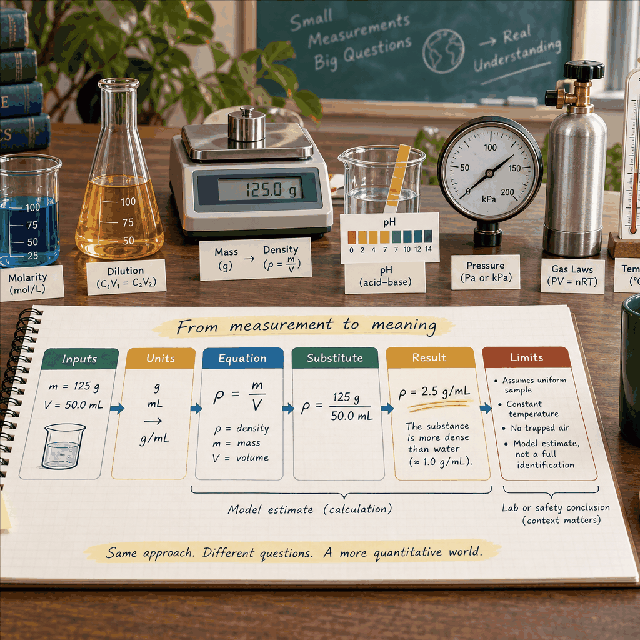
The calculator answers a direct arithmetic question: given a water flow, a hydraulic head, and an entered efficiency, what power follows from the stated equation? Flow describes how much volume passes a reference point per unit time. Head represents the energy available per unit mass in the simplified relation. Efficiency expresses the fraction of hydraulic power retained as the displayed delivered electrical estimate. Each premise is supplied by the user or fixed by the contract; the handler does not discover or verify a physical installation.
Two power outputs are useful because they keep the conversion step visible. Hydraulic power is the ideal power associated with the flow, density, gravity, and head. Delivered electrical power is that value multiplied by the entered efficiency fraction. A result can be mathematically correct while its input values are poorly measured or describe different conditions. The page therefore reports arithmetic from aligned entered values, not a promise about a real generator.
The flow field is measured in cubic metres per second. A cubic metre is a volume unit, and dividing it by a second gives a volumetric rate. The field accepts zero through 1,000,000 cubic metres per second. Zero is a valid mathematical boundary and produces zero hydraulic and delivered power, provided the other values remain valid. Negative flow is rejected because this page uses a nonnegative magnitude rather than a signed direction convention.
The numerical field does not parse a unit suffix or convert litres per second, gallons per minute, or another rate automatically. Convert a source value before entering it and record the conversion. A flow value also needs a measurement location and time basis in any real record. The handler cannot tell whether a value is an instantaneous reading, an average, a design flow, or a seasonal statistic, so those meanings must not be inferred from the output label.
The head field is measured in metres and enters the ideal relation as an energy-per-weight scale. In a simplified hydropower equation, a larger head means more gravitational energy associated with each unit of water mass, while a larger flow means more water mass passing per second. The contract allows head from zero through 10,000 metres. This broad computational range is a validation boundary, not a claim that every value describes an available or practical installation.
Head is not merely a map elevation difference typed into a form without context. Real systems can distinguish gross head from net head and account for losses, pressure conditions, and hydraulic measurement methods. This calculator does none of those things. It accepts the entered head as the value to use in the formula. If a source provides another head convention, convert or define it separately before using this page and preserve that convention in the surrounding record.
The handler uses rho = 1,000 kilograms per cubic metre as a fixed water-density constant and g = 9.80665 metres per second squared as standard gravity. These constants make the arithmetic reproducible across calls. Multiplying density by flow gives a mass rate, and multiplying by gravity and head gives joules per second, which is watts. The constants are not input fields because this batch specifies a water-focused ideal model rather than a variable-fluid or local-gravity calculator.
A fixed density is a simplification. Water density can vary with temperature, dissolved material, and pressure, and a project may use a documented value appropriate to its measurement. Gravity can vary slightly with location and convention. Those effects are outside the selected contract. The use of exact decimal constants here should be read as consistency for a classroom or worksheet calculation, not as evidence that the model has measured the physical fluid or site.
Hydraulic power is P_h = rho x g x Q x H. Here Q is flow and H is head. The unit path is kg/m^3 multiplied by m/s^2, m^3/s, and m. Cubic metres cancel, the remaining kilograms multiplied by metres squared per second squared per second form joules per second, and joules per second is a watt. The handler performs the multiplication in JavaScript number arithmetic and checks the result for finiteness before returning it.
The equation contains no turbine geometry, generator nameplate, penstock loss, friction term, availability factor, or environmental constraint. Adding any of those would create a different model with additional fields. Keeping the formula short helps a reader inspect each supplied quantity and prevents a familiar hydropower label from implying that all site-specific physics has been handled.
Efficiency is entered as a percentage from zero through one hundred. The handler converts it to a fraction by dividing by 100, then computes P_e = P_h x efficiency/100. An efficiency of 80 means 0.80 in the multiplication, not 80 as a raw multiplier. Keeping the percentage conversion explicit is important because a unit-free number can otherwise create an error of one hundred times.
The page permits an efficiency of zero and one hundred as arithmetic endpoints. Zero delivered power can represent a deliberate boundary or a conversion fraction of zero; one hundred is an ideal ceiling within this contract. The permitted range does not estimate a real machine's efficiency, and the handler does not decompose losses into hydraulic, mechanical, electrical, or transmission categories. A real performance statement needs measured or separately justified efficiency data.
The handler returns hydraulic power in watts and kilowatts, followed by delivered electrical power in watts and kilowatts. One kilowatt is 1,000 watts, so each kilowatt result is its corresponding watt result divided by 1,000. Reporting both scales avoids making a reader perform an unlabelled conversion and provides a useful check: multiplying a displayed kilowatt value by 1,000 should recover the corresponding watt value apart from display rounding.
Unit labels remain part of the result contract. A bare value such as 1,569.064 could be read as watts, kilowatts, or another power unit if copied without context. The result entries carry explicit units and the steps state the conversion. If a later document uses megawatts or an energy total over time, that is another conversion and should not be presented as if this instantaneous power page had already calculated it.
Use flow Q = 10 cubic metres per second, head H = 20 metres, and efficiency 80 percent. Hydraulic power is 1,000 x 9.80665 x 10 x 20, which equals 1,961,330 watts. Dividing by 1,000 gives 1,961.33 kilowatts. Applying the 0.80 efficiency fraction gives 1,569,064 watts of delivered electrical power, or 1,569.064 kilowatts. The ratio of delivered to hydraulic power is 0.80, which is an immediate check on the percentage conversion.
This worked example demonstrates substitution and units only. It does not show that a river, channel, reservoir, or machine can sustain those values. It does not account for head loss, flow variation, turbine operating range, generator limits, outages, or connection constraints. Keeping the example explicitly ideal prevents a clean arithmetic answer from being mistaken for a feasibility study or a design specification.
Holding all other inputs fixed, doubling flow doubles hydraulic power and delivered power. Doubling head has the same direct effect. Increasing efficiency changes delivered power but does not change the hydraulic power output, because hydraulic power is calculated before the conversion fraction is applied. These are algebraic sensitivities of the formula. They are not statements that a real site can double flow or head without changing structures, losses, environmental conditions, or operating limits.
The direct scaling can help check a worksheet. If flow changes from 10 to 20 while head and efficiency stay at 20 and 80 percent, both power results should double. If only efficiency changes from 80 to 40 percent, hydraulic power should remain fixed and delivered power should halve. A result that violates those checks may contain a unit error or an input substitution problem. The checks cannot validate the physical meaning of the entered values.
Each numeric input must be a JavaScript number, finite, and within its declared inclusive range. Numeric strings, missing values, NaN, positive infinity, negative infinity, negative flow, negative head, and efficiency outside zero through one hundred are rejected. The handler validates direct calls independently of browser field attributes. That protects the result contract when another interface, a test, or imported data calls the pure function without the current form.
The largest supported combination remains finite in ordinary JavaScript arithmetic, but every derived value still passes through a finite-result guard. The hydraulic watt value, its kilowatt conversion, the delivered watt value, and its conversion are all checked. Rejection is preferred to silently replacing an out-of-range input with a maximum or minimum, because clipping would change the scenario without telling the user that the original values were unsupported.
Site potential is broader than the product of three entered values. A site study may need a flow-duration record, seasonal variability, net head after hydraulic losses, intake and conveyance behavior, turbine and generator characteristics, maintenance and availability assumptions, environmental flows, sediment, permitting, and a definition of the delivery point. None of those data are represented by this page. A single flow and head pair is an operating-condition sketch, not an annual energy estimate or a resource assessment.
The distinction also applies to time. Power is a rate of energy transfer at an instant or a stated condition. Energy over a day or year requires integrating or aggregating power across changing conditions and applying an availability rule. Multiplying this result by an arbitrary number of hours would add an assumption that the calculator does not ask for. If a project question concerns energy yield, use a separately defined time model with source data and uncertainty stated.
The calculator does not size a turbine, generator, penstock, intake, dam, spillway, or transmission connection. It does not select materials, operating pressures, control systems, protection settings, or construction dimensions. It also does not evaluate a flood condition, structural load, worker exposure, waterway hazard, or legal requirement. Those are engineering and safety questions whose answers depend on site measurements, standards, regulations, and qualified review.
The phrase delivered electrical power in this page means the arithmetic output after the entered fraction. It does not guarantee that a grid receives that power or that a device can safely handle it. A grid operator may require interconnection studies, power-quality controls, protection, and scheduling. A dam or water conveyance system may involve public and environmental risks. The result should be labeled as an ideal entered-value estimate whenever it is copied into notes or teaching material.
A clear report records flow, head, efficiency, the fixed density and gravity constants, the formula, and the output units. It should say whether each input is instantaneous, averaged, measured, or hypothetical and should preserve the source location and time context outside the calculator. Include both hydraulic and delivered values so a reader can see where the efficiency fraction enters. Keep enough digits for an arithmetic check, then apply a stated display rounding policy for communication.
Finish the report with the model boundary. Say that the outputs are ideal entered-value arithmetic and do not represent site potential, turbine sizing, dam design, grid output, or safety advice. This is not decorative caution. It identifies exactly which questions the three fields cannot answer. The page is most useful when it is used as a transparent equation check or teaching example and then handed off to a separate, evidence-based process for any real project decision.
The model is appropriate for a classroom exercise, a unit check, a transparent comparison of supplied scenarios, or an early arithmetic note whose hypothetical status is clear. It can show how flow, head, and efficiency appear in the equation and can expose a missing factor of 1,000 between watts and kilowatts. It should not be used as a substitute for measured resource data or a professional review merely because the returned number has several decimal places.
When the question changes from what follows from these inputs to what should be built, operated, connected, or approved, the scope changes. Add the necessary data and engage the appropriate engineering, environmental, regulatory, and safety expertise. Retain this calculation as one auditable step if it remains relevant, but do not let it stand in for the larger analysis. The honest interpretation is simple: this page computes a bounded ideal relation from entered values and stops there.
Power describes a rate at which energy is transferred. The result in watts or kilowatts does not say how long the flow and head remain at their entered values. To calculate energy over an interval, a later model would need a duration or a time-varying record and would need to explain availability, outages, maintenance, environmental releases, and any operating limits. The present page intentionally has no time field and therefore does not produce kilowatt-hours.
This distinction is useful in a worksheet. A constant hypothetical condition can be multiplied by a stated duration in a separate step, but that duration must be an explicit assumption rather than an implied feature of this calculator. If flow changes with season or operation, a single arithmetic result is only one condition in the record. Labeling it as power prevents accidental conversion into an annual production claim.
Flow, head, and efficiency should describe the same condition for the result to have a coherent arithmetic meaning. Pairing a seasonal average flow with a peak head and a laboratory efficiency can be numerically easy but semantically inconsistent. The handler cannot identify such a mismatch because it sees only three numbers. A record should state the time, measurement point, head convention, and source for each input before they are combined.
The same rule applies when comparing scenarios. If one scenario uses net head and another uses gross head, the difference may reflect the definition rather than a resource change. If efficiency includes only a turbine while another value includes a full electrical path, the delivered outputs are not equivalent. The calculator provides a common operation, not a common measurement protocol. Consistency must be established outside the function.
Before sharing a result, confirm that flow is in cubic metres per second, head is in metres, and efficiency is in percent. Recompute hydraulic power with the fixed density and gravity constants, divide the watt values by 1,000 for kilowatts, and check that delivered power equals the hydraulic result multiplied by the efficiency fraction. These steps catch common unit and percentage errors without claiming that the physical inputs are accurate.
Then ask whether the result is being used for the narrow question it can answer. If it is a classroom exercise or transparent scenario, the output is appropriate when labeled. If it is being used to choose equipment, assess a site, plan a dam, promise grid output, or make a safety decision, it has reached the model boundary. Stop and move to the separately reviewed process rather than extending the three-field formula by implication.
Calculate idealized hydraulic and delivered electrical power from entered water flow, hydraulic head, and efficiency.
Hydraulic power P_h = rho x g x Q x H with rho = 1,000 kg/m^3 and g = 9.80665 m/s^2; delivered electrical power P_e = P_h x efficiency/100. This ideal entered-value model converts water flow and hydraulic head into hydraulic power, then applies the entered efficiency to estimate delivered electrical power. It is arithmetic only, not site potential, turbine sizing, dam design, grid output, or safety advice.
Enter Water flow, Hydraulic head, Efficiency, then choose Calculate.
Flow is a finite nonnegative rate in cubic metres per second and head is a finite nonnegative value in metres for the same entered condition. Water density is fixed at 1,000 kg/m^3 and standard gravity is fixed at 9.80665 m/s^2; temperature, elevation, pressure, and measurement uncertainty are not modeled. Efficiency is an entered percentage from 0 to 100, and the output is an ideal arithmetic estimate rather than a site assessment, design result, grid commitment, or safety determination.
This calculator is part of the WorldCalculate library. Its formula, example, assumptions, input bounds, and output formatting follow the official methodology.
These WorldCalculate collections connect this tool with related questions while keeping each calculation separate and transparent.