
Goal
Calculate the total surface area of a straight triangular prism from three valid base sides and prism length.
Worldwide context
Saved once here, used across the site.
Currency changes display only. Country selection guides tax input; no tax rate is guessed.
Calculate the total surface area of a straight triangular prism from three valid base sides and prism length.
S=2A_triangle+(a+b+c)L, with A_triangle=sqrt(s(s-a)(s-b)(s-c)), s=(a+b+c)/2, and all strict triangle inequalities required.A clearer path to an answer
This page keeps the calculation transparent: define the goal, enter the matching values, inspect the method, and decide what the result means in your situation.
Calculate the total surface area of a straight triangular prism from three valid base sides and prism length.
Triangle side a · Triangle side b · Triangle side c · Prism length L
S=2A_triangle+(a+b+c)L, with A_triangle=sqrt(s(s-a)(s-b)(s-c)), s=(a+b+c)/2, and all strict triangle inequalities required.
Calculate, review the assumptions below, then compare a related tool when the decision needs more context.
Calculate the total surface area of a straight triangular prism from three valid base sides and prism length.
Open the Surface Area of a Triangular Prism pageMore math tools
Download PDFDownload Word (.doc)
Enter your values above and choose Calculate to see the result here.
Calculation map
S=2A_triangle+(a+b+c)L, with A_triangle=sqrt(s(s-a)(s-b)(s-c)), s=(a+b+c)/2, and all strict triangle inequalities required.
Bounded, transparent calculation
Your recent runs stay in this browser session only.
Formula: S=2A_triangle+(a+b+c)L, with A_triangle=sqrt(s(s-a)(s-b)(s-c)), s=(a+b+c)/2, and all strict triangle inequalities required.
A straight triangular prism has two congruent triangular ends and three rectangular lateral faces. Heron's formula finds the base area from the three side lengths, and the triangle perimeter times prism length gives the lateral area.
Worked example: The 3-4-5 base has area 6 and perimeter 12, so total surface area is 2(6)+12(10)=132 square units.
The displayed limits are checked before the handler runs. Model-specific domain checks may also reject impossible or non-finite inputs.
Methodology: This calculator follows the WorldCalculate input, formula, precision, and boundary policy. Read the official methodology.
Calculator usage statistics
This section counts anonymous successful Calculate submissions, not unique visitors. Counts and top tools appear only when trusted aggregate data is available; country analysis is shown only under the same condition and reporting threshold.
Answer-first guide
Calculate the total surface area of a straight triangular prism from three valid base sides and prism length. Start with one clearly defined goal, enter values in the units shown, and keep the result attached to the assumptions below.
This tool is useful when your question includes triangular prism surface area, Heron formula, triangle base area. It returns the outputs declared in the calculator contract rather than a live quote, approval, diagnosis, or professional sign-off.
Triangle side a · Triangle side b · Triangle side c · Prism length L. Keep the same time period, unit system, and currency wherever the form requires comparable values.
Run the worked example first, compare its output with the page's example, then change one input at a time. This makes an unexpected result easier to trace to a unit, boundary, or assumption.
Need a wider view? Browse Math Calculators or compare the related tools below. The WorldCalculate methodology explains how formulas, examples, limits, and revisions are reviewed.
S=2A_triangle+(a+b+c)L, with A_triangle=sqrt(s(s-a)(s-b)(s-c)), s=(a+b+c)/2, and all strict triangle inequalities required.
A straight triangular prism has two congruent triangular ends and three rectangular lateral faces. Heron's formula finds the base area from the three side lengths, and the triangle perimeter times prism length gives the lateral area.
The 3-4-5 base has area 6 and perimeter 12, so total surface area is 2(6)+12(10)=132 square units.
Context and background
Math calculators move from named quantities to a relation, then to a result that can be checked with substitution, units, or an alternate form.
Arithmetic, algebra, geometry, trigonometry, and number theory provide reusable structures for classroom work and everyday reasoning. Each page narrows that structure to one declared problem.
Research and review
Researched by Hassan ALRowaie, Founder and editorial researcher at WorldCalculate.
This guide follows the live calculator's declared inputs, formula, worked example, assumptions, validation boundaries, and source-backed methodology. The review date describes editorial review of the calculator explanation; it is not a promise that external facts or rates remain current.
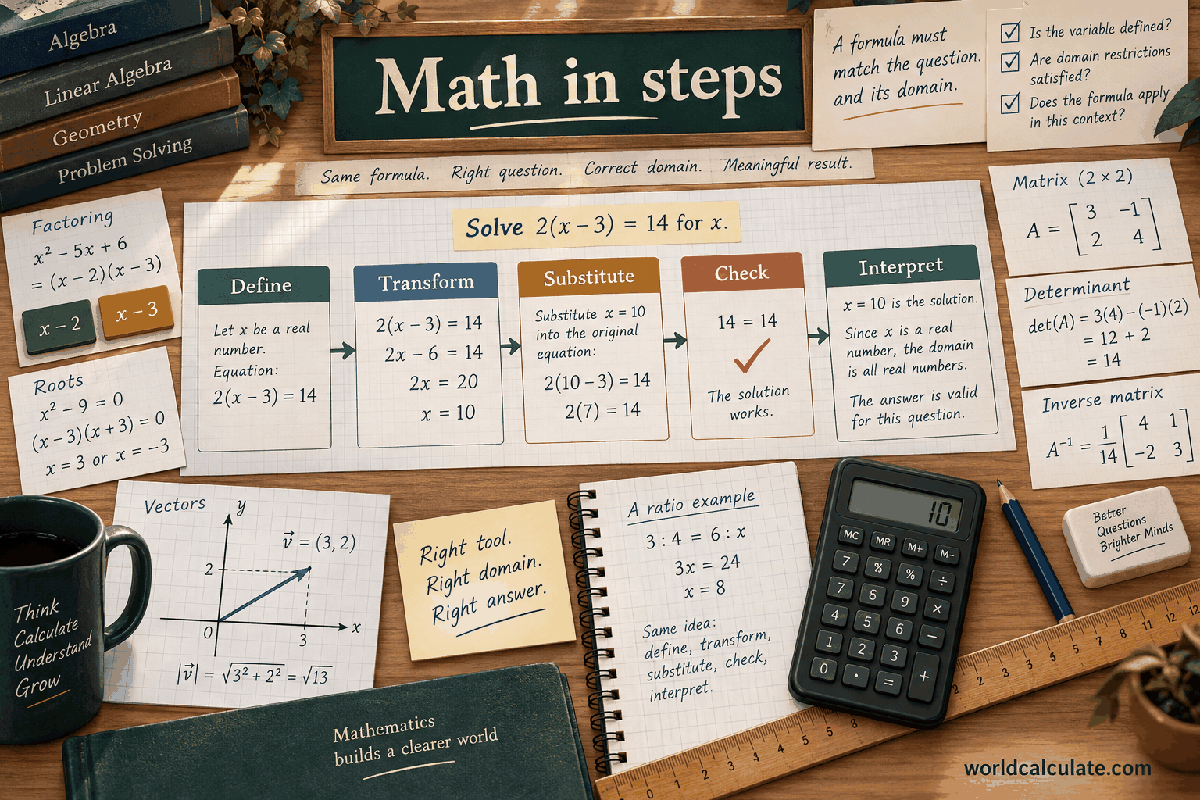
A straight triangular prism has two congruent triangular bases joined by three rectangular lateral faces. This calculator finds total surface area from the three side lengths of the triangular base and the distance between its congruent ends. It uses strict triangle inequalities, Heron's formula for base area, and perimeter times prism length for lateral area: S=2A_triangle+(a+b+c)L. The guide explains the four fields, triangle feasibility, Heron arithmetic, a worked 3-4-5 example, the role of prism length, units, validation, related prism and triangle models, source provenance, assumptions, FAQs, and the conservative limit that ideal surface area is not a fabrication, coating, or structural certification.
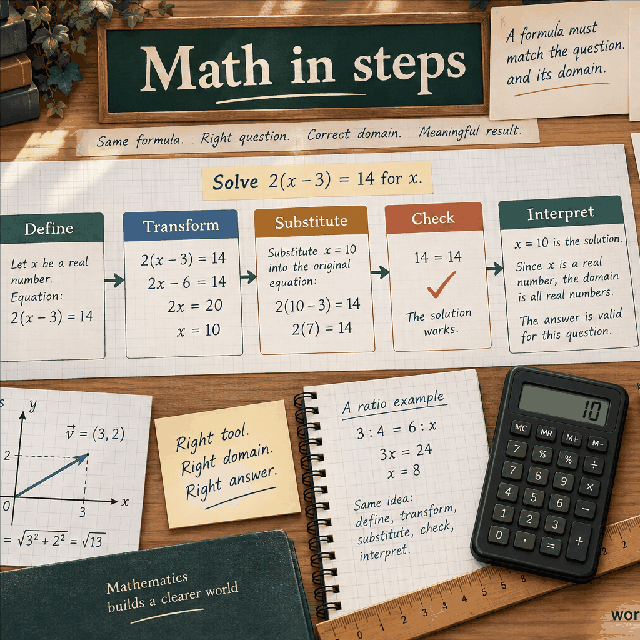
The total surface area is the sum of both triangular ends and all three rectangular side faces. The two ends are congruent, so their combined area is 2A_triangle. Each lateral rectangle has one dimension equal to a base side and the other equal to prism length L. Adding their areas gives (a+b+c)L, which is the base perimeter multiplied by L. The result is a square-length quantity for the ideal closed prism surface described by the fields.
The calculation does not return volume, the area of one triangular base, or only the lateral wrapping area. It returns the complete sum under the assumption that both triangular ends are present and the sides are straight rectangular faces. An open triangular tube, a prism with cutouts, or a prism with bevels has a different exposed-surface contract. The output labels the component values so a reviewer can see how total area was formed.
The fields sideA, sideB, and sideC are the three edge lengths of one triangular base. Their order does not change Heron's formula, but keeping the labels distinct helps map a measurement or test fixture to the correct field. All three values are positive finite lengths within the displayed bounds. They must use one compatible unit because the semiperimeter and area calculations combine them before multiplying by prism length.
The handler checks the strict triangle inequalities: a+b>c, a+c>b, and b+c>a. These conditions ensure that the three lengths can close into a nondegenerate triangle. Equality would produce a flattened triangle with zero area, while a violation would leave a gap in a proposed edge arrangement. The calculator rejects both rather than taking an absolute Heron product or showing a complex-number artifact.
Prism length L is the distance between the two congruent triangular ends measured along the straight extrusion direction. It is not a triangular side and not the length of a diagonal across the solid. The two bases are assumed parallel and congruent, with corresponding vertices joined by straight segments. A positive L produces a three-dimensional prism with lateral area; a zero value would collapse the two ends into one triangle and is excluded by this contract.
Use the same linear unit for L and the three base sides. If the base is in centimetres and L is in centimetres, every rectangular face has square-centimetre area and the total does too. The handler does not infer L from a volume, angle, or diagonal. If the object tapers or the ends are not congruent, the perimeter-times-length lateral formula no longer describes all exposed faces.
When three triangle sides are known, first compute the semiperimeter s=(a+b+c)/2. Heron's formula then gives A_triangle=sqrt(s(s-a)(s-b)(s-c)). The strict inequalities make each factor positive for a nondegenerate triangle. This avoids choosing an angle or an altitude that the input does not provide. The calculator returns the base area and perimeter as intermediate numeric results so the total can be independently inspected.
Heron's formula is symmetric in the three sides even though the expression is written with a, b, and c labels. The result does not depend on how the triangle is rotated or which vertex is named first. Near a degenerate boundary, one Heron factor becomes small and the area becomes sensitive to small side changes. The handler rejects exact and invalid boundaries and checks the product and square root for finite output.
The three lateral faces have areas aL, bL, and cL because each is a rectangle with one triangular side and the common prism length. Their sum is (a+b+c)L. The quantity a+b+c is the triangular base perimeter. This perimeter-times-length relationship is the same idea as sweeping a closed planar boundary along a straight distance, but it assumes the lateral faces remain planar rectangles and no face is removed.
Adding 2A_triangle gives S=2A_triangle+(a+b+c)L. The two terms have the same square-length units. Base area is independent of L, while lateral area grows linearly with L. If L is doubled, the two ends contribute the same amount and the side contribution doubles. If the triangle sides are all scaled by q and L is also scaled by q, total surface area scales by q^2, as a surface measure should.
Use side lengths a=3, b=4, c=5 and prism length L=10. The strict inequalities hold, and the semiperimeter is s=(3+4+5)/2=6. Heron's formula gives sqrt(6*3*2*1)=sqrt(36)=6 square units. The triangular perimeter is 12 units, so the lateral area is 12*10=120 square units. Two triangular ends contribute 12, giving total surface area 132 square units.
A net check reaches the same total: two triangles each have area 6, and the three rectangles have areas 30, 40, and 50. Their sum is 6+6+30+40+50=132. This decomposition is useful because a missed base or an incorrectly assigned prism length is visible. The result is not the volume 6*10=60 cubic units; that is a separate measure with a different unit and formula.
Positive side fields alone do not guarantee a triangular base. For example, sides 2, 3, and 5 satisfy 2+3=5, so they form a degenerate flattened boundary with zero area rather than a nondegenerate triangle. Sides 2, 3, and 6 violate the inequality and cannot close at all. The strict checks distinguish these cases from a valid triangle such as 3, 4, and 5. The error is raised before Heron's square root can receive a nonpositive product.
A triangle close to equality can have a very small area relative to its side lengths. Mathematically it remains valid if all inequalities are strict, but measured or rounded sides may make its area sensitive. The handler does not add an arbitrary near-degeneracy threshold beyond the strict geometry check for this contract. A workflow using measured sides should retain uncertainty and decide whether a conditioning threshold is needed outside the pure calculator.
Every side and L is a length. Heron's formula produces square length, and multiplying a perimeter by L also produces square length. If all inputs are in metres, surface area is in square metres. If all inputs are in inches, it is in square inches. The calculator has no unit selector and cannot detect mixed units, so convert the four inputs to one system before calculation. A linear conversion factor becomes a squared factor in the final surface area.
Surface area is not volume or mass. Volume would multiply the triangular base area by L and would have cubic units. Mass would require density and perhaps material exclusions. A coating estimate would require coverage, thickness, waste, and whether every face is exposed. This calculator supplies the ideal geometric area only. Keep the field unit and the closed-prism assumption attached when passing the result to another workflow.
The pure handler validates all four fields as finite numbers within the displayed bounds. It checks the strict inequalities, semiperimeter, Heron product, square root, base perimeter, lateral area, and total surface area. Numeric strings, blanks, NaN, infinity, zero, negative values, and out-of-range values are rejected. This layered validation prevents a malformed triangle from producing a NaN result or a negative area that could reach the shared renderer.
The result list includes triangular base area, triangle perimeter, lateral area, and total surface area. Each numeric item has a label, number format, unit text, and finite value. Steps show the semiperimeter, Heron calculation, and total decomposition. The pure result does not round values or normalize a shape into an equilateral triangle. Negative zero is normalized by the shared helper so formatting remains stable.
A triangular-prism volume is base area times prism length and is distinct from total surface area. A prism with a right-triangle base is a special case of this general three-side model, not a reason to replace Heron's formula with a base-times-height shortcut unless a triangle altitude is supplied. A rectangular prism has six rectangular faces and different fields. A triangular surface area without prism length would describe only one or two bases, not the complete solid.
A slanted prism can have parallelogram lateral faces rather than rectangles, and a truncated or tapered solid has changing corresponding sections. Those shapes require additional vectors, heights, or cross-sections. The current record assumes a straight prism with congruent parallel ends. Keeping those assumptions visible prevents a user from applying the formula to a visually similar solid whose lateral area is not perimeter times one common length.
The catalog source is private formula provenance for triangular-prism surface construction and triangle geometry. This public article is original WorldCalculate writing and does not reproduce another site's body, code, branding, defaults, or calculator data. The source supports the ideal formulas, but it cannot verify a visitor's measurements, whether all faces are exposed, or whether a real object has seams, bevels, or openings.
The model assumes a nondegenerate Euclidean triangle, a straight uniform prism, congruent parallel ends, rectangular lateral faces, and compatible units. It excludes edge rounding, wall thickness, cutouts, surface roughness, variable length, slant, deformation, and material tolerances. The conservative limit is an ideal closed-prism surface area. Use CAD, inspection, or material-specific analysis when an actual object or resource quantity must be certified.
Why are there four inputs? Three determine the triangular base area and perimeter, while the fourth gives the separation of the two ends. Can the side order change the answer? No, Heron's formula and perimeter are symmetric. Why are strict inequalities needed? Equality flattens the triangle and a violation cannot close the base. Does the result include both triangular ends? Yes, the formula begins with 2A_triangle. Does it include a hole or opening? No, the contract is a closed ideal prism.
Is prism length the same as a diagonal? No, it is the common distance along which the base is translated to form the other congruent end. Can I use this for a slanted prism? Not without changing the lateral-face geometry. What if the base sides are measured with uncertainty? Keep that uncertainty outside the handler and review near-degenerate cases carefully. The conservative result is the surface area of the declared straight triangular prism, not every solid with a triangular-looking end.
A net of the solid contains two congruent triangular faces and three rectangles. The triangle perimeter determines the total width of those rectangles when they are placed edge to edge, and L is the common rectangle dimension. Summing the net areas reproduces 2A_triangle+(a+b+c)L. This picture is a review aid, not a claim that every physical net can be assembled without overlap or seam allowance. The ideal surface contract counts each mathematical face once.
If all four lengths are scaled by q, the base area scales by q squared, the lateral area scales by q squared, and total surface area scales by q squared. If only L changes, the two triangular contributions stay constant while the lateral contribution changes linearly. If only the base sides change, both Heron area and perimeter change. These separate effects help identify whether an input was entered as a diameter, a height, or a length in the wrong unit.
The triangular base can be rotated or reflected without changing its side lengths or area. The prism can also be translated in space without changing total surface area. What matters for this formula is that the two triangular copies are congruent and parallel and that corresponding vertices are connected by the common prism length. The handler does not need coordinates or an orientation angle because those placements preserve the ideal face areas.
A physical object may hide one face against another object, leave ends open, or contain a hole. Total mathematical surface area still includes both triangular ends under this contract. A surface exposure estimate should specify which faces are accessible and whether an opening replaces a face. Do not subtract hidden or missing regions from this result unless a separate application workflow records those changes explicitly.
The three side fields may come from a drawing, nominal design, or measurements. The handler treats them as exact finite values for the formula and does not estimate uncertainty. Heron's area can be sensitive when the triangle is close to degenerate, and total area can be sensitive to a long prism length. Preserve the source precision and use an uncertainty or tolerance analysis when a small difference in area affects a real decision.
A coating, wrapping, or material estimate may use total area, but it needs additional assumptions: coverage rate, thickness, waste, overlap, edge treatment, and which faces are exposed. A thermal or structural model needs material properties and boundary conditions. The calculator supplies a clean geometric baseline and deliberately avoids presenting it as a quantity of paint, mass, heat transfer, or strength.
A focused suite should verify the 3-4-5 base with L=10 as base area 6, perimeter 12, lateral area 120, and total area 132. It should test side-order permutations, an equilateral base, a minimum positive length, and bounded values. It should reject 2,3,5 because the equality case is degenerate and reject a violated inequality with `The three triangle sides must satisfy all strict triangle inequalities.` It should also reject zero, negative, nonfinite, and out-of-range fields.
The catalog test should verify sideA, sideB, sideC, prismLength order, square-length result units, Heron wording, and the numeric example. The integrated registry test should call `surface-area-of-a-triangular-prism` and distinguish it from prism volume and triangular base-area tools. Component results make it possible to diagnose whether a future change breaks Heron area, perimeter, lateral area, or the final sum.
A clear report states the three base side lengths, the prism length, the calculated base area and perimeter, and the total surface-area convention. This lets a reviewer distinguish a closed straight prism from a triangular sheet, an open tube, or a slanted solid. The component results are not decorative: they show whether the total came from two triangular faces plus three rectangular faces and make unit or field-order mistakes easier to locate.
The result can be a useful geometric baseline for CAD comparison or a later material estimate, but it should not be presented as the exact exposed area of an object with seams, holes, rounded edges, or hidden faces. Keep the ideal assumptions and source precision with the number. If the shape is measured rather than designed, evaluate uncertainty and face accessibility outside the pure handler.
Calculate the total surface area of a straight triangular prism from three valid base sides and prism length.
S=2A_triangle+(a+b+c)L, with A_triangle=sqrt(s(s-a)(s-b)(s-c)), s=(a+b+c)/2, and all strict triangle inequalities required. A straight triangular prism has two congruent triangular ends and three rectangular lateral faces. Heron's formula finds the base area from the three side lengths, and the triangle perimeter times prism length gives the lateral area.
Enter Triangle side a, Triangle side b, Triangle side c, Prism length L, then choose Calculate.
The three positive base sides form a nondegenerate triangle satisfying all strict triangle inequalities. The prism is straight with two congruent parallel triangular ends and rectangular lateral faces, and prism length uses the same length unit as the base sides. The result is ideal total surface area; edge thickness, bevels, openings, material, and construction tolerances are not inferred.
This calculator is part of the WorldCalculate library. Its formula, example, assumptions, input bounds, and output formatting follow the official methodology.
These WorldCalculate collections connect this tool with related questions while keeping each calculation separate and transparent.