
Goal
Calculate the perimeter of a regular polygon from an integral side count and common side length.
Worldwide context
Saved once here, used across the site.
Currency changes display only. Country selection guides tax input; no tax rate is guessed.
Calculate the perimeter of a regular polygon from an integral side count and common side length.
P=n*s, where n is an integer with n>=3 and s>0.A clearer path to an answer
This page keeps the calculation transparent: define the goal, enter the matching values, inspect the method, and decide what the result means in your situation.
Calculate the perimeter of a regular polygon from an integral side count and common side length.
Number of sides n · Common side length s
P=n*s, where n is an integer with n>=3 and s>0.
Calculate, review the assumptions below, then compare a related tool when the decision needs more context.
Calculate the perimeter of a regular polygon from an integral side count and common side length.
Open the Regular Polygon Perimeter pageMore math tools
Download PDFDownload Word (.doc)
Enter your values above and choose Calculate to see the result here.
Calculation map
P=n*s, where n is an integer with n>=3 and s>0.
Bounded, transparent calculation
Your recent runs stay in this browser session only.
Formula: P=n*s, where n is an integer with n>=3 and s>0.
A regular polygon has n congruent sides, each of length s. Adding the equal side lengths gives the perimeter n times s.
Worked example: A regular hexagon has P=6*4=24 length units.
The displayed limits are checked before the handler runs. Model-specific domain checks may also reject impossible or non-finite inputs.
Methodology: This calculator follows the WorldCalculate input, formula, precision, and boundary policy. Read the official methodology.
Calculator usage statistics
This section counts anonymous successful Calculate submissions, not unique visitors. Counts and top tools appear only when trusted aggregate data is available; country analysis is shown only under the same condition and reporting threshold.
Answer-first guide
Calculate the perimeter of a regular polygon from an integral side count and common side length. Start with one clearly defined goal, enter values in the units shown, and keep the result attached to the assumptions below.
This tool is useful when your question includes regular polygon perimeter, regular n-gon, polygon side length. It returns the outputs declared in the calculator contract rather than a live quote, approval, diagnosis, or professional sign-off.
Number of sides n · Common side length s. Keep the same time period, unit system, and currency wherever the form requires comparable values.
Run the worked example first, compare its output with the page's example, then change one input at a time. This makes an unexpected result easier to trace to a unit, boundary, or assumption.
Need a wider view? Browse Math Calculators or compare the related tools below. The WorldCalculate methodology explains how formulas, examples, limits, and revisions are reviewed.
P=n*s, where n is an integer with n>=3 and s>0.
A regular polygon has n congruent sides, each of length s. Adding the equal side lengths gives the perimeter n times s.
A regular hexagon has P=6*4=24 length units.
Context and background
Math calculators move from named quantities to a relation, then to a result that can be checked with substitution, units, or an alternate form.
Arithmetic, algebra, geometry, trigonometry, and number theory provide reusable structures for classroom work and everyday reasoning. Each page narrows that structure to one declared problem.
Research and review
Researched by Hassan ALRowaie, Founder and editorial researcher at WorldCalculate.
This guide follows the live calculator's declared inputs, formula, worked example, assumptions, validation boundaries, and source-backed methodology. The review date describes editorial review of the calculator explanation; it is not a promise that external facts or rates remain current.
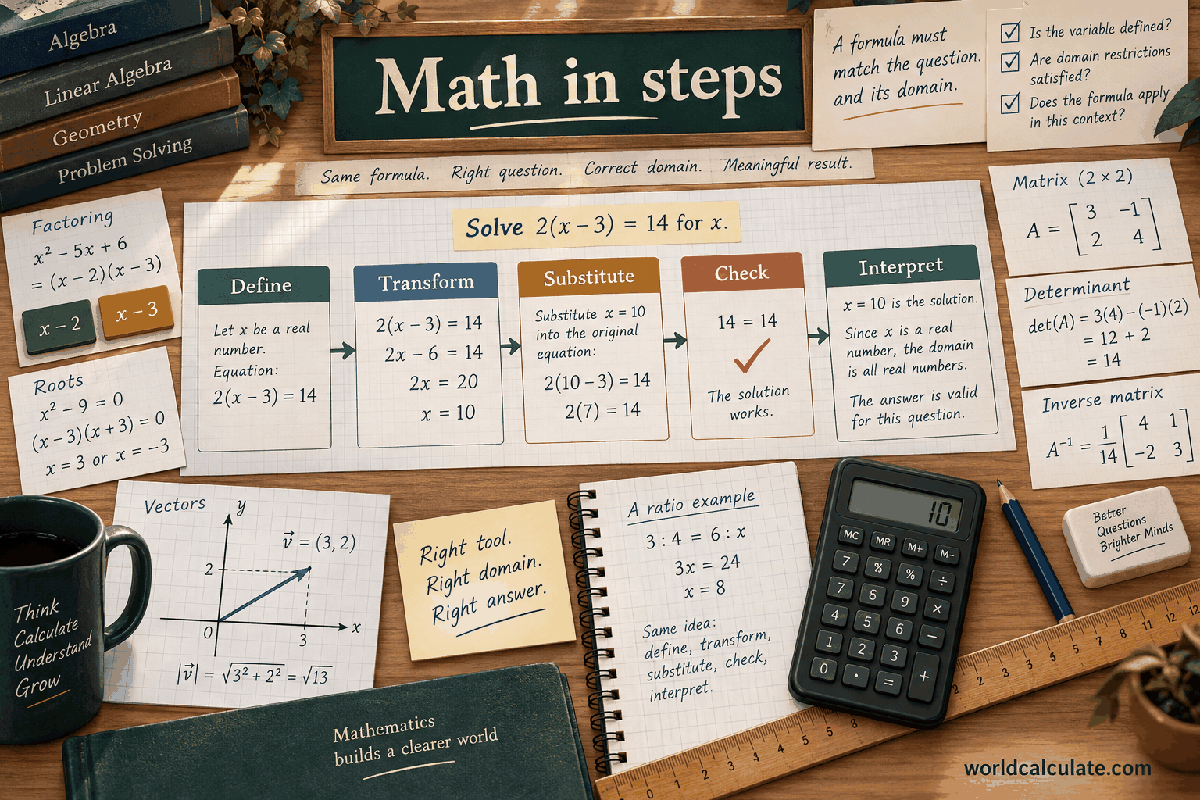
The perimeter of a regular polygon is the total length of its equal sides. This calculator accepts an integral side count n and one common side length s, then returns P=n*s. The regularity assumption is essential: the formula does not add a list of unequal sides or infer a missing shape from an arbitrary polygon. The guide explains the count and length fields, why n must be a whole number of at least three, repeated-side arithmetic, a worked hexagon example, unit scaling, boundary behavior, perimeter versus area and angle, validation, source provenance, assumptions, FAQs, and the conservative limit that a geometric perimeter is not automatically a material or construction quantity.
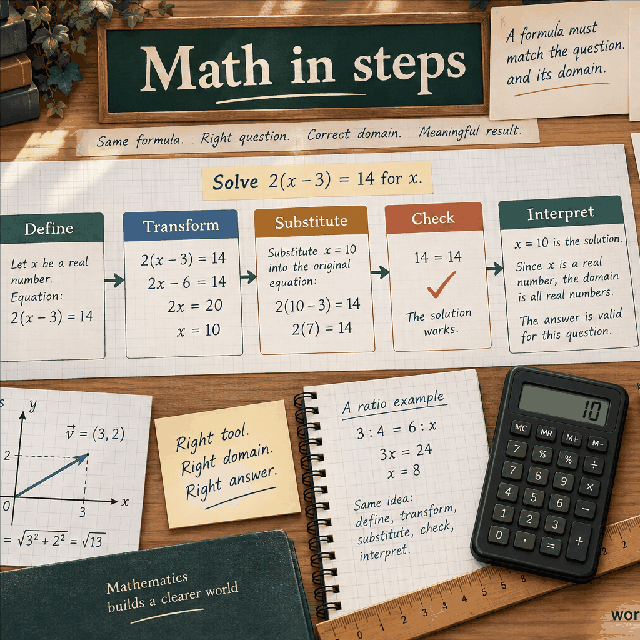
Perimeter is the total distance around a polygon's boundary. For a regular polygon, every side has the same length, so adding n identical lengths gives n*s. The result is one positive length under this calculator's contract. It does not measure the polygon's filled area, distance across the center, diagonal length, apothem, or the circumference of a separate circle. Those quantities may be related to a regular polygon but answer different questions.
The word regular narrows the input model. A regular polygon is equilateral and equiangular in the ordinary plane, while this handler needs only the equal-side fact for perimeter. It does not independently verify a drawing's angles or coordinates. The field assumptions state that the shape is regular, and the output note preserves that boundary. If sides differ, the appropriate operation is an explicit sum of side lengths in a different calculator.
The sides field n tells how many equal sides surround the polygon. The smallest ordinary polygon has three sides. A value of 3 represents a regular triangle, 4 a square, 5 a regular pentagon, and 6 a regular hexagon. The value must be a whole number; 3.5 cannot describe a polygon with a fractional number of sides. The handler checks integrality directly instead of rounding a decimal into a different shape.
The displayed upper bound of one million is a software limit for predictable finite multiplication, not a claim that mathematics stops there. Very large n with a fixed side length still follows the arithmetic formula, but a physical polygon with that many sides may be better understood through a limiting circle or another model. This page does not make that approximation automatically. It returns the exact repeated-side product for the entered integer.
The side-length field s is the length of each of the n equal sides. It is a positive finite number within the displayed bounds. A decimal length is valid, as are values smaller than one and values larger than one, provided the unit convention is consistent. The calculator does not ask for a side list because regularity means every side shares this one value. Entering a diameter, radius, or apothem instead would answer a different geometric question and inflate or reduce the result.
A length of zero collapses every side and no longer represents an ordinary polygon boundary with positive extent. A negative length is not an alternative orientation; lengths are nonnegative and the contract requires positive side size. The handler rejects these values explicitly. It also rejects strings, blanks, NaN, infinity, and out-of-range inputs when called directly, so the model does not depend on browser coercion.
Write the boundary sum as s+s+...+s with n terms. Factoring the repeated value gives P=n*s. No trigonometric function is needed because the side length is already known. The polygon's angles and orientation do not change the sum as long as the side count and every side length remain fixed. This makes the formula short, but the article and output still state the regularity condition so the short expression is not overgeneralized to arbitrary polygons.
The multiplication has a simple unit check. n is a count and has no length dimension, while s has length units. Their product therefore has length units. If the side count is doubled while s remains fixed, perimeter doubles. If s is converted from metres to centimetres, perimeter converts by the same linear factor, not its square. These checks distinguish perimeter scaling from area scaling.
Use n=6 and s=4 length units. A regular hexagon has six equal boundary sides, so P=6*4=24 length units. Listing the sum gives 4+4+4+4+4+4=24. The result does not depend on whether the hexagon is rotated on the page because rotation changes orientation but not side lengths. The same calculation would apply to any regular six-sided polygon with common side length four.
For a comparison, n=8 with the same side length gives P=32, while n=6 with s=2.5 gives P=15. These examples change one field at a time and expose the linear relationship. They do not calculate the area enclosed by either shape. A regular hexagon's area can be derived from additional geometry, but that would require a separate output formula and should not be inferred from this perimeter result alone.
A regular polygon's area depends on more than the repeated-side sum when expressed through apothem and perimeter, or through side length and trigonometric relationships. Interior angle depends on n and is the subject of a separate model. Circumradius and apothem are also different lengths from the side. The present calculator intentionally returns only n*s so the output label and fields remain aligned with the visitor question.
Two regular polygons can have the same perimeter but different side counts and side lengths. For example, a square with side 4 and an octagon with side 2 both have perimeter 16, but their areas, angles, and radii differ. Therefore perimeter alone does not identify the shape. Preserve n and s with the result if a later calculation needs to distinguish these geometries.
The lower bound n=3 is inclusive. A triangle is the first ordinary polygon in this model. Values below three do not enclose a polygonal region in the intended sense and are rejected. The integer check occurs after the finite and range check, so a value such as 3.5 produces an integrality error rather than being silently changed to 3 or 4. This protects the relationship between the displayed count and the returned perimeter.
The side-length lower bound is strictly positive. At the software maximum n=1,000,000 and a valid finite side length, the multiplication remains subject to the handler's finite-result check. The calculator does not introduce an upper bound based on visual size, compactness, or a circle approximation. If a physical design limits the number of sides, side tolerance, or perimeter, those constraints belong to the design workflow outside this arithmetic contract.
If s is in millimetres, P is in millimetres. If s is in metres, P is in metres. The side count has no units and is not a conversion factor. The calculator has no unit selector, so it cannot detect that one side value was copied in inches while another workflow expects metres. Convert the side length before entry and retain the unit with the result. A linear unit conversion applies once to perimeter, unlike the squared conversion used by area.
The pure handler checks n, s, and the product for finite numeric safety. It normalizes negative zero through the shared result helper and returns a labeled numeric result with format number, unit text, steps, and a note. Display precision is separate from arithmetic precision. These conventions let the browser render a stable result while keeping the integral-count rule and regularity assumption visible to a direct caller.
An arbitrary polygon perimeter requires the lengths of every side or the coordinates of every vertex. A regular-polygon area model can use n and s but needs a different formula and output. An interior-angle calculator uses n and returns degrees. A circumscribed or inscribed circle model uses apothem or circumradius, which cannot be substituted for s without an explicit relation. Keeping these records distinct prevents a visitor from treating one regular-polygon measurement as all of them.
A very high-sided regular polygon can visually approximate a circle, but its perimeter remains n*s for the entered discrete shape. The circumference of the approximating circle is not automatically equal to that perimeter and depends on how the polygon is inscribed or circumscribed. This calculator does not choose an approximation convention. If a circle limit is needed, document the radius and construction separately.
The catalog source is private formula provenance for regular-polygon definitions and repeated-side perimeter. This public article is original WorldCalculate writing and does not reproduce another site's page body, code, branding, defaults, or calculator data. The source supports the mathematical relation, but it does not establish whether a visitor's object is truly regular, whether a side measurement is nominal or as-built, or whether a physical boundary has gaps and joins.
The model assumes a planar regular n-gon, an integer n at least three, equal positive sides, and compatible length units. It excludes side tolerances, nonuniform fabrication, vertex rounding, thickness, open boundaries, curved approximations, and material quantities. The conservative limit is the ideal sum of equal side lengths. Use a measured perimeter, tolerance analysis, or CAD geometry workflow when the boundary itself must be certified.
Why must the number of sides be a whole number? A polygon boundary consists of discrete sides, so 3.5 is not a valid side count. Can n be two? Not for the ordinary polygon contract; three is the minimum. Does regular mean every angle is equal? In this model, yes as part of the shape assumption, although the perimeter computation uses the equal side length directly. Can I use a diameter as side length? No, enter the actual side length unless a separate geometric conversion has already been performed.
Does this calculate a regular polygon's area? No, it returns boundary length only. Is the result affected by rotation? No, rotation preserves every side length. What if sides have small measurement differences? The regular assumption no longer exactly holds; use an explicit side-list or measurement model. The conservative answer is P=n*s for the ideal regular polygon described by the two inputs, not a promise about a fabricated or irregular object.
A regular polygon has a boundary made of n congruent segments. Adding them one at a time gives s+s through n terms, and factoring the repeated term gives n*s. This is the entire arithmetic model, but writing the sum conceptually is helpful when checking the field meaning. The count is discrete and the side length is continuous within the numeric bounds. Neither input describes a diagonal or a distance through the interior.
If a polygon is rotated, translated, or reflected in the plane, the boundary segments retain their lengths and the perimeter is unchanged. If a polygon is scaled, every side and the perimeter scale by the same factor. These geometric invariances explain why no center coordinate, orientation angle, or placement field is needed. They also show what is not being measured: placement and orientation are irrelevant to this boundary sum.
As n becomes large, a regular polygon can look visually close to a circle under a chosen construction. The perimeter calculator still returns n*s for the discrete polygon and does not assume an inscribed or circumscribed circle. Those constructions have different radii and limiting relationships. A visitor should not compare the result with a circle circumference unless the circle radius and the way the polygon relates to it have been declared separately.
The one-million side-count bound keeps multiplication and rendering predictable, but it is not a mathematical maximum. At extremely high counts, a physical representation may be impractical even though the arithmetic is finite. The handler intentionally does not switch to a circle approximation, reduce the count, or round a large n. Such an approximation would need its own error and construction contract.
The field s may be a design value, a measured representative, or a nominal common side. The handler does not receive the individual side measurements and cannot verify that they are equal. If actual sides vary, n*s is the perimeter of the ideal regular polygon implied by the chosen representative length, not necessarily the as-built boundary. A measured polygon should use its individual sides or vertices in a separate perimeter calculation.
Rounding one side value before multiplying can change the displayed perimeter, especially for a large n. Preserve source precision and decide whether the common side is a mean, a nominal target, a maximum, or another statistic. The calculator does not choose that summary. Its assumption is explicit equality, so uncertainty in how s was selected belongs in the surrounding record rather than hidden inside the one-field value.
A regular-polygon area formula may use perimeter together with an apothem through A=Pa/2, but this calculator does not accept or calculate the apothem. Supplying the returned perimeter to that formula requires an independently valid apothem in the same length unit. An interior-angle formula uses n and returns an angular measure. A side-to-circumradius relationship also needs a declared regular construction. Keep each result's units and assumptions visible when combining them.
The perimeter can also be used as a boundary measure in a tiling or material workflow, but gaps, overlaps, thickness, and joins are not part of the ideal polygon. A path around a physical object may include rounded vertices or open ends. The calculator's result is a geometric baseline. It becomes an applied quantity only after the receiving workflow defines what portion of the ideal boundary is present and how measurement uncertainty is handled.
A focused suite should verify n=6 and s=4 as perimeter 24, n=3 as a valid boundary, a decimal positive side length, and the maximum bounded count with a safe length. It should reject n=2, fractional n, zero, negative, nonfinite, and out-of-range values. The exact error `Number of sides n must be a whole number of at least 3.` should be asserted for the integrality and minimum-shape cases so invalid values cannot be rounded or accepted as another polygon.
The catalog test should verify fields sides and sideLength in order, step 1 for the count, the regularity wording, and the numeric example. The integrated registry test should call `regular-polygon-perimeter` separately from `polygon-angle`. Similar names and shared n fields are precisely why the ID and output meaning must be tested together.
The safest way to reuse this result is to preserve the integer side count, common side length, unit, and regularity assumption beside the perimeter. The product alone cannot tell whether 24 came from six sides of four units, eight sides of three units, or another pair. Those shapes have different angles and areas even though their boundary totals agree. Keeping the inputs makes the result auditable and prevents a perimeter from being mistaken for a complete polygon description.
The handler deliberately stops at the repeated-side sum. If a later task needs area, apothem, diagonal, vertex coordinates, material edge length, or a circle approximation, it should add the required geometry and its own validation. The current output is reliable as a finite regular-polygon perimeter, not as an unqualified answer for every polygon-shaped object.
Calculate the perimeter of a regular polygon from an integral side count and common side length.
P=n*s, where n is an integer with n>=3 and s>0. A regular polygon has n congruent sides, each of length s. Adding the equal side lengths gives the perimeter n times s.
Enter Number of sides n, Common side length s, then choose Calculate.
The polygon is regular, so every side has the same positive length s and n is an integer of at least 3. Side length uses one compatible linear unit; no apothem, angle, coordinate, or circumscribed-circle measurement is inferred. The result is perimeter of the boundary only and does not calculate area, interior angle, or a polygon with unequal sides.
This calculator is part of the WorldCalculate library. Its formula, example, assumptions, input bounds, and output formatting follow the official methodology.
These WorldCalculate collections connect this tool with related questions while keeping each calculation separate and transparent.