
Goal
Solve a two-equation linear system by isolating y in the first equation, substituting into the second, and checking the ordered pair.
Worldwide context
Saved once here, used across the site.
Currency changes display only. Country selection guides tax input; no tax rate is guessed.
Solve a two-equation linear system by isolating y in the first equation, substituting into the second, and checking the ordered pair.
Solve equation 1 as y=(c₁−a₁x)/b₁, substitute into equation 2, then solve x and back-substitute for y.A clearer path to an answer
This page keeps the calculation transparent: define the goal, enter the matching values, inspect the method, and decide what the result means in your situation.
Solve a two-equation linear system by isolating y in the first equation, substituting into the second, and checking the ordered pair.
Equation 1 x coefficient (a₁) · Equation 1 y coefficient (b₁) · Equation 1 right side (c₁) · Equation 2 x coefficient (a₂) · Equation 2 y coefficient (b₂) · Equation 2 right side (c₂)
Solve equation 1 as y=(c₁−a₁x)/b₁, substitute into equation 2, then solve x and back-substitute for y.
Calculate, review the assumptions below, then compare a related tool when the decision needs more context.
Solve a two-equation linear system by isolating y in the first equation, substituting into the second, and checking the ordered pair.
Open the Substitution Method Calculator pageMore math tools
Download PDFDownload Word (.doc)
Enter your values above and choose Calculate to see the result here.
Calculation map
Solve equation 1 as y=(c₁−a₁x)/b₁, substitute into equation 2, then solve x and back-substitute for y.
Bounded, transparent calculation
Your recent runs stay in this browser session only.
Formula: Solve equation 1 as y=(c₁−a₁x)/b₁, substitute into equation 2, then solve x and back-substitute for y.
This method turns one equation into an expression for y and replaces y in the other equation. The result is a one-variable equation followed by a visible back-substitution and two-equation check.
Worked example: Equation 1 gives y = 7 − 2x; substitution gives x = 4 and y = −1.
The displayed limits are checked before the handler runs. Model-specific domain checks may also reject impossible or non-finite inputs.
Methodology: This calculator follows the WorldCalculate input, formula, precision, and boundary policy. Read the official methodology.
Calculator usage statistics
This section counts anonymous successful Calculate submissions, not unique visitors. Counts and top tools appear only when trusted aggregate data is available; country analysis is shown only under the same condition and reporting threshold.
Answer-first guide
Solve a two-equation linear system by isolating y in the first equation, substituting into the second, and checking the ordered pair. Start with one clearly defined goal, enter values in the units shown, and keep the result attached to the assumptions below.
This tool is useful when your question includes substitution method calculator, solve systems by substitution, linear system substitution. It returns the outputs declared in the calculator contract rather than a live quote, approval, diagnosis, or professional sign-off.
Equation 1 x coefficient (a₁) · Equation 1 y coefficient (b₁) · Equation 1 right side (c₁) · Equation 2 x coefficient (a₂) · Equation 2 y coefficient (b₂) · Equation 2 right side (c₂). Keep the same time period, unit system, and currency wherever the form requires comparable values.
Run the worked example first, compare its output with the page's example, then change one input at a time. This makes an unexpected result easier to trace to a unit, boundary, or assumption.
Need a wider view? Browse Math Calculators or compare the related tools below. The WorldCalculate methodology explains how formulas, examples, limits, and revisions are reviewed.
Solve equation 1 as y=(c₁−a₁x)/b₁, substitute into equation 2, then solve x and back-substitute for y.
This method turns one equation into an expression for y and replaces y in the other equation. The result is a one-variable equation followed by a visible back-substitution and two-equation check.
Equation 1 gives y = 7 − 2x; substitution gives x = 4 and y = −1.
Context and background
Math calculators move from named quantities to a relation, then to a result that can be checked with substitution, units, or an alternate form.
Arithmetic, algebra, geometry, trigonometry, and number theory provide reusable structures for classroom work and everyday reasoning. Each page narrows that structure to one declared problem.
Research and review
Researched by Hassan ALRowaie, Founder and editorial researcher at WorldCalculate.
This guide follows the live calculator's declared inputs, formula, worked example, assumptions, validation boundaries, and source-backed methodology. The review date describes editorial review of the calculator explanation; it is not a promise that external facts or rates remain current.
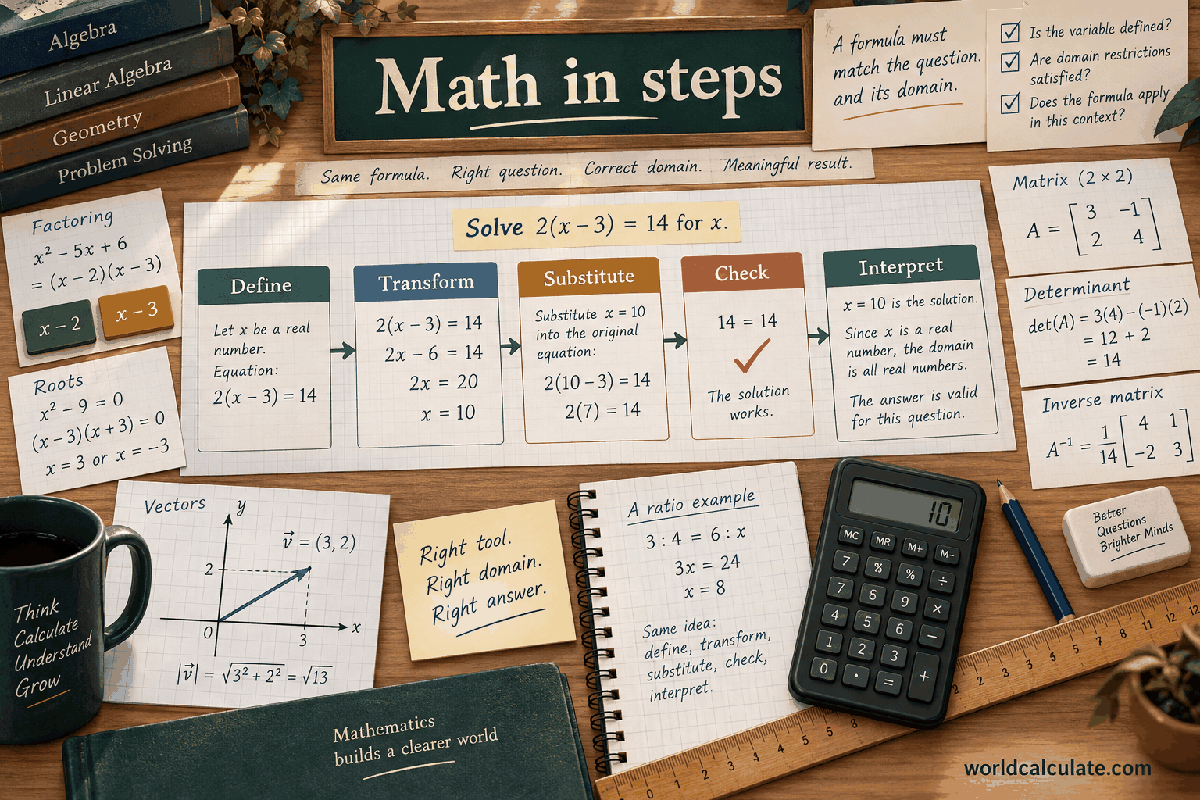
Substitution is useful when one equation can be rearranged into a clear expression for one variable. This calculator keeps that sequence visible: it solves the first equation for y, inserts the expression into the second equation, solves the resulting one-variable equation, and substitutes back. The page is separate from a general system solver because the method itself is the learning goal. Visitors can see not only the pair (x, y), but also the reduced coefficient and the checks against the original equations.
A system contains two statements that must be true at the same time. If equation 1 tells us that y equals an expression in x, every occurrence of y in equation 2 can be replaced by that expression. The two-variable problem then becomes a one-variable problem.
The calculator uses equation 1 as the source of y: y = (c₁ − a₁x)/b₁. This is why b₁ must not be zero. When a different variable or equation is easier to isolate on paper, a student may choose it manually even though the page keeps one consistent workflow.
After substitution, equation 2 becomes a reduced coefficient times x equal to a reduced constant. Solving that equation gives x. The page reports these quantities so the visitor can compare the algebra with a handwritten line such as x − 2(7 − 2x) = 6.
Parentheses protect the sign of the entire expression. Forgetting to distribute a negative coefficient across both terms is one of the most common errors in substitution problems. Reading the displayed reduced equation from left to right helps expose that mistake.
Once x is known, place it into the isolated y expression rather than guessing from a rounded graph. The result is written as an ordered pair. The calculator then evaluates the left side of both original equations so the answer can be checked without repeating the entire derivation.
If a decimal result is displayed, the checks may also be decimal approximations. For exact classroom work, keep fractions in your notes and use the decimal result as a readable check.
If b₁ is zero, equation 1 cannot be solved for y using this fixed setup. If substitution removes the x term as well, the system does not produce one unique x value. The calculator stops at these boundaries so it does not present an undefined result as a solution.
A zero reduced coefficient can indicate parallel or coincident lines depending on the remaining constants. Those cases are worth classifying separately rather than forcing them through a unique-solution formula.
First write the two equations with aligned x, y, and constant columns. Next perform the isolation by hand, then use the calculator to compare the expression and reduced equation. Finally substitute the pair into both original rows. This creates three checkpoints instead of relying on one final number.
For applied problems, the harder part may be translating words into equations. Once the model is correct, substitution is a transparent arithmetic method; it cannot repair a mislabeled variable or an incorrect unit relationship.
The page isolates y from equation 1 so the route is predictable. When working by hand, however, you may isolate x from either equation if that produces a coefficient of 1 or a simple fraction. The mathematical idea is unchanged: replace one variable with an equivalent expression.
A clean isolated expression should show the entire numerator and denominator. Writing parentheses before substitution prevents a sign outside the expression from being lost.
The handler uses ordinary finite-number arithmetic and returns decimal values. If a system has fractional coefficients, the decimal display is convenient for checking but may hide an exact rational relationship. Keep exact fractions in written work when the exercise asks for them.
The two check values are calculated from the original coefficients. A small last-digit difference can come from decimal representation; a large difference usually points to an input, sign, or substitution error.
What if equation 1 has no y term? This fixed y-isolation route cannot start because b₁ is zero. Swap the equation or isolate x on paper, or use a general system solver. What if substitution leaves only a constant statement? That system needs a no-solution or infinitely-many-solutions classification rather than a unique pair.
Should I round x before finding y? Usually no. Keep the internal value or an exact fraction as long as possible, then round the final display. Early rounding can make a correct pair appear not to satisfy the original equations.
The pair (x, y) is a solution only when it satisfies both equations at once. Solving one equation alone produces a line of possible points, not the final answer. Substitution narrows that line by replacing y in the second relationship with an expression that is guaranteed to be equivalent to the first relationship.
This perspective explains why the original equations are checked at the end. A number can solve the reduced equation but fail the story or a transcription of the original row. Keeping the two statements visible protects the method from becoming a sequence of unexplained symbol moves.
To isolate y in a₁x + b₁y = c₁, subtract a₁x from both sides and divide the complete result by b₁. The expression is y = (c₁ − a₁x)/b₁. Both operations are applied to the entire equality, so the set of points on the line does not change as long as b₁ is nonzero.
Keep the numerator in parentheses when substituting. Writing c₁ − a₁x over b₁ as a single expression makes the sign and denominator clear. A common error is to divide only c₁ or only a₁x, which creates an expression that was never equivalent to the original equation.
When y is replaced in a₂x + b₂y = c₂, the factor b₂ multiplies the entire expression (c₁ − a₁x)/b₁. If the numerator contains subtraction, both terms receive the factor. Clearing the denominator can make the reduced equation easier to read, but every term must still be scaled consistently.
For the default system, equation 1 gives y = 7 − 2x. Putting that into x − 2(7 − 2x) = 6 gives x − 14 + 4x = 6, so 5x = 20 and x = 4. The visible parentheses explain where the positive 4x came from.
Take 2x + y = 7 and x − 2y = 6. The first row gives y = 7 − 2x. Substitute into the second row: x − 2(7 − 2x) = 6. After distribution and collection, 5x − 14 = 6, so x = 4. Back-substitution gives y = −1.
The pair (4,−1) checks the first row because 2(4) + (−1) = 7, and it checks the second because 4 − 2(−1) = 6. The arithmetic answer and the verification answer should be kept together. If only one row is checked, a copied coefficient can remain hidden.
This page always takes y from equation 1, but a handwritten solution may isolate a variable with coefficient 1, −1, or another simple value. You can also rearrange equation 2 first. Choosing the cleaner route reduces fractions and makes distribution easier to inspect, while the final pair remains determined by the original system.
If equation 1 has b₁ = 0, the fixed route cannot isolate y. Swap the rows or isolate x if the problem permits. Do not enter a zero denominator and interpret an undefined expression as a valid result; the boundary is a signal to change the method.
Substitution is often natural when one variable is already isolated or has a coefficient of 1. Elimination can be shorter when coefficients are opposites or share a small multiple. Both methods solve the same system when their operations are valid, so using one to check the other is a strong study strategy.
The calculator is method-specific by design. It shows the isolated expression and reduced equation rather than hiding them behind a general solver. If a different method is easier for a particular system, use it on paper and compare the final pair and original-equation checks with this page where the input contract allows.
A zero x coefficient means the equation may be horizontal in its standard-form geometry, while a zero y coefficient means y cannot be isolated from that row using division. A zero coefficient is not a missing input; it is part of the model and should be entered explicitly.
If substitution cancels the x term, the result can be a true constant identity or a contradiction. Those cases correspond to infinitely many or no common points after the rows are compared. The calculator reports the non-unique boundary instead of inventing a pair.
For a two-equation system, the determinant a₁b₂ − a₂b₁ describes whether the two coefficient directions are independent. Substitution produces a reduced x coefficient proportional to that same expression. A nonzero value supports a unique solution; a zero value warns that the reduced division step is impossible.
This relationship lets a learner connect substitution with elimination and matrix methods. It does not turn approximate data into exact data. If coefficients are measurements and the determinant is very small, investigate sensitivity before treating the decimal pair as stable.
A fraction may be the cleanest exact result even when the page displays decimals. Keep the unrounded value when substituting back, and round only the final presentation where possible. Early rounding changes the isolated expression and can make an otherwise correct pair fail a displayed check by more than the expected last digit.
For a measured system, a decimal result should be labeled approximate and the check tolerance should be stated. A tiny residual can be a representation effect, while a large residual signals an input or algebra error. The calculator does not estimate uncertainty or choose a tolerance for an engineering or scientific model.
In a ticket problem, define each ticket type and use one equation for count and one for revenue. In a mixture problem, define amounts and concentrations. In a distance problem, keep time and rate units consistent. These modeling choices happen before the coefficient fields are filled; substitution cannot repair an equation that describes the wrong relationship.
After finding (x, y), translate it back into the story and check domain constraints such as nonnegative amounts, integer counts, available capacity, or a realistic rate. A mathematically valid pair may be unusable for the application if the original model allowed values the story does not.
The numeric fields do not know whether x means dollars, kilograms, hours, or people. Write units beside the variables and constants in the setup. If one equation uses cents and another uses dollars, convert first. If the coefficients combine different quantities, make sure the terms being added are dimensionally compatible.
A unit mistake can produce a neat ordered pair that answers a different question. Preserve the unit conversion in the article or worksheet so another reader can reproduce both the algebra and the interpretation. This is especially important when a calculator is used for finance, laboratory, or construction planning.
Create a two-row check table with the equation number, left-side calculation at the returned pair, entered right side, and difference. For exact inputs, both differences should be zero. For decimal inputs, the differences should be within the chosen display or measurement tolerance. This makes verification more informative than a single statement that the answer is correct.
If one row passes and the other fails, inspect the coefficients and the substitution step for that row. If both fail by a similar amount, inspect early rounding or the input pair. A residual table also gives a teacher or reviewer a compact record of how the final result was tested.
Plot the two original lines and mark the returned pair to connect the algebra with geometry. The intersection should lie on both lines. A graph is useful for explaining why one pair is selected, but screen scale and pixel rounding cannot prove a precise answer, especially when lines are close or nearly parallel.
Standard form remains useful for vertical lines and coefficient-based checks. If a graph appears to disagree, verify the plotted equations and axis scale before changing the calculator result. Use the algebraic substitutions as the authoritative local check for the entered system.
A robust solution record has three layers: the isolated expression for y, the reduced equation and solved x, and the back-substituted ordered pair with both original checks. Saving only the pair removes the evidence that the method was applied correctly. Saving only the expression does not answer the system.
For an assignment or technical note, include the input equations in standard form and state any rounding. For code or data, preserve the six coefficient values and the exact field order. This allows a later reviewer to reproduce the result even if the display style changes.
After substitution, a visitor may need to classify a non-unique system, graph the lines, solve a larger system, evaluate sensitivity, or interpret a word-problem constraint. Descriptive internal links to those next steps make the page a learning path rather than an isolated form. The link label should say what the visitor will do next.
Do not reuse this page for nonlinear equations or a system with more variables. A focused contract is safer because it makes the required assumptions visible. Carry the verified equations and units into the next method instead of copying only a rounded final pair.
Suppose the isolated expression produces x = 7/3. Substituting the exact fraction into y before rounding may produce a clean exact value even when a decimal display would obscure it. The calculator is convenient for decimal inspection, but a written solution should preserve the exact form when the coefficients support it.
If you must report a decimal, state the number of places and evaluate the original equations with the unrounded pair when possible. A rounded pair is a presentation choice, not a new exact solution. This practice prevents a correct algebra path from appearing wrong because the final digits were shortened too early.
The two lines may intersect at a unique real pair while the application still rejects it. A negative quantity, a fractional number of people, or a time outside the allowed interval may be impossible in the story. After substitution checks pass, apply the domain and explain whether the model has a usable solution.
If the pair is infeasible, review the equations and assumptions instead of clipping the number to a convenient boundary. Clipping creates a value that may no longer satisfy either equation. A separate constrained method is appropriate when the story includes inequalities, integer decisions, or capacity rules.
The method follows a general reasoning pattern: replace an expression with an equal expression, solve a simpler problem, and verify the result in the original statements. That pattern appears in algebra, unit conversion, and applied modeling. Naming each replacement helps a learner understand why the method is valid rather than memorizing a formula.
When explaining a solution, say what was isolated, what was substituted, what was solved, and how it was checked. This language also creates strong internal links to elimination, graphing, and equation-classification pages because each next method answers a distinct question.
A reader should see the original equations, the isolated variable, the substituted line, the reduced equation, the ordered pair, and the two checks in that order. Put units or variable definitions beside the equations and state whether the decimals are rounded. This structure lets a student, teacher, or reviewer follow the reasoning without guessing what a number represents.
If the next question is elimination, graphing, or a constrained application, keep the verified system available and link to that specific method. A connected article should guide the visitor to a distinct next answer, not repeat the same pair under a new heading.
For a final response, show the isolated expression, the reduced one-variable equation, and the original-equation checks. These checkpoints explain the route from two variables to one and back again. They also give a reader several places to find a sign or input mistake instead of forcing trust in one rounded ordered pair.
If the result is copied into another worksheet, carry the original coefficients and the rounding rule with it. A mathematically correct pair loses value when the next reader cannot tell which equation, units, or precision produced it.
Before accepting the result, confirm both equations are in standard form, equation 1 has a nonzero y coefficient, the isolated expression includes the full numerator and denominator, parentheses were preserved, the reduced equation was collected correctly, and x was not rounded before back-substitution. Check both original equations at the final pair.
Then label the result as a unique algebraic pair, an approximate model output, or a boundary requiring classification. If the reduced coefficient is zero, stop and classify rather than divide. A strong substitution answer shows the transformation, respects units and precision, and points the reader to the next method when this worksheet’s scope ends.
Solve a two-equation linear system by isolating y in the first equation, substituting into the second, and checking the ordered pair.
Solve equation 1 as y=(c₁−a₁x)/b₁, substitute into equation 2, then solve x and back-substitute for y. This method turns one equation into an expression for y and replaces y in the other equation. The result is a one-variable equation followed by a visible back-substitution and two-equation check.
Enter Equation 1 x coefficient (a₁), Equation 1 y coefficient (b₁), Equation 1 right side (c₁), Equation 2 x coefficient (a₂), Equation 2 y coefficient (b₂), Equation 2 right side (c₂), then choose Calculate.
Equations are entered as a₁x + b₁y = c₁ and a₂x + b₂y = c₂. Equation 1 must have a nonzero y coefficient so y can be isolated. The substituted one-variable coefficient must be nonzero for one unique solution. All inputs are finite real coefficients. The output uses equation 1 as the expression source by design. A zero reduced coefficient is reported rather than returning a division-by-zero result.
This calculator is part of the WorldCalculate library. Its formula, example, assumptions, input bounds, and output formatting follow the official methodology.
These WorldCalculate collections connect this tool with related questions while keeping each calculation separate and transparent.