
Goal
Transpose a finite row-major 3x3 matrix by exchanging its row and column indices.
Worldwide context
Saved once here, used across the site.
Currency changes display only. Country selection guides tax input; no tax rate is guessed.
Transpose a finite row-major 3x3 matrix by exchanging its row and column indices.
(A transpose)ij = Aji, so each row and column index is exchanged.A clearer path to an answer
This page keeps the calculation transparent: define the goal, enter the matching values, inspect the method, and decide what the result means in your situation.
Transpose a finite row-major 3x3 matrix by exchanging its row and column indices.
A11 · A12 · A13 · A21 · A22 · A23 · A31 · A32 · A33
(A transpose)ij = Aji, so each row and column index is exchanged.
Calculate, review the assumptions below, then compare a related tool when the decision needs more context.
Transpose a finite row-major 3x3 matrix by exchanging its row and column indices.
Open the Matrix Transpose pageMore math tools
Download PDFDownload Word (.doc)
Enter your values above and choose Calculate to see the result here.
Calculation map
(A transpose)ij = Aji, so each row and column index is exchanged.
Bounded, transparent calculation
Your recent runs stay in this browser session only.
Formula: (A transpose)ij = Aji, so each row and column index is exchanged.
Transposition reflects a square matrix across its main diagonal. It preserves every entry and changes only its row-column position, producing a deterministic 3x3 text matrix.
Worked example: A^T = [[1, 0, 5], [2, 1, 6], [3, 4, 0]].
The displayed limits are checked before the handler runs. Model-specific domain checks may also reject impossible or non-finite inputs.
Methodology: This calculator follows the WorldCalculate input, formula, precision, and boundary policy. Read the official methodology.
Calculator usage statistics
This section counts anonymous successful Calculate submissions, not unique visitors. Counts and top tools appear only when trusted aggregate data is available; country analysis is shown only under the same condition and reporting threshold.
Answer-first guide
Transpose a finite row-major 3x3 matrix by exchanging its row and column indices. Start with one clearly defined goal, enter values in the units shown, and keep the result attached to the assumptions below.
This tool is useful when your question includes matrix transpose, transpose 3x3 matrix, rows and columns. It returns the outputs declared in the calculator contract rather than a live quote, approval, diagnosis, or professional sign-off.
A11 · A12 · A13 · A21 · A22 · A23 · A31 · A32 · A33. Keep the same time period, unit system, and currency wherever the form requires comparable values.
Run the worked example first, compare its output with the page's example, then change one input at a time. This makes an unexpected result easier to trace to a unit, boundary, or assumption.
Need a wider view? Browse Math Calculators or compare the related tools below. The WorldCalculate methodology explains how formulas, examples, limits, and revisions are reviewed.
(A transpose)ij = Aji, so each row and column index is exchanged.
Transposition reflects a square matrix across its main diagonal. It preserves every entry and changes only its row-column position, producing a deterministic 3x3 text matrix.
A^T = [[1, 0, 5], [2, 1, 6], [3, 4, 0]].
Context and background
Math calculators move from named quantities to a relation, then to a result that can be checked with substitution, units, or an alternate form.
Arithmetic, algebra, geometry, trigonometry, and number theory provide reusable structures for classroom work and everyday reasoning. Each page narrows that structure to one declared problem.
Research and review
Researched by Hassan ALRowaie, Founder and editorial researcher at WorldCalculate.
This guide follows the live calculator's declared inputs, formula, worked example, assumptions, validation boundaries, and source-backed methodology. The review date describes editorial review of the calculator explanation; it is not a promise that external facts or rates remain current.
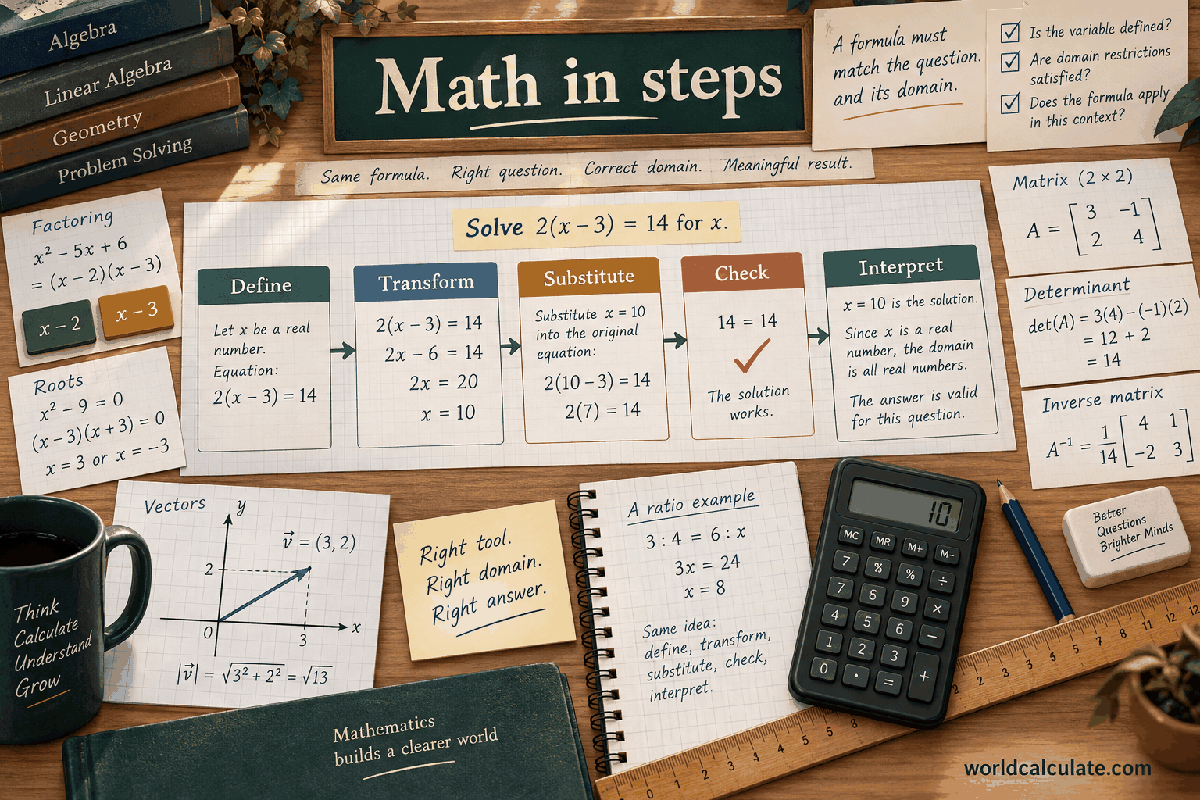
A transpose changes how a matrix is indexed without changing the values stored in it. This calculator accepts one finite row-major 3x3 matrix with keys a11 through a33, exchanges each row index with its column index, and returns a deterministic text matrix. Entries on the main diagonal remain in place while off-diagonal pairs exchange positions. The operation is intentionally narrower than a conjugate transpose, inverse, sort, or multiplication. This article explains the index rule, the fixed field order, a worked example, diagonal and symmetric cases, signs and zeros, finite and serialization behavior, how transpose interacts with nearby operations, and the limits of interpreting a rearranged matrix.
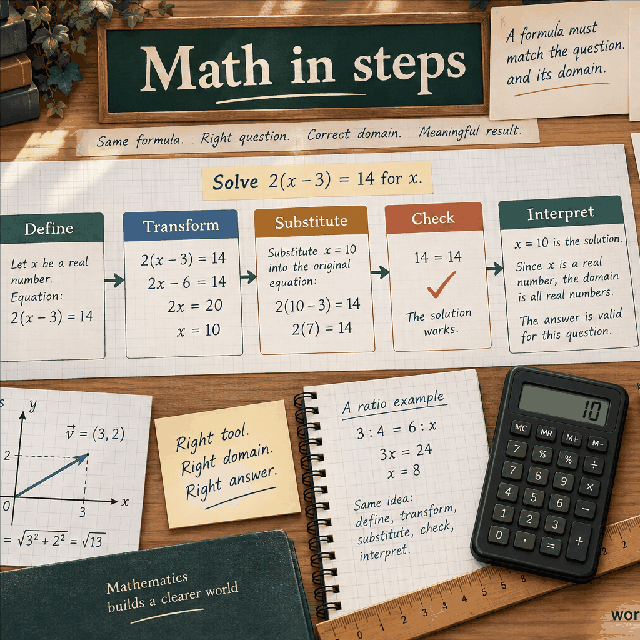
For a matrix A, the transpose is written A^T and is defined by (A^T)ij = Aji. The first index and second index exchange roles. Therefore the value originally at row one, column two moves to row two, column one. The value at row three, column one moves to row one, column three. No arithmetic is required to decide the new value; the operation is a controlled movement of existing entries. The result has the same 3x3 shape because the input is square.
The main diagonal is the set of positions 11, 22, and 33. Each of those positions maps to itself because exchanging equal indices changes nothing. Every off-diagonal position belongs to a pair: 12 with 21, 13 with 31, and 23 with 32. This pairing provides an immediate way to inspect a result. If an output does not show those exchanges, the operation may have been confused with a copy or with a row permutation.
The form presents A as [[a11, a12, a13], [a21, a22, a23], [a31, a32, a33]]. The key names are not arbitrary labels: the first digit is the source row and the second is the source column. To construct the first output row, take a11, a21, and a31. The second output row is a12, a22, and a32. The third output row is a13, a23, and a33. Reading the operation this way makes the column-to-row movement explicit.
Each entry must be a JavaScript number that is finite and lies between -1000 and 1000 inclusive. Negative and decimal values remain valid because transpose does not impose a positivity condition. The handler validates entries before constructing the result, rejects numeric text and nonfinite values, and normalizes negative zero. The example input object contains all nine keys so an independent caller can reproduce the same layout without relying on a visual grid.
For A = [[1, 2, 3], [0, 1, 4], [5, 6, 0]], the first output row is [a11, a21, a31] = [1, 0, 5]. The second output row is [a12, a22, a32] = [2, 1, 6]. The third output row is [a13, a23, a33] = [3, 4, 0]. The returned text is [[1, 0, 5], [2, 1, 6], [3, 4, 0]]. Notice that the numbers themselves did not change; only the named positions changed.
A useful manual check is to compare the six off-diagonal values as pairs. The original a12=2 should appear as output position 21, original a21=0 should appear at output 12, original a13=3 should appear at output 31, and so on. This check catches a common mistake where a caller reverses the visual rows but not the underlying indices. It also confirms that the main diagonal 1, 1, and 0 stayed fixed.
A matrix is symmetric when A^T equals A. In the 3x3 layout this means a12=a21, a13=a31, and a23=a32, while diagonal entries are unrestricted by symmetry. The calculator does not test or require symmetry, but a symmetric fixture should return the same matrix text. This is a useful branch-free check because it tests all paired positions at once. A matrix that is not symmetric should visibly change in the off-diagonal positions.
Applying transpose twice returns the original matrix: (A^T)^T = A. This identity is a strong test of the index implementation. It also clarifies that transpose is not a lossy operation. If a formatted display rounds values, preserve the original finite numbers when applying the second operation so a display decision does not become an unintended numerical modification.
A zero moves like any other entry. If a31 is zero, the transposed position 13 is zero; it is not replaced with a neighboring value or omitted from the output. A negative entry keeps its sign while moving. Because the operation does not add, multiply, or square values, there is no cancellation or magnitude change to interpret. The only possible visual issue is signed zero, which the implementation removes so that a moved zero is rendered as 0.
The lack of arithmetic is important when the matrix represents coefficients, a table, or a record of pairwise relationships. Transposition changes which index is treated as a row and which as a column. It can therefore alter the meaning of a later product even though each scalar value is unchanged. The calculator reports the structural result and does not decide whether the new orientation is appropriate for the next operation.
Since transpose only reuses finite input entries, every output entry is finite when validation succeeds. The engine nevertheless routes displayed values through the same finite formatter used by the matrix family. The result is a text value with outer brackets, three row arrays, comma separators, and row-major order. The result object also includes nonempty steps and a note so a renderer can present the operation without inspecting internal arrays.
Deterministic formatting is useful for tests and for comparing two runs, but the text is a presentation value rather than a general matrix serialization protocol. A caller that needs to transpose the result again should retain the named numeric fields or a structured representation. JSON serialization of the handler output is safe because no array element is undefined, nonfinite, or a signed zero.
Transpose is not inverse. An inverse, when it exists, is a matrix that multiplies with the original to produce the identity and requires division by a determinant in this M1 family. Transpose is not conjugate transpose because this contract accepts real numbers and performs no complex conjugation. It is not a row swap, because all three columns become rows in their original order. It is not multiplication by a permutation matrix, even though some larger workflows can express a row or column rearrangement that way.
Transpose also interacts with products through a reversal identity: (A x B)^T equals B^T x A^T for compatible matrices. The calculator does not compute the whole identity in one call, but the relationship is a useful external check when the multiplication and transpose tools are used together. The reversal of order in that identity is exactly why a transpose should not be treated as a cosmetic display change in a transformation pipeline.
To review a result, write the input as a grid, mark the main diagonal, and trace each off-diagonal pair to its exchanged location. Apply the handler twice and compare the returned matrix with the starting values. Test an explicitly symmetric matrix and a matrix with distinct signed decimal entries so an accidental copy or a sign change becomes visible. Then serialize the result and verify that no row was omitted and no negative zero appears.
The calculator does not know whether rows represent observations, variables, basis vectors, or coefficients. It cannot determine whether a transposed matrix is dimensionally compatible with a later product or whether a change in orientation is meaningful in a real system. Enter only the required numbers and keep sensitive context outside the form. If the matrix is part of a high-consequence model, validate indexing conventions, units, precision, and downstream behavior with the appropriate review process.
The transpose is often used when a row-oriented record must be consumed by a column-oriented operation, but that statement describes a workflow rather than a universal reason to transpose. First identify the interface expected by the next operation. A matrix with rows as observations may need a transpose for a particular product, while another method may already expect those rows. The calculator performs the exchange exactly as requested and does not infer the next interface.
If the source matrix is exported from a table, check whether its visible first row is truly row one in the mathematical convention. Headers, filtered records, and blank cells can shift the mapping before the transpose is called. Validate that exactly nine numeric entries were selected, map them to a11 through a33, and retain the original table labels separately. A structural transpose cannot repair a source mapping error that happened before the nine values were entered.
Symmetry is a useful but limited diagnostic. If all three off-diagonal pairs agree, transpose should return the same numeric matrix. If only one pair differs, the output should show exactly that pair exchanged. A nearly symmetric measured matrix may appear symmetric after display rounding, so compare underlying numbers before applying an approximate symmetry rule. The handler intentionally leaves tolerance selection to the caller because different data sources justify different thresholds.
Transpose also provides a controlled way to test a matrix pipeline without changing scalar magnitudes. Compare the norm and trace before and after transpose, since both should be preserved for this square real matrix. Compare a product before and after moving transpose through the product identity only when the factor order is reversed correctly. These checks reveal whether a later discrepancy came from a layout exchange or from an unrelated arithmetic step.
A final orientation handoff should include the original and transposed grids, the exact index convention, the source labels, and the intended consumer. Store numeric fields separately from the bracketed text so a later operation does not need to parse display prose. Verify double transpose, diagonal preservation, signed values, and JSON serialization. The page supplies a deterministic permutation of nine values; all semantic conclusions belong to the surrounding application and its review process.
Transpose can be used to prepare a table for a method that expects its variables in the opposite orientation, but it does not rename or validate those variables. A row label that moves into a column role may require a corresponding metadata transformation. Keep the label map synchronized with the numeric transpose. If labels are dropped, a later consumer may use the right numbers with the wrong semantic names.
When comparing a source and its transpose in a test, compare both positions and values. A matrix containing repeated values can hide a swap, so include a fixture with nine distinct values and a fixture with mixed signs. Check that a11, a22, and a33 remain exactly where they were and that every off-diagonal pair changes places. This gives direct evidence for the index rule rather than relying only on a visual impression.
A transpose does not turn a row vector into a general matrix parser or infer a missing dimension. The M1 contract starts and ends with a complete 3x3 square. If an external source has one row or one column, represent that operation with a separately designed vector contract. Padding a shorter source into 3x3 would add unentered values and would not be a legitimate transpose of the source object.
Display precision is normally irrelevant because transpose performs no calculation, but formatting can still hide distinctions between close values. Preserve numeric fields when a later equality, symmetry, or norm check matters. The page normalizes negative zero for consistent output, yet it does not collapse small nonzero entries to zero. Any threshold for approximate symmetry should be stated by the caller.
The final acceptance question is whether every source value moved from ij to ji exactly once and whether the surrounding metadata acknowledges that row and column roles changed. The handler provides the finite deterministic permutation and a JSON-safe result. It does not decide what the new orientation means or whether a later operation should consume it.
A useful provenance note identifies the source grid, the mapping from source labels to a11 through a33, the reason for changing orientation, and the consumer that expects the result. If the transpose is part of a product pipeline, record the neighboring factors and the vector convention as well. This prevents a later user from applying a second orientation change simply because the displayed matrix looks unfamiliar.
When a transposed matrix is handed to another person or service, name the operation in the record rather than describing only the output as a matrix. Include whether the source was already transposed, whether labels moved with rows or columns, and whether the consumer expects row-major keys. These details are small, but they prevent a correct permutation from being applied twice or interpreted under the wrong storage convention.
Transposition is reversible because applying it twice restores every original index. This differs from a lossy export or a sort: no source value is removed, duplicated, or numerically altered. The identity (A^T)^T=A can be checked with any valid matrix, including one with repeated values. A matrix with repeated entries is still useful for checking row and column counts, but distinct values make the exchange paths easier to audit by eye.
The operation is also a bijection on the nine positions. Position 11 maps to 11, 12 maps to 21, 13 maps to 31, 21 maps to 12, 22 maps to 22, 23 maps to 32, 31 maps to 13, 32 maps to 23, and 33 maps to 33. Listing the complete map is helpful when a matrix is imported from a system that uses a different storage convention. The calculator uses named positions rather than assuming a language-specific memory layout.
A row-major display is a presentation and input convention, while an application may store a matrix in another memory order. The named fields remove that ambiguity at the calculator boundary. If an external array is column-major, convert it deliberately before assigning a11 through a33; do not rely on a visual copy that happens to show the same nine numbers. A correct transpose of an incorrectly mapped source still produces the wrong result for the intended data.
Rows and columns often have different meanings. A table may use rows for observations and columns for variables, or rows for output channels and columns for inputs. Transpose exchanges those roles. The operation is mathematically clear, but a later consumer must know that the orientation changed. Include labels or a basis description with any shared matrix so a reviewer does not treat transpose as a harmless formatting step.
Transpose should preserve the exact numeric value associated with each position. With ordinary floating-point entries, the handler does not perform arithmetic that would introduce a new rounding operation. It validates and formats the existing values. A comparison between A and its double transpose can therefore use exact numeric equality for the underlying parsed fields when the same values are passed through, while a comparison of formatted strings should still use the declared display convention.
A symmetric check should compare corresponding off-diagonal pairs rather than only compare the final text. If a12 and a21 differ by a small measurement residual, the matrix is not exactly symmetric even if a low-precision display makes the two values look equal. The calculator does not choose a symmetry tolerance. If a workflow needs approximate symmetry, define the tolerance relative to data scale and state whether it applies before or after any transpose.
A reproducible transpose record should keep the source matrix, the fact that the operation was A^T, the row and column labels, and the output text. If the matrix came from a file or a service, preserve the source storage order and the mapping used to populate the nine fields. This context lets another person distinguish a genuine transpose from a mistaken row reversal or a column-major import error.
For focused review, use the worked matrix, a symmetric matrix, a diagonal matrix, a mixed-sign matrix, and a matrix with nine distinct decimals. Apply transpose twice and compare the result. Then use the transposed output as input to a separate operation only after checking that the next operation expects the new orientation. The handler is deliberately quiet about those semantic decisions so its structural result remains reusable.
Transpose a finite row-major 3x3 matrix by exchanging its row and column indices.
(A transpose)ij = Aji, so each row and column index is exchanged. Transposition reflects a square matrix across its main diagonal. It preserves every entry and changes only its row-column position, producing a deterministic 3x3 text matrix.
Enter A11, A12, A13, A21, A22, A23, A31, A32, A33, then choose Calculate.
A is a real 3x3 matrix entered in fixed row-major order. All nine entries are finite numbers between -1000 and 1000 inclusive. The operation is a structural transpose only; no conjugation, sorting, scaling, or unit interpretation is applied.
This calculator is part of the WorldCalculate library. Its formula, example, assumptions, input bounds, and output formatting follow the official methodology.
These WorldCalculate collections connect this tool with related questions while keeping each calculation separate and transparent.