
Goal
Add two finite row-major 3x3 matrices entry by entry and return their deterministic matrix sum.
Worldwide context
Saved once here, used across the site.
Currency changes display only. Country selection guides tax input; no tax rate is guessed.
Add two finite row-major 3x3 matrices entry by entry and return their deterministic matrix sum.
Cij = aij + bij for each row i and column j from 1 through 3.A clearer path to an answer
This page keeps the calculation transparent: define the goal, enter the matching values, inspect the method, and decide what the result means in your situation.
Add two finite row-major 3x3 matrices entry by entry and return their deterministic matrix sum.
A11 · A12 · A13 · A21 · A22 · A23 · A31 · A32 · A33 · B11 · B12 · B13 · B21 · B22 · B23 · B31 · B32 · B33
Cij = aij + bij for each row i and column j from 1 through 3.
Calculate, review the assumptions below, then compare a related tool when the decision needs more context.
Add two finite row-major 3x3 matrices entry by entry and return their deterministic matrix sum.
Open the Matrix Addition pageMore math tools
Download PDFDownload Word (.doc)
Enter your values above and choose Calculate to see the result here.
Calculation map
Cij = aij + bij for each row i and column j from 1 through 3.
Bounded, transparent calculation
Your recent runs stay in this browser session only.
Formula: Cij = aij + bij for each row i and column j from 1 through 3.
Matrix addition pairs entries that occupy the same row and column in two equal-sized matrices. The result keeps the fixed row-major 3x3 layout and contains no reordering, multiplication, or hidden scalar conversion.
Worked example: A + B = [[3, 2, 4], [1, 4, 4], [5, 8, 1]].
The displayed limits are checked before the handler runs. Model-specific domain checks may also reject impossible or non-finite inputs.
Methodology: This calculator follows the WorldCalculate input, formula, precision, and boundary policy. Read the official methodology.
Calculator usage statistics
This section counts anonymous successful Calculate submissions, not unique visitors. Counts and top tools appear only when trusted aggregate data is available; country analysis is shown only under the same condition and reporting threshold.
Answer-first guide
Add two finite row-major 3x3 matrices entry by entry and return their deterministic matrix sum. Start with one clearly defined goal, enter values in the units shown, and keep the result attached to the assumptions below.
This tool is useful when your question includes matrix addition, 3x3 matrix sum, add matrices. It returns the outputs declared in the calculator contract rather than a live quote, approval, diagnosis, or professional sign-off.
A11 · A12 · A13 · A21 · A22 · A23 · A31 · A32 · A33 · B11 · B12 · B13 · B21 · B22 · B23 · B31 · B32 · B33. Keep the same time period, unit system, and currency wherever the form requires comparable values.
Run the worked example first, compare its output with the page's example, then change one input at a time. This makes an unexpected result easier to trace to a unit, boundary, or assumption.
Need a wider view? Browse Math Calculators or compare the related tools below. The WorldCalculate methodology explains how formulas, examples, limits, and revisions are reviewed.
Cij = aij + bij for each row i and column j from 1 through 3.
Matrix addition pairs entries that occupy the same row and column in two equal-sized matrices. The result keeps the fixed row-major 3x3 layout and contains no reordering, multiplication, or hidden scalar conversion.
A + B = [[3, 2, 4], [1, 4, 4], [5, 8, 1]].
Context and background
Math calculators move from named quantities to a relation, then to a result that can be checked with substitution, units, or an alternate form.
Arithmetic, algebra, geometry, trigonometry, and number theory provide reusable structures for classroom work and everyday reasoning. Each page narrows that structure to one declared problem.
Research and review
Researched by Hassan ALRowaie, Founder and editorial researcher at WorldCalculate.
This guide follows the live calculator's declared inputs, formula, worked example, assumptions, validation boundaries, and source-backed methodology. The review date describes editorial review of the calculator explanation; it is not a promise that external facts or rates remain current.

Matrix addition is one of the most direct operations in linear algebra, but its simplicity depends on preserving the position of every entry. This calculator accepts two finite 3x3 matrices through the named row-major keys a11 through a33 and b11 through b33. It adds matching entries and returns one text matrix in a stable row-major format. The page does not multiply matrices, add rows in a different order, infer a dimension, or attach physical units. The guide explains what the result means, how the fields map to positions, why dimensions must match, how the sum is assembled, how signs and zeros behave, how bounded arithmetic is checked, and how to review the result without treating a small matrix operation as a complete domain model.
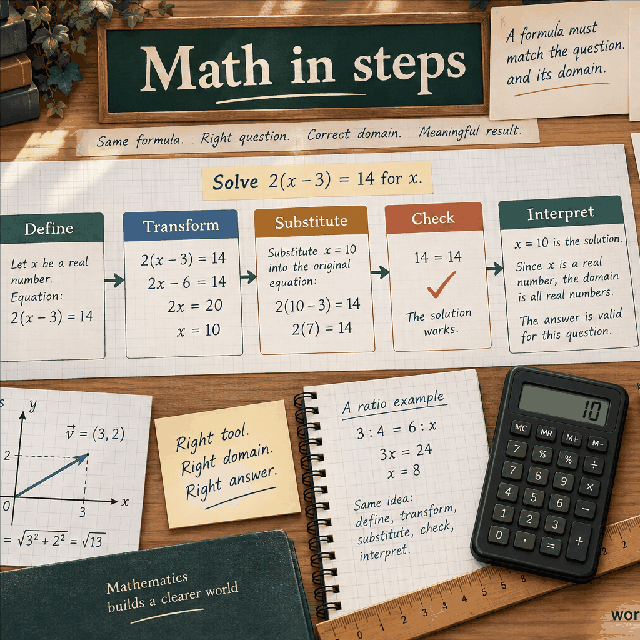
The result of matrix addition is a third matrix C with the same three rows and three columns as A and B. Each position in C is formed from exactly two inputs: the entry in the same position of A and the entry in the same position of B. Thus C11 uses a11 and b11, C12 uses a12 and b12, and the same positional rule continues through C33. The operation has no cross-row or cross-column interaction. A value in the first row cannot influence a value in the second row unless the corresponding input pair itself contains that relationship. This position-preserving behavior is the central contract of the calculator.
A matrix sum is not a list of nine unrelated calculations even though it contains nine scalar additions. The shared shape matters because the result is intended to keep the same indexing system as its operands. If the rows represent observations and the columns represent features, addition combines like features within like observations. If the entries are coefficients, it combines coefficients with the same role. The calculator does not know which interpretation applies, so it reports the arithmetic without assigning a meaning to rows, columns, units, or a downstream transformation. A reviewer should keep that surrounding interpretation next to the returned matrix.
The first matrix uses a11, a12, and a13 for row one; a21, a22, and a23 for row two; and a31, a32, and a33 for row three. The first digit identifies the row and the second digit identifies the column. Matrix B follows the identical pattern with b in place of a. Reading the fields row by row produces A = [[a11, a12, a13], [a21, a22, a23], [a31, a32, a33]]. This explicit order prevents a common mistake in which a value from a column is accidentally entered as if it belonged to the next row.
Each field is a required finite numeric entry between -1000 and 1000 inclusive. Negative and fractional values are allowed, as are exact zeros. The displayed bounds are a software safety boundary rather than a statement that larger matrices or larger entries are impossible in mathematics. The pure handler repeats the checks so a direct call cannot bypass the form with text, missing values, not-a-number, or either infinity. The example object uses the same keys as the field list, allowing the result to be reproduced without guessing which number belongs to which position.
For i and j from 1 through 3, the rule is cij = aij + bij. Writing the rule with two indices is more useful than listing only the first few entries because it shows that the same operation is repeated for the complete grid. The first row is [a11+b11, a12+b12, a13+b13]. The second row is [a21+b21, a22+b22, a23+b23], and the third row follows the same pattern. There is no need to calculate a dot product, a determinant, or a product of corresponding values. Addition uses one pair at a time and retains the original location.
The operation is commutative and associative over ordinary real entries: A+B equals B+A, and a sequence of compatible sums can be regrouped. Those algebraic properties are useful checks, but the form still preserves an explicit A then B input order so the audit trail remains readable. The engine computes each sum, checks it for finiteness, normalizes negative zero, and formats the completed result in row-major order. Formatting changes how a value is shown, not the mathematical operation used to produce it.
Use A = [[1, 2, 3], [0, 1, 4], [5, 6, 0]] and B = [[2, 0, 1], [1, 3, 0], [0, 2, 1]]. The first row of the result is [1+2, 2+0, 3+1] = [3, 2, 4]. The second row is [0+1, 1+3, 4+0] = [1, 4, 4]. The third row is [5+0, 6+2, 0+1] = [5, 8, 1]. The calculator returns [[3, 2, 4], [1, 4, 4], [5, 8, 1]], with the rows and columns shown in their original order.
A manual audit can check one position from each row rather than recomputing only the first entry. For example, c23 uses a23=4 and b23=0, so c23=4; c31 uses 5 and 0, so c31=5; and c33 uses 0 and 1, so c33=1. This sampling is useful when a matrix is copied from a table because it checks both arithmetic and field placement. If every entry is required for a formal proof or a software fixture, write all nine pairs explicitly and compare the complete text matrix.
A negative entry is added with its sign. If a11 is -4 and b11 is 9, the result at position 11 is 5. If both are negative, their magnitudes add in the negative direction. A zero is equally ordinary: adding zero preserves the other entry, while adding opposite entries can produce exact cancellation. These cases are not special branches in the mathematical definition, but they are valuable test cases because a misplaced absolute value or an accidental multiplication would change their behavior. The engine does not erase a legitimate negative result.
Cancellation also explains why negative zero deserves output hygiene. JavaScript can represent a signed zero after some operations, even though ordinary matrix notation does not distinguish it. The handler normalizes numeric intermediate values and the formatter normalizes displayed values, so a result position is shown as 0 rather than -0. This is a presentation guarantee, not a change to nonzero arithmetic. For a matrix whose entries are measured or rounded, a small residual is still a real computed value unless an external tolerance says otherwise.
The entry range keeps every direct input within -1000 through 1000. A single sum therefore remains in a small finite range, but the engine still validates every derived sum instead of assuming that input checks are enough. The result object contains a text value for the matrix because a matrix is not one scalar metric. The text uses brackets, comma separators, row separators, and row-major order consistently. A caller can serialize the result as JSON without encountering undefined values, Infinity, NaN, or a signed zero.
The text representation is deterministic but it is not a parser contract. Downstream code should retain the original named inputs if it needs to perform another operation. Treating a formatted sentence as the only source of truth can make later changes in display precision look like mathematical changes. The calculator uses a compact significant-digit formatter for readability while retaining finite numeric checks before formatting. If a workflow needs exact symbolic expressions, units, uncertainty, or arbitrary precision, those requirements belong to a separate reviewed layer.
Matrix addition and scalar multiplication both preserve the 3x3 shape, but addition combines two matrices while scalar multiplication combines one matrix with one number. Matrix multiplication also consumes two matrices, yet each output entry is a row-column dot product rather than a same-position sum. Transposition changes the placement of entries without changing their values. These distinctions matter because a plausible-looking 3x3 output can still answer the wrong question if the operation is chosen from a label alone. The calculator deliberately implements only same-position addition.
Addition requires compatible dimensions. This page fixes both operands at 3x3, so the dimension check is represented by the field contract rather than a general matrix parser. It does not accept a rectangular list, infer a missing row, or pad a smaller input with zeros. A zero matrix is valid and acts as an additive identity. The identity property provides a useful test: adding an all-zero B should return A exactly, subject only to the stable text formatting used by the renderer.
A reliable review starts by writing both matrices in a visible 3x3 grid, pairing the same row and column, and checking one addition in each row. Then repeat the calculation with A and B exchanged; the result should be unchanged. Add a zero matrix to test identity behavior, and use opposite matrices to test cancellation to a zero matrix. These checks exercise indexing, sign handling, and the operation itself. They are stronger than checking only the default example because they vary the structural conditions that commonly expose a data-entry defect.
The arithmetic can be useful in education, coefficient assembly, image-like grids, and small software fixtures, but the result does not certify a model. It does not decide whether two matrices have compatible units, whether a sum represents a valid physical quantity, or whether a later transformation is stable. Do not enter names, private records, credentials, or unnecessary sensitive data in fields that require only numbers. Keep any operational, scientific, or financial interpretation with the surrounding assumptions and qualified review rather than attributing it to entrywise addition alone.
When a matrix sum is part of a repeated workflow, decide whether the inputs are snapshots, corrections, increments, or complete states before adding them. Adding two complete states can double a quantity that was not intended to be accumulated, while adding a correction to a state may be exactly the intended operation. The handler cannot tell these cases apart from the nine numbers. A short external description of what each matrix represents prevents a correct entrywise result from being used as the wrong kind of total.
Data import deserves the same care as the arithmetic. Map each source row and column to the named fields, verify that the source contains exactly nine values for each operand, and record how missing or filtered values were handled before the call. Do not silently replace a missing cell with zero unless zero is the documented source value. The calculator treats zero as a real number, so an accidental replacement can produce a clean-looking matrix that hides an incomplete input.
The additive identity and opposite-matrix tests can be used as a small integration harness. Generate an all-zero matrix and confirm that the other operand is preserved. Generate the entrywise negative of A and confirm that A plus that matrix is the zero matrix. Use a nontrivial mixed-sign fixture to ensure that the harness checks signs as well as positions. These tests are independent of the default values and help catch a regression in key mapping or serialization.
If a result is displayed to a person, label the rows and columns when those positions have domain names. The fixed text format shows numbers but cannot show that row two means one variable group or that column three means a particular feature. Preserve the labels outside the handler and do not add them into numeric fields. This separation keeps the pure calculation deterministic while allowing a surrounding application to provide the context needed for interpretation.
For a final review, compare the complete result text with a structured recomputation rather than checking only a screenshot. Inspect each of the nine pairs, verify that all result values are finite, and confirm that JSON serialization preserves the result, steps, and note. If a later operation consumes the matrix, pass structured numbers rather than reparsing prose. The safest handoff is the named source matrices, the operation name, the finite result, and the assumptions that made addition appropriate.
A useful audit table has one row for each position: position, A value, B value, operation, and C value. This table makes a wrong key visible even when the final matrix looks plausible. It also gives a concise explanation for a reviewer who does not need to inspect the engine. Keep the table derived from the named input object, not from a manually retyped result, so the audit checks the same data that the handler received.
If a matrix sum is repeated over time, keep each period's operands separate before accumulating a history. A later total should identify whether it sums changes, states, or independently measured matrices. The page performs one two-operand sum and has no date, version, or accumulation field. Adding that context in a surrounding record preserves the mathematical simplicity of the handler while preventing an accidental mixture of snapshots and increments.
A negative result entry is not an error and should not be converted to a magnitude for display. The sign can be the difference between two signed coefficients or the result of cancellation. Reviewers should compare the displayed sign with the two source signs and magnitudes. If a consuming application needs absolute values, it should state that new operation explicitly rather than changing the definition of matrix addition.
The fixed bounds are intentionally conservative for browser arithmetic. They do not reject a mathematically valid larger matrix in every possible context; they reject it for this page's renderer-facing contract. If a scientific or engineering workflow needs larger values, arbitrary precision, or uncertainty propagation, it should use a separately reviewed implementation. Do not silently widen the fields while leaving the article and test assumptions unchanged.
The final acceptance question is narrow: were the same-position finite entries added once, in row-major order, with no hidden coercion? If yes, the handler has answered its contract. Whether the sum is useful, dimensionally valid, or safe to publish is a separate question. Keeping those questions separate makes the result easier to reproduce and prevents a small arithmetic page from becoming an unreviewed domain decision.
The same-position rule gives matrix addition its familiar commutative property. If every pair is added in the opposite order, aij+bij and bij+aij have the same scalar value, so B+A should have the same complete matrix as A+B. This is a useful test of the implementation because it changes the source prefixes without changing the expected positions. It also highlights why addition can be exchanged here while matrix multiplication should not be exchanged by default.
Addition is also associative for compatible finite matrices. If a third matrix were available, calculating (A+B)+C or A+(B+C) would produce the same entries in exact arithmetic. This page intentionally accepts only two matrices, but the property still helps review a chained workflow. Preserve the grouping and the source matrix names in the external record even when the final arithmetic is unaffected, because provenance can matter when one matrix came from a correction or a separate measurement batch.
General matrix addition requires equal dimensions. The M1 page makes that requirement concrete by exposing exactly nine A fields and nine B fields, rather than accepting arbitrary rectangular arrays. There is no hidden padding, truncation, or broadcasting. A missing row is not interpreted as zeros and an extra value cannot be ignored. This fixed shape makes the returned text predictable and keeps the operation distinct from a generic data-table merge.
The source of a matrix can matter as much as the arithmetic. A coefficient matrix, a pixel-like grid, and a table of measurements may all contain nine numbers while having incompatible units or meanings. Addition is algebraically defined for the values, but a responsible workflow should confirm that corresponding positions describe comparable quantities. Record the origin, units, row labels, column labels, and any preprocessing outside the calculator. The handler validates numeric shape, not semantic provenance.
Finite decimal inputs are represented by ordinary JavaScript numbers. Most classroom values and bounded software fixtures add exactly or with a small floating-point representation error. The engine keeps the numeric sums until it formats the matrix, so it does not round each pair before adding the next pair. This prevents display precision from becoming an unannounced arithmetic rule. If a caller requires exact rational arithmetic, it should convert and validate the values before using a different representation.
When a sum feeds a later multiplication, norm, determinant, or inverse, retain the numeric fields and the operation metadata. Copying only the formatted text can discard useful precision or make a later parser depend on punctuation. A tolerance for comparing two results belongs to the downstream check and should be expressed relative to the scale and purpose of that check. The matrix-sum result itself does not decide whether a small difference is meaningful, negligible, or evidence of an error.
A reproducible record should contain the two named input objects, the fixed key order, the operation name, and the returned matrix text. Include the date or scenario that gives the entries meaning when the matrices come from a changing process. The compact result is easy to read, but it is not enough to reconstruct whether a value came from A or B or whether a row label was accidentally changed before entry. Keeping the source objects allows a reviewer to recompute all nine pairs.
A final review can compare a zero-matrix identity case, an opposite-matrix cancellation case, a mixed-sign case, and the worked example. It can then serialize the full handler output and confirm that the steps, note, result label, and text matrix are nonempty. These checks are deliberately small and deterministic. They do not replace a domain review of units, uncertainty, or the larger transformation in which a matrix sum may participate.
Add two finite row-major 3x3 matrices entry by entry and return their deterministic matrix sum.
Cij = aij + bij for each row i and column j from 1 through 3. Matrix addition pairs entries that occupy the same row and column in two equal-sized matrices. The result keeps the fixed row-major 3x3 layout and contains no reordering, multiplication, or hidden scalar conversion.
Enter A11, A12, A13, A21, A22, A23, A31, A32, A33, B11, B12, B13, B21, B22, B23, B31, B32, B33, then choose Calculate.
A and B are real square 3x3 matrices written in the fixed row-major key order a11 through a33 and b11 through b33. Every entry is a finite number in the inclusive range -1000 through 1000, and the arithmetic result must remain finite. The matrices share a compatible mathematical context; no units, basis change, rounding policy, or symbolic expression is inferred.
This calculator is part of the WorldCalculate library. Its formula, example, assumptions, input bounds, and output formatting follow the official methodology.
These WorldCalculate collections connect this tool with related questions while keeping each calculation separate and transparent.