
Goal
Solves ax + b against zero and reports the ray solution with its boundary point.
Worldwide context
Saved once here, used across the site.
Currency changes display only. Country selection guides tax input; no tax rate is guessed.
Solves ax + b against zero and reports the ray solution with its boundary point.
Boundary x = -b/a; keep the direction if a > 0, flip it if a < 0.A clearer path to an answer
This page keeps the calculation transparent: define the goal, enter the matching values, inspect the method, and decide what the result means in your situation.
Solves ax + b against zero and reports the ray solution with its boundary point.
Coefficient a · Constant b · Inequality direction
Boundary x = -b/a; keep the direction if a > 0, flip it if a < 0.
Calculate, review the assumptions below, then compare a related tool when the decision needs more context.
Solves ax + b against zero and reports the ray solution with its boundary point.
Open the Linear Inequality Solver pageMore math tools
Download PDFDownload Word (.doc)
Enter your values above and choose Calculate to see the result here.
Calculation map
Boundary x = -b/a; keep the direction if a > 0, flip it if a < 0.
Bounded, transparent calculation
Your recent runs stay in this browser session only.
Formula: Boundary x = -b/a; keep the direction if a > 0, flip it if a < 0.
Find where ax + b equals zero, then keep or flip the symbol depending on the sign of a. The boundary satisfies the equation; the ray satisfies the inequality.
Worked example: Solution x > 2; boundary 2.
The displayed limits are checked before the handler runs. Model-specific domain checks may also reject impossible or non-finite inputs.
Methodology: This calculator follows the WorldCalculate input, formula, precision, and boundary policy. Read the official methodology.
Calculator usage statistics
This section counts anonymous successful Calculate submissions, not unique visitors. Counts and top tools appear only when trusted aggregate data is available; country analysis is shown only under the same condition and reporting threshold.
Answer-first guide
Solves ax + b against zero and reports the ray solution with its boundary point. Start with one clearly defined goal, enter values in the units shown, and keep the result attached to the assumptions below.
This tool is useful when your question includes linear inequality, solve inequality, boundary point. It returns the outputs declared in the calculator contract rather than a live quote, approval, diagnosis, or professional sign-off.
Coefficient a · Constant b · Inequality direction. Keep the same time period, unit system, and currency wherever the form requires comparable values.
Run the worked example first, compare its output with the page's example, then change one input at a time. This makes an unexpected result easier to trace to a unit, boundary, or assumption.
Need a wider view? Browse Math Calculators or compare the related tools below. The WorldCalculate methodology explains how formulas, examples, limits, and revisions are reviewed.
Boundary x = -b/a; keep the direction if a > 0, flip it if a < 0.
Find where ax + b equals zero, then keep or flip the symbol depending on the sign of a. The boundary satisfies the equation; the ray satisfies the inequality.
Solution x > 2; boundary 2.
Context and background
Math calculators move from named quantities to a relation, then to a result that can be checked with substitution, units, or an alternate form.
Arithmetic, algebra, geometry, trigonometry, and number theory provide reusable structures for classroom work and everyday reasoning. Each page narrows that structure to one declared problem.
Research and review
Researched by Hassan ALRowaie, Founder and editorial researcher at WorldCalculate.
This guide follows the live calculator's declared inputs, formula, worked example, assumptions, validation boundaries, and source-backed methodology. The review date describes editorial review of the calculator explanation; it is not a promise that external facts or rates remain current.
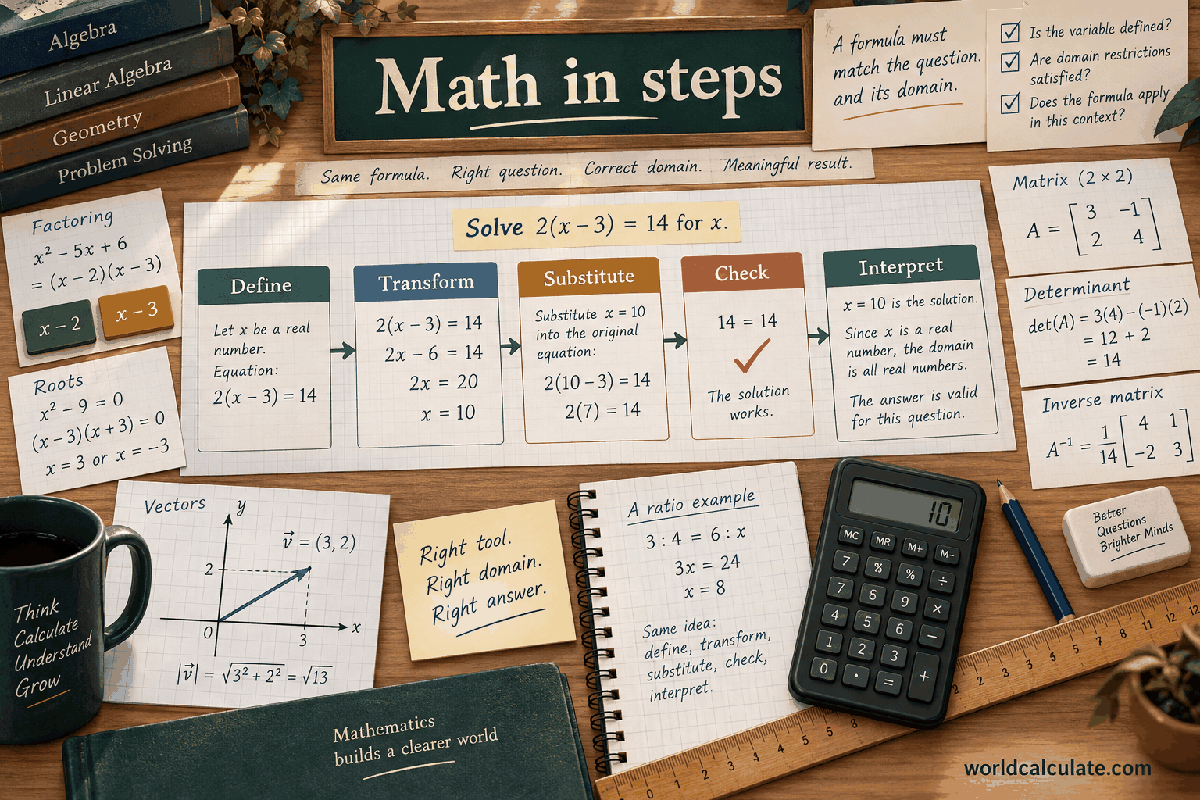
A linear inequality describes every value of x that makes an expression larger than, smaller than, or equal to zero. In the form ax + b compared with zero, a is the coefficient that controls the slope and b is the constant shift. This calculator finds the boundary point where ax + b = 0, then identifies the open or closed ray that satisfies the selected direction. The main idea is simple, but one step deserves special attention: dividing by a negative coefficient reverses the inequality sign. This guide walks through that rule slowly, covers all four directions, explains strict versus non-strict boundaries, and shows how the answer appears in interval notation and on a number line. It also gives worked examples with positive and negative coefficients, explains how equality is handled, describes the input and rounding limits, lists common mistakes, and shows where a one-variable linear inequality is useful. The result is a transparent threshold calculation, not a substitute for checking the units, assumptions, or real-world meaning of the numbers you enter.
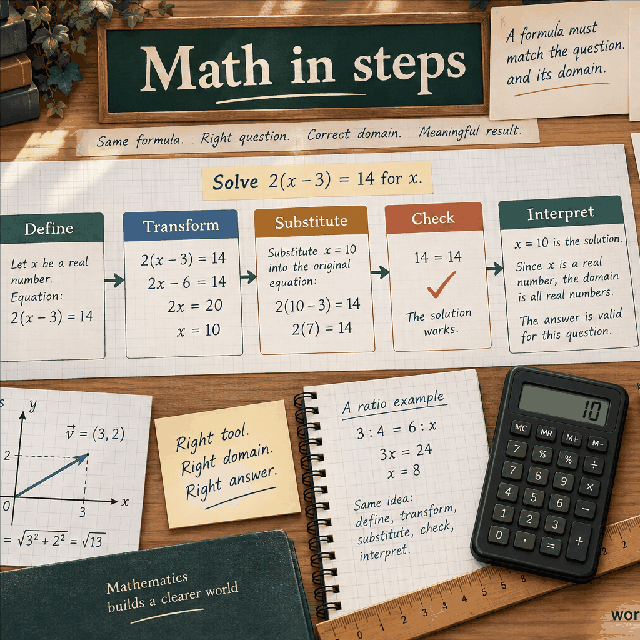
A linear equation asks for the value that makes an expression exactly zero. A linear inequality asks for a whole collection of values that makes the expression positive or negative, with the boundary sometimes included. For example, 2x - 4 > 0 is not asking for one number in the same way that 2x - 4 = 0 does. It asks which values of x make the expression positive. The answer is every x greater than 2. There are infinitely many such values, and they form a continuous ray extending to the right on the real number line.
The calculator uses the compact form ax + b compared with zero. The coefficient a must be nonzero, because a = 0 removes the x term and leaves a constant statement rather than a genuine linear inequality. The constant b may be positive, negative, or zero. The direction selector chooses greater than, greater than or equal to, less than, or less than or equal to. These choices are mathematically different even when they share the same boundary point.
The returned answer has two related parts. The solution is written as an inequality involving x, such as x < 4 or x >= -2. The boundary point is the number obtained by solving the associated equation ax + b = 0. Think of the boundary as the place where the expression changes from one side of zero to the other. Whether that one point belongs to the solution depends on whether the original comparison includes equality.
A helpful mental model is a gate on a number line. The boundary is the gate location. The inequality direction tells you which side of the gate is allowed, while a strict sign leaves the gate itself out and a non-strict sign lets the gate itself in. Keeping those three ideas separate makes most linear inequality problems routine.
The boundary point is found by temporarily replacing the inequality with an equality. Start with ax + b = 0. Subtract b from both sides to get ax = -b. Divide by a to obtain x = -b/a. This value is the point where the expression is exactly zero. It is also the only possible location where the truth of a nonzero linear inequality can change.
The negative sign in -b/a matters. If b is positive, the numerator -b is negative. If b is negative, -b is positive. For example, with 3x + 12, the boundary is -12/3 = -4. With 3x - 12, the boundary is -(-12)/3 = 4. A common shortcut is to move b across the equality without changing its sign; writing the intermediate step ax = -b prevents that error.
Finding the boundary does not finish the problem because the same boundary can lead to different rays. Compare 2x - 6 > 0 and 2x - 6 < 0. Both have boundary x = 3, but the first accepts values to the right and the second accepts values to the left. Likewise, 2x - 6 >= 0 includes 3, while 2x - 6 > 0 excludes 3.
The boundary is also a useful checking point. Substitute it into the original expression and you should get zero, apart from ordinary floating-point display effects. If the calculator reports a boundary of 2, then 2a + b should be zero for the entered a and b. If it is not, inspect the signs, the copied inputs, and the division before interpreting the ray.
A dependable hand method has four stages. First, identify the coefficient a, the constant b, and the selected comparison. Second, isolate the x term by subtracting b from both sides. Third, divide by a, watching its sign. Fourth, test a convenient value on the proposed solution side. The calculator follows the same mathematical structure and reports the boundary and the reason the direction was kept or flipped.
Suppose the statement is 5x + 10 <= 0. Subtract 10 to get 5x <= -10. Divide by the positive number 5, so the sign stays the same: x <= -2. The boundary is -2. A test value such as x = -3 gives -15 + 10 = -5, which satisfies <= 0. A value such as x = 0 gives 10, which does not. Testing one value on each side is especially useful when a sign feels uncertain.
Now consider -5x + 10 <= 0. Subtract 10 to get -5x <= -10. Dividing by -5 changes the direction, giving x >= 2. The boundary is still 2, but the accepted ray is now to the right. Testing x = 3 produces -15 + 10 = -5, which is allowed. Testing x = 1 produces 5, which is not. The test confirms the reversal rather than relying on memory alone.
When working with a comparison to a number other than zero, first move that number into the constant. For instance, ax + b > c can be rewritten as ax + (b - c) > 0. Then the same boundary and sign rules apply. This calculator itself is framed around zero, so perform that rearrangement before entering a and b if your original problem has a separate right-hand constant.
There are four input directions, formed from two choices. The first choice is which side of zero is required: greater than or less than. The second is whether equality is allowed. Greater than and less than are strict comparisons. Greater than or equal to and less than or equal to are non-strict comparisons. The strictness controls only the boundary point; the coefficient sign controls which side of the boundary is selected.
When a is positive, the direction is preserved after division. The four rules are: ax + b > 0 gives x > -b/a; ax + b >= 0 gives x >= -b/a; ax + b < 0 gives x < -b/a; and ax + b <= 0 gives x <= -b/a. A positive coefficient means that ax increases as x increases, so values to the right of the boundary make the expression larger and values to the left make it smaller.
When a is negative, every direction reverses. The rules become: ax + b > 0 gives x < -b/a; ax + b >= 0 gives x <= -b/a; ax + b < 0 gives x > -b/a; and ax + b <= 0 gives x >= -b/a. The boundary formula does not change. Only the side and the inclusion symbol change because the division step reverses order.
It helps to read the four directions as pairs. The strict pair greater than and less than uses an open boundary. The non-strict pair greater than or equal to and less than or equal to uses a closed boundary. The greater pair selects values where the expression is positive, and the less pair selects values where it is negative. Do not infer inclusion from the side of the ray; inclusion comes from the equality part of the original sign.
For an entered direction of greater, the calculator keeps > when a is positive and reports < when a is negative. For greaterEqual it keeps >= or flips to <=. For less it keeps < or flips to >. For lessEqual it keeps <= or flips to >=. Seeing this as a two-step decision, first coefficient sign and then strictness, is less error-prone than trying to memorize eight separate-looking cases.
The reversal is a property of ordered numbers, not a special trick for algebra. Multiplying or dividing both sides of an inequality by a positive number preserves which side is larger. Multiplying or dividing by a negative number reverses the order because the number line is reflected through zero. For example, 2 < 5 is true, but after multiplying both sides by -1 the result is -2 > -5. Writing -2 < -5 would be false.
In an inequality such as -4x + 8 > 0, subtract 8 first to obtain -4x > -8. At this point x is still multiplied by -4. Dividing both sides by -4 reflects the order and gives x < 2. If you wrote x > 2 instead, choose x = 3 to see the contradiction: the original expression is -12 + 8 = -4, which is not greater than zero. The incorrect ray fails its own test.
The boundary calculation can make the reversal feel confusing because -b/a may already contain a negative denominator. Keep the two operations conceptually separate. First calculate the numerical boundary using -b/a. Then decide the direction from the sign of a. Do not try to decide the direction by looking only at whether the boundary number itself is positive or negative. A positive boundary can have a leftward solution, and a negative boundary can have a rightward solution.
A useful physical picture is a thermometer scale viewed through a mirror. Multiplying every location by a negative value swaps left and right while retaining the order of the transformed values in the reversed direction. The algebraic rule is exact: whenever the final isolation of x involves division by a negative coefficient, reverse > to <, >= to <=, < to >, or <= to >=.
Solve 2x - 4 > 0. Here a = 2, b = -4, and the direction is greater. Set the expression equal to zero to find the boundary: 2x - 4 = 0, so 2x = 4 and x = 2. Because a is positive, dividing by 2 does not reverse the sign. The solution is x > 2. The calculator reports boundary point 2 and the same open ray in its solution text.
The boundary itself is not allowed. Substitute x = 2 into the original expression: 2(2) - 4 = 0. The statement asks for a value greater than zero, not a value equal to zero, so x = 2 fails. Try x = 3: 2(3) - 4 = 2, which is positive and allowed. Try x = 1: 2(1) - 4 = -2, which is not allowed. The test values confirm that the valid side lies to the right.
In interval notation, the answer is (2, infinity). The parenthesis at 2 records that the point is excluded. The parenthesis at infinity is always used because infinity is not an actual endpoint that can be included. On a number line, draw a hollow dot at 2 and shade to the right. These are three different representations of the same solution set: x > 2, (2, infinity), and a hollow point at 2 with rightward shading.
Solve -3x + 12 > 0. The coefficient is negative, so this is a good test of the reversal rule. Find the boundary from -3x + 12 = 0. Subtract 12 to get -3x = -12, then divide by -3. The boundary is x = 4. Dividing by the negative coefficient reverses > to <, so the solution is x < 4.
Check the result directly. Choose x = 3, which is left of 4. The expression becomes -3(3) + 12 = 3, and 3 > 0 is true. Choose x = 5, which is right of 4. The expression becomes -15 + 12 = -3, and -3 > 0 is false. The original expression decreases as x grows because its coefficient is negative, so positive values occur on the left side of the boundary.
The interval notation is (-infinity, 4), with a parenthesis at 4 because equality is not allowed. The number-line picture has a hollow dot at 4 and shading to the left. Notice that the boundary is positive while the solution ray points left. This is why using the boundary's sign as a shortcut for the ray direction is unreliable.
If the original sign were -3x + 12 >= 0 instead, the boundary would remain 4 and the side would remain left, but the endpoint would be included. The answer would be x <= 4 and the interval would be (-infinity, 4]. Changing strictness changes the endpoint marker, not the coefficient-based side.
Solve 5x - 10 <= 0. Set the expression equal to zero: 5x - 10 = 0, so 5x = 10 and the boundary is x = 2. Subtracting and dividing by positive numbers preserve the comparison, so the inequality becomes x <= 2. The equality part matters: x = 2 is a valid solution because 5(2) - 10 = 0, and zero is allowed by <= 0.
Values smaller than 2 also work. At x = 1, the expression is 5 - 10 = -5, which is less than zero. Values greater than 2 do not work. At x = 3, the expression is 15 - 10 = 5, which is not less than or equal to zero. Therefore the solution is the entire left ray ending at a solid boundary point.
In interval notation, write (-infinity, 2]. The square bracket at 2 indicates inclusion. On a number line, draw a filled dot at 2 and shade left. Compare this with 5x - 10 < 0, whose solution is x < 2 and whose notation is (-infinity, 2). The only change is whether the endpoint is filled, but that small change can be important when a threshold is exact.
This is also a useful example of equality as a boundary condition. In a practical threshold, equality might mean that an amount exactly at a limit is acceptable. In another problem, the exact boundary might be prohibited. The calculator does not decide that policy; the selected direction tells it whether the equality case belongs to the mathematical solution.
Solve -4x - 8 <= 0. The boundary comes from -4x - 8 = 0. Add 8 to both sides to get -4x = 8. Divide by -4, reverse the sign, and obtain x >= -2. The boundary is -2, but the valid ray points to the right because the expression has a negative coefficient and the original comparison asked for values at or below zero.
Check the equality case first. At x = -2, the expression is -4(-2) - 8 = 8 - 8 = 0, and zero satisfies <= 0. Now choose x = 0, to the right of -2. The expression is -8, so it also satisfies the inequality. Choose x = -3, to the left of -2. The expression is 12 - 8 = 4, which fails <= 0. The three checks show why the solid endpoint and rightward ray are both necessary.
The interval form is [-2, infinity). The square bracket includes -2, and the parenthesis at infinity reflects the fact that infinity is not a number. On a number line, use a filled dot at -2 and shade right. This example combines the two details that are most often lost: a negative coefficient reverses the side, while the non-strict sign retains the boundary.
A useful comparison is -4x - 8 < 0. The direction still reverses to x > -2, but equality is removed. The interval changes from [-2, infinity) to (-2, infinity). The arithmetic boundary is identical in both versions, so always carry the original strictness through the final notation.
An inequality describes a set, and interval notation is a compact way to write that set. A parenthesis means the endpoint is excluded. A square bracket means the endpoint is included. Thus x > 2 becomes (2, infinity), x >= 2 becomes [2, infinity), x < 4 becomes (-infinity, 4), and x <= 4 becomes (-infinity, 4]. The calculator displays the inequality form, but translating it into interval notation helps when comparing several conditions.
The word ray is appropriate because the solution begins at one finite boundary and continues without end in one direction. A positive coefficient makes the expression increase from left to right. A greater-than comparison therefore points right and a less-than comparison points left. A negative coefficient makes the expression decrease from left to right, so the same requested sign points to the opposite side. This geometric view agrees with the algebraic sign reversal.
Infinity receives a parenthesis in interval notation. This is not a matter of strict versus non-strict comparison at infinity; infinity is a direction, not a reachable number. You cannot substitute infinity into ax + b, so it cannot be an included endpoint. The finite boundary is the only endpoint whose inclusion must be decided from the original inequality sign.
Interval notation is especially useful when combining results. If one condition says x >= 2 and another says x < 5, their common values are [2, 5). This calculator handles one linear inequality at a time, so it does not automatically intersect several conditions. You can still use its boundary and direction output as the pieces for a later set calculation, provided all conditions use the same meaning and units for x.
A number line gives an immediate visual check. Place the boundary point at its numeric location. Draw a hollow dot when the inequality is strict, such as > or <. Draw a filled dot when the inequality is non-strict, such as >= or <=. Then shade right for values greater than the boundary or shade left for values less than the boundary. The result is not merely a picture; it is a way to see whether the endpoint and direction match the symbols.
For x > 2, use a hollow dot at 2 and shade right. For x >= 2, fill the dot but keep the rightward shading. For x < 2, use a hollow dot and shade left. For x <= 2, fill the dot and shade left. These four drawings differ only in side and endpoint style. If the coefficient is negative, the requested expression sign may select the opposite side, but the drawing rules for the final x inequality stay the same.
A test point makes the shading objective. Pick a simple value clearly on one side of the boundary, substitute it into the original ax + b expression, and compare with zero. If it passes, shade that side. If it fails, shade the other side. Never use the boundary itself as the test point for deciding the side, because it always produces equality and cannot distinguish a greater-than ray from a less-than ray.
The number line also clarifies what is not included. A hollow dot is not a rounding suggestion; it is a mathematical exclusion. If a display shows a boundary such as 0.333333, the actual boundary is based on the entered ratio, while the text is formatted for readability. When the solution is used near that point, keep enough precision to avoid treating a rounded label as an exact replacement.
The coefficient a and constant b are required to be finite numbers between -1,000,000,000 and 1,000,000,000, inclusive. The direction must be one of the four supported choices. A value is not valid merely because it looks numeric in a note or on a screen; it must arrive as a finite numeric input. Blank values, nonnumeric values, infinity, and not-a-number values do not describe a usable linear inequality for this calculation.
The most important domain rule is a cannot equal zero. If a = 0, the expression becomes b and no longer changes with x. The resulting statement could be true for every real number, false for every real number, or depend on a separate comparison, but it is not the single-boundary linear case handled here. Rejecting zero protects you from mistaking a constant statement for a ray solution.
The boundary is calculated as -b/a and the implementation checks that the result remains finite. The input limits normally keep the ratio manageable, but an extremely small nonzero coefficient can make the boundary so large that ordinary numeric representation overflows. Such a result is not a meaningful displayed threshold. Reduce the scale of the problem or reconsider whether the coefficient is being entered in the intended unit.
The solution text is formatted to a maximum of six decimal places for non-integer boundary values. For example, a boundary near 1/3 may appear as 0.333333. The displayed text is a readable approximation, not a promise that the underlying ratio has terminated at six places. The numeric boundary result carries six-decimal presentation precision as well, so retain the original a and b when an exact fraction or higher-precision record matters.
Rounding matters most when a value is close to the boundary. If the boundary is 2.0000004 and a separate measurement is rounded to 2.000000, deciding inclusion from the rounded labels can give the wrong practical conclusion. Use the unrounded inputs for the comparison whenever possible, state the precision of the measurements, and avoid reporting more certainty than those measurements support. The calculator rounds presentation; it does not perform uncertainty analysis or choose a safe side for you.
Validation also does not confirm the meaning of a and b. It cannot know whether a coefficient is measured per hour, per meter, or per item, whether a constant has compatible units, or whether the zero threshold is the right reference. Passing the numeric checks means that the requested arithmetic is inside the page's contract. It does not certify a model, a measurement, or a decision based on the model.
The most common error is solving the boundary correctly but forgetting to decide the side. Finding x = 2 from 2x - 4 = 0 gives only the transition point. It does not tell you whether the answer is x > 2, x >= 2, x < 2, or x <= 2. Return to the original direction and the sign of a before writing the final solution.
Another frequent error is changing the sign when moving a constant but not when dividing by a negative coefficient. Moving +b across an equality produces -b, while division by a negative number reverses the inequality. These are separate operations. Writing each line, such as -3x + 12 > 0, then -3x > -12, then x < 4, makes both sign changes visible.
People also confuse a strict sign with an endpoint marker. Greater than does not include the boundary, even if the boundary is a neat integer. Greater than or equal to does include it. On a number line, hollow and filled dots are not decorative choices. In interval notation, the same distinction appears as a parenthesis or square bracket.
A fourth mistake is dividing by b instead of a. The coefficient of x is the number that must be removed to isolate x. The constant b helps determine the boundary but is not the divisor unless the particular algebraic rearrangement happens to make it so. The reliable formula is -b/a, with a in the denominator.
A fifth mistake is using the sign of the boundary to choose the ray. The boundary tells you where the switch occurs, not which direction is valid. In -3x + 12 > 0, the boundary is positive 4 but the solution goes left. In -4x - 8 <= 0, the boundary is negative -2 but the solution goes right. Use the sign of a and a test point instead.
Finally, do not silently replace a rounded value with the exact boundary. A displayed six-place number may be close enough for a classroom sketch but not for a tight tolerance. Keep the original coefficient and constant, use consistent units, and check the original expression at any value whose status matters.
Many everyday decisions have the form of a threshold. A budget may require a remaining amount to be at least zero. A capacity limit may require a quantity to stay below a maximum. A score may need to be above a cutoff. If the quantity of interest enters a relationship linearly, rearranging that relationship into ax + b compared with zero gives a direct way to identify acceptable values.
For example, suppose a simple balance is modeled as 12x - 360, where x is a count and the balance must be greater than or equal to zero. The boundary is x = 30, so the mathematical result is x >= 30. If x represents whole items, the real decision also includes the fact that x is discrete. The calculator works over real numbers, so you must apply the whole-number interpretation afterward rather than assuming the page knows that x cannot be fractional.
A second example is a remaining-capacity expression 500 - 8x, required to be greater than or equal to zero. Here a = -8 and b = 500. The boundary is 62.5, and the negative coefficient sends the solution to x <= 62.5. If x counts complete units, the practical choices may be integers no greater than 62, but that rounding comes from the meaning of x, not from the algebraic inequality itself.
Linear thresholds also appear in rate comparisons, simple break-even sketches, resource planning, tolerances, and classroom exercises. In every case, label the variable, keep the units consistent, and decide whether equality is acceptable before selecting the direction. The calculator can expose the mathematical ray, while the surrounding context determines whether that ray is a sensible policy, estimate, or operating condition.
This page solves one expression of the form ax + b compared with zero. It does not solve a quadratic, an absolute-value inequality, a system with several variables, or a collection of inequalities that must be intersected or united. A quadratic can change sign at two boundaries, while a linear expression with nonzero a has only one. Applying the one-ray rule to a different expression can hide important solutions.
The real-number domain is assumed. If a problem says x is a whole number, an integer, positive, within a physical range, or inside a particular interval, combine the returned ray with that domain restriction. For example, x > 2 over the integers means x = 3, 4, 5, and so on, while over the reals it includes every fractional value greater than 2. The calculator does not infer this distinction from a label.
Expressions with denominators need extra care. Multiplying an inequality by a variable denominator may reverse the sign depending on whether that denominator is positive or negative, and it may be zero at a forbidden point. Expressions with logarithms, square roots, or other restricted operations also need domain checks before algebraic rearrangement. First reduce a genuinely linear problem to ax + b compared with zero; do not force a non-linear or restricted problem into these fields.
The page also does not measure uncertainty, select a model, validate units, or make a safety, financial, legal, medical, or engineering determination. A mathematically correct ray can still be based on the wrong coefficient, an inconsistent unit conversion, or an oversimplified relationship. Use the returned boundary and direction as one transparent step in a larger review, and keep the original assumptions visible.
What happens when a is zero? The x term disappears, so ax + b becomes the constant b. There is no single boundary obtained by dividing by a, because division by zero is not allowed. Depending on the original comparison, a constant statement may be true for every real x or false for every real x. This page rejects a = 0 so that it does not label such a case as a one-sided linear ray.
Why is the boundary always -b/a? The boundary is defined as the point where the expression changes sign, so set ax + b = 0. Subtract b to get ax = -b, then divide by a. The formula is independent of whether the original direction is greater, greaterEqual, less, or lessEqual. Direction and endpoint inclusion are applied after the boundary is found.
Why does dividing by a negative number flip the inequality? Negative multiplication reflects the number line and reverses order. If one number is less than another, multiplying both by a negative number makes the first transformed number greater. Since isolating x divides by a, the comparison must reverse whenever a < 0.
Does equality belong in the answer? It belongs when the original sign includes it. Greater than or equal to and less than or equal to include the boundary because ax + b = 0 satisfies those comparisons. Greater than and less than exclude it because zero is not strictly positive or strictly negative. Check the original sign, not just the final direction.
Can the same boundary produce different answers? Yes. The four directions can share a boundary while selecting different sides or endpoint rules. For a fixed positive coefficient and boundary 2, the results are x > 2, x >= 2, x < 2, and x <= 2. A negative coefficient changes which side corresponds to positive or negative expression values, but the boundary formula remains the same.
How can I check a result quickly? Substitute the boundary into ax + b and confirm that it gives zero. Then choose one simple value clearly on the proposed side and evaluate the original expression. It should satisfy the selected comparison. Choose a value on the other side as a second check when the coefficient is negative or the signs are crowded.
Why does the displayed boundary have only a few decimal places? The text representation is formatted to at most six decimal places for readability. A ratio such as 1/3 cannot be written exactly with a finite decimal, so a display such as 0.333333 is rounded. Preserve a and b, and do not use the rounded text as an exact value when a later comparison is close to the boundary.
Can I use this for a real-world limit? You can use it to solve the mathematical threshold after confirming that the model is linear and the units match. You still need to apply restrictions such as whole-number counts, nonnegative quantities, measurement uncertainty, and any domain or policy rules. The returned ray is a calculation result, not an automatic approval or guarantee.
Solves ax + b against zero and reports the ray solution with its boundary point.
Boundary x = -b/a; keep the direction if a > 0, flip it if a < 0. Find where ax + b equals zero, then keep or flip the symbol depending on the sign of a. The boundary satisfies the equation; the ray satisfies the inequality.
Enter Coefficient a, Constant b, Inequality direction, then choose Calculate.
a is nonzero, so the statement is genuinely linear. Real-number solutions only; no domain restrictions.
This calculator is part of the WorldCalculate library. Its formula, example, assumptions, input bounds, and output formatting follow the official methodology.
These WorldCalculate collections connect this tool with related questions while keeping each calculation separate and transparent.