
Goal
Solve |a*x+b| in relation to a nonnegative threshold and report the interval or solution meaning explicitly.
Worldwide context
Saved once here, used across the site.
Currency changes display only. Country selection guides tax input; no tax rate is guessed.
Solve |a*x+b| in relation to a nonnegative threshold and report the interval or solution meaning explicitly.
Let m=-b/a and r=c/|a|. Then |a*x+b| <, <=, >, or >= c is solved from the boundaries m-r and m+r.A clearer path to an answer
This page keeps the calculation transparent: define the goal, enter the matching values, inspect the method, and decide what the result means in your situation.
Solve |a*x+b| in relation to a nonnegative threshold and report the interval or solution meaning explicitly.
Coefficient a · Constant b · Threshold c · Relation
Let m=-b/a and r=c/|a|. Then |a*x+b| <, <=, >, or >= c is solved from the boundaries m-r and m+r.
Calculate, review the assumptions below, then compare a related tool when the decision needs more context.
Solve |a*x+b| in relation to a nonnegative threshold and report the interval or solution meaning explicitly.
Open the Absolute-Value Inequalities pageMore math tools
Download PDFDownload Word (.doc)
Enter your values above and choose Calculate to see the result here.
Calculation map
Let m=-b/a and r=c/|a|. Then |a*x+b| <, <=, >, or >= c is solved from the boundaries m-r and m+r.
Bounded, transparent calculation
Your recent runs stay in this browser session only.
Formula: Let m=-b/a and r=c/|a|. Then |a*x+b| <, <=, >, or >= c is solved from the boundaries m-r and m+r.
The absolute value is centered at x=-b/a and the threshold creates a half-width c/|a|. Less-than relations keep the inside interval, less-than-or-equal relations close its endpoints, and greater-than relations keep the outside rays with the appropriate endpoint openness.
Worked example: |2x-4| <= 6 gives center m=2 and half-width r=3, so the solution is -1 <= x <= 5, a closed interval.
The displayed limits are checked before the handler runs. Model-specific domain checks may also reject impossible or non-finite inputs.
Methodology: This calculator follows the WorldCalculate input, formula, precision, and boundary policy. Read the official methodology.
Calculator usage statistics
This section counts anonymous successful Calculate submissions, not unique visitors. Counts and top tools appear only when trusted aggregate data is available; country analysis is shown only under the same condition and reporting threshold.
Answer-first guide
Solve |a*x+b| in relation to a nonnegative threshold and report the interval or solution meaning explicitly. Start with one clearly defined goal, enter values in the units shown, and keep the result attached to the assumptions below.
This tool is useful when your question includes absolute value inequality, interval solution, linear inequality. It returns the outputs declared in the calculator contract rather than a live quote, approval, diagnosis, or professional sign-off.
Coefficient a · Constant b · Threshold c · Relation. Keep the same time period, unit system, and currency wherever the form requires comparable values.
Run the worked example first, compare its output with the page's example, then change one input at a time. This makes an unexpected result easier to trace to a unit, boundary, or assumption.
Need a wider view? Browse Math Calculators or compare the related tools below. The WorldCalculate methodology explains how formulas, examples, limits, and revisions are reviewed.
Let m=-b/a and r=c/|a|. Then |a*x+b| <, <=, >, or >= c is solved from the boundaries m-r and m+r.
The absolute value is centered at x=-b/a and the threshold creates a half-width c/|a|. Less-than relations keep the inside interval, less-than-or-equal relations close its endpoints, and greater-than relations keep the outside rays with the appropriate endpoint openness.
|2x-4| <= 6 gives center m=2 and half-width r=3, so the solution is -1 <= x <= 5, a closed interval.
Context and background
Math calculators move from named quantities to a relation, then to a result that can be checked with substitution, units, or an alternate form.
Arithmetic, algebra, geometry, trigonometry, and number theory provide reusable structures for classroom work and everyday reasoning. Each page narrows that structure to one declared problem.
Research and review
Researched by Hassan ALRowaie, Founder and editorial researcher at WorldCalculate.
This guide follows the live calculator's declared inputs, formula, worked example, assumptions, validation boundaries, and source-backed methodology. The review date describes editorial review of the calculator explanation; it is not a promise that external facts or rates remain current.

An absolute-value inequality asks which real values of x make the distance-like quantity |a*x+b| satisfy a chosen comparison with c. This calculator accepts three finite numeric coefficients and one closed relation menu. It does not read an entered expression, rearrange a hidden polynomial, or guess a domain. Instead, it identifies the center of the absolute-value graph, computes the threshold half-width, and states whether the answer is an open interval, a closed interval, two outside rays, a singleton, an empty set, or all real numbers. The article keeps the signs, endpoint rules, zero threshold, validation boundaries, and conservative interpretation visible so a compact result cannot be mistaken for a general symbolic solver.
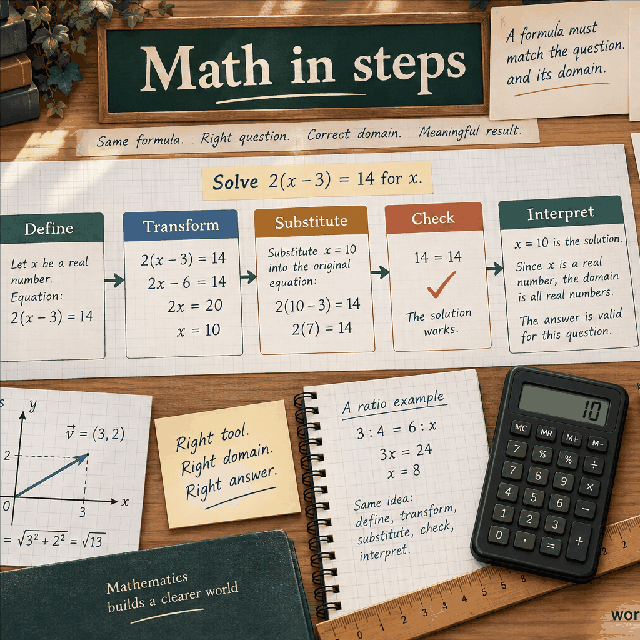
A useful manual check chooses one value in the candidate interval, one value on a boundary, and one value outside. With the worked values, x=2 is interior and gives |2(2)-4|=0, which is below 6. At x=-1 and x=5, the absolute value equals 6, so those points are included only by a non-strict relation. At x=6, the value is 8, which is outside the less-than-or-equal interval but belongs to a greater-than-or-equal solution. These checks connect the text set to the original expression.
The checks should follow the selected relation rather than assume that every branch keeps the middle. For a strict less relation, an endpoint is a deliberate failing test even though it satisfies the equality boundary. For a strict greater relation, an interior point fails and an exterior point passes. At c=0, test the center and one non-center value because the four relation branches collapse in different ways. A small table of values is often clearer than relying on a sketch alone.
The expression |a*x+b| can be read as the distance between the linear value a*x+b and zero on a second number line. The equation boundary asks when that distance is exactly c. Solving first for the inside value gives -c <= a*x+b <= c for a non-strict less relation, then the center and half-width form translates that condition into x-space without losing the sign of a. This distance interpretation explains why the answer is centered at -b/a rather than at b/a.
When a is negative, increasing x makes the inside linear expression decrease, but distance from zero is unchanged after reflection. Dividing an inequality directly by a would require reversing signs when a is negative. The handler avoids that fragile branch by using |a| for the width and by applying the selected relation to ordered numeric boundaries. This is not merely a formatting convenience; it is the reason the same interval logic works for either sign of a.
Interval notation records whether endpoints are part of a set. The strict less branch uses an open interval because equality at either boundary is not allowed. The lessEqual branch uses a closed interval because both equality points are accepted. Greater branches produce two rays: strict greater excludes both boundaries, while greaterEqual includes them. The result sentence spells out these choices because a pair of numbers by itself cannot communicate open or closed membership.
At a zero threshold, the usual interval picture becomes a set with coincident endpoints. Strict less than zero is empty because absolute value cannot be negative. Less than or equal to zero contains only the center. Strict greater than zero removes the center from the real line, and greater than or equal to zero includes every real value. The output keeps finite boundary numbers while using descriptive text for the unbounded portions of the real line.
As a function of x, |a*x+b| is a V-shaped graph with vertex at (-b/a,0). The magnitude of a controls how sharply the arms rise, while b moves the vertex horizontally after division by a. Comparing the expression with c draws a horizontal level at height c. The two intersection x-values are the reported boundaries. This graph is a reasoning aid for the interval rules, although the handler does not return sampled graph points or a chart object.
The graph also explains why the greater set is outside rather than between the roots. Values above the horizontal level occur on the two arms, while values below it occur in the valley. A threshold of zero touches the vertex only. This visual interpretation is useful in teaching, but the numeric result remains the authoritative contract. Do not infer a y-axis domain, a graph viewport, or an optimization conclusion from the compact inequality output.
The catalog fields provide a user-facing range, but the pure handler repeats the range and type rules so it can be called from tests or another module without trusting HTML. The relation is checked against the four exact option values. This separation is important when a value arrives from a serialized request or a future page: a caller cannot bypass the nonzero-a, nonnegative-c, finite-number, or allowed-relation requirements simply by avoiding the form.
The output is renderer-safe even for unbounded solution meanings. Numeric boundaries, center, and half-width are finite checked, while infinity is kept in the solution sentence rather than represented as numeric Infinity. The text result is nonempty and the numeric entries have labels and units. A downstream renderer can therefore display the result without parsing interval syntax or evaluating an expression. The contract is small enough to review line by line and explicit enough to test each branch.
For a lesson, the page can be used to compare equality, strict inequality, and non-strict inequality from one set of coefficients. A learner can change only c to see the interval widen, shrink, or collapse. Changing b moves the center, and changing the magnitude of a changes the width for the same threshold. These controlled changes make the formula more transparent than a black-box answer and provide natural prompts for substitution checks.
For a software workflow, retain the original a, b, c, and relation with the result. The center and boundaries are derived values, not a replacement for the input contract. If a later step intersects this solution with another domain, it should operate on the explicit set meaning and endpoint openness. This calculator does not intersect multiple inequalities, solve systems, parse absolute expressions, or decide application-specific admissibility. Those additions need their own reviewed contracts.
The solution sentence is designed to be understandable without symbolic parser support. It names an open interval, closed interval, outside rays, empty set, singleton, or all real values. That wording is intentionally conservative: it does not claim that an application has an additional domain such as x>=0, an integer-only restriction, a time window, or a physical operating range. If another problem supplies such a domain, intersect it explicitly after this calculator and document the extra rule.
The finite numeric fields also have a scope boundary. A mathematically valid coefficient may be larger than the software limit, and an application may require more precision than ordinary JavaScript numbers provide. The handler reports a bounded answer for its declared range. It does not turn a display approximation into a proof, certify an optimization constraint, or determine a safe control threshold. Use an appropriate symbolic or high-precision method when those requirements matter.
The page answers one specific question: for a linear expression inside an absolute value, which real x values satisfy the selected relation with a nonnegative threshold? The expression is |a*x+b|. Its absolute value is never negative, but its distance from zero changes as x moves along the number line. A less-than relation asks for points close enough to the expression's zero. A greater-than relation asks for points far enough away. The calculator reports this set directly instead of returning only a pair of roots and leaving the visitor to decide which side survives.
Endpoint language is part of the answer. A strict relation excludes a boundary, while a non-strict relation includes it. Thus an open interval, a closed interval, or open outside rays are not interchangeable display choices. The result text names the meaning in plain language and the numeric results retain the two boundary values and the center. This separation is useful for a worksheet, a lesson, or a small software check because it keeps the mathematical set distinct from the formatting used to show it.
Coefficient a multiplies x, constant b shifts the expression, and threshold c is the nonnegative comparison value. The relation menu has four exact choices: less, lessEqual, greater, and greaterEqual. A value in the menu is not a free-form symbol, so a direct handler call with an unrecognized string is rejected. Numeric fields accept finite real numbers inside their displayed bounds. A blank entry, numeric text supplied directly to the pure handler, NaN, either infinity, and an out-of-range value are not interpreted as shorthand for another value.
The requirement a!= 0 is structural rather than cosmetic. If a were zero, the expression would be the constant |b| and the problem would no longer be a linear absolute-value inequality with a movable boundary. This page deliberately does not add a separate constant-case solver. The threshold condition c >= 0 is equally important because the absolute value cannot be less than or equal to a negative number or greater than a negative number in the same simple interval pattern. Rejecting that domain keeps every returned description tied to the stated model.
The inside expression becomes zero at x=m=-b/a. That value is the center of the absolute-value graph when viewed as a function of x. The equation |a*x+b|=c reaches its two boundaries at a distance r=c/|a| from that center. Therefore the lower boundary is m-r and the upper boundary is m+r. The absolute value of a matters because a negative slope reverses the expression's direction but does not change how far the two solution boundaries are from the center.
This construction avoids dividing an inequality by a quantity whose sign could be forgotten. First calculate the geometric half-width with |a|, then apply the selected relation to the ordered boundaries. When c is positive, the boundaries are distinct and divide the line into an inside interval and two outside rays. When c is zero, both boundaries coincide. The result still needs relation-specific logic because strict less-than becomes empty, non-strict less-than becomes one point, and the two greater relations have different treatment of that one boundary.
For |a*x+b|<c with c>0, the answer is the open interval m-r < x < m+r. For the non-strict version, the answer is the closed interval m-r <= x <= m+r. These are the familiar inside cases: the absolute value stays below the threshold only between the two points where it reaches the threshold. The calculator includes the relation wording and parenthetical interval meaning so a visitor can distinguish the two cases even when the numerical endpoints are identical.
For |a*x+b|>c with c>0, the answer is x<m-r or x>m+r, with both boundary points excluded. The non-strict greater relation includes those boundaries: x<=m-r or x>=m+r. The outside cases are unions of two rays, not one interval. Infinity is not stored as a numeric result because a renderer-safe output must remain finite; the solution description uses the text word infinity while lower and upper finite boundaries remain available as numeric results.
The zero threshold is a useful diagnostic. Since an absolute value is always at least zero, |a*x+b|>=0 is all real x. The strict relation |a*x+b|>0 excludes only the center m. The non-strict relation <=0 contains only m, while the strict less-than relation has no real solution. These four branches are not optional formatting details; they are the distinctive behavior that separates this tool from a generic linear inequality page.
Use a=2, b=-4, c=6, and the relation <=. The expression is |2x-4|. Its zero occurs at m=-(-4)/2=2. The half-width is r=6/|2|=3. The two equality boundaries are 2-3=-1 and 2+3=5. Because the selected relation is non-strict and less-than, both endpoints belong to the solution. The result is -1 <= x <= 5, described as a closed interval. Substitution at x=-1 gives |-6|=6 and at x=5 gives |6|=6, so the endpoint inclusion can be checked directly.
The same inputs with the strict less relation produce -1 < x < 5, while greaterEqual produces x <= -1 or x >= 5. The boundaries do not move when only the relation changes; only membership at and between those boundaries changes. This is why the calculator returns both the numeric construction and a relation-specific solution sentence. Testing one interior point, one endpoint, and one exterior point gives a compact independent check of the branch.
Why are there two numeric boundaries when c is zero? The general interval construction still has a lower and upper boundary, and both equal the center. Keeping both fields makes the output shape stable while the text explains whether the set is empty, a singleton, a punctured real line, or all real numbers. Why does the page show infinity as words? Infinity is not a finite numeric result and cannot be stored as an ordinary renderer value without breaking the finite-output contract.
Can a negative a change the answer? It changes the direction of the inside linear expression but not the absolute distance from zero after the expression is evaluated. The center and half-width method handles that effect without silently flipping a relation. Can this solve an inequality with a number on both sides? Only if the problem has already been reduced to |a*x+b| compared with one entered c. More complicated expressions need their own domain and parsing rules, which this page intentionally does not provide.
Keep a=2, b=-4, and c=6 while changing only the relation. The less result is the open interval -1 < x < 5, the lessEqual result is the closed interval -1 <= x <= 5, the greater result is the two open outside rays, and the greaterEqual result includes the two finite boundaries. The numeric center, half-width, lower boundary, and upper boundary are identical in all four runs. Only the relation controls membership language and endpoint treatment.
This comparison is also a useful integration check because a select value must reach the pure handler unchanged. A browser may display a friendly option label, but the handler receives one of the exact identifiers less, lessEqual, greater, or greaterEqual. Resetting the card should clear the previous solution rather than leave a stale interval visible. If validation fails, the error should be shown without treating the last successful interval as the current answer.
The absolute-value result is a complete answer only for the four-field contract. If the original problem also restricts x to a domain, intersects another inequality, or contains a nonlinear expression inside the absolute value, apply that additional mathematics explicitly. The center and finite boundaries are useful intermediate values, but they do not encode an unentered domain or prove that a solution is an integer, positive, physical, or otherwise admissible. Keep the relation and endpoint status when passing the result to another step.
The pure handler provides deterministic arithmetic and clear boundaries, but it does not infer context from labels. A reviewed workflow should preserve the original a, b, c, and relation, the numeric output, and the assumptions so another calculation can be audited without guessing which neighboring contract was intended. If a later step uses the interval in a system, it should retain whether each endpoint is open or closed rather than reducing the set to two bare numbers.
Solve |a*x+b| in relation to a nonnegative threshold and report the interval or solution meaning explicitly.
Let m=-b/a and r=c/|a|. Then |a*x+b| <, <=, >, or >= c is solved from the boundaries m-r and m+r. The absolute value is centered at x=-b/a and the threshold creates a half-width c/|a|. Less-than relations keep the inside interval, less-than-or-equal relations close its endpoints, and greater-than relations keep the outside rays with the appropriate endpoint openness.
Enter Coefficient a, Constant b, Threshold c, Relation, then choose Calculate.
a is a nonzero real coefficient and c is a nonnegative real threshold. The entered relation applies to the linear expression |a*x+b|, not to a parsed equation or a more complicated expression. The answer uses the real-number line and the displayed finite bounds; interval endpoints are numeric boundaries, while infinity is rendered as text.
This calculator is part of the WorldCalculate library. Its formula, example, assumptions, input bounds, and output formatting follow the official methodology.
These WorldCalculate collections connect this tool with related questions while keeping each calculation separate and transparent.