
Goal
Adds, subtracts, multiplies, or divides two complex numbers and reports the magnitude.
Worldwide context
Saved once here, used across the site.
Currency changes display only. Country selection guides tax input; no tax rate is guessed.
Adds, subtracts, multiplies, or divides two complex numbers and reports the magnitude.
(a+bi) op (c+di); magnitude |z| = sqrt(re^2 + im^2).A clearer path to an answer
This page keeps the calculation transparent: define the goal, enter the matching values, inspect the method, and decide what the result means in your situation.
Adds, subtracts, multiplies, or divides two complex numbers and reports the magnitude.
Real part of first number · Imaginary part of first number · Real part of second number · Imaginary part of second number · Operation
(a+bi) op (c+di); magnitude |z| = sqrt(re^2 + im^2).
Calculate, review the assumptions below, then compare a related tool when the decision needs more context.
Adds, subtracts, multiplies, or divides two complex numbers and reports the magnitude.
Open the Complex Number Arithmetic pageMore math tools
Download PDFDownload Word (.doc)
Enter your values above and choose Calculate to see the result here.
Calculation map
(a+bi) op (c+di); magnitude |z| = sqrt(re^2 + im^2).
Bounded, transparent calculation
Your recent runs stay in this browser session only.
Formula: (a+bi) op (c+di); magnitude |z| = sqrt(re^2 + im^2).
Combine real and imaginary parts per the operation; division uses the conjugate over c^2 + d^2. Magnitude is the distance from the origin.
Worked example: Result 4+6i; magnitude 7.2111.
The displayed limits are checked before the handler runs. Model-specific domain checks may also reject impossible or non-finite inputs.
Methodology: This calculator follows the WorldCalculate input, formula, precision, and boundary policy. Read the official methodology.
Calculator usage statistics
This section counts anonymous successful Calculate submissions, not unique visitors. Counts and top tools appear only when trusted aggregate data is available; country analysis is shown only under the same condition and reporting threshold.
Answer-first guide
Adds, subtracts, multiplies, or divides two complex numbers and reports the magnitude. Start with one clearly defined goal, enter values in the units shown, and keep the result attached to the assumptions below.
This tool is useful when your question includes complex numbers, imaginary arithmetic, complex modulus. It returns the outputs declared in the calculator contract rather than a live quote, approval, diagnosis, or professional sign-off.
Real part of first number · Imaginary part of first number · Real part of second number · Imaginary part of second number · Operation. Keep the same time period, unit system, and currency wherever the form requires comparable values.
Run the worked example first, compare its output with the page's example, then change one input at a time. This makes an unexpected result easier to trace to a unit, boundary, or assumption.
Need a wider view? Browse Math Calculators or compare the related tools below. The WorldCalculate methodology explains how formulas, examples, limits, and revisions are reviewed.
(a+bi) op (c+di); magnitude |z| = sqrt(re^2 + im^2).
Combine real and imaginary parts per the operation; division uses the conjugate over c^2 + d^2. Magnitude is the distance from the origin.
Result 4+6i; magnitude 7.2111.
Context and background
Math calculators move from named quantities to a relation, then to a result that can be checked with substitution, units, or an alternate form.
Arithmetic, algebra, geometry, trigonometry, and number theory provide reusable structures for classroom work and everyday reasoning. Each page narrows that structure to one declared problem.
Research and review
Researched by Hassan ALRowaie, Founder and editorial researcher at WorldCalculate.
This guide follows the live calculator's declared inputs, formula, worked example, assumptions, validation boundaries, and source-backed methodology. The review date describes editorial review of the calculator explanation; it is not a promise that external facts or rates remain current.

Complex numbers combine an ordinary real value with a perpendicular imaginary component. Written as a+bi, a complex number has real part a, imaginary part b, and the imaginary unit i whose square is -1. This calculator accepts the two components of each of two numbers, applies a selected addition, subtraction, multiplication, or division rule, and reports the resulting complex number together with its magnitude. The component rules are straightforward for addition and subtraction, while multiplication depends on i^2 = -1 and division is made ordinary by multiplying by the conjugate of the divisor. Division has one essential restriction: the second number cannot be 0+0i, because its modulus would be zero and no quotient would be defined. This guide develops each rule from the representation, works through all four operations, explains geometry and polar form, and shows how to check a result without relying on a single displayed decimal. It also describes signs, zero cases, units, rounding, practical uses, and the questions a numerical complex-arithmetic tool cannot answer for you.
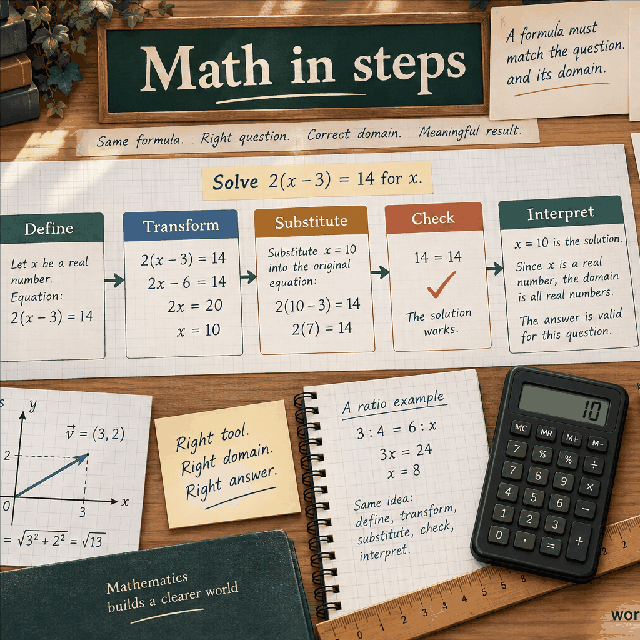
A complex number is commonly written as z = a+bi. The symbol a is the real part and b is the imaginary part. Both a and b are ordinary real numbers; the word imaginary describes the role of the second component, not an absence of numerical meaning. The unit i is defined by i^2 = -1. That definition lets algebra continue when a square root of a negative real number would otherwise leave the real-number system. The same number can therefore be viewed in two equivalent ways: as the expression a+bi and as the ordered pair (a, b).
The ordered-pair view gives each complex number a location in a plane. The horizontal coordinate is a and the vertical coordinate is b. This plane makes the two components visibly different without making either one less important. Two complex numbers are equal exactly when their real parts are equal and their imaginary parts are equal. Thus 4+3i and 4+3i describe the same number, while 4+3i and 3+4i do not. The first has coordinates (4,3); the second has coordinates (3,4).
Signs belong to the components. A number such as 5-2i has real part 5 and imaginary part -2, so its point lies below the horizontal axis. A number such as -5+2i lies in the opposite quadrant. If the imaginary part is zero, the number is simply real, even though it can still be written as 5+0i. If the real part is zero, the number is purely imaginary, such as 0-2i. These special cases are useful for checking general formulas.
The calculator keeps the two components separate throughout the calculation and combines them only in the formatted result. This matters because a plus sign between a real part and an imaginary part is part of the representation, not an instruction to add the two values into one real number. Read 3+2i as one point or one algebraic quantity with two coordinates. Treating it as the ordinary number 5 would discard the direction carried by i and would make every operation after that incorrect.
The first complex number is supplied through Real part of first number and Imaginary part of first number. In the record these fields are named reA and imA, so the first number is a+bi when reA is a and imA is b. The second number uses reB and imB; call those values c and d, making the second number c+di. The labels describe components rather than complete expressions. Enter the signed numerical value of each component in its own field, including a negative sign when the component points in the negative direction.
Each of the four component fields must be a finite number from -1,000,000,000 through 1,000,000,000, inclusive. Decimal values are allowed because the fields accept any numeric step. Finite means an ordinary number that is neither infinity nor a not-a-number value. The bounds constrain each entered component individually, not the final real part, imaginary part, or magnitude. An operation can combine valid inputs into a result outside the input interval and still be valid if the result remains finite.
The operation selector supports Add, Subtract, Multiply, and Divide. Addition and subtraction use the first number as the left operand and the second as the right operand. Multiplication and division use the same ordering, so reversing the two entries can change the answer. This is especially important for subtraction and division, which are not commutative. The default values are 3+2i and 1+4i with addition selected, producing 4+6i and a magnitude of about 7.2111.
After validation, the result is displayed in a+bi-style form and a separate magnitude is reported. A division request also checks the second number before calculating. The divisor c+di must not have both components equal to zero. That condition is the same as requiring its modulus to be nonzero. The tool does not parse a typed equation, infer missing signs, or decide what the component numbers represent physically; the input contract is four finite real values plus one permitted operation choice.
Addition is the simplest operation because like components combine with like components. Start with (a+bi) + (c+di). Group the real terms and the imaginary terms to obtain (a+c) + (b+d)i. There is no need to combine a with b or c with d. The real coordinates add along the horizontal direction, and the imaginary coordinates add along the vertical direction. In the ordered-pair view, this is ordinary vector addition: (a, b) + (c, d) = (a+c, b+d).
Subtraction follows the same component separation. The expression (a+bi) - (c+di) becomes (a-c) + (b-d)i. The minus sign applies to both components of the second number. A safe way to remember this is to add the opposite number: the opposite of c+di is -c-di, so a+bi plus that opposite gives (a-c)+(b-d)i. Forgetting to reverse the imaginary component is one of the most common sign errors in a complex subtraction.
The operation order is visible in the formulas. Swapping the inputs in addition makes no difference because a+c equals c+a and b+d equals d+b. Swapping them in subtraction changes both differences to their negatives, so the new result is the additive opposite of the original result. The same observation helps with checks: adding a number to its opposite must give 0+0i, while subtracting a number from itself must also give 0+0i.
Negative components do not require a special rule. They enter the ordinary real additions or subtractions with their signs intact. For example, adding 2-5i to -7+3i gives 2+(-7) for the real component and -5+3 for the imaginary component. The result is -5-2i. Keeping the signs attached to the values, rather than reading the printed plus or minus as a separate afterthought, makes these cases routine.
Multiply complex numbers by distributing each term just as in a product of two binomials. For (a+bi)(c+di), the four products are ac, adi, bci, and bd i^2. Since i^2 = -1, the last product is -bd rather than bd i^2 remaining as a separate symbol. The real terms are ac and -bd, while the imaginary terms are ad i and bc i. Collecting them gives (ac-bd) + (ad+bc)i.
The product formula has a useful internal structure. The real output is a difference because the product of the two imaginary contributions carries i^2. The imaginary output is a sum because each cross term contains exactly one i. If either input is purely real, the formula reduces to ordinary scaling of both components. If both are purely imaginary, the product is real and negative when their nonzero imaginary components have the same sign, because i times i is -1.
Multiplication is commutative even though the individual terms appear in a different order when the factors are swapped. The real expression ac-bd is unchanged because ordinary multiplication commutes. The imaginary expression ad+bc becomes cb+da, which is the same sum. The calculator still honors the entered order for consistency, but a swapped multiplication result should agree apart from numerical rounding. This is a strong verification property.
Multiplication also changes both size and direction in the complex plane. The magnitude of a product equals the product of the magnitudes, so a factor with magnitude below one shrinks the result and a factor with magnitude above one enlarges it. The angle adds in a polar description. Rectangular component arithmetic is the direct way to calculate the result here, while the geometric interpretation explains why the two output components can look very different from the inputs.
Division asks for a quotient in the same a+bi form. To divide (a+bi) by (c+di), multiply the numerator and denominator by the conjugate of the denominator, c-di. A conjugate keeps the real part and changes the sign of the imaginary part. Multiplying by the same nonzero quantity on the top and bottom does not change a fraction, but this particular choice removes i from the denominator. The denominator becomes (c+di)(c-di), which is c^2 - (di)^2 = c^2+d^2 because i^2 is -1.
Now expand the numerator: (a+bi)(c-di) gives ac - adi + bci - bd i^2. The term involving i^2 becomes +bd, so the real numerator is ac+bd. The imaginary terms combine as bc-ad, giving (ac+bd)+(bc-ad)i. Dividing both components by the real denominator produces the quotient with real part (ac+bd)/(c^2+d^2) and imaginary part (bc-ad)/(c^2+d^2). This derivation explains both signs in the division rule.
The denominator c^2+d^2 is the squared magnitude of the divisor. It is never negative, and it is zero only when c and d are both zero. Therefore the nonzero-divisor requirement is not an arbitrary interface rule: it is exactly the mathematical condition that permits the conjugate method. If c+di is zero, multiplying by its conjugate still leaves a zero denominator, and no complex number can serve as its reciprocal.
For extreme but finite inputs, the numerical calculation can use an equivalent rescaling of the divisor components before applying the conjugate relationship. Rescaling avoids unnecessary overflow or underflow in intermediate squares while preserving the same quotient. The displayed rule remains the ordinary conjugate derivation, and the final result is checked for finiteness. A division that would produce a nonfinite result is rejected rather than presented as a misleading number.
The magnitude, or modulus, of z = a+bi is written |z| and equals the nonnegative distance from the point (a, b) to the origin. By the Pythagorean theorem, |z| = sqrt(a^2+b^2). The real and imaginary components are perpendicular coordinates, so their squared contributions add. A magnitude is never negative, even when one or both components are negative. The sign determines direction in the plane; the magnitude measures distance without direction.
The calculator reports the magnitude of the selected operation's result, not just the magnitude of one input. If the operation returns r+si, the reported value is sqrt(r^2+s^2). That distinction matters for subtraction, where two large inputs can nearly cancel and leave a small result, and for multiplication, where the result magnitude reflects the scale of both factors. The magnitude is therefore a second view of the result, useful for interpretation and checking.
Several identities follow directly from this geometric definition. The magnitude of the conjugate a-bi equals the magnitude of a+bi because changing a vertical sign does not change distance. The magnitude of the opposite -a-bi is also unchanged because reflecting through the origin preserves distance. The magnitude is zero exactly for 0+0i. For a nonzero z, the product z times its conjugate is |z|^2, a nonnegative real number.
For numerical stability, adding the squares directly can be awkward when component sizes differ greatly. A stable distance calculation first accounts for scale before combining the normalized components. That does not change the mathematical value of the square root; it reduces the chance that an intermediate calculation overflows or loses a very small contribution. The reported magnitude is rounded for display, so use the original component values for demanding precision work.
For addition, use the default pair 3+2i and 1+4i. Add the real components to get 3+1 = 4, then add the imaginary components to get 2+4 = 6. The result is 4+6i. Its magnitude is sqrt(4^2+6^2) = sqrt(52), which is approximately 7.2111 when shown to four decimal places. The point moves from the first vector by the second vector, so the coordinate result also gives a visual check: (3,2)+(1,4) = (4,6).
For subtraction, take z1 = 5-3i and z2 = 2+4i. The real component is 5-2 = 3. The imaginary component is -3-4 = -7 because the entire second component is subtracted. The result is 3-7i. Its magnitude is sqrt(3^2+(-7)^2) = sqrt(58), approximately 7.6158. If the second number were subtracted in the opposite order, the result would be -3+7i, the opposite point with the same magnitude.
A sign-focused example is useful when both numbers cross axes. Let z1 = -2+6i and z2 = 5-8i. Addition gives (-2+5)+(6-8)i = 3-2i. Subtraction gives (-2-5)+(6-(-8))i = -7+14i. The second imaginary calculation is 6-(-8), which becomes 14; a negative component in the right operand turns into addition when it is subtracted. The magnitude of the sum is sqrt(13), while the magnitude of the difference is sqrt(245).
These examples show why the result should be checked in two stages. First check each output component using the relevant real arithmetic. Then calculate the distance from the origin. A plausible magnitude cannot repair a wrong component pair, because many different points share similar distances. Component checks identify sign errors; the magnitude check confirms the final pair and supplies a useful independent numerical summary.
Multiply z1 = 2+3i by z2 = 4-i. Here a = 2, b = 3, c = 4, and d = -1. The real component is ac-bd = 2(4)-3(-1) = 8+3 = 11. The imaginary component is ad+bc = 2(-1)+3(4) = -2+12 = 10. The product is 11+10i. Expanding directly gives 8-2i+12i-3i^2, and replacing i^2 with -1 changes the last term to +3, leading to the same result.
The product magnitude provides a strong check. The first magnitude is sqrt(2^2+3^2) = sqrt(13), and the second is sqrt(4^2+(-1)^2) = sqrt(17). Their product is sqrt(221). The result 11+10i has magnitude sqrt(11^2+10^2) = sqrt(221), so the multiplicative identity is satisfied exactly before decimal rounding. The displayed decimal is approximately 14.8661.
Consider a product with purely imaginary factors: (0+2i)(0-5i). The real component formula gives 0(0)-2(-5) = 10, and the imaginary component gives 0(-5)+2(0) = 0. The result is the real number 10. Directly, 2i times -5i is -10i^2, which is 10. This example is a reminder that multiplying imaginary components can produce a real output.
A zero factor behaves as expected. If one input is 0+0i, both product formulas produce zero components. A factor of 1+0i leaves the other number unchanged, while a factor of -1+0i reverses both components. A factor of 0+1i rotates a number by a quarter turn in the geometric interpretation: multiplying a+bi by i gives -b+ai. The calculator applies the component formula, while these special factors make the result easier to anticipate.
Divide 5+4i by 2-i. The divisor is 2-i, so its conjugate is 2+i. Multiply both parts of the fraction by 2+i. The numerator becomes (5+4i)(2+i) = 10+5i+8i+4i^2 = 6+13i because 4i^2 is -4. The denominator becomes (2-i)(2+i) = 2^2+(-1)^2 = 5. Dividing each numerator component by 5 gives 6/5+13/5i, or 1.2+2.6i.
The quotient can be checked by multiplying it by the original divisor. Multiply 1.2+2.6i by 2-i. The real component is 1.2(2)-2.6(-1) = 2.4+2.6 = 5. The imaginary component is 1.2(-1)+2.6(2) = -1.2+5.2 = 4. The product is 5+4i, which reconstructs the dividend. This check is more informative than checking only the rounded quotient text.
The magnitude check also follows the division identity. The dividend magnitude is sqrt(5^2+4^2) = sqrt(41), and the divisor magnitude is sqrt(5). Their ratio is sqrt(41/5), approximately 2.8636. The quotient magnitude from 1.2+2.6i is sqrt(1.2^2+2.6^2) = sqrt(8.2), the same value. The quotient points in the direction of the dividend minus the direction of the divisor in polar language.
A divisor with a negative imaginary part does not make the method different; it only changes the signs in the substitution. The conjugate always changes the sign of the divisor's imaginary component. For a pure imaginary divisor such as 0+2i, the conjugate is 0-2i and the squared magnitude is 4. The rule still works, although a direct mental rotation may be quicker. The calculation always fails when both divisor components are zero.
Zero is a normal component value, but the zero complex number has a special role. Adding 0+0i changes nothing, and subtracting 0+0i changes nothing. Multiplying by 0+0i produces zero. Dividing zero by a nonzero complex number produces zero because both numerator components in the conjugate formula are zero. In contrast, division by 0+0i is undefined. The restriction concerns the complete divisor, not whether just its real component or just its imaginary component is zero.
A negative sign on the imaginary component changes the point's vertical direction and changes several formulas through b or d. In addition, a negative imaginary component is simply added with its sign. In multiplication, a negative d affects both the real term -bd and the imaginary term ad. In division, the signs are carried into ac+bd and bc-ad. There is no separate negative-imaginary rule; careful substitution into the general rule is safer than trying to improvise one.
Pure real numbers provide useful edge checks. If b and d are both zero, addition, subtraction, multiplication, and division reduce to ordinary real arithmetic, with division allowed only when c is nonzero. A purely imaginary input tests the i^2 behavior. Conjugate inputs have equal real parts and opposite imaginary parts. Their sum is real, and their product is the squared magnitude, which is also real and nonnegative.
The implementation normalizes negative zero to ordinary zero in components and formatted output. This prevents a result that is mathematically 0+0i from being displayed with an awkward negative-zero sign caused by floating-point representation. Near-zero values that are not exactly zero are different: a tiny nonzero component may be meaningful in the entered numerical model. Do not erase small values merely because the display rounds them away.
Cancellation can make an output much smaller than its inputs. For example, subtracting two nearly equal complex numbers may leave a result whose direction is sensitive to small input changes. A very small nonzero divisor can also make a quotient very large. These are mathematical sensitivities, not automatically errors. Inspect the scale of the inputs, keep sufficient precision, and treat a result close to a decision threshold with appropriate caution.
Rectangular form records a complex number as a real coordinate and an imaginary coordinate. Polar form records the same number by its magnitude and angle: z = r(cos theta+i sin theta), where r is |z| and theta is the direction from the positive real axis. For a nonzero number, the angle is determined by the location of (a, b), while the zero number has magnitude zero and no unique direction. Both forms describe the same point, but they make different operations look simple.
In polar form, multiplying two nonzero complex numbers multiplies their magnitudes and adds their angles. Dividing divides the magnitudes and subtracts the divisor's angle from the dividend's angle. This agrees with the rectangular formulas even when the component results look complicated. A conjugate keeps the magnitude and negates the angle, so conjugation is reflection across the real axis. The rectangular conjugate c-di is therefore also a geometric operation.
Addition and subtraction are usually easier in rectangular form because the coordinates combine directly. Multiplication and division can be easier to understand in polar form because scale and rotation separate. The calculator accepts rectangular components and does not ask for an angle, so polar form is an interpretation and a manual cross-check rather than a second input mode. If an angle is needed, calculate it separately with a quadrant-aware angle procedure; looking only at b/a can lose the quadrant.
Angles are periodic: adding a full turn describes the same direction. As a result, two correct polar answers can differ by a whole number of turns while representing the same complex number. This calculator avoids that presentation issue by returning rectangular components. When translating a result into polar language, state the angle convention and unit, and remember that an angle for a zero result is not defined even though the magnitude is exactly zero.
The arithmetic rules assume that the real and imaginary components of one complex number represent compatible quantities. If a+bi represents a phasor measured in volts, both a and b are voltage components. Adding another voltage phasor is meaningful because corresponding components share the same unit. Adding a length to a time would not become valid merely because both values fit into numeric fields. The calculator validates numbers, not dimensional consistency.
The imaginary unit is dimensionless in ordinary dimensional analysis, so the components of one complex quantity carry the same unit. The magnitude then carries that same unit because it is formed from the distance of components with a common dimension. If the components are in volts, the magnitude is in volts. If they are normalized ratios, the magnitude is a normalized ratio. The numerical formula does not choose or attach the unit for you.
Multiplication and division require extra attention. Multiplying two quantities with the same unit can produce a squared unit, while multiplying unlike quantities produces their combined unit. Dividing a quantity by another quantity produces a ratio of units. Complex arithmetic itself does not remove those dimensions. For instance, a complex impedance and a complex current can be multiplied to produce a complex voltage, but that interpretation comes from the surrounding model, not from the symbols a, b, c, and d alone.
Before entering measured values, convert all components into one consistent unit system and decide what the imaginary component means in that model. Do not mix degrees with radians if you later use a polar angle, and do not mix scales such as milli-units and base units without conversion. The output is mathematically consistent with the numbers supplied, but a unit mistake can make a numerically polished result physically meaningless.
The component fields accept finite floating-point numerical values within the stated one-billion bounds. The result is calculated numerically, not as an exact symbolic expression. Noninteger components in the formatted complex result are rounded to at most six decimal places. The separate magnitude is presented with four decimal places in the result record. These formatting choices make the page readable, but they do not turn a rounded display into an exact fraction or an exact zero.
A familiar example is a quotient whose exact component is one third. The display may show 0.333333 even though the exact decimal expansion continues. If that displayed value is copied into another calculation, it can introduce an additional rounding error. Keep the original component inputs and, when necessary, preserve exact fractions or higher precision in your own notes. Compare unrounded values when a later decision depends on a small difference.
Floating-point arithmetic can also expose tiny residuals after exact mathematical cancellation. For example, a component that should be zero may be represented internally as a very small value because a sequence of decimal operations did not land exactly on zero. Exact negative zero is normalized for presentation, but ordinary tiny residuals are not all discarded. A displayed zero can mean that a nonzero value was smaller than the chosen formatting precision, so inspect the underlying calculation when that distinction matters.
The division path uses a scale-aware equivalent of the conjugate formula for difficult size ratios, then rejects a result if either component is nonfinite. This protects against displaying infinity or not-a-number as if it were a valid complex result. Finite input does not guarantee that every intermediate expression is safe when a divisor is extremely small. If the result is rejected as too large, reduce the scale of the inputs only when doing so preserves the intended ratio and units; never rescale blindly when absolute units matter.
Rounding is most consequential near zero, near a sign change, or when comparing two nearly equal magnitudes. Report enough decimal places for the purpose, but do not imply more precision than the inputs support. If the inputs are measurements with limited resolution, the mathematical output inherits that limitation. The calculator gives a deterministic numerical result for the entered values; it does not perform uncertainty propagation or select a significant-figures policy for a scientific report.
A reliable result can be checked independently from the displayed answer. Start by naming the inputs as z1 = a+bi and z2 = c+di, then write the selected formula before substituting numbers. For addition, recompute a+c and b+d. For subtraction, recompute a-c and b-d while keeping the full second number in parentheses. For multiplication, calculate ac-bd and ad+bc separately. Comparing each component with the output catches more errors than looking at the final magnitude alone.
Division has a particularly strong reconstruction check. If q is the returned quotient, multiply q by the original divisor z2. The result should agree with z1 within the precision of the calculation. Also calculate c^2+d^2 and confirm it is positive for a valid divisor. If the divisor is nonzero but its squared magnitude is very small, expect the quotient to be sensitive to small input or rounding changes. A failed reconstruction indicates a sign, operand-order, or precision problem that deserves investigation.
Use magnitude identities as a second layer. The magnitude of a sum is generally not the sum of the magnitudes, so do not use that false rule as a check. The triangle inequality says the magnitude of a sum cannot exceed the sum of the input magnitudes, and it cannot be less than their magnitude difference. For products, the magnitudes multiply. For a quotient with a nonzero divisor, the quotient magnitude equals the dividend magnitude divided by the divisor magnitude. These relationships expose many arithmetic mistakes.
Symmetry checks are also valuable. Swapping the inputs of addition or multiplication should not change the result. Reversing subtraction should negate the result. Dividing z1 by z2 and then multiplying by z2 should recover z1, while multiplying a nonzero number by its conjugate should produce its squared magnitude as a real value. Check the actual components, not just whether a rounded string looks plausible. Use a tolerance appropriate to the input scale when comparing numerical values.
Complex numbers are useful whenever two coupled real quantities behave like perpendicular components or like an amplitude and a phase. In plane geometry, a+bi can represent a point or a displacement, so addition combines displacements and multiplication by a unit-magnitude complex number can represent a rotation. The calculator can perform the component arithmetic behind these models when the inputs have already been expressed in a consistent coordinate system.
In alternating-current analysis, a complex quantity can encode an in-phase component and a quadrature component. Addition can combine contributions, multiplication can combine compatible complex factors, and division can express a response ratio. The reported magnitude can describe an amplitude in that chosen representation. The arithmetic tool does not know whether the entries are voltage, current, impedance, or another phasor quantity, so the user must supply the model, frequency convention, sign convention, and units.
Complex multiplication and division also appear in signal descriptions, frequency-domain calculations, filter models, and the algebra of polynomial roots. A pair of real numbers may be used to store a complex coefficient or result even when a later application uses a different name for the two components. The same formulas remain valid, but the surrounding assumptions can change what a result means. A mathematically correct 2.0+1.0i can be a coordinate, a ratio, or a coefficient depending on context.
The calculator is most useful as a transparent arithmetic step inside a larger workflow. Enter values from a documented model, record the selected operation, retain units and precision, then pass the result to a later calculation only after checking the expected scale and symmetry. For safety-critical, financial, medical, or engineering decisions, the complex result should be reviewed against the governing model and independent evidence rather than accepted because its formatting looks precise.
This tool performs numerical arithmetic on two already specified complex numbers. It does not read a full equation from text, expand hidden parentheses, simplify a symbolic expression, or infer which values should be real and imaginary. If a source formula uses a different convention, such as an opposite sign for the imaginary component, convert that convention explicitly before entering values. A correct operation applied to incorrectly prepared components still produces the wrong answer for the intended problem.
It also does not choose a domain, a unit system, or a physical interpretation. The fields permit negative and positive real components, including values that may be impossible for a particular measurement. The page does not know whether a count must be integral, whether a quantity must be nonnegative, whether a phase should be wrapped into a preferred interval, or whether a result meets a tolerance. Those restrictions belong to the model around the arithmetic.
The page does not solve for an unknown complex variable, find roots, perform powers or logarithms, convert between rectangular and polar input, or propagate measurement uncertainty. It returns one operation result and its magnitude. If a task requires a branch choice, a quadrant-aware angle, a probability statement, a stability analysis, or a physical law beyond the four elementary operations, use an appropriate method and document its additional assumptions.
Finally, a finite result is not a guarantee of usefulness. The calculator can confirm that the selected numerical path stayed within a representable range, but it cannot validate an experiment, a circuit, a coordinate system, a sign convention, or a decision. Treat the output as one auditable arithmetic component. Preserve the original inputs, operation, units, and intended interpretation so another person can reproduce and challenge the conclusion.
Begin by writing each input in component form. Identify the first number as a+bi and the second as c+di, then enter a, b, c, and d in the matching fields. Confirm that each component is finite, inside the allowed bounds, and expressed in the same intended unit system. Do not let the visual plus sign in a complex expression hide a negative component; the sign is part of the value that belongs in its field.
Next select the operation and consider whether operand order matters. Addition and multiplication can be reversed without changing the exact mathematical result, but subtraction and division cannot. If division is selected, inspect the divisor's two components together and make sure it is not 0+0i. For a very small nonzero divisor, anticipate a potentially large quotient and preserve more precision in any external record.
After the result appears, read the real and imaginary components as one ordered pair, not as an ordinary sum. Calculate or inspect the reported magnitude as the distance of that pair from the origin. Recompute the selected formula on paper or in an independent calculation, then use a structural check such as multiplication back, magnitude multiplication, commutativity, or conjugation. If the displayed value is rounded, compare using the original numbers when a close result matters.
Only after those checks should the result be assigned a context-specific meaning. State the units, coordinate or phase convention, precision, and any restrictions that were applied outside this page. A short record containing the four inputs, selected operation, exact or high-precision components, displayed result, and verification method makes the calculation reproducible. This workflow keeps the page's narrow contract clear while still making it useful in a larger mathematical or technical process.
For a final review, let z1 = a+bi and z2 = c+di. Addition keeps the real components together and the imaginary components together, giving (a+c)+(b+d)i. Subtraction does the same with differences, giving (a-c)+(b-d)i. These rules are componentwise and do not use i^2 because no two imaginary factors are multiplied. They are the direct analogue of adding or subtracting ordered pairs.
Multiplication combines all four cross-products and then uses i^2 = -1. The result is (ac-bd)+(ad+bc)i. Division first multiplies by c-di, the conjugate of the divisor. The denominator becomes c^2+d^2, and the result is ((ac+bd)+(bc-ad)i)/(c^2+d^2). The denominator is positive exactly when the divisor is nonzero, so division is valid only when c and d are not both zero.
For any resulting pair r+si, the magnitude is sqrt(r^2+s^2). This is a distance, not a signed component and not a substitute for reading the result. Use the magnitude identity for products and quotients, the triangle inequality for sums, and direct reconstruction for division. These quick rules are compact, but their reliability depends on carrying signs, preserving operand order, and respecting the numerical input and output limits.
The compact formulas should be treated as a starting point for reasoning rather than as isolated symbols to memorize. Deriving them from ordered pairs, distributivity, and the conjugate makes sign choices explainable. When a result is surprising, return to those foundations: name the components, expand the operation, use i^2 = -1 where appropriate, and check the final point's distance. That approach works for ordinary classroom examples and for carefully bounded numerical inputs.
Adds, subtracts, multiplies, or divides two complex numbers and reports the magnitude.
(a+bi) op (c+di); magnitude |z| = sqrt(re^2 + im^2). Combine real and imaginary parts per the operation; division uses the conjugate over c^2 + d^2. Magnitude is the distance from the origin.
Enter Real part of first number, Imaginary part of first number, Real part of second number, Imaginary part of second number, Operation, then choose Calculate.
Finite real and imaginary parts. Division requires a nonzero-modulus divisor.
This calculator is part of the WorldCalculate library. Its formula, example, assumptions, input bounds, and output formatting follow the official methodology.
These WorldCalculate collections connect this tool with related questions while keeping each calculation separate and transparent.