
Goal
Calculate the Euclidean L2 magnitude of a three-dimensional vector from its x, y, and z components.
Worldwide context
Saved once here, used across the site.
Currency changes display only. Country selection guides tax input; no tax rate is guessed.
Calculate the Euclidean L2 magnitude of a three-dimensional vector from its x, y, and z components.
|v| = sqrt(x^2 + y^2 + z^2).A clearer path to an answer
This page keeps the calculation transparent: define the goal, enter the matching values, inspect the method, and decide what the result means in your situation.
Calculate the Euclidean L2 magnitude of a three-dimensional vector from its x, y, and z components.
Vector x · Vector y · Vector z
|v| = sqrt(x^2 + y^2 + z^2).
Calculate, review the assumptions below, then compare a related tool when the decision needs more context.
Calculate the Euclidean L2 magnitude of a three-dimensional vector from its x, y, and z components.
Open the 3D Vector Magnitude pageMore math tools
Download PDFDownload Word (.doc)
Enter your values above and choose Calculate to see the result here.
Calculation map
|v| = sqrt(x^2 + y^2 + z^2).
Bounded, transparent calculation
Your recent runs stay in this browser session only.
Formula: |v| = sqrt(x^2 + y^2 + z^2).
The Euclidean L2 magnitude is the nonnegative length of a three-dimensional Cartesian vector. The zero vector is valid and returns zero.
Worked example: The vector magnitude is 13.
The displayed limits are checked before the handler runs. Model-specific domain checks may also reject impossible or non-finite inputs.
Methodology: This calculator follows the WorldCalculate input, formula, precision, and boundary policy. Read the official methodology.
Calculator usage statistics
This section counts anonymous successful Calculate submissions, not unique visitors. Counts and top tools appear only when trusted aggregate data is available; country analysis is shown only under the same condition and reporting threshold.
Answer-first guide
Calculate the Euclidean L2 magnitude of a three-dimensional vector from its x, y, and z components. Start with one clearly defined goal, enter values in the units shown, and keep the result attached to the assumptions below.
This tool is useful when your question includes vector magnitude, vector length, Euclidean norm. It returns the outputs declared in the calculator contract rather than a live quote, approval, diagnosis, or professional sign-off.
Vector x · Vector y · Vector z. Keep the same time period, unit system, and currency wherever the form requires comparable values.
Run the worked example first, compare its output with the page's example, then change one input at a time. This makes an unexpected result easier to trace to a unit, boundary, or assumption.
Need a wider view? Browse Math Calculators or compare the related tools below. The WorldCalculate methodology explains how formulas, examples, limits, and revisions are reviewed.
|v| = sqrt(x^2 + y^2 + z^2).
The Euclidean L2 magnitude is the nonnegative length of a three-dimensional Cartesian vector. The zero vector is valid and returns zero.
The vector magnitude is 13.
Context and background
Math calculators move from named quantities to a relation, then to a result that can be checked with substitution, units, or an alternate form.
Arithmetic, algebra, geometry, trigonometry, and number theory provide reusable structures for classroom work and everyday reasoning. Each page narrows that structure to one declared problem.
Research and review
Researched by Hassan ALRowaie, Founder and editorial researcher at WorldCalculate.
This guide follows the live calculator's declared inputs, formula, worked example, assumptions, validation boundaries, and source-backed methodology. The review date describes editorial review of the calculator explanation; it is not a promise that external facts or rates remain current.
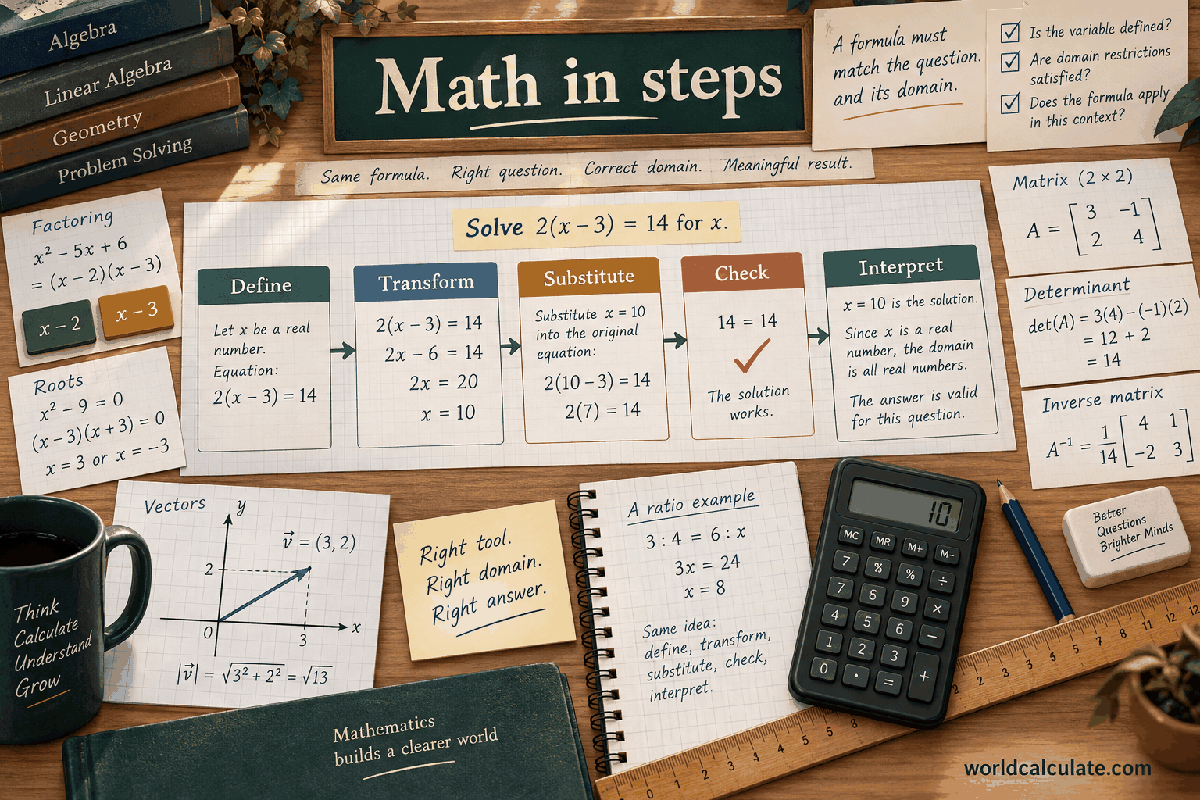
A vector magnitude is the Euclidean length of a vector. This calculator accepts exactly three ordered Cartesian components, x, y, and z, and returns the nonnegative L2 norm sqrt(x^2 + y^2 + z^2). Zero is a valid value: a vector with all three components zero has magnitude zero. Negative components are also valid because squaring measures their contribution to length without preserving direction in the final scalar. The page does not assign units or decide whether the vector represents a distance, velocity, force, or abstract direction. This guide follows the exact form and handler, explains stable interpretation, examples and boundaries, common errors, privacy and safety limits, and questions that often arise when a length is reused in another calculation.
The result is the straight-line Euclidean length associated with the triple (x, y, z). It is a scalar and cannot show which direction produced it. A vector and its negative have the same magnitude because all three squared components are unchanged. The returned value is never negative when the arithmetic is valid. These properties distinguish magnitude from a signed coordinate, a dot product between two different vectors, or a component sum.
The word Euclidean matters. This page uses the ordinary Cartesian distance geometry in which perpendicular coordinate contributions combine by the Pythagorean rule. Other norms, such as a Manhattan sum or a weighted norm, answer different questions. The calculator does not offer a norm selector and does not silently substitute another definition. If the surrounding problem uses a different metric, use a formula that names that metric explicitly.
The output keeps the unit convention of the components when the components are compatible. If x, y, and z are lengths in metres, the result is in metres. If the entries are unitless, the result is unitless. The form cannot identify or convert units, so retain that information with the result.
The fields are intentionally named x, y, and z rather than a generic list. Enter the first coordinate in x, the second in y, and the third in z. Each value may be negative, positive, zero, or fractional. The permitted finite interval is negative 1,000,000 through positive 1,000,000 for every component. A blank value, text value sent directly to the handler, infinity, not-a-number, or out-of-range number is rejected.
The bounds keep the browser calculation predictable while allowing a substantial range of classroom and planning examples. They apply to each input separately. A vector with three upper-bound components has a magnitude of 1,732,050.8075688772 approximately, which is larger than an individual component but remains finite. The handler checks that derived value before returning it rather than assuming every finite input automatically makes every formula safe.
When the values come from two points, decide which displacement convention is intended before entry. The distance from P to Q uses Q minus P as a vector, but the magnitude page itself does not take two points or perform that subtraction. Providing a point coordinate triple instead of a displacement can be mathematically valid yet answer a different question.
The formula is |v| = sqrt(x^2 + y^2 + z^2). Square each component, add the three nonnegative squares, and take the principal square root. The square root selects the nonnegative length. For x = 3, y = 4, and z = 12, the squares are 9, 16, and 144. Their sum is 169, and sqrt(169) is 13. The engine uses a Euclidean norm operation that follows this same definition while reducing avoidable intermediate scaling problems.
A negative coordinate contributes its square just like the matching positive coordinate. For (-3, 4, 12), the result is still 13. This does not mean the sign is irrelevant to the vector as a whole; it means sign records direction while magnitude records length. If direction matters, retain the original triple or use a directional operation rather than only the scalar norm.
The result is checked for finiteness and normalized so a zero result is ordinary zero rather than negative zero. The handler does not round the internal value. The renderer may show a limited number of decimals for readability, but the numeric result returned to code retains the available finite precision.
The default vector (3, 4, 12) gives sqrt(9 + 16 + 144) = sqrt(169) = 13. This is a useful integer example because the three-dimensional calculation reduces to a perfect square. If z were zero, the same x and y values would give sqrt(3^2 + 4^2) = 5, showing that the familiar two-dimensional Pythagorean case is a special slice of the 3D formula.
Consider v = (-6, 8, 0). The squared sum is 36 + 64 + 0 = 100, so the magnitude is 10. The negative x component changes the direction but not the length. For v = (1, 2, 2), the squared sum is 1 + 4 + 4 = 9, giving magnitude 3. Comparing these examples shows why a small coordinate can still matter and why a zero component does not invalidate the vector.
At the zero case, v = (0, 0, 0) gives sqrt(0) = 0. This is a valid mathematical result and a useful identity test. It is different from unit-vector normalization, where the same input must be rejected because division by magnitude zero has no meaning. Each page's domain is tied to the operation it performs.
Any subset of the components may be zero. A vector along one axis has magnitude equal to the absolute value of its one nonzero coordinate. A vector in a coordinate plane uses the two-dimensional Pythagorean relation. The handler does not require a nonzero vector because the square-root expression remains defined at the origin. This is an important boundary distinction from formulas that divide by the norm.
The component limits are inclusive. Inputs at negative or positive 1,000,000 are accepted, and the resulting norm is finite. A value beyond that range is rejected even if JavaScript could still represent it, because the calculator promises a bounded domain. Non-finite values are rejected first by the same helper. The output is checked independently so future formula changes cannot accidentally weaken the renderer contract.
If the displayed value rounds to a whole number, do not assume the exact norm is an integer. For example, sqrt(2) is not 1. The page's output precision is intended for reading, while comparisons that depend on a small difference should use the underlying numeric value and an appropriate tolerance.
In a Cartesian drawing, the magnitude is the distance from the origin to the point whose coordinates are x, y, and z. If the triple is a displacement, it is the straight-line distance of that displacement. If it is an abstract vector, the same arithmetic supplies its Euclidean length. The calculator cannot decide which of these interpretations is intended, so the surrounding label and unit remain important.
Magnitude is homogeneous: multiplying all components by a positive factor multiplies the magnitude by that factor, while multiplying by a negative factor also changes direction but leaves the magnitude scaled by the factor's absolute value. It also satisfies the triangle inequality when used with vector addition. These are useful theoretical checks, but the page returns only one norm and does not calculate a second vector or a comparison bound.
A magnitude can be used as a denominator in an angle or unit-vector calculation only after confirming it is nonzero. The value can also be compared with a physical threshold, but such a comparison becomes a domain decision that requires units, uncertainty, and context. Do not attach a safety or quality label to the bare norm.
The most common error is forgetting the square root and returning the squared magnitude. Another is adding absolute components, which computes a different L1 norm. A third is taking the square root of a signed sum without squaring each component first. Keep the formula visible as sqrt(x^2 + y^2 + z^2) and check the result against a simple axis vector before trusting a complicated value.
Useful tests include the origin, one-axis vectors, a two-dimensional 3-4-5 triple, and sign reversals. The magnitude of (x, y, z) should equal the magnitude of (-x, -y, -z). If you add vectors first, the resulting magnitude should not exceed the sum of their separate magnitudes under the ordinary Euclidean model. These checks catch both formula and component-order errors.
When an answer differs from a source, check whether the source uses a different norm, rounds squared values before the square root, or applies a unit conversion. Also check whether the source calls a point's distance from a different origin a magnitude. The handler cannot infer a translated origin or a weighted coordinate scale.
This is the ordinary finite Euclidean L2 norm. It does not calculate a weighted distance, a grid distance, a statistical norm, a covariance-adjusted distance, or a relativistic interval. It assumes the axes are orthogonal and equally scaled. If a coordinate system has unequal units or a non-orthogonal basis, the plain formula may not be the correct metric. The page does not inspect that structure.
Only three numbers are required, but those numbers can encode sensitive locations, motion, images, health measurements, or proprietary geometry. Do not add personal names, identifiers, or secrets to a calculation that does not need them. Share only the minimum result and context. A finite local arithmetic tool is not a substitute for an organizational privacy policy or secure handling procedure.
For medical, navigation, robotics, structural, or other safety-sensitive work, treat this result as a transparent arithmetic component and not as clearance or diagnosis. Validate the coordinate frame, units, calibration, uncertainty, and downstream model with appropriate tools and qualified reviewers.
Is a negative magnitude possible? Not under this formula. Squaring removes component signs and the principal square root is nonnegative. If a workflow needs a signed distance along an axis or normal, it must retain an orientation and use a different signed quantity. A negative output from a magnitude implementation would indicate a formula or data-handling defect.
Why is the zero vector accepted? Its length is well-defined as zero. The problem appears only when another operation tries to divide by that length, such as normalization or the cosine formula for an angle. This page stops at the norm and therefore has no zero-vector rejection. Do not infer a direction from a zero-length result.
Does the magnitude tell me the direction? No. Infinitely many vectors share one magnitude. Keep x, y, and z beside the result whenever direction, orientation, or reconstruction matters. The norm is a summary of length, not a reversible encoding of the original vector.
The norm is often used as an intermediate value, so keep the unrounded numeric result when passing it to another calculation. A displayed value such as 0.7071 is a readable approximation of a value that may be used to normalize a vector or form an angle. Re-entering the rounded display can introduce an avoidable error. The page's result steps and numeric output should be treated separately from the formatting chosen for a screen or report.
Scaling gives a simple invariant. If every component is multiplied by a positive factor k, the magnitude is multiplied by k. If k is negative, the magnitude is multiplied by the absolute value of k while the vector direction reverses. Multiplying only one coordinate does not produce a simple overall scale and changes the shape of the vector. These distinctions are useful when checking whether a source has been converted or copied correctly.
For large component values, a direct expression that squares each number can create avoidable overflow in an unbounded implementation. The K1 handler uses the standard Euclidean norm operation available in the runtime, then checks the derived value. The visible component bounds already keep the intended scenarios finite, but the implementation still treats the output as a value that needs validation rather than assuming the formula cannot fail.
The norm does not preserve orientation. If two different triples have the same squared sum, the page returns the same magnitude for both. For example, (3, 4, 0), (-3, 4, 0), and (0, 0, 5) have magnitudes 5 even though they point in different directions. When reconstructing a vector or comparing directions, retain the original components and use a directional operation in addition to the norm.
A norm can be used to test whether a vector is nonzero before an angle, projection, or unit-vector operation. That test should use the numeric value and a domain-appropriate tolerance when the source is measured. The calculator itself treats an exactly zero vector as valid and does not decide whether a very small nonzero vector is physically reliable. A near-zero direction can be mathematically normalizable yet unstable for the purpose of a real measurement.
When comparing a result with another source, first confirm that both use the Euclidean L2 definition. A source may report a squared norm, an L1 norm, a weighted norm, or a distance after translating the origin. Next compare component order, sign, units, and rounding. Only after those definitions match should a decimal discrepancy be attributed to floating-point precision or data entry.
A concise review record includes the three inputs, the squared component contributions, their sum, the square-root result, and the unit convention. This makes a norm auditable without requiring the reviewer to guess whether a missing square root or a hidden absolute value was used. It also preserves the distinction between a calculation that is correct under Euclidean geometry and a conclusion that requires a different metric.
The norm is also translation-independent when a vector is treated as a free displacement: moving both endpoints by the same amount does not change their difference or its length. That statement does not mean the page accepts endpoints; it means a caller should form the intended displacement before supplying its three components. Keeping this distinction visible prevents a point's distance from the origin from being confused with the distance between two translated positions.
When a result feeds a threshold, compare quantities in the same unit and metric. A norm of ten can mean ten metres, ten pixels, or ten abstract units, and the same number can have different practical consequences in those contexts. The handler reports only the finite Euclidean scalar. Labels, unit conversion, acceptance limits, and uncertainty belong to the surrounding calculation record.
A reviewer can reproduce the result by squaring each signed component, adding the nonnegative contributions, and taking the principal square root. If an independent implementation uses a stable hypot operation, its final value should agree within floating-point tolerance. Disagreement in the squared sum points to data or formula handling; a tiny final difference usually points to representation or display precision.
The most useful boundary distinction is between a valid zero length and an invalid zero denominator in a later tool. The magnitude page can safely report zero, while normalization and angle calculation must stop before division. Use the result as a domain check only when the next operation states what zero or near-zero means.
A norm can also be compared with the norm of a translated displacement or with a separately computed distance, but only after confirming that both quantities use the same origin and metric. A point coordinate's magnitude measures distance from the chosen origin, whereas a displacement's magnitude measures separation between two positions. The page accepts one triple and cannot infer which of those source constructions produced it.
For numerical review, keep squared contributions unrounded until the square root is taken. Rounding each square first can create a visible difference for values with many decimals or for components that nearly cancel in a later comparison. The K1 handler uses the runtime norm operation and validates the final scalar; an independent manual worksheet should state any intermediate rounding explicitly.
A magnitude is often the first signal that a vector is too small, too large, or outside an expected operating envelope. Those classifications require a threshold with units and uncertainty. The page should remain neutral: it reports the norm and does not label a vector safe, significant, normal, or anomalous.
For a numerical regression, include vectors with one dominant coordinate, balanced coordinates, mixed signs, fractional values, and all-zero input. Compare the stable norm result with an independently calculated squared sum. This gives coverage for sign handling, zero behavior, scale, and the final square root without relying on a single Pythagorean example.
Calculate the Euclidean L2 magnitude of a three-dimensional vector from its x, y, and z components.
|v| = sqrt(x^2 + y^2 + z^2). The Euclidean L2 magnitude is the nonnegative length of a three-dimensional Cartesian vector. The zero vector is valid and returns zero.
Enter Vector x, Vector y, Vector z, then choose Calculate.
The three components are Cartesian coordinates in one Euclidean length convention. The result is a geometric norm only; no unit conversion, uncertainty estimate, or physical interpretation is added.
This calculator is part of the WorldCalculate library. Its formula, example, assumptions, input bounds, and output formatting follow the official methodology.
These WorldCalculate collections connect this tool with related questions while keeping each calculation separate and transparent.