
Goal
Estimate egg heating time from mass, starting temperature, water temperature, and a selected center-temperature target.
Worldwide context
Saved once here, used across the site.
Currency changes display only. Country selection guides tax input; no tax rate is guessed.
Estimate egg heating time from mass, starting temperature, water temperature, and a selected center-temperature target.
Time = 0.447 × mass^(2/3) × ln(0.76 × (starting temperature − water temperature) ÷ (target center temperature − water temperature)); the target is 63, 68, or 75 °C for the selected doneness scenario.A clearer path to an answer
This page keeps the calculation transparent: define the goal, enter the matching values, inspect the method, and decide what the result means in your situation.
Estimate egg heating time from mass, starting temperature, water temperature, and a selected center-temperature target.
Egg mass · Egg starting temperature · Water temperature · Center-temperature target
Time = 0.447 × mass^(2/3) × ln(0.76 × (starting temperature − water temperature) ÷ (target center temperature − water temperature)); the target is 63, 68, or 75 °C for the selected doneness scenario.
Calculate, review the assumptions below, then compare a related tool when the decision needs more context.
Estimate egg heating time from mass, starting temperature, water temperature, and a selected center-temperature target.
Open the Egg Boiling Time Physics Calculator pageMore food tools
Download PDFDownload Word (.doc)
Enter your values above and choose Calculate to see the result here.
Calculation map
Time = 0.447 × mass^(2/3) × ln(0.76 × (starting temperature − water temperature) ÷ (target center temperature − water temperature)); the target is 63, 68, or 75 °C for the selected doneness scenario.
Bounded, transparent calculation
Your recent runs stay in this browser session only.
Formula: Time = 0.447 × mass^(2/3) × ln(0.76 × (starting temperature − water temperature) ÷ (target center temperature − water temperature)); the target is 63, 68, or 75 °C for the selected doneness scenario.
An egg heats inward by diffusion, so mass and temperature gaps matter more than a single universal kitchen timer. This worksheet exposes a simplified spherical-egg model and rounds the result into a practical timer setting.
Worked example: The simplified model estimates about 4.5 minutes, or a timer setting of about 4 minutes 32 seconds, for a 57 g egg reaching the soft-center scenario.
The displayed limits are checked before the handler runs. Model-specific domain checks may also reject impossible or non-finite inputs.
Methodology: This calculator follows the WorldCalculate input, formula, precision, and boundary policy. Read the official methodology.
Calculator usage statistics
This section counts anonymous successful Calculate submissions, not unique visitors. Counts and top tools appear only when trusted aggregate data is available; country analysis is shown only under the same condition and reporting threshold.
Answer-first guide
Estimate egg heating time from mass, starting temperature, water temperature, and a selected center-temperature target. Start with one clearly defined goal, enter values in the units shown, and keep the result attached to the assumptions below.
This tool is useful when your question includes egg boiling time calculator, how long to boil an egg, egg cooking time. It returns the outputs declared in the calculator contract rather than a live quote, approval, diagnosis, or professional sign-off.
Egg mass · Egg starting temperature · Water temperature · Center-temperature target. Keep the same time period, unit system, and currency wherever the form requires comparable values.
Run the worked example first, compare its output with the page's example, then change one input at a time. This makes an unexpected result easier to trace to a unit, boundary, or assumption.
Need a wider view? Browse Food & Recipe Calculators or compare the related tools below. The WorldCalculate methodology explains how formulas, examples, limits, and revisions are reviewed.
Time = 0.447 × mass^(2/3) × ln(0.76 × (starting temperature − water temperature) ÷ (target center temperature − water temperature)); the target is 63, 68, or 75 °C for the selected doneness scenario.
An egg heats inward by diffusion, so mass and temperature gaps matter more than a single universal kitchen timer. This worksheet exposes a simplified spherical-egg model and rounds the result into a practical timer setting.
The simplified model estimates about 4.5 minutes, or a timer setting of about 4 minutes 32 seconds, for a 57 g egg reaching the soft-center scenario.
Context and background
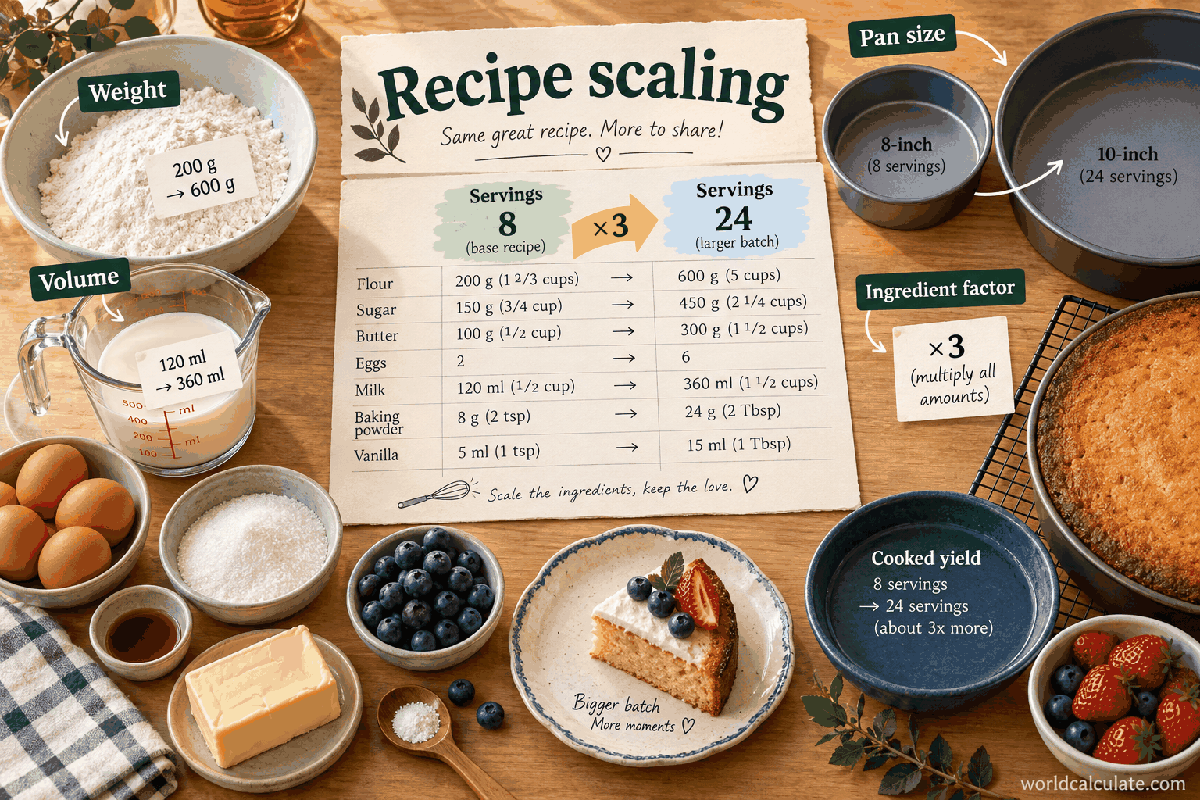
Recipe scaling uses a serving ratio, then keeps the ingredient unit visible. Cooking chemistry, pan size, heat, texture, and safety can require adjustments beyond linear arithmetic.
Scaling a recipe is a familiar applied ratio problem. The useful calculation is the transparent factor; the cooking result still depends on the ingredient and method.
Research and review
Researched by Hassan ALRowaie, Founder and editorial researcher at WorldCalculate.
This guide follows the live calculator's declared inputs, formula, worked example, assumptions, validation boundaries, and source-backed methodology. The review date describes editorial review of the calculator explanation; it is not a promise that external facts or rates remain current.
Egg timing changes with the mass of the egg, the temperature it starts at, and the temperature of the cooking water. WorldCalculate turns those variables into a visible heating-time scenario while keeping the difference between a model temperature and a guaranteed kitchen result clear.
The page estimates how long a selected egg model takes to reach a center-temperature target. It is useful when comparing eggs from the refrigerator with eggs that have warmed, or when water is below a full boil.
It does not inspect the egg, measure the water, or decide whether a cooked egg is safe. Those are separate physical and food-handling questions.
Heat has to travel from the shell toward the center. A larger egg has a longer characteristic distance, so the simplified diffusion model scales with mass raised to the two-thirds power rather than with mass alone.
That relationship is a model of a rounded object, not a promise that every egg of the same mass behaves identically.
A cold egg begins farther from the water temperature than a room-temperature egg. The logarithmic temperature term therefore changes the estimated time even when the mass is unchanged.
Record whether the egg was refrigerated, kept at room temperature, or partly warmed. Do not silently change that assumption between attempts.
Soft, medium, and harder-center choices represent different target temperatures in this worksheet. The labels describe the model target, not a universal definition of texture.
Egg proteins change over a range of temperatures and the white and yolk do not behave as one material. Treat the output as a comparison point for a cooking experiment.
For a 57 g egg at 4 °C placed into 100 °C water, the soft scenario uses a 63 °C center target. The heat-diffusion expression gives a result close to four and a half minutes.
The page also converts that result to seconds and rounds the timer upward so a visitor can record the chosen schedule without hiding the unrounded estimate.
At altitude, water can boil below 100 °C. Entering the measured or expected water temperature is more honest than forcing a sea-level assumption into the formula.
If the water cannot reach the selected target temperature, the handler rejects the scenario because the chosen model cannot reach the requested center state.
Egg shape, shell, convection, pot size, the number of eggs, water recovery, and carryover cooking can all affect the observed result. The page does not estimate each effect independently.
Use the first result as a starting test, then record the actual texture and adjust the next scenario with one change at a time.
A timer is a convenient control for a cooking process, while this page is a calculation of a center-temperature scenario. The two can be related without being interchangeable. A timer starts counting at a chosen event and assumes that the surrounding conditions stay close to the intended process. The calculator begins with measured or estimated temperatures and a mass, then solves a simplified heat-transfer relationship. It does not hear a boil, see a simmer, or know when an egg entered the pan.
Use the result to compare conditions and design a repeatable trial. If your kitchen uses a cold-water start, steaming, a pressure cooker, or a method that changes water temperature during heating, the result is not directly the same process. Describe the method in your notes and do not present a number produced for one boundary condition as a universal instruction for another method.
The underlying calculation treats the egg as a rounded, homogeneous object so that heat diffusion can be represented with a compact equation. That approximation makes the role of mass and temperature gaps visible and gives a result that can be reproduced by a student with a calculator or spreadsheet. It is an educational model, not a claim that the shell, white, yolk, and air cell have identical thermal properties.
Real eggs vary in shape and composition. A narrow egg and a broad egg with the same mass do not necessarily have the same distance from the surface to the center. The shell and the two interior regions also respond differently as they warm. Keeping this limitation in the article is important: a simple model can teach a relationship while still requiring observation when a precise cooking outcome matters.
The temperature term compares the starting egg temperature, the water temperature, and the selected center target. For the model to make physical sense, the water must be hotter than the target center temperature and the egg must start below that target. The handler checks those relationships instead of allowing a logarithm with an impossible sign or a result that looks numeric but does not describe heating toward the selected target.
Enter temperatures as temperatures, not as differences. If the egg starts at 4 °C and the water is 100 °C, enter 4 and 100 in their labeled fields; do not enter 96 as the starting temperature. The model performs its own differences. Keeping the raw measurements visible makes a later review possible and prevents a correct-looking result from being built on a hidden conversion.
The menu offers soft, medium, and harder center-temperature scenarios. These labels help a visitor compare target states, but they are not a complete physical definition of texture. Egg white and yolk contain different materials, and changes occur across ranges rather than at one magical instant. A center target is therefore a useful reference point for the calculation and not a guarantee of a particular mouthfeel.
If the goal is a specific recipe result, describe the target in a practical way as well as choosing the menu item. Note whether the yolk should be flowing, jammy, or firm, and record the egg size and cooking method. Then compare the observed result with the model and adjust carefully. Do not change the target, starting temperature, and water method all at once because the next result will be difficult to interpret.
Egg size names can differ between markets and may describe a grading range rather than the exact mass of the individual egg. The calculator accepts mass in grams so the visitor can use a measured value and see how it affects the diffusion term. Weigh the egg in its shell if that is the convention used by the selected model, and keep the same convention in later trials. A label such as large is less reproducible than a recorded gram value.
The accepted range is 20 to 150 grams, which is a validation boundary for this worksheet rather than a classification of every egg sold worldwide. If a value is outside the range, check the unit and the model scope before forcing it into the field. Decimal mass is permitted because a kitchen scale can report it, but the result should still be treated as an estimate whose shape and composition assumptions may dominate a small difference in mass.
The water-temperature field represents the boundary condition used by the equation. A full boil at sea level is often approximated as 100 °C, but a simmer, a covered pan, a lower-pressure location, or a loaded pot can produce a different temperature. Measure the water when possible or state the assumption in the scenario record. Do not describe the result as a boiling time if the entered water temperature represents a different cooking environment.
The model also assumes the water temperature remains substantially stable while the egg heats. In a small pan, adding several cold eggs can lower the water temperature temporarily. A heat source may then restore it at a rate that depends on the pan, volume, lid, and power. The calculator has no pan-energy balance, so use the water input to compare a defined scenario and use observation to decide whether the boundary condition was actually maintained.
Hold the mass, target, and water temperature constant and change only the starting temperature. A 57 g egg at 4 °C in 100 °C water with the soft 63 °C target produces a result close to 4.5 minutes in this model. A second run using 21 °C as the starting temperature produces a shorter estimate because the center begins closer to the target. The comparison teaches the direction of the effect without claiming that the two eggs will have identical shape or handling history.
Write both scenarios in a small table or note with the starting temperature beside the result. If the measured cooking outcomes do not follow the expected direction, inspect the process before blaming the equation: the water may not have recovered, the timer may have started at a different event, or the eggs may not have had the same mass. One controlled change is more informative than several unrecorded adjustments.
At higher altitude, the boiling point of water can be below the sea-level approximation. A lower water temperature reduces the driving temperature gap and can lengthen the modeled time to a target. Entering a measured or well-supported water temperature makes that assumption visible. If the water temperature is below the selected center target, the model cannot reach that target under the stated boundary and the input should be rejected rather than converted into a misleading negative or undefined answer.
Altitude is only one reason the boundary may change. Wind, an uncovered pan, a cold starting vessel, and the number of eggs can also alter the observed water condition. The page does not contain an altitude-to-boiling-point table or a weather model, so it does not silently infer a local value. Use a separate sourced temperature assumption when the location matters and keep its date or measurement method with the result.
The formula estimates one egg under a boundary condition; it does not model the thermal interaction among many eggs. Adding more eggs can lower the water temperature and reduce circulation around each shell. The pot may also take longer to return to its initial condition. If several eggs are being prepared, treat the single-egg result as a starting reference and test the actual batch method rather than multiplying the time by the number of eggs.
A batch trial should record the pot size, water volume, starting egg temperature, number of eggs, water temperature before and after loading, and the timing event. These details explain why a batch result can differ from a single-egg model. The calculator remains helpful for understanding mass and target sensitivity, but it cannot promise that a batch follows the same heating curve as an isolated egg.
If a center-temperature measurement is appropriate for the experiment, use a suitable food thermometer and understand that inserting it can disturb the sample. Measure consistently at the same location and note when the reading was taken. A single reading is not proof that the entire egg has the same temperature, but repeated measurements can show whether the simple model is a reasonable planning approximation for your equipment.
Do not use the calculator's target as a substitute for current food-safety guidance. A target in a physics model is chosen for the scenario; safety recommendations depend on the food, handling, population, time, and authority involved. When safety consequences are important, follow the applicable official guidance and use validated procedures. The honest value of this page is that it separates a mathematical estimate from a safety decision.
The page reports an unrounded model time, a practical minutes-and-seconds interpretation, and a rounded timer setting. Rounding is useful in a kitchen, but it should not erase the underlying value when scenarios are compared. Two estimates that round to the same minute can still differ in their unrounded values, while a small physical change near a display boundary can change the suggested timer setting.
Keep full precision through the calculation and round only for the final presentation or the device you intend to use. If a recipe or procedure specifies a rounding convention, record it. The calculator's display is not a measurement of accuracy; it is a readable summary of the model output. A result such as 4 minutes 32 seconds should be read as an estimate under declared inputs, not as a promise to the second.
A frequent error is entering the target temperature in the water field or entering a temperature difference in the starting field. Another is choosing a harder target while keeping the description of a soft center. Check the labels, units, and menu choice before changing the values. The handler rejects impossible relationships, but it cannot know whether a physically possible number is the temperature you intended to record.
A second error is copying a cooking time from a different method and trying to make the calculator reproduce it by altering the mass or temperature. That reverses the direction of the tool. Start from the actual egg and water conditions, calculate the scenario, then compare the result with the observed procedure. If they differ, investigate method boundaries such as cold-water start, steaming, water recovery, and carryover rather than hiding the difference in an arbitrary input.
A useful experiment record has the egg mass, starting temperature, water temperature, target choice, pan and water method, number of eggs, timer start event, and observed result. Include whether the shell cracked, whether the egg was immersed, and whether it was cooled afterward. These notes turn a one-time number into evidence that can be compared with the next trial. They also make it clear which facts came from a measurement and which were assumptions.
Change one variable at a time when learning. For example, keep the water and target constant while comparing two masses, or keep mass and target constant while comparing two starting temperatures. Use the calculator to predict the direction and approximate size of the change, then record what happened. If the physical result consistently differs, preserve that observation and ask whether the model's boundary is too simple for the equipment rather than presenting a local correction as a universal law.
Begin by asking the practical question: are you comparing egg sizes, starting temperatures, water conditions, or target centers? Measure or document the mass and temperatures, choose the target, and verify that the water can reach it. Run the calculation and read the unrounded time, rounded setting, and validation state. Then write down the assumptions that are not represented by fields, especially the cooking method and whether the pan is crowded.
Next, compare a meaningful alternative and decide what action follows. The action may be to set a timer, measure the center, run a second trial, or use a professional food-safety procedure. A result with no next action is easy to misread; a result with a named next action teaches the visitor how to use the model responsibly. This is the difference between a formula demonstration and a useful kitchen planning page.
The heating-time estimate ends at the modeled center target under the chosen water boundary. It does not calculate the cooling phase, carryover cooking, or the time needed to make the egg comfortable to handle. Removing an egg from hot water changes the boundary condition immediately, while leaving it in the pan allows heat to continue moving inward. If the recipe includes an ice bath or another cooling step, record that as a separate process rather than changing the heating input to force the final texture into the model.
Cooling can also make observation easier without making the preceding heating calculation more accurate. A visitor may compare a warm center reading with a later texture after cooling, but those are different observations. Keep the measurement time, cooling method, and target choice in the record. This avoids the common mistake of treating a post-cooling result as direct proof that the egg reached the selected target at the exact timer endpoint.
A boiled egg, steamed egg, cold-start egg, and pressure-cooked egg can have different heat boundaries and timing events. The calculator's simple scenario assumes an egg enters water that is already at the entered temperature and remains substantially immersed. A different method may still be compared conceptually, but its result should be labeled as an observation or a separate method estimate, not as a direct validation of the same equation.
When comparing methods, define the start and stop events before collecting times. Does the clock start when the egg enters, when the water returns to a boil, or when steam begins? Does it stop at removal, at a center reading, or after cooling? Use the same definitions across trials and record the pan load. Clear event definitions often explain an apparent disagreement better than changing the formula inputs without evidence.
Before cooking, check the egg condition, handling, storage, intended diners, and the current food-safety guidance that applies to the situation. Before calculating, verify mass, starting temperature, water temperature, and target. During cooking, use a consistent method and observe the water condition. After cooking, follow the appropriate handling and cooling procedure. The calculator can support the measurement and comparison part of this workflow, but it cannot certify the food or replace an official safety procedure.
For a public article, the boundary should be easy to see: this is a simplified heat-diffusion estimate, not a guarantee of doneness or safety. That sentence is not a weakness; it tells a reader when the tool is useful and when a different authority is required. The most valuable answer is sometimes a calculated time, and sometimes a reminder to measure, document, and follow validated guidance before serving.
Does the timer guarantee a hard-boiled egg? No. It estimates a target temperature under simplified assumptions; texture and safety require observation and current guidance.
Why can a cold egg take longer? The center starts farther from the hot-water boundary, so the temperature term increases the estimated heating time.
Estimate egg heating time from mass, starting temperature, water temperature, and a selected center-temperature target.
Time = 0.447 × mass^(2/3) × ln(0.76 × (starting temperature − water temperature) ÷ (target center temperature − water temperature)); the target is 63, 68, or 75 °C for the selected doneness scenario. An egg heats inward by diffusion, so mass and temperature gaps matter more than a single universal kitchen timer. This worksheet exposes a simplified spherical-egg model and rounds the result into a practical timer setting.
Enter Egg mass, Egg starting temperature, Water temperature, Center-temperature target, then choose Calculate.
The egg is modeled as a homogeneous object and is placed into water that is already at the entered temperature. The target is a center-temperature scenario, not a direct measurement of firmness or food safety. The 0.447 calibration factor expresses the simplified thermal-property convention in minutes for grams raised to the two-thirds power. The egg remains substantially immersed and water temperature does not collapse during the modeled interval. Shell thickness, shape, white-to-yolk ratio, convection, pan loading, and carryover cooking are not separately solved. Altitude can change the attainable boiling temperature; enter the actual water temperature instead of assuming 100 °C when needed. Use current local food-safety guidance and a thermometer when doneness or safety has consequences.
This calculator is part of the WorldCalculate library. Its formula, example, assumptions, input bounds, and output formatting follow the official methodology.
These WorldCalculate collections connect this tool with related questions while keeping each calculation separate and transparent.