
Goal
Estimate the present value of a tree or timber scenario from harvest revenue, thinning revenue, management costs, upfront cost, timing, and an entered discount rate.
Worldwide context
Saved once here, used across the site.
Currency changes display only. Country selection guides tax input; no tax rate is guessed.
Estimate the present value of a tree or timber scenario from harvest revenue, thinning revenue, management costs, upfront cost, timing, and an entered discount rate.
Present value of an event = future cash flow ÷ (1 + discount rate)^(event year). At a positive rate, present value of annual costs = annual cost × [1 − (1 + rate)^−cost years] ÷ rate; at zero rate it equals annual cost × cost years. Scenario net present value = PV harvest + PV intermediate revenue − PV annual costs − upfront cost.A clearer path to an answer
This page keeps the calculation transparent: define the goal, enter the matching values, inspect the method, and decide what the result means in your situation.
Estimate the present value of a tree or timber scenario from harvest revenue, thinning revenue, management costs, upfront cost, timing, and an entered discount rate.
Future harvest revenue · Harvest year · Intermediate or thinning revenue · Intermediate revenue year · Annual management cost · Years of annual cost · Upfront establishment cost · Annual discount rate
Present value of an event = future cash flow ÷ (1 + discount rate)^(event year). At a positive rate, present value of annual costs = annual cost × [1 − (1 + rate)^−cost years] ÷ rate; at zero rate it equals annual cost × cost years. Scenario net present value = PV harvest + PV intermediate revenue − PV annual costs − upfront cost.
Calculate, review the assumptions below, then compare a related tool when the decision needs more context.
Estimate the present value of a tree or timber scenario from harvest revenue, thinning revenue, management costs, upfront cost, timing, and an entered discount rate.
Open the Tree Value Discounted-Cash-Flow Scenario Calculator pageMore ecology tools
Download PDFDownload Word (.doc)
Enter your values above and choose Calculate to see the result here.
Calculation map
Present value of an event = future cash flow ÷ (1 + discount rate)^(event year). At a positive rate, present value of annual costs = annual cost × [1 − (1 + rate)^−cost years] ÷ rate; at zero rate it equals annual cost × cost years. Scenario net present value = PV harvest + PV intermediate revenue − PV annual costs − upfront cost.
Bounded, transparent calculation
Your recent runs stay in this browser session only.
Formula: Present value of an event = future cash flow ÷ (1 + discount rate)^(event year). At a positive rate, present value of annual costs = annual cost × [1 − (1 + rate)^−cost years] ÷ rate; at zero rate it equals annual cost × cost years. Scenario net present value = PV harvest + PV intermediate revenue − PV annual costs − upfront cost.
This page applies a transparent discounted-cash-flow scenario to a tree or timber investment. It does not appraise an urban tree, predict growth, set a stumpage price, or replace a forester’s inventory and market analysis; every revenue, cost, timing, and rate remains an input.
Worked example: The entered scenario has a present harvest value of about 487.5, intermediate revenue value of about 221.2, annual-cost present value of about 68.8, and an estimated net present value of about 389.8 currency units.
The displayed limits are checked before the handler runs. Model-specific domain checks may also reject impossible or non-finite inputs.
Methodology: This calculator follows the WorldCalculate input, formula, precision, and boundary policy. Read the official methodology.
Calculator usage statistics
This section counts anonymous successful Calculate submissions, not unique visitors. Counts and top tools appear only when trusted aggregate data is available; country analysis is shown only under the same condition and reporting threshold.
Answer-first guide
Estimate the present value of a tree or timber scenario from harvest revenue, thinning revenue, management costs, upfront cost, timing, and an entered discount rate. Start with one clearly defined goal, enter values in the units shown, and keep the result attached to the assumptions below.
This tool is useful when your question includes tree value calculator, timber value calculator, forest investment calculator. It returns the outputs declared in the calculator contract rather than a live quote, approval, diagnosis, or professional sign-off.
Future harvest revenue · Harvest year · Intermediate or thinning revenue · Intermediate revenue year · Annual management cost · Years of annual cost · Upfront establishment cost · Annual discount rate. Keep the same time period, unit system, and currency wherever the form requires comparable values.
Run the worked example first, compare its output with the page's example, then change one input at a time. This makes an unexpected result easier to trace to a unit, boundary, or assumption.
Need a wider view? Browse Ecology & Sustainability Calculators or compare the related tools below. The WorldCalculate methodology explains how formulas, examples, limits, and revisions are reviewed.
Present value of an event = future cash flow ÷ (1 + discount rate)^(event year). At a positive rate, present value of annual costs = annual cost × [1 − (1 + rate)^−cost years] ÷ rate; at zero rate it equals annual cost × cost years. Scenario net present value = PV harvest + PV intermediate revenue − PV annual costs − upfront cost.
This page applies a transparent discounted-cash-flow scenario to a tree or timber investment. It does not appraise an urban tree, predict growth, set a stumpage price, or replace a forester’s inventory and market analysis; every revenue, cost, timing, and rate remains an input.
The entered scenario has a present harvest value of about 487.5, intermediate revenue value of about 221.2, annual-cost present value of about 68.8, and an estimated net present value of about 389.8 currency units.
Context and background
Ecology and sustainability scenarios depend on geography, technology, lifecycle boundary, season, measurement method, and the factor supplied by the visitor.
Environmental analysis became more actionable as systems were described by flows, stocks, boundaries, and time periods. A transparent scenario is more useful than a universal-looking number with hidden assumptions.
Research and review
Researched by Hassan ALRowaie, Founder and editorial researcher at WorldCalculate.
This guide follows the live calculator's declared inputs, formula, worked example, assumptions, validation boundaries, and source-backed methodology. The review date describes editorial review of the calculator explanation; it is not a promise that external facts or rates remain current.
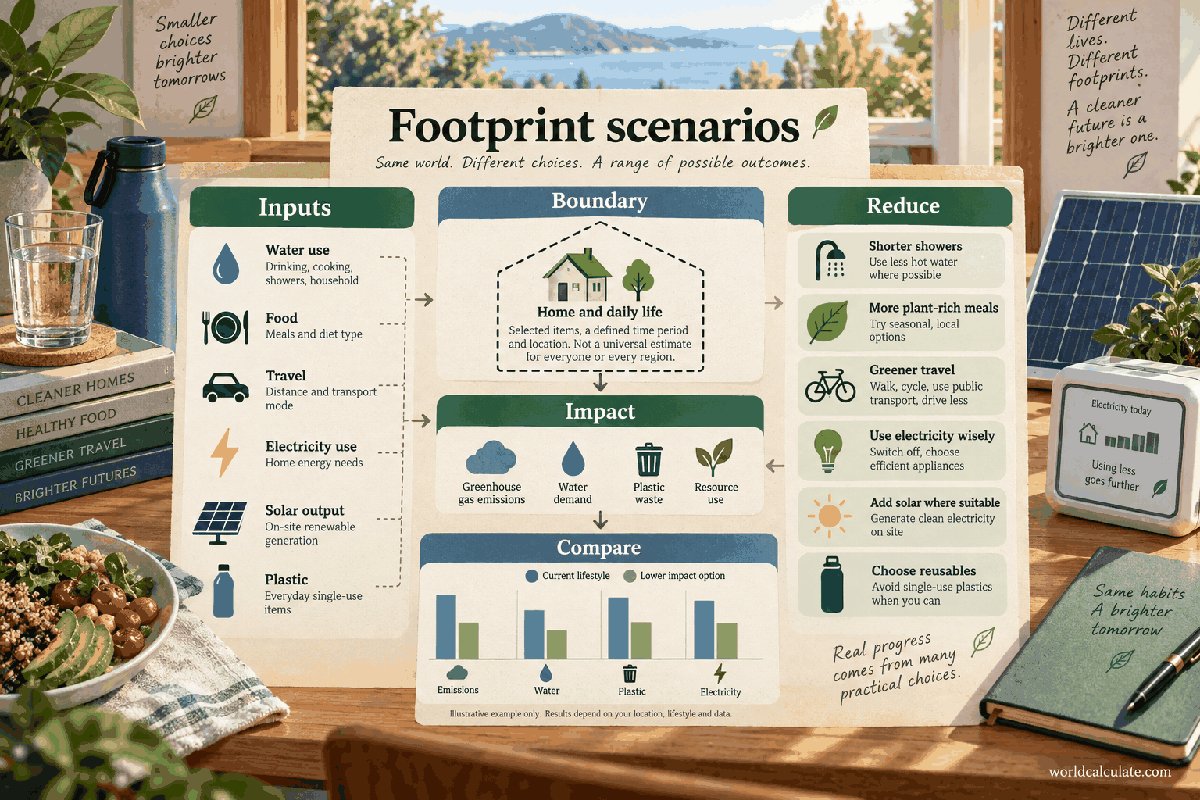
A tree’s value depends on what is being valued: future timber revenue, land, shade, habitat, a standing urban tree, or a complete forestry investment. This calculator deliberately chooses one narrow contract—a discounted cash-flow scenario—and shows every timing and cost assumption instead of presenting a universal tree price.
Enter future harvest revenue, an intermediate revenue, annual management cost, upfront cost, event timing, and a discount rate. The page discounts each cash flow to the present and reports the scenario net present value.
It is an investment worksheet, not an appraisal or a biological growth model.
A currency unit received later is discounted by the entered rate. The same harvest revenue has a lower present value when it occurs farther in the future, all else equal.
This is why the year attached to a thinning or final harvest must remain beside the calculated value rather than being hidden in a preset.
For a future event, PV = future cash flow ÷ (1 + r)^t. r is the rate as a decimal and t is the event year. The calculator applies this separately to the intermediate and final revenue.
The formula does not decide whether the revenue is realistic. That requires species, volume, grade, market, access, harvest cost, and local forestry evidence.
A repeated annual cost is discounted as an annuity when the rate is positive. At a zero rate, the present value is simply annual cost multiplied by the number of cost years.
Separating recurring cost from the upfront cost helps a visitor see which assumption is driving the result and avoids treating all expenses as if they happened today.
With 2,800 due in year 30 at 6%, the harvest PV is about 2,800 ÷ 1.06³⁰ = 487.5. A 500 intermediate receipt in year 14 has a PV of about 221.2.
The 5-per-year cost for 30 years has a PV of about 68.8. Subtracting that and the 250 upfront cost gives an NPV near 389.8 currency units under the entered scenario.
A positive NPV means the entered receipts exceed the entered costs after discounting at the chosen hurdle rate. A negative NPV means they do not under this model.
Neither result is a complete tree valuation. Shade, habitat, carbon, cultural value, land appreciation, risk, and non-market benefits may matter even when they are not monetized here.
Use documented local prices and a defensible schedule. Do not enter a maximum possible harvest as an expected average, omit harvesting or access costs, or mix nominal revenues with a real discount rate without labeling the choice.
Run scenarios rather than pretending one forecast is certain. Changing the rate, harvest year, or revenue is often more informative than reporting one precise answer.
A standing timber crop, an immature plantation, and an urban tree may need different valuation methods. This page does not use a trunk formula, replacement cost, amenity benefit, or species-specific growth curve.
A forester, arborist, appraiser, or land professional can identify the appropriate method and local evidence for the real decision.
Does this calculate timber volume? No; revenue is an input. Does it include taxes or inflation? No; keep the currency basis and rate consistent. Is the NPV the tree’s market price? No; it is the present value of the entered cash-flow scenario only.
Estimate the present value of a tree or timber scenario from harvest revenue, thinning revenue, management costs, upfront cost, timing, and an entered discount rate.
Present value of an event = future cash flow ÷ (1 + discount rate)^(event year). At a positive rate, present value of annual costs = annual cost × [1 − (1 + rate)^−cost years] ÷ rate; at zero rate it equals annual cost × cost years. Scenario net present value = PV harvest + PV intermediate revenue − PV annual costs − upfront cost. This page applies a transparent discounted-cash-flow scenario to a tree or timber investment. It does not appraise an urban tree, predict growth, set a stumpage price, or replace a forester’s inventory and market analysis; every revenue, cost, timing, and rate remains an input.
Enter Future harvest revenue, Harvest year, Intermediate or thinning revenue, Intermediate revenue year, Annual management cost, Years of annual cost, Upfront establishment cost, Annual discount rate, then choose Calculate.
All monetary inputs use one consistent currency or currency unit; no exchange rate is applied. Harvest and intermediate revenues occur at the entered end-of-year points. Annual management cost is paid once per year for the entered number of years. The discount rate is a nominal scenario rate entered as a percentage and converted to a decimal. Zero discount rate is handled as undiscounted cash flow rather than divided by zero. The model does not estimate tree growth, volume, species price, mortality, land value, taxes, or inflation. Harvest year and intermediate timing are supplied by the visitor and are not validated against a biological rotation model. A positive NPV means the entered cash flows exceed the entered discount hurdle in this simplified scenario. A negative NPV is not a valuation of the tree’s ecological, cultural, shade, or amenity benefits. Forestry, arboricultural, land, and tax decisions require local professional and jurisdictional review.
This calculator is part of the WorldCalculate library. Its formula, example, assumptions, input bounds, and output formatting follow the official methodology.
These WorldCalculate collections connect this tool with related questions while keeping each calculation separate and transparent.