
Goal
Plan overlapping privacy-fence boards, sections, posts, rails, and post length from a fence run, gates, overlap, and spacing assumptions.
Worldwide context
Saved once here, used across the site.
Currency changes display only. Country selection guides tax input; no tax rate is guessed.
Plan overlapping privacy-fence boards, sections, posts, rails, and post length from a fence run, gates, overlap, and spacing assumptions.
Usable run = fence length − gate count × gate width; board coverage = picket width − overlap; pickets = ceiling((usable run ÷ board coverage) × (1 + waste/100)); sections = ceiling(usable run ÷ post spacing); posts = sections + 1 + gate count; rail order length = usable run × rail count × (1 + waste/100).A clearer path to an answer
This page keeps the calculation transparent: define the goal, enter the matching values, inspect the method, and decide what the result means in your situation.
Plan overlapping privacy-fence boards, sections, posts, rails, and post length from a fence run, gates, overlap, and spacing assumptions.
Total fence length · Picket width · Overlap per adjacent picket · Fence height · Planning post spacing · Gate openings · Width of each gate opening · Rails per fence run · Board and rail allowance
Usable run = fence length − gate count × gate width; board coverage = picket width − overlap; pickets = ceiling((usable run ÷ board coverage) × (1 + waste/100)); sections = ceiling(usable run ÷ post spacing); posts = sections + 1 + gate count; rail order length = usable run × rail count × (1 + waste/100).
Calculate, review the assumptions below, then compare a related tool when the decision needs more context.
Plan overlapping privacy-fence boards, sections, posts, rails, and post length from a fence run, gates, overlap, and spacing assumptions.
Open the Privacy Fence Board and Post Planner pageMore construction tools
Download PDFDownload Word (.doc)
Enter your values above and choose Calculate to see the result here.
Calculation map
Usable run = fence length − gate count × gate width; board coverage = picket width − overlap; pickets = ceiling((usable run ÷ board coverage) × (1 + waste/100)); sections = ceiling(usable run ÷ post spacing); posts = sections + 1 + gate count; rail order length = usable run × rail count × (1 + waste/100).
Bounded, transparent calculation
Your recent runs stay in this browser session only.
Formula: Usable run = fence length − gate count × gate width; board coverage = picket width − overlap; pickets = ceiling((usable run ÷ board coverage) × (1 + waste/100)); sections = ceiling(usable run ÷ post spacing); posts = sections + 1 + gate count; rail order length = usable run × rail count × (1 + waste/100).
Board-on-board or overlapping privacy construction covers the gap with a second board edge, so the installed coverage is narrower than the physical picket width. The planner exposes that overlap instead of reusing a spaced-picket formula.
Worked example: After one 1 m gate, effective board coverage is 0.115 m; the scenario orders 278 pickets, 15 posts, about 95.7 m of rails, and 36 m of post length.
The displayed limits are checked before the handler runs. Model-specific domain checks may also reject impossible or non-finite inputs.
Methodology: This calculator follows the WorldCalculate input, formula, precision, and boundary policy. Read the official methodology.
Calculator usage statistics
This section counts anonymous successful Calculate submissions, not unique visitors. Counts and top tools appear only when trusted aggregate data is available; country analysis is shown only under the same condition and reporting threshold.
Answer-first guide
Plan overlapping privacy-fence boards, sections, posts, rails, and post length from a fence run, gates, overlap, and spacing assumptions. Start with one clearly defined goal, enter values in the units shown, and keep the result attached to the assumptions below.
This tool is useful when your question includes privacy fence calculator, board on board fence calculator, privacy fence pickets. It returns the outputs declared in the calculator contract rather than a live quote, approval, diagnosis, or professional sign-off.
Total fence length · Picket width · Overlap per adjacent picket · Fence height · Planning post spacing · Gate openings · Width of each gate opening · Rails per fence run · Board and rail allowance. Keep the same time period, unit system, and currency wherever the form requires comparable values.
Run the worked example first, compare its output with the page's example, then change one input at a time. This makes an unexpected result easier to trace to a unit, boundary, or assumption.
Need a wider view? Browse Construction & Home Project Calculators or compare the related tools below. The WorldCalculate methodology explains how formulas, examples, limits, and revisions are reviewed.
Usable run = fence length − gate count × gate width; board coverage = picket width − overlap; pickets = ceiling((usable run ÷ board coverage) × (1 + waste/100)); sections = ceiling(usable run ÷ post spacing); posts = sections + 1 + gate count; rail order length = usable run × rail count × (1 + waste/100).
Board-on-board or overlapping privacy construction covers the gap with a second board edge, so the installed coverage is narrower than the physical picket width. The planner exposes that overlap instead of reusing a spaced-picket formula.
After one 1 m gate, effective board coverage is 0.115 m; the scenario orders 278 pickets, 15 posts, about 95.7 m of rails, and 36 m of post length.
Context and background
Construction tools begin with dimensions, coverage, waste, package sizes, or rates. The output is a planning quantity, not a substitute for a site-specific takeoff or structural review.
Material planning applies geometry and unit arithmetic to real spaces. Professional practice adds drawings, tolerances, site conditions, codes, and installation requirements that a compact calculator cannot infer.
Research and review
Researched by Hassan ALRowaie, Founder and editorial researcher at WorldCalculate.
This guide follows the live calculator's declared inputs, formula, worked example, assumptions, validation boundaries, and source-backed methodology. The review date describes editorial review of the calculator explanation; it is not a promise that external facts or rates remain current.
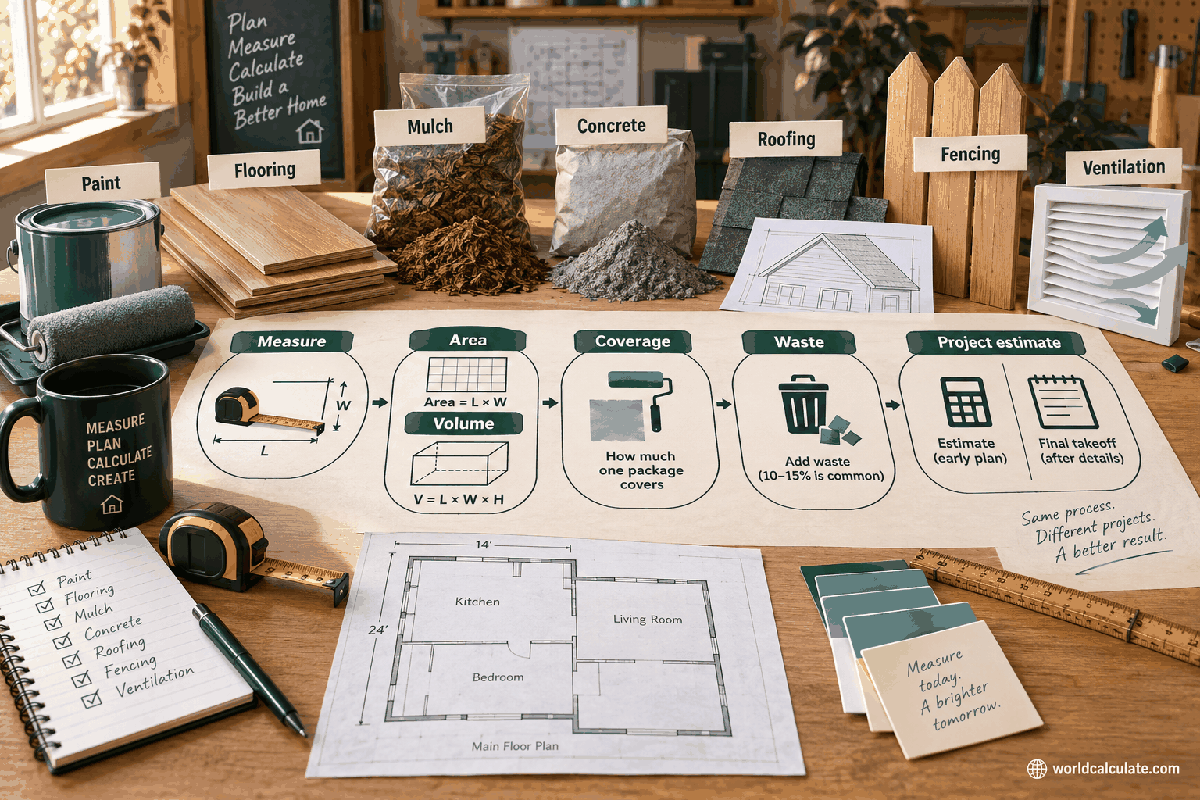
A privacy fence uses more than a perimeter: board overlap, gate openings, section spacing, rails, and post layout all change the material list. This worksheet makes each assumption editable and labels the result as planning arithmetic.
Start with the total planned fence length and record gates separately. The calculator subtracts the gate openings before estimating boards and rails, so the same opening is not accidentally counted as covered fence.
Corners, changes in direction, grade, and partial sections can affect the final count. Keep a sketch beside the single-line estimate.
A physical picket can be wider than the horizontal width it contributes when neighboring boards overlap. The page calculates effective coverage as picket width minus overlap.
If the overlap is 25 mm on a 140 mm board, one installed board covers 115 mm of run in this model. That is different from a spaced picket, where coverage is width plus a gap.
Removing a gate opening reduces the continuous board and rail run, but the gate still needs its own support arrangement. The worksheet adds one planning post per gate beyond the continuous sections.
Actual gate hardware, hinge posts, latch posts, corners, and reinforcement can require a different count. Use the manufacturer or engineered layout for the final build.
A 30 m fence with one 1 m gate leaves 29 m of board run. With 0.14 m pickets and 0.025 m overlap, coverage is 0.115 m.
Ceiling(29 ÷ 0.115 × 1.10) gives 278 boards. Ceiling(29 ÷ 2.4) gives 13 sections, so the planning count is 15 posts after adding one end post and one gate post.
Three rails across the 29 m usable run produce 87 m before allowance. With ten percent added, the planning order is 95.7 m of rail length.
The result is linear length, not a count of stock pieces. Divide it into available board lengths only after accounting for joints, corners, and cuts.
The displayed post length uses the fence height plus a simple 0.6 m planning allowance. Soil, frost, wind, retaining conditions, and local rules can require a different depth.
Treat that number as a purchasing screen, not a statement that a post is safe or adequately founded. A fence can be a structural load in exposed locations.
Confirm the property line, easements, height restrictions, corner visibility, gate swing, and underground utilities before digging. A mathematically tidy run can still be located incorrectly.
Use a string line and measure actual post centers. Preassembled systems may specify a maximum spacing or a panel-to-post dimension that overrides a generic planning value.
Can I use zero overlap? This record is intended for privacy overlap and rejects an overlap equal to or greater than board width; use the spaced wood-fence worksheet for a positive gap model.
Does the calculator choose a fence style? No. It calculates the dimensions you enter and leaves materials, code, installation, and structural review outside the model.
Plan overlapping privacy-fence boards, sections, posts, rails, and post length from a fence run, gates, overlap, and spacing assumptions.
Usable run = fence length − gate count × gate width; board coverage = picket width − overlap; pickets = ceiling((usable run ÷ board coverage) × (1 + waste/100)); sections = ceiling(usable run ÷ post spacing); posts = sections + 1 + gate count; rail order length = usable run × rail count × (1 + waste/100). Board-on-board or overlapping privacy construction covers the gap with a second board edge, so the installed coverage is narrower than the physical picket width. The planner exposes that overlap instead of reusing a spaced-picket formula.
Enter Total fence length, Picket width, Overlap per adjacent picket, Fence height, Planning post spacing, Gate openings, Width of each gate opening, Rails per fence run, Board and rail allowance, then choose Calculate.
The entered overlap is smaller than the physical picket width and is applied consistently along the usable run. Gate openings are removed from board and rail run length; each gate adds one planning post beyond the continuous-run count. Post spacing is a planning maximum supplied by the visitor or product instructions, not a universal structural rule. A 0.6 m post embedment allowance is used only to estimate total post purchase length and must be replaced when the project requires another depth. Rails are counted as straight run length and do not include splice, corner, slope, or gate framing details. Waste covers cuts and fitting variation but does not certify material strength, wind resistance, or local compliance. Confirm property lines, underground utilities, gates, soil, slope, height limits, and manufacturer or code requirements before construction.
This calculator is part of the WorldCalculate library. Its formula, example, assumptions, input bounds, and output formatting follow the official methodology.
These WorldCalculate collections connect this tool with related questions while keeping each calculation separate and transparent.