
Goal
Calculate the final equilibrium temperature and signed heat transfer for two bodies sharing heat in an isolated constant-specific-heat model.
Worldwide context
Saved once here, used across the site.
Currency changes display only. Country selection guides tax input; no tax rate is guessed.
Calculate the final equilibrium temperature and signed heat transfer for two bodies sharing heat in an isolated constant-specific-heat model.
Tf = (m1 c1 T1 + m2 c2 T2) / (m1 c1 + m2 c2); signed heat transfer to body 1 is Q1 = m1 c1 (Tf - T1).A clearer path to an answer
This page keeps the calculation transparent: define the goal, enter the matching values, inspect the method, and decide what the result means in your situation.
Calculate the final equilibrium temperature and signed heat transfer for two bodies sharing heat in an isolated constant-specific-heat model.
Mass 1 · Specific heat 1 · Initial temperature 1 · Mass 2 · Specific heat 2 · Initial temperature 2
Tf = (m1 c1 T1 + m2 c2 T2) / (m1 c1 + m2 c2); signed heat transfer to body 1 is Q1 = m1 c1 (Tf - T1).
Calculate, review the assumptions below, then compare a related tool when the decision needs more context.
Calculate the final equilibrium temperature and signed heat transfer for two bodies sharing heat in an isolated constant-specific-heat model.
Open the Two-Body Thermal Equilibrium Temperature pageMore science tools
Download PDFDownload Word (.doc)
Enter your values above and choose Calculate to see the result here.
Calculation map
Tf = (m1 c1 T1 + m2 c2 T2) / (m1 c1 + m2 c2); signed heat transfer to body 1 is Q1 = m1 c1 (Tf - T1).
Bounded, transparent calculation
Your recent runs stay in this browser session only.
Formula: Tf = (m1 c1 T1 + m2 c2 T2) / (m1 c1 + m2 c2); signed heat transfer to body 1 is Q1 = m1 c1 (Tf - T1).
This calculator applies an isolated two-body calorimetry balance with constant specific heats. It returns the heat-capacity-weighted final temperature and heat transferred to body 1, where a positive Q1 means body 1 gains heat; phase changes, heat loss, container capacity, and time rates are outside the model.
Worked example: Equal water-like heat capacities reach 333.15 K; body 1 gains 167440 J in this isolated model.
The displayed limits are checked before the handler runs. Model-specific domain checks may also reject impossible or non-finite inputs.
Methodology: This calculator follows the WorldCalculate input, formula, precision, and boundary policy. Read the official methodology.
Calculator usage statistics
This section counts anonymous successful Calculate submissions, not unique visitors. Counts and top tools appear only when trusted aggregate data is available; country analysis is shown only under the same condition and reporting threshold.
Answer-first guide
Calculate the final equilibrium temperature and signed heat transfer for two bodies sharing heat in an isolated constant-specific-heat model. Start with one clearly defined goal, enter values in the units shown, and keep the result attached to the assumptions below.
This tool is useful when your question includes thermal equilibrium, calorimetry, specific heat. It returns the outputs declared in the calculator contract rather than a live quote, approval, diagnosis, or professional sign-off.
Mass 1 · Specific heat 1 · Initial temperature 1 · Mass 2 · Specific heat 2 · Initial temperature 2. Keep the same time period, unit system, and currency wherever the form requires comparable values.
Run the worked example first, compare its output with the page's example, then change one input at a time. This makes an unexpected result easier to trace to a unit, boundary, or assumption.
Need a wider view? Browse Science Calculators or compare the related tools below. The WorldCalculate methodology explains how formulas, examples, limits, and revisions are reviewed.
Tf = (m1 c1 T1 + m2 c2 T2) / (m1 c1 + m2 c2); signed heat transfer to body 1 is Q1 = m1 c1 (Tf - T1).
This calculator applies an isolated two-body calorimetry balance with constant specific heats. It returns the heat-capacity-weighted final temperature and heat transferred to body 1, where a positive Q1 means body 1 gains heat; phase changes, heat loss, container capacity, and time rates are outside the model.
Equal water-like heat capacities reach 333.15 K; body 1 gains 167440 J in this isolated model.
Context and background
Science calculators define a system, choose an equation, apply units and constants, and show the substitution. Effects outside that model remain outside the result.
Introductory science problem solving builds from measured quantities and idealized relationships. Those models are valuable for learning and first-pass estimates, while experiments and engineering decisions need additional evidence.
Research and review
Researched by Hassan ALRowaie, Founder and editorial researcher at WorldCalculate.
This guide follows the live calculator's declared inputs, formula, worked example, assumptions, validation boundaries, and source-backed methodology. The review date describes editorial review of the calculator explanation; it is not a promise that external facts or rates remain current.
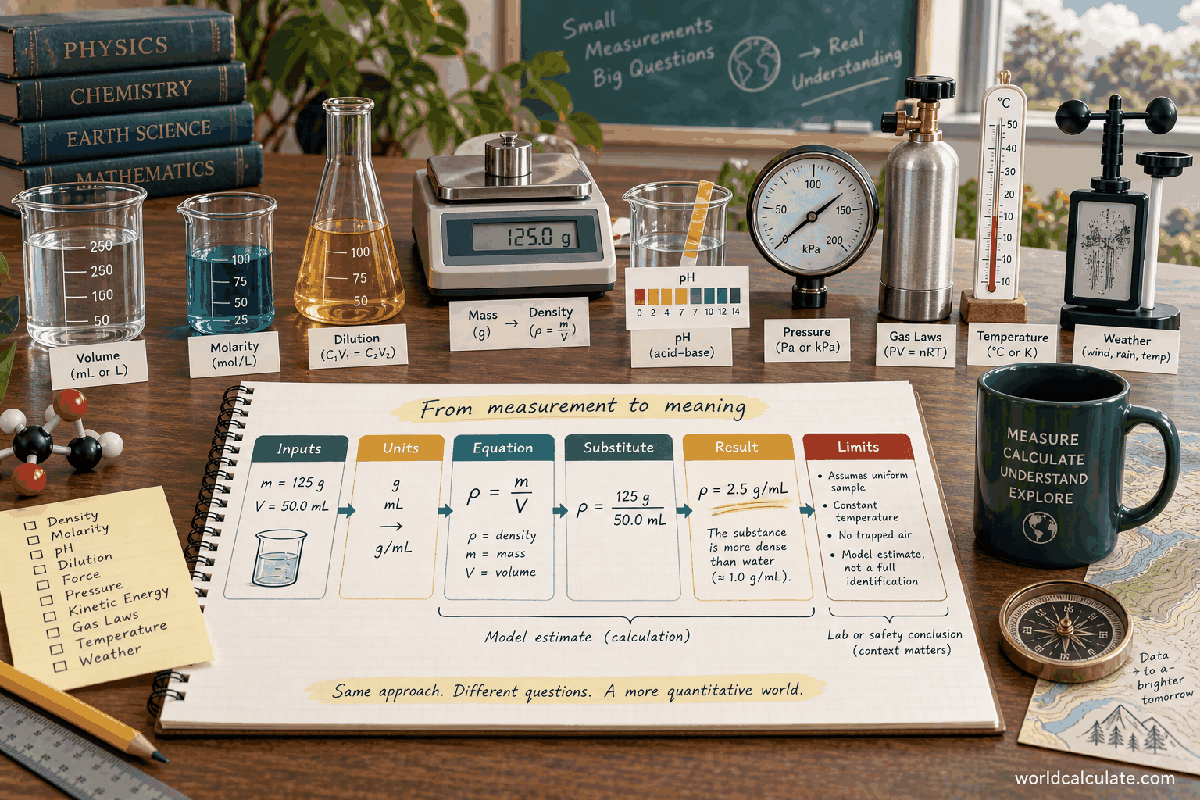
Thermal equilibrium in a two-body calorimetry problem is found by balancing the heat capacities of bodies that exchange energy in an isolated model. This calculator accepts two positive masses, two positive constant specific heats, and two nonnegative initial temperatures in kelvins. It evaluates Tf = (m1 c1 T1 + m2 c2 T2)/(m1 c1 + m2 c2), then reports the signed heat transferred to body 1 using Q1 = m1 c1 (Tf - T1). A positive Q1 means body 1 gains heat. The result is an ideal equilibrium calculation, not a heat-transfer rate, laboratory measurement, appliance forecast, or safety instruction. The guide follows every field, bound, unit, example, validation rule, and model limit.
The calculator answers a narrow calorimetry question: if two bodies are treated as an isolated thermal system and eventually share one temperature, what is that final temperature? It also answers how much heat body 1 gains or loses under the same balance. The handler does not need a clock because this is a state-to-state energy balance. It uses the entered mass and specific heat of each body to determine thermal capacity, then weights the two initial temperatures by those capacities. The fields describe a mathematical model, not a sensor network or a complete experiment.
The final value is meaningful only with the assumptions attached. A real setup may lose heat to air, a container, supports, or a measuring probe. Specific heat can vary with temperature, and a body can undergo a phase change instead of remaining in one state. The calculator intentionally excludes those effects so the energy balance remains visible. If a problem includes an insulated container and constant material data, the output is a useful ideal comparison. If it asks for timing, losses, or equipment performance, the two-body contract is not enough.
For each body, mass multiplied by specific heat gives heat capacity C = m c in J/K. Heat capacity describes how much energy is associated with a one-kelvin temperature change in the constant-specific-heat approximation. A larger mass or larger specific heat gives a larger capacity, so that body has more influence on the final weighted temperature. The calculator asks for both factors instead of accepting a precomputed capacity, which keeps the field units and the physical interpretation visible. It does not identify the substance from a numerical value.
The specific heat fields use J/(kg K), and the masses use kg. Multiplying them cancels kilograms and leaves J/K. This unit path matters when a source reports a value per gram, per degree Celsius, or in another energy unit. The visitor must convert before entry. A temperature difference in degrees Celsius has the same size as a kelvin difference, but the absolute initial values in this page are labeled K and should be entered on the absolute scale. The handler performs no hidden material or unit lookup.
Under the constant-specific-heat assumption, the thermal energy change of a body can be written as Q = m c (Tf - Ti). In an isolated two-body system, the energy gained by one body is balanced by the energy lost by the other. Setting the two contributions to a common Tf and collecting the final-temperature terms produces Tf = (m1 c1 T1 + m2 c2 T2)/(m1 c1 + m2 c2). The handler follows this expression directly rather than averaging the temperatures with equal weights.
A simple arithmetic average is correct only when the two heat capacities are equal. If one body is much heavier or has a much larger specific heat, its initial temperature has greater influence. This is why the catalog example with equal masses and equal specific heats lands halfway between the two initial temperatures. In an unequal case, the final value lies closer to the temperature of the body with greater capacity. The handler explicitly checks that the result remains between the two input temperatures, preserving this model-specific property instead of silently accepting an impossible weighted result.
The example uses mass 1 = 1 kg, specific heat 1 = 4186 J/(kg K), and temperature 1 = 293.15 K. Body 2 has the same mass and specific heat and starts at 373.15 K. Both heat capacities are therefore 4186 J/K. The weighted numerator divides evenly between the two initial temperatures, giving Tf = 333.15 K. Body 1 changes by 40 K, so Q1 = 4186 J/K multiplied by 40 K = 167440 J. The positive sign says that body 1 gains heat from the warmer body.
This result is a deliberately simple numerical check, not a claim that two real one-kilogram water samples will exchange exactly that energy in an uncontrolled setup. The example treats the supplied specific heat as constant, ignores the vessel and surroundings, and assumes a common equilibrium state. If a report uses a real experiment, it should identify the materials, container, insulation, initial measurement method, and uncertainty. The calculator supplies the arithmetic for the stated ideal boundary and does not fill in missing laboratory evidence.
The second result is Q1 = m1 c1 (Tf - T1). A positive number means the final temperature is above body 1's initial temperature, so body 1 gains heat in the chosen sign convention. A negative number means body 1 cools and gives up heat. Zero means that body 1 has no net temperature change under the calculated equilibrium state. The label says heat transferred to body 1 rather than simply heat because the sign and receiving body are part of the output definition.
The magnitude of Q1 can be useful when a question asks how much energy moved, but the signed value carries more information for a balance. The handler also computes the corresponding body 2 transfer internally and checks that the two transfers sum to a finite balance near zero. It returns Q1 as the requested useful transfer result. It does not report a positive number as if it were automatically heat supplied by a device, and it does not calculate the direction from a hidden convention.
The ideal balance assumes that heat leaving one body enters the other. With C1 and C2 as the heat capacities, Q1 = C1(Tf - T1) and Q2 = C2(Tf - T2). The weighted formula makes Q1 + Q2 equal to zero in exact arithmetic. The implementation calculates both transfers and checks their sum for finiteness, so an overflow or invalid intermediate cannot be hidden behind a plausible final temperature. The returned output focuses on body 1, while the steps expose the balance for auditability.
Conservation here is a boundary statement, not a claim that every real experiment is perfectly isolated. If a container absorbs energy or the room receives heat, the system has more terms and the two-body expression changes. External work, stirring, radiation, evaporation, and electrical heating can also alter the balance. The page has no fields for those channels. A reader should treat the zero-sum relation as the assumption used to derive the result and add new terms in a separate reviewed model when the physical setup requires them.
For positive heat capacities, a weighted average of two finite temperatures must lie between the lower and upper initial values. The handler validates this cross-field property after calculating Tf. This check is useful even though the algebra should guarantee it, because it catches a future change to the formula, an invalid capacity, or a non-finite intermediate before a misleading result reaches the renderer. The values are not reordered: temperature 1 remains associated with body 1 and temperature 2 remains associated with body 2.
The ordering check does not reject equal temperatures. Equal inputs describe a valid state in which no net heat transfer is required, and the final temperature equals that shared value. It also does not claim that every pair between zero and the maximum catalog value is a realizable thermodynamic state. The numeric contract permits nonnegative kelvins for broad educational use, while the model note reminds the reader that phase, material, and experimental feasibility remain outside the arithmetic.
Each mass accepts 0.000001 through 1,000,000 kg, and each specific heat accepts 0.000001 through 1,000,000 J/(kg K). Each initial temperature accepts 0 through 1,000,000 K. These inclusive values are deliberately broad enough for classroom scale comparisons while keeping products, weighted sums, and heat transfers finite in JavaScript number arithmetic. The default values use one-kilogram, water-like heat capacities and ordinary room-scale temperatures so that both the default and catalog example remain readable and meaningful.
The metadata and engine use the same endpoints, but the engine remains the authoritative runtime guard. A value below a positive minimum, above a maximum, a string, or a nonfinite value is rejected. The handler also checks individual heat capacities, the total capacity, the weighted numerator, both heat transfers, and the final temperature. It does not clip inputs to an endpoint. If a larger physical scenario is needed, its numeric range and precision requirements should be reviewed rather than assumed to fit this page.
The handler requires positive finite masses and specific heats and nonnegative finite initial temperatures. Numeric text is not converted, and missing values do not acquire a default inside the pure function. This is intentional because a direct caller should receive the same domain behavior as a form submission after values have been read. The validation labels identify body and field, making a correction possible without guessing which of the six numbers failed. Negative zero is normalized before it can become a confusing signed temperature or transfer artifact.
After individual validation, the engine calculates C1, C2, their positive total, and the weighted temperature. It then applies the between-temperatures cross-field check and calculates Q1 and Q2. The total transfer balance also passes through a finite-result guard. These checks separate input validity from model validity: a finite input can still produce an unusable derived value if a future bound is changed. The current conservative bounds keep ordinary endpoint cases finite, but explicit guards make that property testable.
If both bodies start at the same temperature, the weighted formula returns that same temperature regardless of their different masses or specific heats. Both Q1 and Q2 are zero in the ideal balance. This is a useful boundary test because it shows that heat capacity determines how a temperature changes when there is a difference, but it does not create a difference by itself. The engine normalizes any negative-zero representation to ordinary zero so the shared renderer displays a stable result.
A zero kelvin input is accepted by the numeric contract when paired with a positive mass and specific heat. The page treats it as a nonnegative Kelvin value for arithmetic, not as a claim that a real body can be prepared at an absolute boundary. At a zero and positive-temperature pair, the weighted result remains finite and between the inputs. Any material behavior, phase state, or practical attainability at an extreme temperature needs a separate physical analysis.
The formula treats each specific heat as constant over the complete temperature interval. That approximation is often useful for an introductory calorimetry exercise, but real material properties can vary with temperature. If a body melts, boils, freezes, reacts, or changes composition during the interval, energy may be associated with a latent or transition term and one final-temperature expression is no longer sufficient. The calculator does not ask for phase boundaries or latent heat, so it cannot detect those events from the six numeric fields.
The final equilibrium label also assumes that both bodies can reach one common temperature. A slow thermal contact, a temperature gradient, or a body with internal resistance can make a single final value a coarse summary rather than a time-resolved description. The page does not calculate conduction, convection, radiation, mixing, or relaxation. It gives the equilibrium value implied by the selected capacities and initial temperatures and leaves the route to equilibrium outside the model.
The temperature fields are in kelvins because the formula uses absolute initial temperatures in the energy-weighted numerator. For a temperature difference, a kelvin and a degree Celsius have equal interval size, but the initial values in this expression must be handled consistently. Mass must be in kilograms and specific heat in joules per kilogram kelvin. A source reported in grams or calories needs conversion before entry. The handler sees only numbers and cannot detect a unit that was mislabeled by the user.
A useful dimensional check is C T = [J/K][K] = J. The numerator is a sum of energy-like terms, and the denominator is J/K, so their quotient is K. For Q1, J/K multiplied by K gives joules. These checks explain why the formula returns the selected units without a hidden conversion factor. Preserve the original source values and conversion method in a report when precision or reproducibility matters.
The output is not a heating or cooling rate because no time interval appears in the input. It does not say how quickly the bodies approach equilibrium, whether contact is sufficient, or how much power a heater or cooler would need. It also does not select insulation, estimate energy bills, size a heat exchanger, or predict room temperature. Those questions require transport coefficients, geometry, environment, control behavior, and often a time-dependent model.
The result is not a safety decision. A finite final temperature does not approve a material, container, process, or exposure condition. It does not account for pressure, boiling, combustion, biological response, or a hazardous temperature gradient. The note beside the results keeps this boundary visible. If the two-body arithmetic is used inside a larger engineering or laboratory calculation, carry the signed heat transfer and exact assumptions forward, then perform the additional review separately.
A clear report should list m1, c1, T1, m2, c2, and T2 with their units and body labels. Show C1 and C2, then show the weighted formula for Tf. Include the signed Q1 convention so a reader knows whether a positive value means gain or loss. If the bodies are real materials, name the temperature interval over which the constant-specific-heat assumption was chosen and state whether a container was excluded. These details let another reader reproduce the calculation rather than treating the final temperature as a measurement with no boundary.
The report should state that the model is an isolated two-body calorimetry balance. It should repeat that heat loss, container capacity, phase changes, variable specific heats, transport time, and safety are not modeled. A result copied into a worksheet is most useful when it retains those limits beside the number. The calculator has done its job when the energy balance is transparent and the next, more detailed question is identified rather than answered by an unsupported assumption.
Before accepting an output, verify that both masses and specific heats are positive finite numbers, both temperatures are nonnegative finite kelvins, and each body pairing is correct. Check that the final temperature falls between the two initial values and that Q1 has the expected sign. For equal initial temperatures, confirm that the transfer is zero. Recheck the units with C = m c and Q = C delta T. These checks establish the model arithmetic without proving that a real apparatus is isolated or at equilibrium.
The honest conclusion is limited: the two-body constant-specific-heat equilibrium formula was evaluated for the entered values. No heat-transfer time, phase transition, container, environmental loss, device performance, or safety instruction was produced. If the actual problem includes any of those features, stop at this page and define the added energy terms or transport model separately. The explicit boundary is what keeps a useful calorimetry equation from becoming a false description of a real thermal system.
Calculate the final equilibrium temperature and signed heat transfer for two bodies sharing heat in an isolated constant-specific-heat model.
Tf = (m1 c1 T1 + m2 c2 T2) / (m1 c1 + m2 c2); signed heat transfer to body 1 is Q1 = m1 c1 (Tf - T1). This calculator applies an isolated two-body calorimetry balance with constant specific heats. It returns the heat-capacity-weighted final temperature and heat transferred to body 1, where a positive Q1 means body 1 gains heat; phase changes, heat loss, container capacity, and time rates are outside the model.
Enter Mass 1, Specific heat 1, Initial temperature 1, Mass 2, Specific heat 2, Initial temperature 2, then choose Calculate.
Both masses and specific heats are finite positive SI quantities, and both initial temperatures are finite nonnegative absolute temperatures in kelvins. Each body has constant specific heat over the interval, remains in one phase, and reaches one common final equilibrium temperature. The two bodies form an isolated thermal system with no heat loss, no external work, and no unentered container or environmental heat capacity. Heat transfer to body 1 is signed as Q1 = m1 c1 (Tf - T1); a negative value means body 1 loses heat.
This calculator is part of the WorldCalculate library. Its formula, example, assumptions, input bounds, and output formatting follow the official methodology.
These WorldCalculate collections connect this tool with related questions while keeping each calculation separate and transparent.