
Goal
Find the concentration after diluting a stock solution to a new volume.
Worldwide context
Saved once here, used across the site.
Currency changes display only. Country selection guides tax input; no tax rate is guessed.
Find the concentration after diluting a stock solution to a new volume.
M2 = M1 * V1 / V2.A clearer path to an answer
This page keeps the calculation transparent: define the goal, enter the matching values, inspect the method, and decide what the result means in your situation.
Find the concentration after diluting a stock solution to a new volume.
Stock concentration (M1) · Stock volume used (V1) · Final volume (V2)
M2 = M1 * V1 / V2.
Calculate, review the assumptions below, then compare a related tool when the decision needs more context.
Find the concentration after diluting a stock solution to a new volume.
Open the Solution Dilution (M1V1 = M2V2) pageMore science tools
Download PDFDownload Word (.doc)
Enter your values above and choose Calculate to see the result here.
Calculation map
M2 = M1 * V1 / V2.
Bounded, transparent calculation
Your recent runs stay in this browser session only.
Formula: M2 = M1 * V1 / V2.
Dilution adds solvent, not solute, so moles stay constant: M1V1 = M2V2. Both volumes must use the same unit.
Worked example: 0.6 M
The displayed limits are checked before the handler runs. Model-specific domain checks may also reject impossible or non-finite inputs.
Methodology: This calculator follows the WorldCalculate input, formula, precision, and boundary policy. Read the official methodology.
Calculator usage statistics
This section counts anonymous successful Calculate submissions, not unique visitors. Counts and top tools appear only when trusted aggregate data is available; country analysis is shown only under the same condition and reporting threshold.
Answer-first guide
Find the concentration after diluting a stock solution to a new volume. Start with one clearly defined goal, enter values in the units shown, and keep the result attached to the assumptions below.
This tool is useful when your question includes dilution, stock solution, M1V1. It returns the outputs declared in the calculator contract rather than a live quote, approval, diagnosis, or professional sign-off.
Stock concentration (M1) · Stock volume used (V1) · Final volume (V2). Keep the same time period, unit system, and currency wherever the form requires comparable values.
Run the worked example first, compare its output with the page's example, then change one input at a time. This makes an unexpected result easier to trace to a unit, boundary, or assumption.
Need a wider view? Browse Science Calculators or compare the related tools below. The WorldCalculate methodology explains how formulas, examples, limits, and revisions are reviewed.
M2 = M1 * V1 / V2.
Dilution adds solvent, not solute, so moles stay constant: M1V1 = M2V2. Both volumes must use the same unit.
0.6 M
Context and background
Science calculators define a system, choose an equation, apply units and constants, and show the substitution. Effects outside that model remain outside the result.
Introductory science problem solving builds from measured quantities and idealized relationships. Those models are valuable for learning and first-pass estimates, while experiments and engineering decisions need additional evidence.
Research and review
Researched by Hassan ALRowaie, Founder and editorial researcher at WorldCalculate.
This guide follows the live calculator's declared inputs, formula, worked example, assumptions, validation boundaries, and source-backed methodology. The review date describes editorial review of the calculator explanation; it is not a promise that external facts or rates remain current.
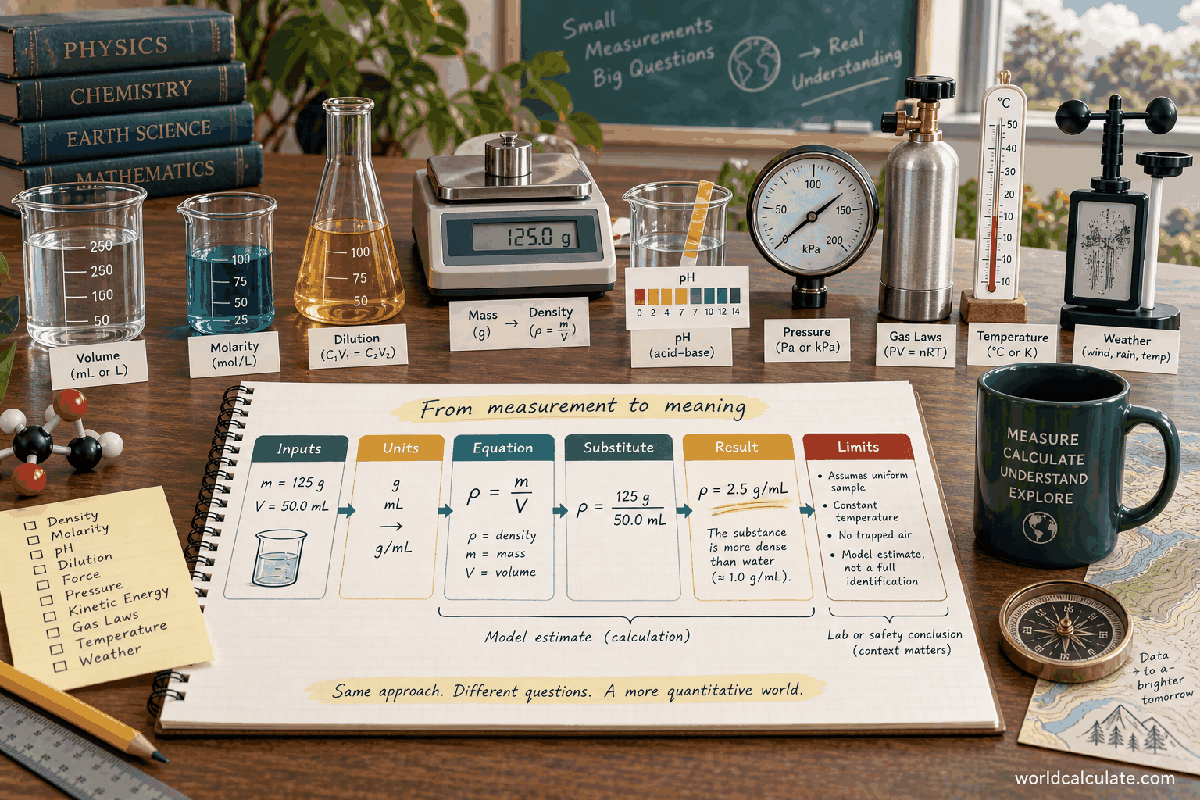
The dilution relation M1V1 = M2V2 describes a simple concentration change when the amount of solute stays constant. This calculator accepts a stock concentration M1, the stock volume used V1, and the final total solution volume V2, then returns M2 = M1 * V1 / V2. Both volumes must use the same unit, and V2 means the whole solution after dilution, not merely the solvent added. The model assumes no reaction and no volume contraction on mixing. It is equation and unit guidance only, not a laboratory procedure, handling instruction, dosing recommendation, or safety approval. The sections below unpack the variables, conservation premise, examples, scaling, input checks, measurement limits, and the point where a richer chemical model is required.
The page answers a narrow question: what final concentration follows from a stated stock concentration, a stated volume taken from that stock, and a stated final total volume? The answer is a scalar M2 obtained by multiplying M1 by V1 and dividing by V2. The arithmetic is based on a conserved amount of solute under the ideal dilution premise. It does not identify a substance, inspect a container, measure a volume, or decide whether a real mixture behaves according to the premise.
A dilution normally means that the same dissolved solute is spread through a larger amount of solution space without adding more solute. That idea is represented by the equality M1V1 = M2V2. The calculator does not track a sequence of transfers or a series of intermediate containers. It receives the three numeric premises directly and reports the fourth quantity implied by the equation.
The output should remain labeled as a calculated final concentration. It is not a statement about a suitable concentration, an acceptable exposure, an effective formulation, or a safe operating condition. Those conclusions need substance-specific and context-specific information that is absent from the record.
M1 is the concentration of the stock solution before the stated portion is treated as the input. V1 is the volume taken from that stock and used in the calculation. M2 is the concentration after the same solute amount is distributed through the final solution. V2 is the final total volume of that solution. Keeping the subscripts tied to their states prevents a common error in which a final volume is accidentally used as the stock volume or a stock concentration is reported as the final result.
The word used matters for V1. The field does not ask for the stock container's entire capacity or the amount remaining after a portion is removed. It asks for the stock volume used in the modeled portion. The word final matters for V2. It is not automatically the volume of solvent added and not automatically the sum of two nominal component volumes. The user supplies the final total volume as a premise.
The concentration units must be compatible, and the two volume units must match one another. The current record uses M and L, so the default interpretation is mol/L for concentrations and litres for both volumes. The formula can be expressed in other consistent units, but a number entered under this page's labels should follow the catalog contract.
Concentration is amount per volume. The amount of solute in the selected stock portion is M1 multiplied by V1, while the amount represented by the final solution is M2 multiplied by V2. If the solute amount does not change between those two states, the products are equal: M1V1 = M2V2. Solving that equality for M2 gives M2 = M1 * V1 / V2, which is the formula used by the handler.
The equality does not mean that every physical process called dilution has identical behavior. It is an assumption about the two states represented by the inputs. If solute is consumed, produced, lost, precipitated, adsorbed, or otherwise changed, then the amount on the two sides is not the same without an added balance. This page has no reaction, loss, recovery, or phase field and does not infer one.
The conservation idea also explains why the result changes when V2 changes. A fixed amount spread through a larger final volume has a smaller amount-per-volume ratio. If V2 equals V1, the calculated concentration equals M1. If V2 is larger than V1, the conventional dilution result is lower than the stock concentration, assuming positive M1.
Start with M1V1 = M2V2. To isolate M2, divide both sides by V2, which must be positive: M2 = M1V1 / V2. The handler writes the product as stock multiplied by stockVolume and then divides by finalVolume. This order reflects the conservation equation and keeps the units visible. Multiplying a concentration by a volume gives an amount in compatible concentration-volume units; dividing by a volume returns concentration.
The relation can also be rearranged on paper to solve for a stock concentration, a stock volume, or a final volume when the other quantities are known. This page does not expose those alternatives. It has a fixed three-input contract and one final-concentration output. A rearranged result should not be described as an additional feature of the calculator unless its assumptions and field definitions are stated separately.
The equation is not a percentage shortcut. A dilution factor may be expressed as V2 divided by V1 in a conventional setup, but the handler does not ask for a factor and does not replace the entered volumes with a guessed ratio. Enter the actual stock volume used and the actual final total volume represented by the question.
V2 must be the total volume of the final solution after the stock portion and added solvent or other permitted components are together under the stated model. It is not simply the volume of solvent added. Confusing those quantities changes the denominator and therefore changes M2. The calculator cannot reconstruct V2 from a solvent amount because the record deliberately treats final total volume as an input.
For a conceptual example, suppose the stock portion is 0.1 L and the final solution volume is 1 L. The formula divides the conserved stock amount by 1 L. If a user instead enters 0.9 L because that is the amount of solvent thought to have been added, the result is larger than the result based on the required final volume. Both numbers may be valid divisions, but only the one using 1 L answers the contract for this final state.
The word total does not authorize an automatic sum of nominal volumes. The catalog assumptions explicitly exclude volume contraction on mixing, but the calculator still does not calculate a final volume from component volumes. If V2 is known from the problem statement or an established measurement, enter it. If V2 is uncertain or estimated, keep that uncertainty in the surrounding record.
The example uses a stock concentration of 6 M, a stock volume used of 0.1 L, and a final total volume of 1 L. First calculate the stock amount in concentration-volume units: M1V1 = 6 M * 0.1 L = 0.6 M L. Then divide by V2: M2 = 0.6 M L / 1 L = 0.6 M. The displayed result is therefore 0.6 M.
The result is lower than the 6 M stock concentration because the final volume is ten times the stock portion's volume. The same conclusion can be checked with the ratio V1/V2 = 0.1/1 = 0.1, so M2 = 6 * 0.1 = 0.6 M. The two paths are algebraically identical and provide a useful check against swapping a volume or reversing the ratio.
This example is only a numerical illustration. It does not identify a chemical, recommend a target, or say how a person should carry out a dilution. The values are sufficient to test the equation, not to establish a practical procedure, container choice, handling method, or safety conclusion.
Consider a stock concentration of 2 M, a stock volume used of 0.25 L, and a final total volume of 0.5 L. The formula gives M2 = 2 * 0.25 / 0.5 = 1 M. The final volume is twice the stock portion volume, so the concentration is half the stock concentration. This simple ratio provides a quick mental check before inspecting decimal formatting.
Now keep M1 and V1 fixed while changing V2 to 1 L. The same conserved stock amount is spread through twice as much final volume as in the first scenario, so M2 becomes 0.5 M. Nothing about the stock amount changed; the denominator did. This comparison is a useful way to explain why final volume, rather than solvent added, controls the output in the formula.
A reverse check multiplies the calculated M2 by V2. In the first scenario, 1 M * 0.5 L equals 0.5 M L, which matches 2 M * 0.25 L. In the second, 0.5 M * 1 L also equals 0.5 M L. Keeping the concentration-volume product visible helps catch errors that a plausible-looking final concentration might hide.
The two volume fields must use the same unit because they are multiplied and divided within one conservation equation. If V1 is entered in litres, V2 must also be in litres. If a problem gives 100 mL and 1,000 mL, those values can be used together if the field contract has been extended to that unit, but this record labels both inputs as L, so convert them to 0.1 L and 1 L before entry.
Using 100 as if it were litres when it means 100 mL changes the volume ratio by a factor of 1,000. In a dilution calculation, that error passes directly into M2. A unit mismatch can therefore look like a dramatic chemical conclusion while being only a bookkeeping mistake. Write the unit next to each source number and convert before applying the formula.
Concentration units must also be shared between M1 and M2. The current fields use M for both, so the result remains M. A concentration stated in mmol/L would need conversion to the chosen basis before using it with a stock value in mol/L, unless the ratio is explicitly kept in a consistent smaller unit. The calculator does not infer or reconcile these labels from raw numbers.
For positive volumes, the ratio V1/V2 is the fraction of the stock concentration retained in the final result. In the catalog example that ratio is 0.1, so one tenth of the stock concentration remains under the ideal model. Describing the ratio can help explain the output, but the calculator still obtains it from the two entered volumes rather than from a separate dilution-factor field.
A conventional dilution has a final total volume larger than the stock portion used, which makes V1/V2 less than one and M2 lower than M1 when M1 is positive. The engine's numeric contract permits any positive V2 within range and does not independently decide whether the scenario is a conventional dilution. If V2 is smaller than V1, the algebraic output can be greater than M1; that result should be recognized as a mathematical consequence of the entered values, not automatically called a valid dilution outcome.
Ratios are most useful when their numerator and denominator describe comparable states. A ratio based on the stock container's total volume, or on solvent added rather than final volume, is not the ratio in this formula. Keep V1 tied to the stock portion used and V2 tied to the final total solution volume.
The stock concentration field allows zero, so a zero-stock input returns zero final concentration for any positive stock and final volumes. This follows from the product M1V1 being zero. It is a valid arithmetic boundary, though the surrounding description should explain why a zero concentration is being considered. Negative stock concentration is rejected because the page models a concentration amount, not a signed source-and-sink balance.
Both V1 and V2 must be strictly positive. A zero stock volume would make the modeled stock amount zero but is excluded by the field contract because the page asks for a positive volume used from the stock. A zero final volume would make the division undefined. Negative volumes do not describe the ratio represented here and are also outside the allowed domain.
The numeric ranges are not physical recommendations. A value at the minimum or maximum may be useful for a software boundary test, but it does not prove that a volume can be measured accurately or that a concentration is practical. The calculation accepts a bounded premise and stops at the reported arithmetic.
A useful comparison is the quotient M2/M1 when M1 is positive. Under the equation, that quotient equals V1/V2. The comparison therefore describes how the volume ratio scales the stock concentration. It does not measure a separate efficiency, recovery percentage, or chemical yield. If M1 is zero, the ratio M2/M1 is undefined even though the calculator can still return M2 as zero.
If V1 and V2 are equal, the formula preserves the stock concentration. If V2 is four times V1, the final concentration is one quarter of M1. These statements are direct consequences of the ideal relation and can be used to audit examples. They should not be expanded into a claim that a real sample will have no losses or that a target is suitable for an application.
Comparisons also require the same concentration basis and the same identity of the solute. A stock concentration in one unit system cannot be compared to a final result in another without conversion. Likewise, if a reaction changes the species being measured, a numerical comparison may not describe the same solute even when the labels look similar.
The catalog assumptions explicitly say that no reaction occurs during the modeled dilution. This means the solute amount represented by M1V1 is carried to the final state without a chemical transformation that would require a new balance. The page does not test whether a reaction might occur, calculate equilibrium, account for heat, or identify products. If chemistry changes the amount or identity of the solute, the simple equality is not enough by itself.
The same assumptions exclude volume contraction on mixing. The handler does not add component volumes, subtract a contraction, estimate expansion, or solve a density relation. It simply uses the entered V2 as the final total volume. If a problem requires a measured or modeled mixing volume, that work must be completed outside this page and its result supplied with the relevant uncertainty.
These exclusions are model boundaries, not claims that reactions or volume changes never occur. They state what this calculator refuses to represent. A result can be numerically correct under M1V1 = M2V2 while being an inadequate description of a process with reaction, evaporation, precipitation, adsorption, gas exchange, or significant nonideal mixing.
The formula treats M1, V1, and V2 as known values, but a real record may obtain them through measurements with different uncertainty. A stock concentration may be certified, estimated, or itself calculated. A stock volume may have a reading tolerance, and a final volume may be measured under a particular temperature and state. The engine cannot inspect those methods, so retain them outside the numeric fields.
The final volume deserves special documentation because it controls the denominator. State whether V2 is a measured total, a stated target state, or an estimate based on other information. The calculator will produce a result for each case, but the confidence in the result differs. Do not use extra decimal places to hide uncertainty in a volume or concentration input.
When comparing repeated dilutions, keep the same definitions for stock state, volume units, solute identity, and final state. A change in M2 may reflect a changed stock value, a changed portion volume, a changed final volume, or a measurement convention. The equation exposes the numerical relationship but does not diagnose the source of a discrepancy.
A denominator error is using solvent added instead of final total volume. Another is using the stock container's capacity instead of the stock portion used. Both mistakes alter V1 or V2 while leaving the rest of the formula looking familiar. A third is reversing V1 and V2, which changes a conventional dilution fraction into its reciprocal and can make the final concentration too large.
A unit mismatch is another source of error. Entering V1 in millilitres and V2 in litres without conversion multiplies or divides the result by a factor of 1,000. Concentration labels can also be mixed, such as mol/L for M1 and mmol/L for a value treated as M2. Write every number with its unit and state before substitution.
Finally, do not assume that a plausible number proves the model is appropriate. A value below M1 may look like a dilution even if the solute reacted or the denominator was misdefined. Check the conservation premise, final-volume meaning, and unit path in addition to checking the decimal.
The engine calculates a deterministic quotient for the three entered numbers, but uncertainty in any input transfers to M2. Since M2 is proportional to M1 and V1 and inversely proportional to V2, a relative error in the stock concentration or stock volume tends to move the result in the same direction, while a relative error in final volume moves it in the opposite direction. The calculator does not perform formal uncertainty propagation.
Keep unrounded inputs through the multiplication and division, then round for display according to the precision supported by the source data. Early rounding of a stock concentration or either volume can change the final result, especially when values are close or the ratio is small. Retain the original values in a report if another reader may need to reproduce the calculation.
A displayed result such as 0.60 M should not be interpreted as a guarantee that the final state is known to two decimal places. Conversely, a long decimal from the engine does not make an estimated final volume more accurate. Separate arithmetic precision, measurement resolution, and model uncertainty when explaining the result.
The pure engine validates all three inputs as finite numbers within the catalog ranges. Stock concentration may be from 0 through 1,000,000 M. Stock volume used and final total volume must each be from 0.000001 through 1,000,000,000 L. Missing values, unconverted numeric text, NaN, infinity, negative concentrations, zero volumes, and out-of-range values are rejected before division.
The output passes through a finite-result guard. This protects the shared calculation layer from returning infinity or NaN if a future contract changes or an extreme combination is introduced. The handler rejects invalid values rather than clipping them to the nearest boundary. Silent clipping would change the stock amount or final state and could make a mistaken calculation appear valid.
These checks establish a software and numeric contract, not a laboratory validation. A number can pass every type and range rule while naming the wrong stock, using the wrong volume state, or violating the no-reaction premise. Review the meaning of the inputs before treating the result as a useful model of a real solution.
A richer model is needed when the solute reacts, evaporates, precipitates, binds to a surface, crosses a membrane, or is otherwise removed or added. In those cases the conserved quantity may not be the original solute amount, and M1V1 = M2V2 alone cannot determine the final concentration. A mass balance would need terms for sources, sinks, species, phases, and possibly time.
The simple relation also does not handle a sequence of different stocks with separate solutes, nonuniform samples, concentration-dependent volume behavior, or a final volume that has not been defined. A user may perform several ideal dilution calculations in a larger worksheet, but each step must identify its own M1, V1, and V2 and preserve the assumptions. This page does not combine steps or check consistency between containers.
Likewise, the calculator does not predict temperature change, pressure response, viscosity, activity, reaction rate, biological effect, or process performance. It is a compact equation engine. If the question includes any of those outcomes, treat the calculated M2 as one conditional arithmetic value and create a separate model with the missing inputs and boundaries.
A clear record names the solute or stock identity, states M1 and its unit, states V1 as the stock volume used, states V2 as the final total solution volume, and shows M1V1 = M2V2 followed by M2 = M1V1/V2. Record the volume units even when both are litres. Include whether each input is measured, specified, or estimated, and retain enough digits for another reader to reproduce the displayed result.
The report should say that the calculation assumes no reaction and no volume contraction on mixing. It should not silently imply that the final concentration is appropriate for a person, organism, process, instrument, or material. If the result enters a larger analysis, pass it forward with its input definitions and model boundary rather than copying only the decimal.
A useful reverse check is M2V2 compared with M1V1. If they differ beyond expected rounding, inspect the formula, volume units, and final-volume definition. If they agree but the scenario still seems chemically unusual, that is evidence to review the model assumptions, not evidence that the calculator has validated the process.
This calculator does not tell a user how to perform a dilution. It does not instruct anyone to measure, pour, transfer, mix, label, store, transport, dispose of, or handle a substance. It does not choose containers, equipment, protective controls, order of operations, or environmental conditions. Those details are substance-specific and context-specific and cannot be derived from three numeric fields.
The result is also not dosing guidance or a safe-concentration recommendation. A concentration may be relevant to a medical, biological, industrial, agricultural, or household decision, but suitability depends on identity, purity, route, recipient or system, exposure, interactions, regulation, and professional judgment. None of those factors is represented here. A correct M2 value must not be presented as approval for a use.
The explicit boundary protects the meaning of the equation. Use the page for classroom work, unit checks, or a separately governed calculation whose stock and final-volume premises have already been established. If the intended question has become procedural, clinical, operational, or safety-related, stop treating this article as an answer and move the decision to the appropriate reviewed process.
Before accepting M2, verify that M1 is the stock concentration for the state being modeled, V1 is the stock volume used, and V2 is the final total solution volume. Confirm that both volumes use the same unit and that the concentration basis is consistent. Apply M2 = M1 * V1 / V2, then reverse-check by comparing M2V2 with M1V1 within the chosen rounding precision.
Next, ask whether the conserved-solute premise is reasonable for the question. Confirm that the calculation is not being asked to model a reaction, solute loss, precipitation, evaporation, volume contraction, or other effect excluded by the assumptions. If any of those effects matter, retain the equation result only as a conditional ideal value and document why a separate model is required.
Finally, keep the usage boundary attached to the number. The page computes a final concentration from M1V1 = M2V2 with final total volume and no reaction or volume-contraction model. It does not provide a laboratory procedure, dosing guidance, operational recommendation, or safety approval.
Find the concentration after diluting a stock solution to a new volume.
M2 = M1 * V1 / V2. Dilution adds solvent, not solute, so moles stay constant: M1V1 = M2V2. Both volumes must use the same unit.
Enter Stock concentration (M1), Stock volume used (V1), Final volume (V2), then choose Calculate.
No reaction or volume contraction on mixing. Volumes share one unit; concentrations share one unit. Final volume is positive and is the total after dilution.
This calculator is part of the WorldCalculate library. Its formula, example, assumptions, input bounds, and output formatting follow the official methodology.
These WorldCalculate collections connect this tool with related questions while keeping each calculation separate and transparent.