
Goal
Estimate fresh and settled snow depth from liquid-equivalent precipitation, a chosen snow-to-liquid ratio, and a transparent settling allowance.
Worldwide context
Saved once here, used across the site.
Currency changes display only. Country selection guides tax input; no tax rate is guessed.
Estimate fresh and settled snow depth from liquid-equivalent precipitation, a chosen snow-to-liquid ratio, and a transparent settling allowance.
Fresh snow depth = liquid-equivalent depth × snow-to-liquid ratio. Settled depth = fresh depth × (1 − settling percentage ÷ 100). Millimetres are converted to centimetres by dividing by 10 and to inches by dividing by 25.4.A clearer path to an answer
This page keeps the calculation transparent: define the goal, enter the matching values, inspect the method, and decide what the result means in your situation.
Estimate fresh and settled snow depth from liquid-equivalent precipitation, a chosen snow-to-liquid ratio, and a transparent settling allowance.
Liquid-equivalent precipitation · Snow-to-liquid ratio · Settling or compaction allowance
Fresh snow depth = liquid-equivalent depth × snow-to-liquid ratio. Settled depth = fresh depth × (1 − settling percentage ÷ 100). Millimetres are converted to centimetres by dividing by 10 and to inches by dividing by 25.4.
Calculate, review the assumptions below, then compare a related tool when the decision needs more context.
Estimate fresh and settled snow depth from liquid-equivalent precipitation, a chosen snow-to-liquid ratio, and a transparent settling allowance.
Open the Rain-to-Snow Equivalent Calculator pageMore science tools
Download PDFDownload Word (.doc)
Enter your values above and choose Calculate to see the result here.
Calculation map
Fresh snow depth = liquid-equivalent depth × snow-to-liquid ratio. Settled depth = fresh depth × (1 − settling percentage ÷ 100). Millimetres are converted to centimetres by dividing by 10 and to inches by dividing by 25.4.
Bounded, transparent calculation
Your recent runs stay in this browser session only.
Formula: Fresh snow depth = liquid-equivalent depth × snow-to-liquid ratio. Settled depth = fresh depth × (1 − settling percentage ÷ 100). Millimetres are converted to centimetres by dividing by 10 and to inches by dividing by 25.4.
The page is a scenario calculator, not a local weather forecast. Snow-to-liquid ratios vary with crystal type, temperature profile, wind, compaction, and storm evolution, so the ratio and settling allowance remain explicit inputs.
Worked example: 25.4 mm of liquid equivalent at a 10:1 ratio gives 254 mm (25.4 cm or 10 in) fresh snow and 228.6 mm after a 10% settling allowance.
The displayed limits are checked before the handler runs. Model-specific domain checks may also reject impossible or non-finite inputs.
Methodology: This calculator follows the WorldCalculate input, formula, precision, and boundary policy. Read the official methodology.
Calculator usage statistics
This section counts anonymous successful Calculate submissions, not unique visitors. Counts and top tools appear only when trusted aggregate data is available; country analysis is shown only under the same condition and reporting threshold.
Answer-first guide
Estimate fresh and settled snow depth from liquid-equivalent precipitation, a chosen snow-to-liquid ratio, and a transparent settling allowance. Start with one clearly defined goal, enter values in the units shown, and keep the result attached to the assumptions below.
This tool is useful when your question includes rain to snow calculator, snow ratio calculator, liquid equivalent snow. It returns the outputs declared in the calculator contract rather than a live quote, approval, diagnosis, or professional sign-off.
Liquid-equivalent precipitation · Snow-to-liquid ratio · Settling or compaction allowance. Keep the same time period, unit system, and currency wherever the form requires comparable values.
Run the worked example first, compare its output with the page's example, then change one input at a time. This makes an unexpected result easier to trace to a unit, boundary, or assumption.
Need a wider view? Browse Science Calculators or compare the related tools below. The WorldCalculate methodology explains how formulas, examples, limits, and revisions are reviewed.
Fresh snow depth = liquid-equivalent depth × snow-to-liquid ratio. Settled depth = fresh depth × (1 − settling percentage ÷ 100). Millimetres are converted to centimetres by dividing by 10 and to inches by dividing by 25.4.
The page is a scenario calculator, not a local weather forecast. Snow-to-liquid ratios vary with crystal type, temperature profile, wind, compaction, and storm evolution, so the ratio and settling allowance remain explicit inputs.
25.4 mm of liquid equivalent at a 10:1 ratio gives 254 mm (25.4 cm or 10 in) fresh snow and 228.6 mm after a 10% settling allowance.
Context and background
Science calculators define a system, choose an equation, apply units and constants, and show the substitution. Effects outside that model remain outside the result.
Introductory science problem solving builds from measured quantities and idealized relationships. Those models are valuable for learning and first-pass estimates, while experiments and engineering decisions need additional evidence.
Research and review
Researched by Hassan ALRowaie, Founder and editorial researcher at WorldCalculate.
This guide follows the live calculator's declared inputs, formula, worked example, assumptions, validation boundaries, and source-backed methodology. The review date describes editorial review of the calculator explanation; it is not a promise that external facts or rates remain current.
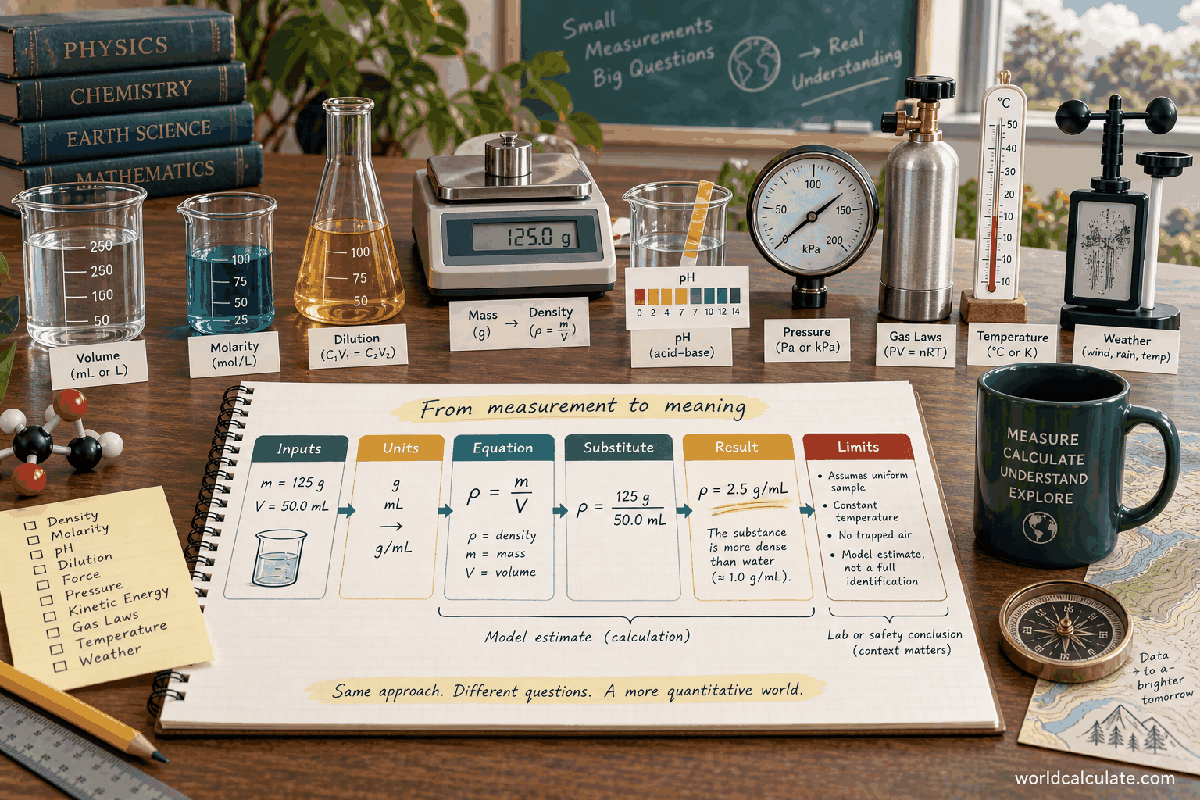
A liquid-equivalent forecast and a snowfall forecast are related, but they are not interchangeable without a snow-to-liquid assumption. This calculator lets visitors test that assumption, convert the result into familiar depth units, and see how simple settling changes the planning number.
Liquid equivalent is the depth of water represented by precipitation after melting frozen precipitation. The calculator starts there and does not treat a rain gauge reading as a guaranteed snowfall amount.
A ratio of 10:1 means ten depth units of fresh snow for one depth unit of liquid equivalent. The same ratio works numerically in millimetres, centimetres, or inches when both depths use the same unit.
25.4 mm is one inch of liquid depth. At 10:1, the fresh result is 254 mm, or 25.4 cm and 10 inches. A 10% settling allowance leaves 228.6 mm in this simple scenario.
Warm, wet snow generally produces a lower ratio, while cold fluffy snow can produce a higher ratio. The visitor should change the input ratio instead of treating 10:1 as a universal law.
The optional settling allowance is a simple reduction in depth after accumulation. It does not model melting, rain-on-snow, wind redistribution, sublimation, or the time history of compaction.
Operational forecasts can use atmospheric profiles, model physics, observations, and event-specific ratios. A single ratio worksheet cannot reproduce that process or provide a location-specific forecast.
Depth does not directly determine roof force because density and water content vary. Do not use this result as a structural design load or as a substitute for a local warning.
The input is millimetres so the global interface has a clear metric base. Outputs also show centimetres and inches; they are display conversions and do not change the scenario.
Do not enter a snowfall depth where liquid equivalent is requested, reverse the ratio, or apply settling before multiplying by the ratio. Keep fresh and settled results separate when sharing the estimate.
This is a transparent educational estimate. Check official forecasts, measured observations, and local safety guidance for travel, flood, avalanche, roof, or winter-weather decisions.
Estimate fresh and settled snow depth from liquid-equivalent precipitation, a chosen snow-to-liquid ratio, and a transparent settling allowance.
Fresh snow depth = liquid-equivalent depth × snow-to-liquid ratio. Settled depth = fresh depth × (1 − settling percentage ÷ 100). Millimetres are converted to centimetres by dividing by 10 and to inches by dividing by 25.4. The page is a scenario calculator, not a local weather forecast. Snow-to-liquid ratios vary with crystal type, temperature profile, wind, compaction, and storm evolution, so the ratio and settling allowance remain explicit inputs.
Enter Liquid-equivalent precipitation, Snow-to-liquid ratio, Settling or compaction allowance, then choose Calculate.
Liquid-equivalent precipitation is water depth before conversion to snow depth. The snow-to-liquid ratio is fresh accumulation divided by liquid equivalent. The ratio is supplied for the event or scenario and is not inferred from one surface temperature. Settling is a simple percentage applied after fresh depth is calculated. Melting, drifting, sublimation, sleet, rain mixing, and ground warmth are not modeled. The result is a depth estimate, not snow load or water-volume storage. Millimetres, centimetres, and inches describe the same depth, not different forecasts. A forecast ratio can change during one storm and across nearby locations. The page does not fetch live weather data or select a jurisdictional ratio. Use local observations and official forecasts for travel, flood, roof, or safety decisions.
This calculator is part of the WorldCalculate library. Its formula, example, assumptions, input bounds, and output formatting follow the official methodology.
These WorldCalculate collections connect this tool with related questions while keeping each calculation separate and transparent.