
Goal
Calculate classical kinetic energy and momentum from projectile mass, speed, and a stated count for an educational physics worksheet.
Worldwide context
Saved once here, used across the site.
Currency changes display only. Country selection guides tax input; no tax rate is guessed.
Calculate classical kinetic energy and momentum from projectile mass, speed, and a stated count for an educational physics worksheet.
Mass in kilograms = grams ÷ 1000; kinetic energy = ½mv²; momentum = mv; total energy = energy per projectile × count.A clearer path to an answer
This page keeps the calculation transparent: define the goal, enter the matching values, inspect the method, and decide what the result means in your situation.
Calculate classical kinetic energy and momentum from projectile mass, speed, and a stated count for an educational physics worksheet.
Projectile mass · Speed · Number of projectiles
Mass in kilograms = grams ÷ 1000; kinetic energy = ½mv²; momentum = mv; total energy = energy per projectile × count.
Calculate, review the assumptions below, then compare a related tool when the decision needs more context.
Calculate classical kinetic energy and momentum from projectile mass, speed, and a stated count for an educational physics worksheet.
Open the Projectile Kinetic Energy Calculator pageMore science tools
Download PDFDownload Word (.doc)
Enter your values above and choose Calculate to see the result here.
Calculation map
Mass in kilograms = grams ÷ 1000; kinetic energy = ½mv²; momentum = mv; total energy = energy per projectile × count.
Bounded, transparent calculation
Your recent runs stay in this browser session only.
Formula: Mass in kilograms = grams ÷ 1000; kinetic energy = ½mv²; momentum = mv; total energy = energy per projectile × count.
This page is a classical mechanics worksheet that turns a supplied mass and speed into translational kinetic energy and momentum. The count field helps compare a series of identical objects, but the result remains an idealized physics quantity and is not a prediction of terminal effects, range, accuracy, or safety.
Worked example: Mass = 0.008 kg, kinetic energy = 640 J, and momentum = 3.2 kg·m/s.
The displayed limits are checked before the handler runs. Model-specific domain checks may also reject impossible or non-finite inputs.
Methodology: This calculator follows the WorldCalculate input, formula, precision, and boundary policy. Read the official methodology.
Calculator usage statistics
This section counts anonymous successful Calculate submissions, not unique visitors. Counts and top tools appear only when trusted aggregate data is available; country analysis is shown only under the same condition and reporting threshold.
Answer-first guide
Calculate classical kinetic energy and momentum from projectile mass, speed, and a stated count for an educational physics worksheet. Start with one clearly defined goal, enter values in the units shown, and keep the result attached to the assumptions below.
This tool is useful when your question includes bullet energy calculator, projectile kinetic energy, muzzle energy formula. It returns the outputs declared in the calculator contract rather than a live quote, approval, diagnosis, or professional sign-off.
Projectile mass · Speed · Number of projectiles. Keep the same time period, unit system, and currency wherever the form requires comparable values.
Run the worked example first, compare its output with the page's example, then change one input at a time. This makes an unexpected result easier to trace to a unit, boundary, or assumption.
Need a wider view? Browse Science Calculators or compare the related tools below. The WorldCalculate methodology explains how formulas, examples, limits, and revisions are reviewed.
Mass in kilograms = grams ÷ 1000; kinetic energy = ½mv²; momentum = mv; total energy = energy per projectile × count.
This page is a classical mechanics worksheet that turns a supplied mass and speed into translational kinetic energy and momentum. The count field helps compare a series of identical objects, but the result remains an idealized physics quantity and is not a prediction of terminal effects, range, accuracy, or safety.
Mass = 0.008 kg, kinetic energy = 640 J, and momentum = 3.2 kg·m/s.
Context and background
Science calculators define a system, choose an equation, apply units and constants, and show the substitution. Effects outside that model remain outside the result.
Introductory science problem solving builds from measured quantities and idealized relationships. Those models are valuable for learning and first-pass estimates, while experiments and engineering decisions need additional evidence.
Research and review
Researched by Hassan ALRowaie, Founder and editorial researcher at WorldCalculate.
This guide follows the live calculator's declared inputs, formula, worked example, assumptions, validation boundaries, and source-backed methodology. The review date describes editorial review of the calculator explanation; it is not a promise that external facts or rates remain current.

Kinetic energy is one of the clearest places to see why units and speed matter. This calculator converts a supplied projectile mass into kilograms, applies one half times mass times speed squared, and reports momentum alongside the energy. The count field supports a simple repeated-object comparison. The page deliberately stops at classical mechanics: it does not infer what an object will do to a target, how far it will travel, or whether a real device or activity is safe.
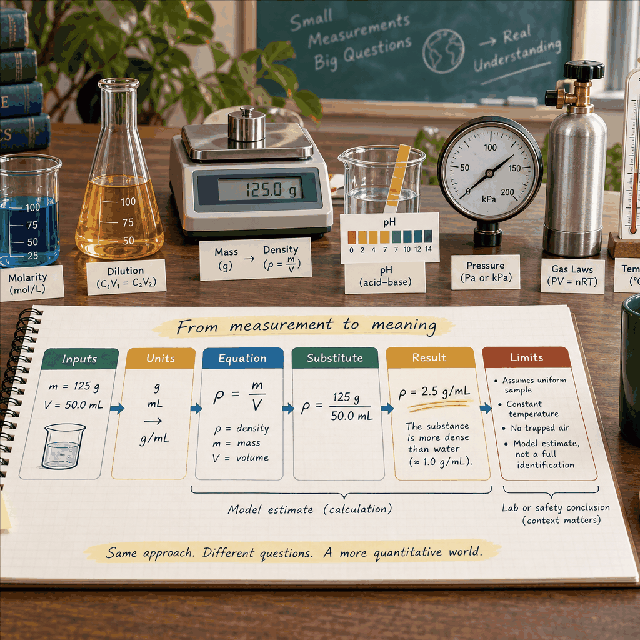
The kinetic-energy result is the translational energy associated with the motion of an object of mass m at speed v. It is measured in joules, where one joule is one kilogram metre squared per second squared. Momentum is a separate quantity, measured in kilogram metres per second, and is included because two objects can have related energy and momentum while responding differently in an interaction.
The output is a model value at the entered speed. If the speed changes during flight, impact, or another process, the value changes with it. The page does not decide which speed should be measured; choose a clearly defined point and preserve the instrument, timing, and uncertainty in the surrounding record.
The mass field is in grams because small projectiles and laboratory objects are often labelled that way. The handler divides grams by 1000 to obtain kilograms. An 8 g object is 0.008 kg. Omitting that conversion would inflate the result by a factor of 1000 and could still produce a number that looks superficially plausible.
Write the unit beside the input and result. If a source reports grains, ounces, pounds, or another local unit, convert to grams using a documented conversion before entering it. Do not mix a mass in grams with a speed in kilometres per hour; convert the speed to metres per second as well.
The formula is E = ½mv². If mass stays constant and speed doubles, the energy becomes four times larger, not twice as large. If speed is reduced to half, the energy becomes one quarter. This squared relationship is why small measurement or interpretation errors in speed can have a larger effect on energy than a similarly sized relative error in mass.
A worked comparison makes the point. An 8 g object at 400 m/s has 640 J. At 200 m/s the same mass has 160 J. The object did not become four times lighter; the change comes from the square of the speed. Always state the speed condition beside a reported energy.
Momentum is p = mv and points in the direction of motion. Kinetic energy is a scalar and uses v², so it is nonnegative. Two objects can have equal momentum with different masses and speeds, while their kinetic energies differ. Reporting both values can help a student distinguish the formulas and units.
For the example of 0.008 kg at 400 m/s, momentum is 3.2 kg·m/s and kinetic energy is 640 J. Neither number alone describes the full outcome of a collision or interaction. Contact time, geometry, material response, rotation, and external forces all matter in a real system.
The count field multiplies the per-projectile energy by the number of identical, independent projectiles. It does not model a coupled system or the energy actually delivered to a target. If ten identical objects each have 640 J in the same idealized state, the arithmetic total is 6,400 J, but the physical distribution of that energy depends on timing, location, interaction, and losses.
Use the count only when the objects really share the same mass and speed definition. If the masses or speeds vary, calculate each group separately and add the group totals. Do not use a count to disguise uncertainty or to make a safety decision without a qualified engineering analysis.
Take mass 8 g and speed 400 m/s. Convert mass: 8 ÷ 1000 = 0.008 kg. Square speed: 400² = 160,000 m²/s². Multiply by mass and one half: 0.5×0.008×160,000 = 640 kg·m²/s², which is 640 J. Momentum is 0.008×400 = 3.2 kg·m/s.
The calculation is easy to reproduce because every step is visible. If a different source reports 8 g and 1,312 ft/s, convert the speed consistently before comparing. Keep the source conditions, measurement method, and significant figures; a long decimal output does not create measurement accuracy that was not present in the inputs.
Speed may be measured at a launch point, a sensor gate, a moving vehicle, or another defined location. Drag and gravity can change it between points. The calculator does not infer a launch speed from a label or a distance. Enter the speed tied to the question and name the reference point in the report.
If speed is estimated rather than directly measured, record the range or uncertainty. Because energy depends on v², an uncertainty interval should be propagated or at least shown as a low and high scenario. Presenting a single precise value from a rough speed estimate can be misleading.
The classical formula is an excellent approximation at ordinary laboratory and sporting speeds when v is much smaller than the speed of light. At extreme speeds, relativistic kinetic energy is required and the classical result underestimates the energy. This page does not switch formulas automatically because a user should know which model is being applied.
For ordinary human-scale and many educational projectile examples, the classical model is the intended one. If the scenario approaches relativistic conditions, use a physics text or specialist tool that defines the reference frame and relativistic mass-energy relationship. Do not extend this calculator beyond its stated model simply because it accepts a large input.
The ideal calculation ignores air resistance, which can reduce speed over distance. It also ignores spin and rotational kinetic energy, which may matter for a rotating body. At impact, an object may deform, fragment, rebound, or transfer only part of its energy to another body. None of those details can be recovered from mass and one speed alone.
This boundary is especially important for any object described as a bullet or projectile. The formula is a mechanics identity, not a terminal-effect model. Do not infer penetration, injury, damage, range, or legal classification from the output. Those questions require controlled testing, domain expertise, and the rules that govern the location and activity.
Comparing two objects using the same formula is useful when the mass, speed definition, and reference point are comparable. It is not valid to compare a measured impact speed for one object with a nominal launch speed for another and call the difference a material effect. Align the measurement conditions before drawing a conclusion.
Use a table with object name, mass source, speed source, energy, momentum, uncertainty, and model note. The calculator can fill the arithmetic columns, while the researcher or engineer supplies the provenance. This separation makes it easier to revise a result when a measurement is corrected.
A number in joules is not a safety limit. Safe handling, storage, transport, testing, and operation of projectiles or launch systems are governed by local law, institutional rules, manufacturer procedures, and trained supervision. This page should be used for classroom mechanics, measurement comparison, or a documented theoretical exercise.
Do not use the page to optimize a weapon, select ammunition, plan a harmful action, or replace a risk assessment. Avoid entering sensitive operational details into a shared or public session. If a real-world experiment is being considered, stop at the calculation and obtain the appropriate qualified review before doing anything physical.
The calculator can display more decimal places than the inputs justify. If mass is known to two significant figures and speed to three, the energy should not be reported as though it were known to ten. Round at the reporting stage, not during intermediate multiplication, and state the unit.
A good report might state 0.0080 kg, 400 m/s, 640 J, and 3.2 kg·m/s with a note about the measurement sources. If the speed is a range, report an energy range. The page's precision setting is a display choice, not a claim about instrument resolution.
A safe classroom activity can use low-energy carts, foam objects, or virtual values rather than a weapon or hazardous projectile. Students can hold mass constant and vary speed, graph energy against v², and verify the linear relationship. They can also hold speed constant and verify that energy changes linearly with mass.
The educational question should be designed before measurements are taken. Define what is measured, choose a safe apparatus, record uncertainty, and compare the result with the ideal formula. A calculator is helpful after the experiment, but it does not make an unsafe experiment appropriate.
Kinetic energy depends on the reference frame. An object may be stationary relative to a moving platform but moving relative to the ground. State the frame used for the speed. Momentum also depends on the frame, while the physical interaction must be analysed consistently in one chosen frame.
If a vehicle, conveyor, or moving target is involved, do not combine speeds informally. Use the appropriate relative-velocity analysis, then enter the speed that belongs to the specific energy question. The simple handler assumes one scalar speed has already been chosen correctly.
If energy is zero, check whether speed was entered as zero or lost during unit conversion. If energy is unexpectedly huge, inspect grams versus kilograms, metres per second versus kilometres per hour, and whether a speed was squared twice. If momentum looks reasonable but energy does not, recheck the factor of one half and the speed unit.
If comparing with a published number, verify whether the publication reports foot-pounds, joules, energy per object, or a total for several objects. The same physical calculation can appear different when units or counting conventions differ. Keep the original source beside the converted value.
Include the mass, speed, count, conversion steps, energy per object, momentum per object, total energy, reference point, reference frame, and uncertainty. Add a sentence that the result is classical translational energy and list the effects excluded by the model. This makes the output auditable and discourages readers from treating it as a complete performance description.
For a regulated or safety-sensitive setting, route the handoff to the responsible professional and use the governing procedures. The calculator's role is to make the elementary arithmetic visible. It should never be the only control around a physical hazard or a decision that could injure someone.
Confirm the mass unit, speed unit, reference point, reference frame, projectile count, and intended formula. Convert grams to kilograms and kilometres per hour to metres per second before applying E = ½mv². Check that the outputs have joules and kilogram metres per second, then round to the quality of the inputs.
Finally, state what the number does not mean. It is a transparent model of translational kinetic energy and momentum. Use it to learn, compare, and document assumptions; do not use it to infer target effects, safety, legality, or operational advice that the inputs cannot support.
The work-energy theorem connects a net work done on an object with a change in kinetic energy. That relationship can help explain why a force applied over a distance changes speed, but this calculator begins with mass and speed and does not infer the force or distance that produced them.
If a student wants to connect the results, keep the signs and reference frame consistent. Work can be positive or negative while kinetic energy itself is nonnegative. Do not add a work calculation to the page by guessing a force path that was never measured.
If mass has uncertainty dm and speed has uncertainty dv, the speed term often dominates the energy uncertainty because energy depends on v squared. A simple sensitivity check can calculate a low-speed and high-speed scenario while holding other inputs fixed. This is more honest than reporting many decimal places from rough measurements.
The calculator accepts one value for each field, so store the uncertainty beside the result. For a formal experiment, propagate uncertainty using the method appropriate to the instrument and distribution. The page is a transparent arithmetic layer, not a metrology report.
Two objects can have the same total kinetic energy but different mass, speed, shape, and interaction area. This page reports total translational energy and momentum only. It does not calculate energy per area, pressure, stress, or a material response.
Shape can affect drag and impact behaviour even when mass and speed are identical. Do not use equal joules as proof that two objects have equal risk or effect. State the model boundary whenever an energy comparison is reused outside a textbook problem.
If an observer or target is moving, the relevant relative speed may differ from the speed measured against the ground. Choose the frame first and use a consistent velocity analysis. The simple handler should receive the speed that belongs to the selected frame, not a casual subtraction that mixes directions.
For one-dimensional classroom examples, write the sign convention and calculate the relative velocity before entering its magnitude. For two- or three-dimensional motion, use vectors and a specialist analysis. A scalar speed field cannot represent a direction change or a rotating frame.
The count field is a linear multiplier: doubling the number of identical objects doubles the arithmetic total. It does not mean that energy accumulates safely in a real container or that simultaneous interactions are independent. Heat, pressure, structural loads, and timing may introduce different constraints.
For a batch with variation, group objects by measured mass and speed and calculate each group. Add the totals only after the groups are defined. Keep the count small enough that the input represents the actual population being compared rather than a rhetorical scale-up.
A useful student table can hold mass in grams, converted mass in kilograms, speed in metres per second, speed squared, energy in joules, momentum, and notes on the reference frame. Recalculate one row by hand and use the tool to check it. This catches unit errors before a graph is made.
Plot energy against speed squared for constant mass and against mass for constant speed. The slopes have physical meaning, while the intercept should be near zero in the ideal model. Any large departure should prompt a measurement or data-definition review rather than a hidden formula change.
A request for projectile energy may arise in education, sports, engineering, or a dangerous context. The formula is general, but the surrounding decision may not be. Keep the page at the level of physics arithmetic and do not add guidance about weapon construction, targeting, penetration, or harm.
For a legitimate engineering or safety project, use approved procedures, qualified personnel, controlled test facilities, and the laws that apply. A calculator result can be included in a review package, but it cannot authorize an experiment or replace a risk assessment.
The interface uses grams, kilograms, and metres per second so the output is directly tied to SI mechanics. A source in grains, ounces, feet per second, or miles per hour must be converted before entry. Keep the conversion factor and rounding in the record, especially when comparing values from different countries or publications.
Do not convert energy by changing only the label. A joule is a derived SI unit; foot-pound force and other units need a documented energy conversion. The page's result is internally consistent only when the input conversions are complete.
Momentum can help introduce impulse, which is the change in momentum caused by a net force over time. This page does not calculate impulse because it has no final velocity or collision time. If a problem asks about stopping force, add the missing measurements and choose a model that states the contact assumptions.
A high kinetic energy does not automatically imply a high average force; stopping distance and time matter. Do not derive a force from energy without a defined work path. The calculator reports the quantity it can support and leaves the rest explicit.
Mass and speed determine the ideal translational energy, but materials determine how an interaction stores, converts, or dissipates that energy. Temperature, deformation, fracture, friction, and fluid drag can all change the observed outcome. The page intentionally does not assign a target material or a transfer efficiency.
If an engineering model needs those effects, use tested material properties and a qualified simulation or experiment. Keep the simple energy result as a boundary-condition or sanity-check quantity, not as a complete prediction.
A published energy value should include the input mass, input speed, unit conversions, reference point, count, formula, rounding, and source of each measurement. If the value is nominal rather than measured, label it nominal. If it is a range, preserve the range and do not collapse it to a confident midpoint.
Readers often copy a joule value without its conditions. A short model note prevents that number from being reused as if it applied at another speed or in another frame. The best page output is easy to quote without losing its assumptions.
A safe example can use a toy cart, foam ball, laboratory simulation, or a published classroom dataset. The same mass-speed formula teaches unit conversion and the squared speed relationship without requiring a hazardous object. State that the example is idealized and keep the activity within approved supervision.
If a source uses the word projectile, the physics calculation still needs only mass and speed, but the surrounding context may need stronger boundaries. Keep demonstrations non-harmful and do not turn an educational result into instructions for a real-world device.
A concise result line can state the converted mass, speed, energy per object, momentum per object, count, and total energy. Follow it with the reference frame and a sentence describing drag, deformation, and other excluded effects. This keeps the useful number together with the reason it should not be overinterpreted.
When a reader asks whether the energy is large or small, ask compared with what defined system and for what purpose. A value has meaning only inside a model and a decision context. The calculator supplies a reproducible comparison, not a universal scale of danger or importance.
Calculate classical kinetic energy and momentum from projectile mass, speed, and a stated count for an educational physics worksheet.
Mass in kilograms = grams ÷ 1000; kinetic energy = ½mv²; momentum = mv; total energy = energy per projectile × count. This page is a classical mechanics worksheet that turns a supplied mass and speed into translational kinetic energy and momentum. The count field helps compare a series of identical objects, but the result remains an idealized physics quantity and is not a prediction of terminal effects, range, accuracy, or safety.
Enter Projectile mass, Speed, Number of projectiles, then choose Calculate.
Mass is converted from grams to kilograms before the formula is applied. Speed is the translational speed at the point being studied and is entered in metres per second. Classical kinetic energy is used; relativistic effects are outside the intended range. Each counted projectile is treated as identical and independent. Air drag, spin, deformation, fragmentation, gravity, and impacts are excluded. The formula does not model a firearm, launcher, ammunition, target, or real-world operating condition. A zero speed has zero kinetic energy and momentum even though the object still has mass. The output is for education, measurement comparison, and documented physics analysis only.
This calculator is part of the WorldCalculate library. Its formula, example, assumptions, input bounds, and output formatting follow the official methodology.
These WorldCalculate collections connect this tool with related questions while keeping each calculation separate and transparent.