
Goal
Calculate w/w, w/v, or v/v solution concentration from a solute amount and the total solution amount using matching basis units.
Worldwide context
Saved once here, used across the site.
Currency changes display only. Country selection guides tax input; no tax rate is guessed.
Calculate w/w, w/v, or v/v solution concentration from a solute amount and the total solution amount using matching basis units.
Percentage = solute amount ÷ total solution amount × 100; choose w/w for mass ÷ mass, w/v for mass ÷ solution volume, or v/v for volume ÷ volume.A clearer path to an answer
This page keeps the calculation transparent: define the goal, enter the matching values, inspect the method, and decide what the result means in your situation.
Calculate w/w, w/v, or v/v solution concentration from a solute amount and the total solution amount using matching basis units.
Concentration basis · Solute amount · Total solution amount
Percentage = solute amount ÷ total solution amount × 100; choose w/w for mass ÷ mass, w/v for mass ÷ solution volume, or v/v for volume ÷ volume.
Calculate, review the assumptions below, then compare a related tool when the decision needs more context.
Calculate w/w, w/v, or v/v solution concentration from a solute amount and the total solution amount using matching basis units.
Open the Percent Solution Concentration Calculator pageMore science tools
Download PDFDownload Word (.doc)
Enter your values above and choose Calculate to see the result here.
Calculation map
Percentage = solute amount ÷ total solution amount × 100; choose w/w for mass ÷ mass, w/v for mass ÷ solution volume, or v/v for volume ÷ volume.
Bounded, transparent calculation
Your recent runs stay in this browser session only.
Formula: Percentage = solute amount ÷ total solution amount × 100; choose w/w for mass ÷ mass, w/v for mass ÷ solution volume, or v/v for volume ÷ volume.
The phrase percent solution hides a convention unless the basis is named. This page lets the visitor choose the basis and keeps the two entered amounts visible, reducing the risk of confusing grams per 100 mL with grams per 100 g.
Worked example: The entered preparation is 5% w/v, meaning 5 mass units of solute per 100 volume units of total solution under the matching-unit convention.
The displayed limits are checked before the handler runs. Model-specific domain checks may also reject impossible or non-finite inputs.
Methodology: This calculator follows the WorldCalculate input, formula, precision, and boundary policy. Read the official methodology.
Calculator usage statistics
This section counts anonymous successful Calculate submissions, not unique visitors. Counts and top tools appear only when trusted aggregate data is available; country analysis is shown only under the same condition and reporting threshold.
Answer-first guide
Calculate w/w, w/v, or v/v solution concentration from a solute amount and the total solution amount using matching basis units. Start with one clearly defined goal, enter values in the units shown, and keep the result attached to the assumptions below.
This tool is useful when your question includes percent solution calculator, w/w concentration, w/v percentage. It returns the outputs declared in the calculator contract rather than a live quote, approval, diagnosis, or professional sign-off.
Concentration basis · Solute amount · Total solution amount. Keep the same time period, unit system, and currency wherever the form requires comparable values.
Run the worked example first, compare its output with the page's example, then change one input at a time. This makes an unexpected result easier to trace to a unit, boundary, or assumption.
Need a wider view? Browse Science Calculators or compare the related tools below. The WorldCalculate methodology explains how formulas, examples, limits, and revisions are reviewed.
Percentage = solute amount ÷ total solution amount × 100; choose w/w for mass ÷ mass, w/v for mass ÷ solution volume, or v/v for volume ÷ volume.
The phrase percent solution hides a convention unless the basis is named. This page lets the visitor choose the basis and keeps the two entered amounts visible, reducing the risk of confusing grams per 100 mL with grams per 100 g.
The entered preparation is 5% w/v, meaning 5 mass units of solute per 100 volume units of total solution under the matching-unit convention.
Context and background
Science calculators define a system, choose an equation, apply units and constants, and show the substitution. Effects outside that model remain outside the result.
Introductory science problem solving builds from measured quantities and idealized relationships. Those models are valuable for learning and first-pass estimates, while experiments and engineering decisions need additional evidence.
Research and review
Researched by Hassan ALRowaie, Founder and editorial researcher at WorldCalculate.
This guide follows the live calculator's declared inputs, formula, worked example, assumptions, validation boundaries, and source-backed methodology. The review date describes editorial review of the calculator explanation; it is not a promise that external facts or rates remain current.
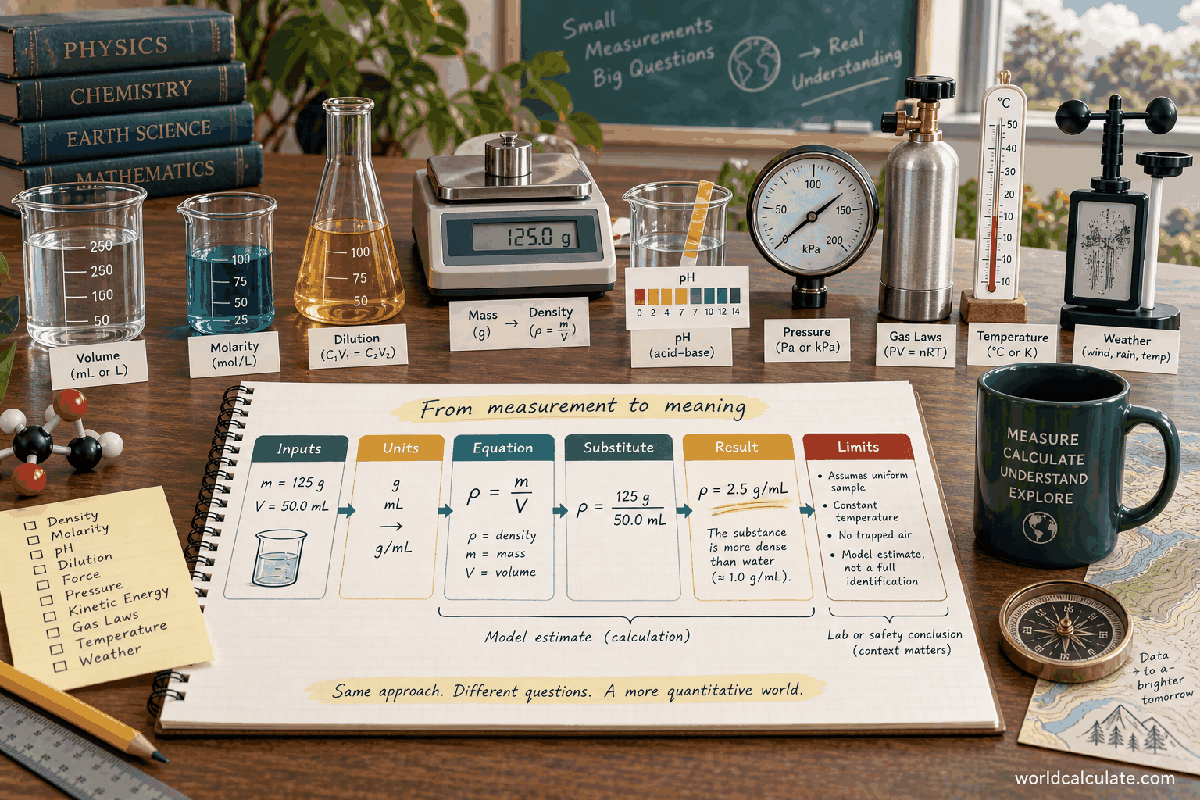
A percentage is incomplete until its numerator and denominator are named. This calculator separates w/w, w/v, and v/v conventions so a visitor can calculate a concentration without silently treating mass and volume as interchangeable.
A percent solution describes how much solute is present relative to the total solution on a stated basis. The same number, such as 5%, can describe different physical quantities under w/w, w/v, and v/v notation.
The page therefore asks for the basis before doing the division. That choice is part of the answer, not a cosmetic label.
The arithmetic is solute amount divided by total solution amount, multiplied by 100. For w/w, both amounts are masses; for w/v, the numerator is mass and the denominator is solution volume; for v/v, both are volumes.
Use matching measurement units within the selected convention. Converting grams to millilitres without a density is not a valid unit conversion.
If 5 g of solute is present in 100 mL of total solution, the result is 5% w/v. The denominator is the final solution volume, not automatically the volume of solvent added.
This distinction matters when dissolving a solid and then bringing the preparation to a final volume. The calculator reports the ratio; it does not infer how much solvent to add.
For 5 g solute in 100 g total solution, the result is 5% w/w. For 5 mL solute in 100 mL total solution, it is 5% v/v.
The arithmetic is identical while the physical interpretation changes. Write the basis beside the result in a lab note, recipe, product specification, or classroom answer.
The denominator is the amount of the completed solution under the chosen convention. It is not always the amount of solvent before mixing and it is not always the sum of raw volumes.
Density and volume contraction can matter in real preparations. Those effects are outside this transparent ratio tool and require a material-specific procedure or reference.
One common mistake is entering grams in the solution field while selecting v/v. Another is reading 5% w/v as 5 g per 100 g. Check the basis and units before trusting the result.
A second mistake is calling the amount difference solvent volume. The page shows that difference for arithmetic visibility but labels it as basis units because it is not a universal solvent-volume calculation.
The result does not approve a chemical, food, medical, or cleaning preparation. Concentration, purity, temperature, order of addition, compatibility, labeling, and protective equipment can all matter.
Use the formula to check a stated protocol or understand a definition, then follow the applicable professional or product instructions for the actual preparation.
Is 5% always 5 grams per 100 mL? No; that is the w/v convention. Can I use ounces? Yes if both values are compatible in the chosen basis, but record whether they are mass or volume ounces. Does the tool calculate molarity? No; molarity needs moles per litre and is a different concentration unit.
Calculate w/w, w/v, or v/v solution concentration from a solute amount and the total solution amount using matching basis units.
Percentage = solute amount ÷ total solution amount × 100; choose w/w for mass ÷ mass, w/v for mass ÷ solution volume, or v/v for volume ÷ volume. The phrase percent solution hides a convention unless the basis is named. This page lets the visitor choose the basis and keeps the two entered amounts visible, reducing the risk of confusing grams per 100 mL with grams per 100 g.
Enter Concentration basis, Solute amount, Total solution amount, then choose Calculate.
The solute and total solution values use compatible units for the selected basis. w/w uses mass over mass, w/v uses solute mass over total solution volume, and v/v uses solute volume over total solution volume. The solute amount cannot exceed the total solution amount in the entered basis units. Volume contraction, density, temperature, purity, and preparation order are not modeled. The result is a concentration arithmetic value, not a mixing instruction or safety approval. A label or protocol may define a concentration convention differently; reproduce that definition before entering values. The displayed amount difference is only a same-basis subtraction and should not be interpreted as solvent volume for w/v or v/v.
This calculator is part of the WorldCalculate library. Its formula, example, assumptions, input bounds, and output formatting follow the official methodology.
These WorldCalculate collections connect this tool with related questions while keeping each calculation separate and transparent.