
Goal
Parse a chemical formula with element counts and brackets to estimate molar mass, relative molecular mass, and total atoms per formula unit.
Worldwide context
Saved once here, used across the site.
Currency changes display only. Country selection guides tax input; no tax rate is guessed.
Parse a chemical formula with element counts and brackets to estimate molar mass, relative molecular mass, and total atoms per formula unit.
Molar mass = Σ(element count × average atomic mass); the relative molecular mass has the same numerical value when expressed in unified atomic mass units.A clearer path to an answer
This page keeps the calculation transparent: define the goal, enter the matching values, inspect the method, and decide what the result means in your situation.
Parse a chemical formula with element counts and brackets to estimate molar mass, relative molecular mass, and total atoms per formula unit.
Chemical formula
Molar mass = Σ(element count × average atomic mass); the relative molecular mass has the same numerical value when expressed in unified atomic mass units.
Calculate, review the assumptions below, then compare a related tool when the decision needs more context.
Parse a chemical formula with element counts and brackets to estimate molar mass, relative molecular mass, and total atoms per formula unit.
Open the Molecular Weight from Chemical Formula Calculator pageMore science tools
Download PDFDownload Word (.doc)
Enter your values above and choose Calculate to see the result here.
Calculation map
Molar mass = Σ(element count × average atomic mass); the relative molecular mass has the same numerical value when expressed in unified atomic mass units.
Bounded, transparent calculation
Your recent runs stay in this browser session only.
Formula: Molar mass = Σ(element count × average atomic mass); the relative molecular mass has the same numerical value when expressed in unified atomic mass units.
The parser expands element symbols, integer subscripts, and nested bracket groups before summing average atomic masses. It makes the composition visible so a visitor can check whether the formula was entered as intended.
Worked example: The parser counts Ca1, O2, and H2, giving a molar mass of about 74.092 g/mol and six atoms per formula unit.
The displayed limits are checked before the handler runs. Model-specific domain checks may also reject impossible or non-finite inputs.
Methodology: This calculator follows the WorldCalculate input, formula, precision, and boundary policy. Read the official methodology.
Calculator usage statistics
This section counts anonymous successful Calculate submissions, not unique visitors. Counts and top tools appear only when trusted aggregate data is available; country analysis is shown only under the same condition and reporting threshold.
Answer-first guide
Parse a chemical formula with element counts and brackets to estimate molar mass, relative molecular mass, and total atoms per formula unit. Start with one clearly defined goal, enter values in the units shown, and keep the result attached to the assumptions below.
This tool is useful when your question includes molecular weight calculator, molar mass from formula, chemical formula mass. It returns the outputs declared in the calculator contract rather than a live quote, approval, diagnosis, or professional sign-off.
Chemical formula. Keep the same time period, unit system, and currency wherever the form requires comparable values.
Run the worked example first, compare its output with the page's example, then change one input at a time. This makes an unexpected result easier to trace to a unit, boundary, or assumption.
Need a wider view? Browse Science Calculators or compare the related tools below. The WorldCalculate methodology explains how formulas, examples, limits, and revisions are reviewed.
Molar mass = Σ(element count × average atomic mass); the relative molecular mass has the same numerical value when expressed in unified atomic mass units.
The parser expands element symbols, integer subscripts, and nested bracket groups before summing average atomic masses. It makes the composition visible so a visitor can check whether the formula was entered as intended.
The parser counts Ca1, O2, and H2, giving a molar mass of about 74.092 g/mol and six atoms per formula unit.
Context and background
Science calculators define a system, choose an equation, apply units and constants, and show the substitution. Effects outside that model remain outside the result.
Introductory science problem solving builds from measured quantities and idealized relationships. Those models are valuable for learning and first-pass estimates, while experiments and engineering decisions need additional evidence.
Research and review
Researched by Hassan ALRowaie, Founder and editorial researcher at WorldCalculate.
This guide follows the live calculator's declared inputs, formula, worked example, assumptions, validation boundaries, and source-backed methodology. The review date describes editorial review of the calculator explanation; it is not a promise that external facts or rates remain current.
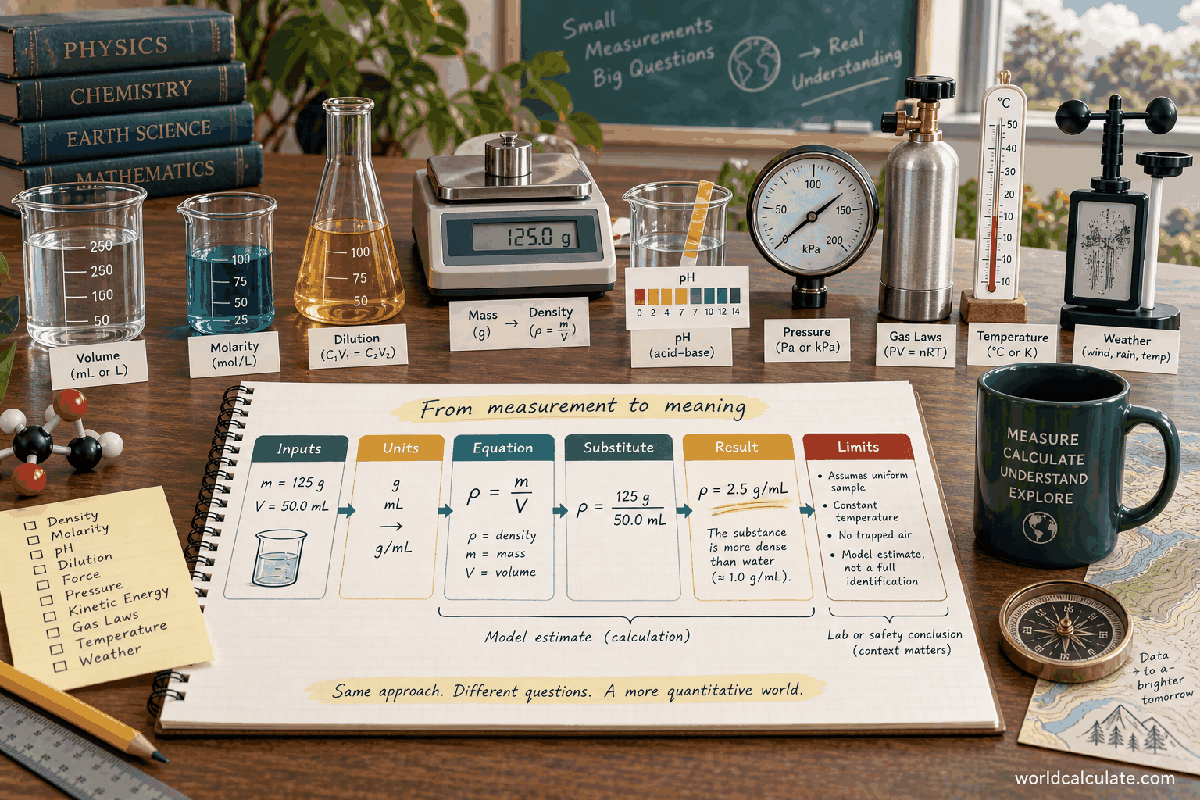
A molecular formula is a compact description of composition. This calculator expands that description into element counts and then applies average atomic masses, making the intermediate structure visible instead of returning an unexplained number.
The page reads element symbols such as Ca and O, applies integer subscripts, and expands groups such as (OH)2. It then sums the mass contribution of each element.
The element-count line is part of the result because a mass value is easier to audit when the parsed composition is visible.
The numerical relative molecular mass is expressed in unified atomic mass units, while the molar mass uses grams per mole. Their numerical values match under the conventional average-atomic-mass presentation.
Do not confuse either result with the mass of one laboratory portion. A portion's mass depends on how much material is present.
A subscript applies to the symbol or group immediately before it. In Ca(OH)2, the two multiplies both O and H, so the formula contains one calcium, two oxygen atoms, and two hydrogen atoms.
Nested groups are parsed from the inside out. Check the element-count summary when studying a complex formula or when preparing a downstream stoichiometry calculation.
For Ca(OH)2, the contributions are one Ca, two O, and two H. Using average atomic masses produces about 74.092 g/mol.
The total atom count is six per formula unit. That count is separate from the molar mass and can be used to reason about atom-level quantities.
The calculator uses average atomic masses suitable for ordinary composition calculations. A mass-spectrum problem may instead require exact isotopic or monoisotopic masses.
If an assignment specifies an isotope, do not treat this default result as interchangeable. Use a tool and atomic-mass table that explicitly match the requested convention.
The parser rejects unknown symbols, unmatched brackets, empty groups, invalid punctuation, and unreasonable counts. Returning an error is safer than silently interpreting a typo.
Dot-separated hydrates, charge notation, and fractional occupancy need conventions beyond this compact parser. Write those cases using a validated chemical reference or expand the components separately.
The molar mass can become the denominator in n = m/M for a grams-to-moles problem. The element counts can also support a separate atoms-per-formula-unit calculation.
Keep the formula, mass convention, and source together. A downstream result inherits any error in the original formula, even if the arithmetic is flawless.
Does molecular weight mean the weight of a molecule on a scale? No; it is a relative or molar mass convention. Can I enter NaCl? Yes, ordinary element symbols and integer counts are supported. Can I enter a charge? Not in this compact worksheet; remove it only if the intended calculation is for the neutral composition, otherwise use a charge-aware reference.
Parse a chemical formula with element counts and brackets to estimate molar mass, relative molecular mass, and total atoms per formula unit.
Molar mass = Σ(element count × average atomic mass); the relative molecular mass has the same numerical value when expressed in unified atomic mass units. The parser expands element symbols, integer subscripts, and nested bracket groups before summing average atomic masses. It makes the composition visible so a visitor can check whether the formula was entered as intended.
Enter Chemical formula, then choose Calculate.
Element symbols use a capital letter followed by an optional lowercase letter. Integer subscripts and nested round or square brackets describe the composition of one formula unit. Average atomic masses are used rather than a selected isotope or a monoisotopic mass. Charges, isotope labels, dot-separated hydrates, fractional occupancy, and non-stoichiometric solids are outside this parser. The supported element table is broad but finite; unsupported symbols are rejected instead of assigned a guessed mass. A formula weight does not by itself identify the physical sample, purity, phase, or hydration state. Use a validated chemical database or laboratory method when an exact material specification is required.
This calculator is part of the WorldCalculate library. Its formula, example, assumptions, input bounds, and output formatting follow the official methodology.
These WorldCalculate collections connect this tool with related questions while keeping each calculation separate and transparent.