
Goal
Calculate the energy required for a phase change from mass and specific latent heat.
Worldwide context
Saved once here, used across the site.
Currency changes display only. Country selection guides tax input; no tax rate is guessed.
Calculate the energy required for a phase change from mass and specific latent heat.
Phase-change energy Q = m L, where m is mass and L is specific latent heat. This is phase-change energy arithmetic only.A clearer path to an answer
This page keeps the calculation transparent: define the goal, enter the matching values, inspect the method, and decide what the result means in your situation.
Calculate the energy required for a phase change from mass and specific latent heat.
Mass · Specific latent heat
Phase-change energy Q = m L, where m is mass and L is specific latent heat. This is phase-change energy arithmetic only.
Calculate, review the assumptions below, then compare a related tool when the decision needs more context.
Calculate the energy required for a phase change from mass and specific latent heat.
Open the Latent Heat pageMore science tools
Download PDFDownload Word (.doc)
Enter your values above and choose Calculate to see the result here.
Calculation map
Phase-change energy Q = m L, where m is mass and L is specific latent heat. This is phase-change energy arithmetic only.
Bounded, transparent calculation
Your recent runs stay in this browser session only.
Formula: Phase-change energy Q = m L, where m is mass and L is specific latent heat. This is phase-change energy arithmetic only.
This calculator multiplies an entered mass by an entered specific latent heat and returns joules and kilojoules. It describes phase-change energy arithmetic only and does not estimate heating time, heat loss, or appliance performance.
Worked example: Phase-change energy is 500,000 J, or 500 kJ.
The displayed limits are checked before the handler runs. Model-specific domain checks may also reject impossible or non-finite inputs.
Methodology: This calculator follows the WorldCalculate input, formula, precision, and boundary policy. Read the official methodology.
Calculator usage statistics
This section counts anonymous successful Calculate submissions, not unique visitors. Counts and top tools appear only when trusted aggregate data is available; country analysis is shown only under the same condition and reporting threshold.
Answer-first guide
Calculate the energy required for a phase change from mass and specific latent heat. Start with one clearly defined goal, enter values in the units shown, and keep the result attached to the assumptions below.
This tool is useful when your question includes latent heat, phase change energy, specific latent heat. It returns the outputs declared in the calculator contract rather than a live quote, approval, diagnosis, or professional sign-off.
Mass · Specific latent heat. Keep the same time period, unit system, and currency wherever the form requires comparable values.
Run the worked example first, compare its output with the page's example, then change one input at a time. This makes an unexpected result easier to trace to a unit, boundary, or assumption.
Need a wider view? Browse Science Calculators or compare the related tools below. The WorldCalculate methodology explains how formulas, examples, limits, and revisions are reviewed.
Phase-change energy Q = m L, where m is mass and L is specific latent heat. This is phase-change energy arithmetic only.
This calculator multiplies an entered mass by an entered specific latent heat and returns joules and kilojoules. It describes phase-change energy arithmetic only and does not estimate heating time, heat loss, or appliance performance.
Phase-change energy is 500,000 J, or 500 kJ.
Context and background
Science calculators define a system, choose an equation, apply units and constants, and show the substitution. Effects outside that model remain outside the result.
Introductory science problem solving builds from measured quantities and idealized relationships. Those models are valuable for learning and first-pass estimates, while experiments and engineering decisions need additional evidence.
Research and review
Researched by Hassan ALRowaie, Founder and editorial researcher at WorldCalculate.
This guide follows the live calculator's declared inputs, formula, worked example, assumptions, validation boundaries, and source-backed methodology. The review date describes editorial review of the calculator explanation; it is not a promise that external facts or rates remain current.
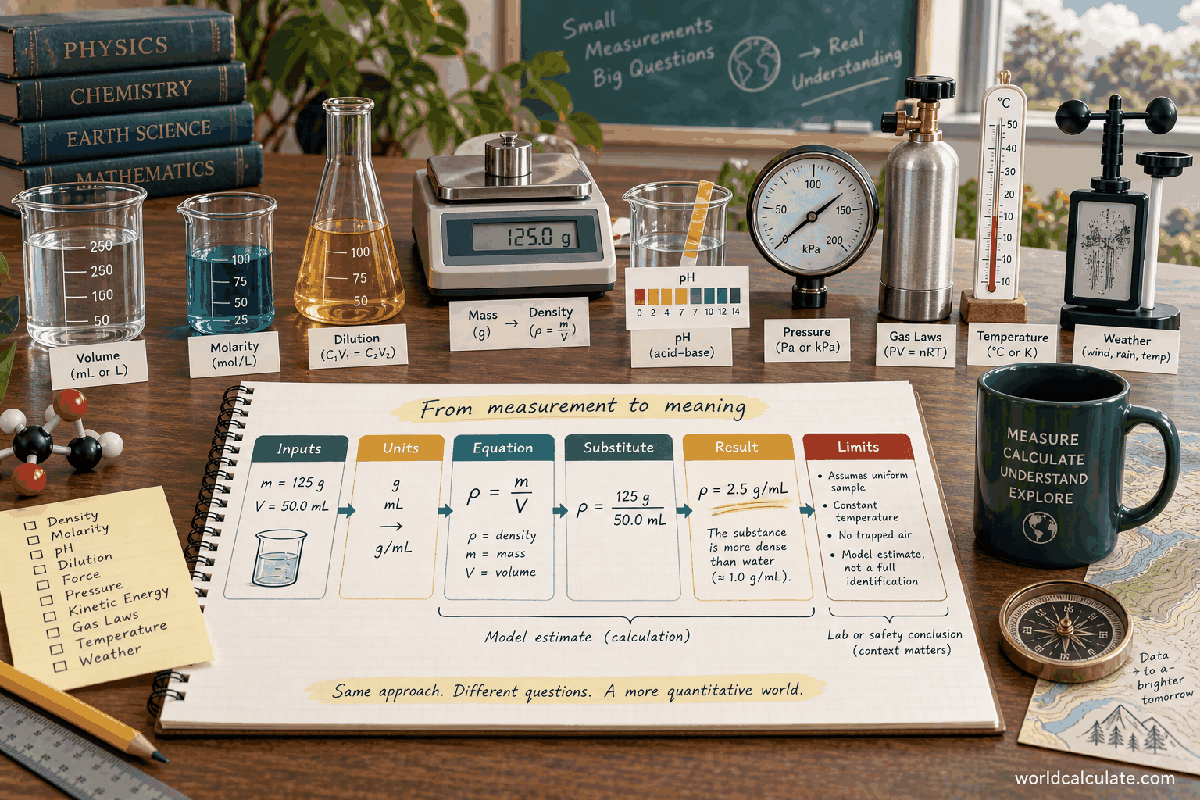
Latent heat is the energy associated with changing the phase of a substance without representing that energy as a temperature change during the ideal transition. This calculator uses Q = m L, where mass is entered in kilograms and specific latent heat in joules per kilogram. It reports the product in joules and kilojoules. The relation is intentionally limited to phase-change energy arithmetic with one entered material value. It does not calculate how long heating takes, how much heat is lost, what appliance is needed, or whether a real process is safe. The sections below explain phase change, specific latent heat, units, the formula, examples, sensible heat, boundaries, validation, and the difference between an energy calculation and equipment advice.
The page answers a direct arithmetic question: how much ideal energy corresponds to a stated mass and a stated specific latent heat for one phase transition? The handler treats both entries as finite nonnegative quantities, multiplies them, and returns two unit scales. It does not identify the substance, choose a transition, measure the sample, or verify that the supplied material value matches the process.
The result is an energy amount, not a heating rate. A process may require additional energy to raise temperature before the phase change, and some supplied energy may leave through the environment. Those effects are not hidden in Q = m L. The page is useful when the phase-change premise and material constant are already defined, and it stops before time, equipment, and safety questions.
A phase change is a change in physical state, such as solid to liquid or liquid to gas. In a simple textbook treatment, energy supplied during the transition changes the arrangement and separation of particles while temperature is treated as constant at the transition condition. The exact transition and conditions determine which specific latent heat belongs in the calculation. The handler accepts the value rather than inferring it.
The same multiplication can describe energy released during a reverse transition if the entered latent-heat value is interpreted for that process, but the output is a magnitude. The calculator does not label melting, freezing, boiling, or condensation and does not decide the direction of heat flow. That process context should accompany the input record.
Specific latent heat L is the energy per unit mass associated with a specified phase transition. Its SI unit is joules per kilogram. A value of 250,000 J/kg means that the idealized transition energy is 250,000 joules for each kilogram under the stated material and transition conditions. The field is not a universal substance constant independent of pressure, composition, or phase boundary, even though the calculator treats the entered value as fixed.
The page does not provide a material table or a substance selector. A user must supply a reviewed L value in the requested unit and preserve its source and conditions outside the form. Entering a value in a different unit without conversion would scale the answer incorrectly. The handler checks the numeric range but cannot check the identity or purity of the material.
Mass m appears as a direct factor. Doubling mass doubles the ideal phase-change energy when specific latent heat stays fixed. A zero mass is allowed and returns zero energy, which is a useful mathematical boundary. The upper bound is 1,000,000,000 kg, chosen for a finite browser contract rather than as a statement about a practical batch or process.
Mass should represent the portion that actually undergoes the stated transition. If only part of a sample changes phase, the entered mass should describe that portion for this simple model. The handler does not track untransformed material, mixtures, losses, or a changing composition. Those details belong to a more detailed energy balance.
The formula is Q = m L. Kilograms multiplied by joules per kilogram cancel the kilogram unit and leave joules. The kilojoule result divides that energy by 1,000. This direct unit path is the central check: if the entered latent heat is in calories per gram or another unit, it must be converted before entry rather than silently treated as J/kg.
The idealized textbook boundary is near the formula itself. Q = m L represents only the phase-change term with one constant L. It does not add sensible heating, cooling, container energy, heat loss, phase-transition range, pressure work, or reaction energy. Those terms may be relevant but require separate definitions.
For m = 2 kg and L = 250,000 J/kg, multiply 2 by 250,000 to obtain Q = 500,000 J. Dividing by 1,000 gives 500 kJ. The mass unit cancels the denominator in J/kg, leaving energy. This example is a simple calibration of the direct product and the output conversion.
The example does not identify a real substance or tell a user how to heat two kilograms. It does not include the energy needed to reach the transition temperature, energy lost through a container, or the power and time of a heater. It is an ideal phase-change arithmetic example and should be reported as such.
Heating a material to a transition temperature generally involves sensible heat, often represented by mass, a specific heat capacity, and a temperature change. Latent heat is the separate energy associated with the phase transition itself. The current page has no initial temperature, final temperature, or specific heat field, so it cannot calculate the total energy for a multi-stage process.
Adding a sensible-heat estimate after the fact would be a new calculation with new assumptions. It should not be described as if Q = m L already included it. The narrow output is still useful as one term in a larger heat balance when the phases and conditions are explicitly documented.
Both mass and specific latent heat accept zero. If either is zero, the product is zero. This is mathematically valid in the contract, although a zero latent heat may represent a limiting or deliberately simplified case rather than an ordinary phase transition. The handler returns a finite numeric result without adding a special correction.
The upper bounds are 1e9 kg and 1e9 J/kg. Their product is 1e18 J, which remains finite in JavaScript arithmetic. An accepted endpoint does not approve a material value or a process scale. It only states that the selected numeric model can evaluate the entered product.
The primary result is in joules, the SI unit of energy. The secondary result is in kilojoules, with one kilojoule equal to 1,000 joules. Reporting both scales makes large values easier to read while preserving the direct SI result. The steps show the conversion so a copied value is not separated from its unit.
Neither output is a power. Power would describe the rate at which the energy is delivered and would require time. A 500 kJ phase-change amount could be delivered quickly or slowly in different hypothetical processes, and the current two-field page does not distinguish them.
Specific latent heat can depend on the substance, the particular transition, and the conditions under which that transition occurs. Mixtures can behave differently from pure materials, and pressure can change a transition temperature and associated data. The page does not ask for pressure, composition, purity, or a transition label. It therefore cannot determine whether a supplied L is appropriate for a real process.
This is a reason to preserve metadata around the input, not a reason to invent a correction inside the formula. The handler uses the entered constant exactly. If a detailed process needs a varying latent heat or phase diagram, it requires a separate model and source-backed data.
The pure handler requires finite JavaScript numbers between zero and the declared maxima for both fields. Numeric strings, missing values, NaN, infinities, negative mass, negative latent heat, and values beyond range are rejected. This validation applies even when a caller does not use the browser form and keeps the multiplication contract explicit.
The product, joule result, kilojoule conversion, and result entries pass through finite checks. The engine does not substitute a material constant, clip an oversized batch, or evaluate expressions. Explicit rejection protects the meaning of a phase-change scenario and avoids presenting a hidden unit or range correction as a physical answer.
Heating time would require a power input and an account of how much of that power reaches the material. The latent-energy result alone contains no heater power, efficiency, thermal resistance, ambient condition, container mass, or heat-loss path. Dividing Q by a guessed wattage could produce a time, but that would be an additional model not represented by this page.
A real process may also heat nonuniformly or pass through more than one phase. The calculator does not simulate temperature or spatial gradients. Its output can be retained as a phase-change term in a separately reviewed energy balance, but it should not be labeled as a heating-time estimate or appliance requirement.
The result does not select a heater, vessel, insulation, refrigeration system, boiler, freezer, or other appliance. It does not determine an electrical rating, pressure condition, containment need, material compatibility, or operating procedure. Those decisions depend on process details and applicable review that cannot be reduced to mass times latent heat.
The requested scope is phase-change energy arithmetic only. Even a finite and physically plausible number carries no equipment or heat-safety approval. If a user is planning a real thermal process, this output may be one documented energy term, while equipment and safety questions must be handled separately.
A clear record identifies the mass that changes phase, names the transition and material outside the form, records the specific latent heat and its conditions, and shows Q = m L. Preserve the joule and kilojoule values with their labels. If the value will be used in a larger process, note which sensible-heat and loss terms remain separate.
End with the boundary statement: this is phase-change energy arithmetic only and does not calculate heating time or provide appliance advice. The statement makes the handoff honest and prevents a unit conversion from being mistaken for a process model.
The calculator is suited to thermal-physics and chemistry exercises, unit checks, and comparisons of phase-change energy for different masses or entered material constants. It can demonstrate the difference between an energy-per-mass property and the total energy for a batch. The paired J and kJ outputs make scale conversion easy to verify.
It should not be used as a heating schedule, appliance specification, or process-safety decision. When the question changes from how much ideal transition energy is represented to how fast or how safely a real system should operate, additional data and qualified review are required.
Check that m is the mass undergoing the chosen transition in kilograms and L is the corresponding specific latent heat in J/kg. Confirm that Q is a product, that joules are divided by 1,000 for kilojoules, and that no sensible-heat term has been hidden in the input. These checks verify the requested phase-change relation while leaving material suitability to the surrounding record.
Then ask whether the desired conclusion remains an energy amount. If it does, the output is transparent. If it asks for heating time, power, equipment, or heat safety, stop at the model boundary. Q = m L has been evaluated, and no appliance or process advice has been produced.
A complete ideal heating sequence can have several stages: warming a solid, reaching a transition, changing phase, warming the new phase, and perhaps changing phase again. Each sensible stage can use a heat capacity and a temperature interval, while each latent stage uses mass times a transition-specific latent heat. The current calculator supplies only one of those latent terms. It does not decide which stages apply or add them automatically.
This separation helps prevent double counting and omission. If a user enters a mass and latent heat that already include a process total, multiplying by another mass would change the meaning. Conversely, adding sensible heat inside the latent-heat field would make the input no longer a specific latent heat. The handler trusts the declared units and does not inspect the source of the value.
A report can place the returned Q beside other terms while preserving its name. State whether the phase transition is one-way, partial, or complete in the surrounding process. The calculator itself returns a magnitude and does not calculate a schedule or temperature path.
A specific latent heat belongs to a defined substance and phase boundary. Pure substances can have tabulated values under stated pressure, while mixtures may change phase over a range rather than at one sharp condition. Dissolved material, composition drift, and pressure can alter the appropriate value. The calculator cannot identify any of these conditions from a number in J/kg.
The mass field should match the material represented by L. If the sample contains multiple components with separate transitions, one product may be inadequate. A more detailed calculation can partition mass and apply different values, but that is a separate process with its own assumptions. The current page intentionally avoids a hidden material database.
The formula remains useful as a transparent ideal term when its source conditions are retained. Do not interpret the field bounds as a material library or use a convenient constant without documenting what transition it represents.
Comparing two phase-change energy values is straightforward only when the mass definition, transition, units, and material conditions match. Doubling the same material mass doubles Q, but changing the phase transition changes L as well. A larger result can therefore reflect quantity, property, or both. The calculator provides the product but does not judge which factor explains a comparison.
The displayed decimal precision is not a measurement guarantee. A latent-heat value may be rounded in a source, and the mass may have its own uncertainty. The handler returns a finite JavaScript number and does not propagate intervals or choose significant figures. Keep source precision and process context with the output.
For a larger thermal model, label this output as ideal phase-change energy and identify excluded sensible heat, loss, power, and time terms. The page does not select equipment or provide heat-safety advice, even when the result is large or small.
The simple latent-heat expression assumes the material is at the relevant phase-transition condition while the transition term is applied. In a classroom problem, that condition is often supplied separately and the latent step can be isolated cleanly. The calculator does not calculate the transition temperature or determine whether the sample has reached equilibrium. It accepts mass and L as the complete premises for the selected step.
During a real transition, portions of a sample can be in different phases and temperature can vary through the material. A single mass times a single property is then an ideal average or a simplified accounting term. The handler does not resolve spatial gradients, nucleation, interface motion, or a transition range.
Making the phase condition explicit in a report prevents a reader from treating the output as a complete process simulation. The formula is simple because the state definition is supplied outside it.
If only a fraction of a batch changes phase, the appropriate mass for this relation is the portion undergoing that transition. A user can calculate separate products for separate portions, but the current page does not ask for fractions or assemble a batch balance. The result should be named according to the mass actually represented.
For a mixture, one component may melt while another remains solid, or different components may transition at different conditions. Applying one average latent heat can hide that structure. The calculator deliberately has no composition or phase-fraction fields, so it cannot judge whether an average is appropriate.
These cases do not make Q = m L unusable; they mark the point where a larger model must own the partitioning assumptions. Preserve the simple output as a named term rather than an unexplained total.
The joule result can be placed in a process record with the material, transition, mass, latent heat, and conditions. If a duration or power is later introduced, state it as a new step. Dividing energy by power is not part of this page and can be misleading if power changes or heat is lost.
A good record also distinguishes energy required by an ideal sample from energy supplied by equipment. The latter may be larger because of efficiency and losses. The current output does not estimate that difference, and it does not identify how a heater or cooler should operate.
The narrow conclusion remains Q = m L for the entered phase-change term. No heating-time estimate, appliance choice, or heat-safety advice is implied by the conversion to kJ.
Calculate the energy required for a phase change from mass and specific latent heat.
Phase-change energy Q = m L, where m is mass and L is specific latent heat. This is phase-change energy arithmetic only. This calculator multiplies an entered mass by an entered specific latent heat and returns joules and kilojoules. It describes phase-change energy arithmetic only and does not estimate heating time, heat loss, or appliance performance.
Enter Mass, Specific latent heat, then choose Calculate.
Mass is a finite nonnegative quantity in kilograms and specific latent heat is a finite nonnegative value in J/kg for the chosen substance and phase transition. The phase change is represented by one constant specific latent heat and sensible heating before or after the transition is not included. This is phase-change energy arithmetic only. Heating time, power, heat transfer, equipment selection, and appliance advice are outside scope.
This calculator is part of the WorldCalculate library. Its formula, example, assumptions, input bounds, and output formatting follow the official methodology.
These WorldCalculate collections connect this tool with related questions while keeping each calculation separate and transparent.