
Goal
Calculate a medium's refractive index and light-speed fraction from its supplied light speed.
Worldwide context
Saved once here, used across the site.
Currency changes display only. Country selection guides tax input; no tax rate is guessed.
Calculate a medium's refractive index and light-speed fraction from its supplied light speed.
Refractive index n = c/v, where c = 299792458 m/s is the exact speed of light in vacuum and v is the supplied medium speed.A clearer path to an answer
This page keeps the calculation transparent: define the goal, enter the matching values, inspect the method, and decide what the result means in your situation.
Calculate a medium's refractive index and light-speed fraction from its supplied light speed.
Light speed in the medium
Refractive index n = c/v, where c = 299792458 m/s is the exact speed of light in vacuum and v is the supplied medium speed.
Calculate, review the assumptions below, then compare a related tool when the decision needs more context.
Calculate a medium's refractive index and light-speed fraction from its supplied light speed.
Open the Index of Refraction from Light Speed pageMore science tools
Download PDFDownload Word (.doc)
Enter your values above and choose Calculate to see the result here.
Calculation map
Refractive index n = c/v, where c = 299792458 m/s is the exact speed of light in vacuum and v is the supplied medium speed.
Bounded, transparent calculation
Your recent runs stay in this browser session only.
Formula: Refractive index n = c/v, where c = 299792458 m/s is the exact speed of light in vacuum and v is the supplied medium speed.
This calculator evaluates the basic index-of-refraction relation from a supplied light speed. It returns n and the speed as a fraction of c while leaving wavelength dependence, absorption, material selection, and optical design outside the model.
Worked example: A light speed of 156000000 m/s corresponds to n = 1.921746526 and a speed fraction of about 0.52035c.
The displayed limits are checked before the handler runs. Model-specific domain checks may also reject impossible or non-finite inputs.
Methodology: This calculator follows the WorldCalculate input, formula, precision, and boundary policy. Read the official methodology.
Calculator usage statistics
This section counts anonymous successful Calculate submissions, not unique visitors. Counts and top tools appear only when trusted aggregate data is available; country analysis is shown only under the same condition and reporting threshold.
Answer-first guide
Calculate a medium's refractive index and light-speed fraction from its supplied light speed. Start with one clearly defined goal, enter values in the units shown, and keep the result attached to the assumptions below.
This tool is useful when your question includes index of refraction, refractive index, light speed in medium. It returns the outputs declared in the calculator contract rather than a live quote, approval, diagnosis, or professional sign-off.
Light speed in the medium. Keep the same time period, unit system, and currency wherever the form requires comparable values.
Run the worked example first, compare its output with the page's example, then change one input at a time. This makes an unexpected result easier to trace to a unit, boundary, or assumption.
Need a wider view? Browse Science Calculators or compare the related tools below. The WorldCalculate methodology explains how formulas, examples, limits, and revisions are reviewed.
Refractive index n = c/v, where c = 299792458 m/s is the exact speed of light in vacuum and v is the supplied medium speed.
This calculator evaluates the basic index-of-refraction relation from a supplied light speed. It returns n and the speed as a fraction of c while leaving wavelength dependence, absorption, material selection, and optical design outside the model.
A light speed of 156000000 m/s corresponds to n = 1.921746526 and a speed fraction of about 0.52035c.
Context and background
Science calculators define a system, choose an equation, apply units and constants, and show the substitution. Effects outside that model remain outside the result.
Introductory science problem solving builds from measured quantities and idealized relationships. Those models are valuable for learning and first-pass estimates, while experiments and engineering decisions need additional evidence.
Research and review
Researched by Hassan ALRowaie, Founder and editorial researcher at WorldCalculate.
This guide follows the live calculator's declared inputs, formula, worked example, assumptions, validation boundaries, and source-backed methodology. The review date describes editorial review of the calculator explanation; it is not a promise that external facts or rates remain current.
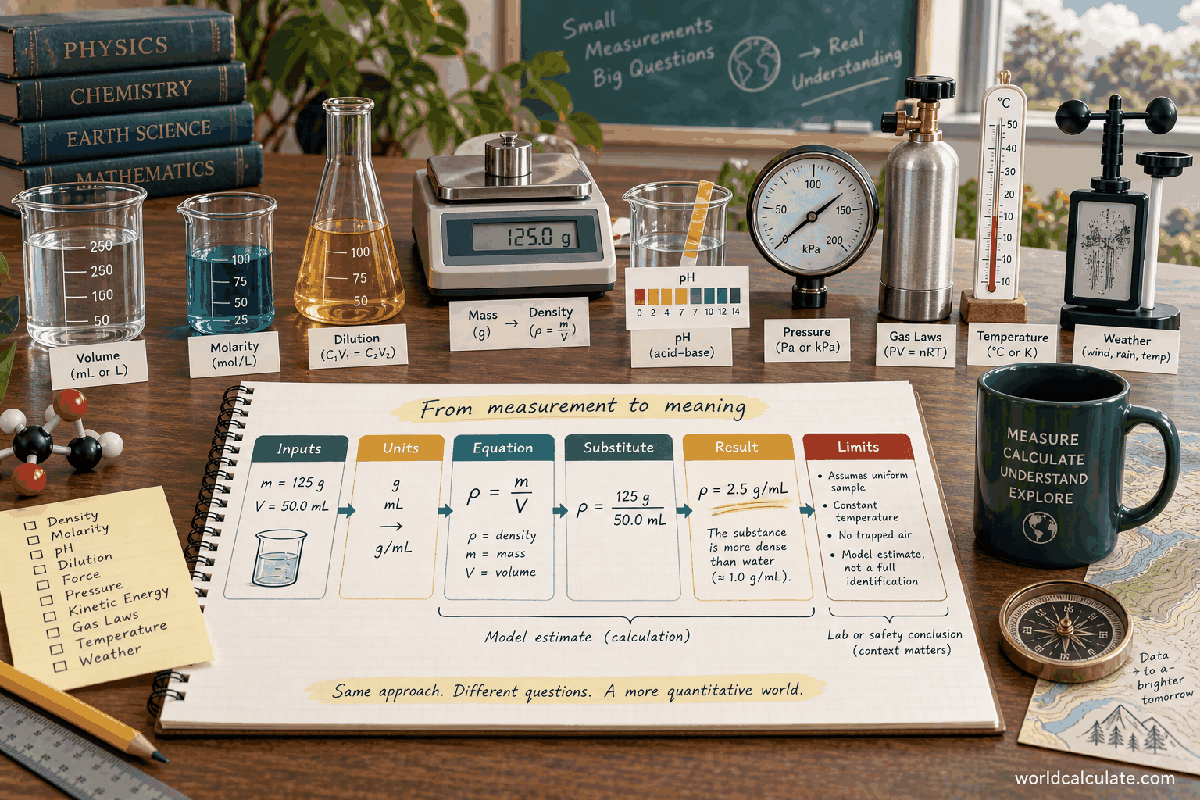
The index of refraction is a dimensionless ratio that compares the exact speed of light in vacuum with a supplied light speed in a medium. This calculator uses n = c/v, accepts v in metres per second, and returns both the index and the speed as a fraction of c. It is a narrow optics relation: the form does not identify a material, account for wavelength-dependent dispersion, or design a lens, fiber, coating, or instrument. The guide explains the vacuum reference, units, ratio, examples, limits, validation, and the difference between a simple index calculation and full optical characterization.
The page answers one defined question: what refractive index follows from a supplied light speed in a medium when the vacuum speed is taken as the reference? The handler divides c by v and returns a dimensionless n. It also reports v/c so a reader can see the same relationship from the other direction. The calculation begins with a speed that has already been identified as the relevant phase speed under the chosen conditions. It does not measure that speed or decide which optical speed a laboratory source intended.
A refractive index is often used in refraction equations, but knowing one ratio does not fully describe an optical material. Index can vary with wavelength, temperature, pressure, composition, polarization, and frequency. The simple output is therefore best treated as a value for a stated condition. If the context does not specify those conditions, the decimal result may appear more universal than the underlying measurement warrants.
The symbol c denotes the speed of light in vacuum and has the exact SI value 299792458 metres per second. Using this reference makes the ratio comparable across media. The calculator keeps the constant in the engine rather than asking the visitor to type it, which avoids introducing an unnecessary rounded or inconsistent value. The returned steps show the constant and the division so the provenance of the ratio is visible in the calculation record.
The vacuum reference is not the same as the speed of light through a material. The input v describes the medium, while c supplies the standard reference. Replacing c with an approximate value can change the last displayed digits, especially when a result is compared with a high-precision source. The page uses the exact defined value for reproducible arithmetic and does not claim that every displayed digit is experimentally known.
Both c and v have units of metres per second. Dividing one by the other cancels those units, leaving a pure number. A value such as 1.5 does not mean 1.5 metres or 1.5 seconds; it states a ratio between two speeds. Keeping the result unitless is useful because the same index can appear in equations that relate angles, wavelengths, and speeds, provided the relevant conditions and definitions match.
The second result, v/c, is also dimensionless but carries the display unit c to make its interpretation explicit. It is the reciprocal of n for positive inputs. A reader should not confuse this fraction with a claim that light travels at an arbitrary controllable fraction in every context. It is a ratio for the supplied medium speed in the simple model.
A basic refraction law relates indices and angles across a boundary. In that setting, a larger index corresponds through this simple relation to a smaller phase speed relative to vacuum. The current page does not calculate an incident angle, a refracted angle, or a boundary result. It supplies one ingredient that may be used in a separately defined refraction problem. Keeping the index calculation separate prevents an angle convention or interface geometry from being silently invented.
The index alone also does not identify whether a ray bends toward or away from a normal at an interface. That comparison requires the index on both sides, the incident direction, and a valid refraction model. A material's index may be listed at one wavelength while the experiment uses another. Treat the output as a condition-specific input and preserve the wavelength and temperature context when they matter.
For v = 156000000 m/s, the engine computes n = 299792458 / 156000000, which is approximately 1.921746526. The speed fraction is v/c, approximately 0.52035. Multiplying that fraction by the index returns one, aside from ordinary floating-point rounding. The two outputs are deliberately paired: one describes the medium relative to vacuum, and the other describes the medium speed relative to the same reference.
The example is an arithmetic check, not a material identification. A visitor should not infer a substance from a rounded index alone because different materials and conditions can share similar values. If a measured speed is used, state the instrument, wavelength, temperature, and uncertainty outside the form. The calculator applies the entered central value and does not perform a measurement uncertainty analysis.
If the supplied speed equals c, the ratio is n = 1 and v/c = 1. This is the vacuum-reference endpoint of the contract. As v becomes smaller while remaining positive, n becomes larger and v/c becomes smaller. If v approaches zero, the ratio grows without bound, which is why the form enforces a positive lower bound and checks finite outputs. The boundary behavior follows directly from division and should be understood before interpreting a large index.
The upper input bound is c, so the simple page does not accept a medium speed greater than the vacuum reference. This is a model and contract choice consistent with the ordinary passive-medium scenario described here. The handler does not explore exotic effective velocities or phase/group-velocity distinctions. A rejected value should lead to a clarified physical question rather than being clipped to c.
The relation n = c/v requires a clear definition of v. In elementary refraction contexts, v is commonly the phase speed used by the wave model. In dispersive media, phase speed and group speed can differ, and a pulse's information or envelope behavior may not be described by the same number. The calculator has one speed field and does not label a measurement automatically. The visitor must use a value appropriate to the intended equation.
This distinction is not a reason to make the form accept every possible optical convention without explanation. It is a reason to keep the scope visible. If the source reports group velocity, signal velocity, or an effective propagation speed, preserve that terminology and do not silently rename it as the phase speed required by a different derivation. A numerical ratio is only as meaningful as the definition attached to v.
The field accepts finite speeds from 1 m/s through 299792458 m/s. It rejects zero, negative values, strings, nonfinite values, and speeds greater than c. These checks protect both the ratio and its reciprocal display. They also make the input contract explicit in the rendered form. A numeric bound does not assert that every speed inside it is a plausible measurement for a particular material; it only defines what this general arithmetic page will process.
If a measurement has uncertainty, enter the selected central value and perform interval propagation separately. Near a very small speed, the ratio is sensitive to uncertainty because division magnifies relative changes. Near c, the index is close to one, but a small difference between c and v can still matter for the intended optical application. The page returns one deterministic result and does not invent an uncertainty interval.
If a source reports kilometres per second, convert to metres per second before entry by multiplying by 1000. If it reports centimetres per second, use the appropriate factor and record the conversion. The form does not accept a unit selector, so a bare number has meaning only under the displayed m/s contract. A unit error can produce an index that looks numerically reasonable while representing the wrong speed by a large factor.
The engine keeps several digits in the numeric result and the renderer formats them for display. The number of displayed digits should be chosen according to the input precision and the source context. Do not treat trailing digits as certified optical constants. Preserve the original measurement precision, conditions, and any rounding rule when the result is copied into a report.
Validate the implementation with the endpoint v = c, where n should equal one and the speed fraction should equal one. Test a smaller positive speed and confirm that n is greater than one and v/c is less than one. Multiply the two returned values to check the reciprocal relationship. Repeat with a known source value while using the same c constant and unit conversion. These checks test the ratio without pretending to validate a material database.
For an experimental record, compare the calculated index with a source value only after matching wavelength, temperature, pressure, composition, and the definition of speed. If those conditions differ, the discrepancy may be physical rather than computational. Write down the comparison criteria instead of selecting the closest-looking decimal.
The page is useful in lessons that connect wave speed with refraction and in exercises that ask students to interpret a dimensionless index. A teacher can vary v while holding c fixed and ask how n changes. A learner can compare the ratio with an independently stated index and identify whether the discrepancy comes from units or conditions. The transparent steps help preserve the distinction between a formula input and a material property lookup.
It can also serve as a preparation step for a separate Snell-law calculation. First establish which index belongs to each medium and at what condition. Then use the appropriate incident and refracted angle model. The current page intentionally stops before those geometry and boundary choices.
A computed index does not establish transparency, absorption, reflectivity, birefringence, dispersion, or optical quality. It does not calculate a critical angle, lens focal length, numerical aperture, coating thickness, or image position. Each of those questions needs additional variables and often a wavelength-specific model. The simple ratio is one building block, not a complete optical characterization.
It also does not certify a material for a laser, sensor, medical device, fiber link, or high-power optical setup. Safety depends on wavelength, power, exposure, enclosure, and application context. The calculator provides no safety advice and should not be used to select equipment or approve an experiment.
A useful report includes the medium-speed value, its unit, the exact c reference, the resulting index, the speed fraction, and the condition attached to the speed. If the value is measured, include wavelength, temperature, pressure, instrument, and uncertainty when relevant. If it is taken from a table, preserve the table's condition and rounding. This makes a dimensionless number traceable rather than presenting it as an eternal label for a substance.
The honest conclusion is that n = c/v was evaluated for the entered speed. No material was identified, no refractive interface was solved, no lens was designed, and no optical safety conclusion was made. That boundary lets the result be reused as a clear input to a later, separately reviewed calculation.
In a medium, wavelength, frequency, and phase speed are related by v = f lambda for the relevant wave description. At a stationary, linear boundary, frequency is often preserved while wavelength changes as speed changes. The current calculator does not ask for frequency or wavelength, so it cannot infer either one from the index alone. A visitor should not treat an index as a substitute for a wavelength-specific optical record when dispersion matters.
A tabulated index may be quoted at a named spectral line or a standard test condition. Reusing that number for a broadband source can introduce a model error even when the arithmetic is flawless. Keep the spectral condition next to the entered speed and do not imply that the calculator has chosen a wavelength.
Refraction at an interface depends on the indices on both sides and on the angle measured relative to the normal. This page calculates one index from one speed, so it does not decide what the second medium is or how a ray meets the boundary. The output can be copied into a separate interface calculation after those geometric definitions are established. Treating the scalar index as a complete ray path would hide the missing direction information.
The same index can appear in several optical relationships with different assumptions. A planar interface, a curved lens, a fiber boundary, and a layered coating do not share one complete geometry merely because they share a material ratio. The calculator intentionally stops at the ratio and leaves surface shape, orientation, and boundary conditions explicit.
Because n is a quotient, uncertainty in a measured medium speed transfers into the index. For small relative uncertainty, the relative uncertainty in n has approximately the same magnitude as the relative uncertainty in v when c is treated as exact. The calculator does not perform this propagation. It reports a value from the entered central speed, so any precision statement should be made separately from the formatted output.
Near the upper speed boundary, the index is close to one and small speed differences can matter in a sensitive optical comparison. Near the lower bound, the quotient changes rapidly with speed. These sensitivities are properties of the ratio and do not mean that the page can rank instruments or choose a measurement method.
Before using the result, confirm that the input is the phase speed intended by the source, expressed in metres per second, and no greater than the vacuum reference. Recalculate c/v and check the reciprocal v/c. If the value will enter Snell's law or a lens equation, identify the second index, wavelength, surface geometry, and angle convention in that later calculation. These checks preserve the distinction between a ratio and a full optical model.
The honest conclusion remains narrow: the simple speed-ratio index was evaluated for the entered condition. No material database lookup, spectral interpolation, interface angle, lens design, fiber performance, or optical safety decision was produced. Keep those questions separate so the convenient number does not acquire unsupported meaning.
Introductory treatments usually present refractive index as a real positive ratio. In more advanced material models, an index can be represented with complex components to describe absorption, and the sign or convention can depend on the time dependence chosen for the wave. This calculator deliberately uses a real positive medium speed and returns a real scalar n. It does not infer a complex index, absorption coefficient, or phase convention from a single speed input.
Keeping the contract real and simple is useful for ordinary refraction exercises, but it is also a boundary that should be named. If a source reports a complex optical constant or a frequency-dependent response, preserve that information rather than reducing it to this page without a stated approximation. The handler cannot represent those additional degrees of freedom.
A reliable workflow begins by identifying the wave, its frequency or wavelength, and the definition of the supplied speed. Convert the speed to metres per second, verify that it is positive and no greater than c, then evaluate n. Next, attach the condition to the result and decide whether a later question concerns an interface, a lens, a waveguide, or only a dimensionless comparison. This order keeps the arithmetic from becoming an unsupported material claim.
If the result is reused, copy the formula, c value, input, output, and assumptions together. A later calculation should not treat the index as universal if its wavelength or temperature differs. The page is most useful when it makes the first ratio transparent and leaves the next physical decision visible.
Calculate a medium's refractive index and light-speed fraction from its supplied light speed.
Refractive index n = c/v, where c = 299792458 m/s is the exact speed of light in vacuum and v is the supplied medium speed. This calculator evaluates the basic index-of-refraction relation from a supplied light speed. It returns n and the speed as a fraction of c while leaving wavelength dependence, absorption, material selection, and optical design outside the model.
Enter Light speed in the medium, then choose Calculate.
The entered speed is a positive finite phase speed expressed in metres per second. The exact SI speed of light in vacuum is used as c. The result describes the simple ratio relation at the supplied condition and does not model dispersion or absorption. Material characterization, lens design, waveguides, and optical safety are outside the calculation.
This calculator is part of the WorldCalculate library. Its formula, example, assumptions, input bounds, and output formatting follow the official methodology.
These WorldCalculate collections connect this tool with related questions while keeping each calculation separate and transparent.