
Goal
Calculate the Rayleigh diffraction-limit angular resolution of a circular aperture from wavelength and diameter.
Worldwide context
Saved once here, used across the site.
Currency changes display only. Country selection guides tax input; no tax rate is guessed.
Calculate the Rayleigh diffraction-limit angular resolution of a circular aperture from wavelength and diameter.
Rayleigh angular resolution theta = 1.22 lambda/D for wavelength lambda and circular-aperture diameter D; report radians and arcseconds. This is a diffraction-limit relation only.A clearer path to an answer
This page keeps the calculation transparent: define the goal, enter the matching values, inspect the method, and decide what the result means in your situation.
Calculate the Rayleigh diffraction-limit angular resolution of a circular aperture from wavelength and diameter.
Wavelength · Circular aperture diameter
Rayleigh angular resolution theta = 1.22 lambda/D for wavelength lambda and circular-aperture diameter D; report radians and arcseconds. This is a diffraction-limit relation only.
Calculate, review the assumptions below, then compare a related tool when the decision needs more context.
Calculate the Rayleigh diffraction-limit angular resolution of a circular aperture from wavelength and diameter.
Open the Diffraction-Limited Angular Resolution pageMore science tools
Download PDFDownload Word (.doc)
Enter your values above and choose Calculate to see the result here.
Calculation map
Rayleigh angular resolution theta = 1.22 lambda/D for wavelength lambda and circular-aperture diameter D; report radians and arcseconds. This is a diffraction-limit relation only.
Bounded, transparent calculation
Your recent runs stay in this browser session only.
Formula: Rayleigh angular resolution theta = 1.22 lambda/D for wavelength lambda and circular-aperture diameter D; report radians and arcseconds. This is a diffraction-limit relation only.
This calculator evaluates the Rayleigh diffraction-limit relation for an ideal circular aperture and returns angular resolution in radians and arcseconds. It does not guarantee instrument performance or provide instrument-design advice.
Worked example: Diffraction-limit resolution is 0.0000061 radians, or about 1.258 arcseconds.
The displayed limits are checked before the handler runs. Model-specific domain checks may also reject impossible or non-finite inputs.
Methodology: This calculator follows the WorldCalculate input, formula, precision, and boundary policy. Read the official methodology.
Calculator usage statistics
This section counts anonymous successful Calculate submissions, not unique visitors. Counts and top tools appear only when trusted aggregate data is available; country analysis is shown only under the same condition and reporting threshold.
Answer-first guide
Calculate the Rayleigh diffraction-limit angular resolution of a circular aperture from wavelength and diameter. Start with one clearly defined goal, enter values in the units shown, and keep the result attached to the assumptions below.
This tool is useful when your question includes angular resolution, Rayleigh criterion, diffraction limit. It returns the outputs declared in the calculator contract rather than a live quote, approval, diagnosis, or professional sign-off.
Wavelength · Circular aperture diameter. Keep the same time period, unit system, and currency wherever the form requires comparable values.
Run the worked example first, compare its output with the page's example, then change one input at a time. This makes an unexpected result easier to trace to a unit, boundary, or assumption.
Need a wider view? Browse Science Calculators or compare the related tools below. The WorldCalculate methodology explains how formulas, examples, limits, and revisions are reviewed.
Rayleigh angular resolution theta = 1.22 lambda/D for wavelength lambda and circular-aperture diameter D; report radians and arcseconds. This is a diffraction-limit relation only.
This calculator evaluates the Rayleigh diffraction-limit relation for an ideal circular aperture and returns angular resolution in radians and arcseconds. It does not guarantee instrument performance or provide instrument-design advice.
Diffraction-limit resolution is 0.0000061 radians, or about 1.258 arcseconds.
Context and background
Science calculators define a system, choose an equation, apply units and constants, and show the substitution. Effects outside that model remain outside the result.
Introductory science problem solving builds from measured quantities and idealized relationships. Those models are valuable for learning and first-pass estimates, while experiments and engineering decisions need additional evidence.
Research and review
Researched by Hassan ALRowaie, Founder and editorial researcher at WorldCalculate.
This guide follows the live calculator's declared inputs, formula, worked example, assumptions, validation boundaries, and source-backed methodology. The review date describes editorial review of the calculator explanation; it is not a promise that external facts or rates remain current.

Angular resolution describes the angular separation associated with an ideal diffraction limit. This calculator uses the Rayleigh relation theta = 1.22 lambda/D for wavelength lambda and circular-aperture diameter D. Wavelength and diameter are entered in metres. The output is reported in radians and arcseconds. The factor 1.22 belongs to the ideal circular-aperture Rayleigh criterion. The result is not a guarantee of an instrument's real performance and does not provide instrument-design advice. The sections below explain angular separation, wavelength, aperture, the Rayleigh factor, unit conversion, examples, scaling, atmospheric and optical limits, validation, and the boundary between a diffraction relation and an actual observing system.
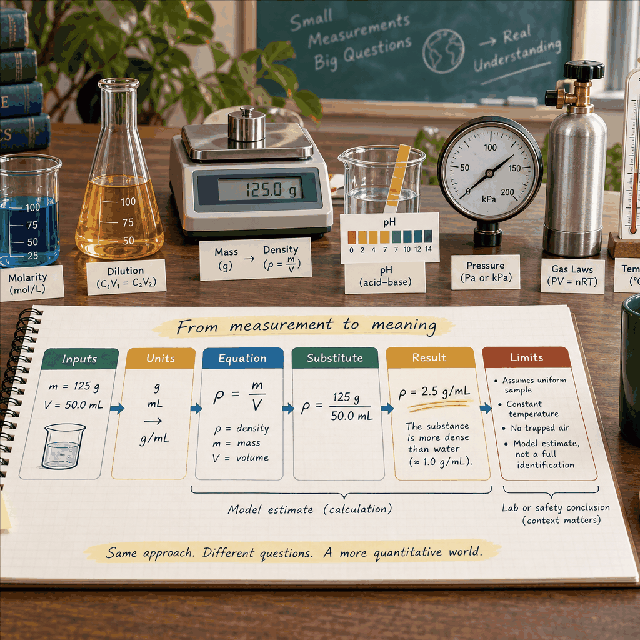
The page answers a focused optics question: what angular scale follows from an ideal circular aperture and one entered wavelength under the Rayleigh diffraction relation? The handler multiplies wavelength by 1.22, divides by aperture diameter, and converts radians to arcseconds. It does not observe a target, measure a point-spread function, or test an instrument.
The result is an ideal diffraction-limit angle, not a general statement about image quality. A smaller angle represents finer ideal separation under the selected criterion, but actual performance may be limited by atmosphere, aberrations, detector sampling, vibration, focus, contrast, or processing. Those factors are not part of the two-field contract.
Angular resolution is an angular separation rather than a linear distance. It describes how close two directions can be in an idealized criterion before their diffraction patterns are considered just resolved. The calculator returns the threshold angle from the entered optical scale. It does not identify the angular size of a target or convert the result into a distance without additional geometry.
A resolution number is meaningful only with its criterion and conditions. This page uses the Rayleigh criterion for a circular aperture. Other criteria can define a different threshold, and visual or algorithmic resolution can depend on contrast and signal. The word diffraction-limited should remain attached to the result.
Wavelength lambda is entered in metres and appears in the numerator. Holding aperture fixed, doubling wavelength doubles the ideal angular-resolution angle. Longer wavelengths therefore correspond to a larger diffraction limit under this relation. The field accepts 1e-12 m through 1 m as a bounded positive range for numerical and educational use.
The calculator treats wavelength as one fixed value. It does not model a bandpass, spectral weighting, dispersion, or a source with multiple wavelengths. A real observation may have a wavelength range and a detector response, but those facts are not inferred from a single numeric input.
Circular-aperture diameter D appears in the denominator. Holding wavelength fixed, doubling diameter halves the ideal diffraction-limit angle. A larger ideal pupil therefore corresponds to a smaller angular threshold in the formula. The field accepts 1e-6 m through 1e6 m as a finite positive range.
The input is an ideal effective circular diameter, not automatically a telescope outside diameter, clear opening, or usable pupil in a real assembly. Central obstructions, segmentation, apodization, support structures, and illumination can affect a real diffraction pattern. The handler does not infer those details.
The formula is theta = 1.22 lambda/D. The factor 1.22 is the circular-aperture Rayleigh criterion, lambda is wavelength, and D is diameter. Metres cancel, leaving a dimensionless angle expressed in radians. The calculator applies the relation directly and then converts that angle to arcseconds.
The idealized boundary is close to the formula: it assumes diffraction from a circular aperture is the relevant limitation. It does not add aberration, atmospheric seeing, detector sampling, focus, tracking, contrast, or image-processing effects. A numeric result is therefore a theoretical limit, not a performance guarantee.
The direct formula produces radians. One radian equals 180 divided by pi degrees, and one degree contains 3,600 arcseconds. The calculator multiplies the radian result by approximately 206,264.806 arcseconds per radian. Reporting both units makes a small astronomical angle easier to read while preserving the direct SI-derived result.
Arcseconds are a display conversion, not a new resolution criterion. A value can be converted to milliarcseconds in a separate step, but the physical assumptions remain unchanged. Keep the unit label with the result because a bare small number is easy to misread.
For lambda = 5e-7 m and D = 0.1 m, the numerator 1.22 lambda is 6.1e-7 m. Dividing by 0.1 m gives theta = 6.1e-6 radians. Multiplying by about 206,264.806 arcseconds per radian gives approximately 1.258 arcseconds. The metre units cancel in the ratio.
This example calibrates the Rayleigh factor and unit conversion. It does not describe a real telescope, camera, eye, microscope, or atmosphere. The aperture is an ideal circular diameter and the wavelength is one entered value.
The formula gives direct comparison rules. Doubling wavelength doubles theta, while doubling aperture diameter halves theta. Doubling both leaves the ratio unchanged. These checks are useful for a worksheet and make the inverse relationship with aperture visible. They describe the ideal formula, not a promise that a real instrument improves in direct proportion when its aperture changes.
Comparisons should use the same criterion, wavelength definition, pupil convention, and unit system. Comparing a visible wavelength with an infrared band or a clear aperture with an obstructed pupil may require additional analysis. The handler cannot detect those semantic differences from the two numbers.
A diffraction-limited angle describes the ideal pattern produced by a specified aperture and wavelength. Real image quality can be worse because of optical aberrations, imperfect alignment, focus error, vibration, detector sampling, noise, contrast, and processing. A system can also be designed or operated so that diffraction is not its dominant limitation. None of those effects appears in theta = 1.22 lambda/D.
The calculator therefore returns a theoretical reference. It does not measure a point-spread function or determine whether two targets are visually separable. The number should not be promoted from a limit to a tested capability.
For ground-based observations, atmospheric turbulence can blur images by an angle larger than the ideal diffraction limit. Weather, path length, wavelength, and site conditions can affect that blur. The calculator has no atmosphere field and does not add a seeing estimate. It is equally unsuitable for claiming a site or night will achieve the returned theoretical value.
Space-based or laboratory systems remove some atmospheric effects but still have alignment, thermal, detector, and optical constraints. The same two-field result can be a useful baseline in those contexts, provided it is labeled as the ideal circular-aperture relation.
The handler requires finite positive wavelength from 1e-12 through 1 m and finite positive aperture diameter from 1e-6 through 1e6 m. Numeric strings, missing values, NaN, infinities, zero, negative inputs, and out-of-range values are rejected. Direct validation protects callers that bypass the browser form.
The radian result, arcsecond conversion, and result entries pass through finite guards. The engine does not replace a zero diameter with a small epsilon, clip a wavelength, or evaluate text. Explicit rejection preserves the selected diffraction model.
A smaller calculated angle does not guarantee that an instrument resolves two sources at that separation. Resolution can be limited by factors outside the Rayleigh formula, and a target's contrast and signal can affect detectability. The page does not test an optical train, detector, atmosphere, or observer. Its output is a criterion-based theoretical angle.
The requested boundary is explicit: diffraction-limit relation only, with no instrument performance guarantee. This wording matters whenever a user compares aperture sizes or wavelengths for a proposed system.
The calculator does not recommend an aperture, telescope, microscope, camera, detector, wavelength, mount, or observing site. It does not calculate focal length, field of view, sampling, sensitivity, or cost. Choosing an instrument requires a system-level tradeoff and evidence that the ideal diffraction value alone cannot supply.
Use the result as one theoretical relation in a separately reviewed optics analysis. Do not treat the input bounds or a favorable angle as approval of an instrument design.
A clear report records wavelength, ideal circular-aperture diameter, the Rayleigh criterion, and both angle units. Show 1.22 lambda/D and the radians-to-arcseconds conversion. State whether wavelength represents a line or band and preserve any system context outside the calculator. The result should be labeled diffraction-limited.
End with the boundary: no instrument performance guarantee or instrument-design advice is provided. This allows the theoretical value to serve as a baseline without being mistaken for a tested observation capability.
The page is useful for optics and astronomy lessons, dimensional analysis, and comparisons showing the opposite effects of wavelength and aperture. It gives learners a concrete way to convert a very small radian angle into arcseconds and to distinguish an ideal diffraction criterion from a measured performance result.
It should not be used to promise an instrument's resolution or choose a system. When practical performance matters, retain the Rayleigh number as one baseline and use an analysis that includes the relevant optical, atmospheric, detector, and operational evidence.
Check that wavelength and aperture diameter are positive metre values, that the pupil is intended as circular, and that the formula uses 1.22 lambda divided by D. Confirm the radians-to-arcseconds conversion and keep both labels. Test the inclusive minimum and maximum ranges. These checks verify the ideal relation but not an actual instrument or observing condition.
Then ask whether the desired conclusion remains a Rayleigh diffraction-limit angle. If it does, the output is transparent. If it asks whether an instrument will perform, what aperture to choose, or whether a design is adequate, stop at the boundary.
The Rayleigh value comes from comparing the diffraction pattern of two point-like sources through a circular aperture. It is a criterion for when the central maximum of one pattern meets a relevant minimum of the other under an idealized arrangement. The calculator uses the resulting 1.22 factor but does not generate the pattern, measure contrast, or determine whether a target has the assumed point-like character.
Other resolution criteria can produce other numerical thresholds. A visual observer, a detector algorithm, and a laboratory point-spread measurement may use different definitions of just resolved. The page selects Rayleigh explicitly so the output has a clear meaning within one textbook convention.
The criterion also presumes a wavelength and an aperture that describe the same optical path. If the inputs represent different bands or different pupils, the result may be mathematically valid but physically mismatched.
The 1.22 factor is tied to an ideal circular aperture. A rectangular opening, segmented pupil, central obstruction, apodized pupil, or interferometric baseline can produce a different diffraction pattern. The aperture diameter field intentionally does not encode those designs. It represents the circular-pupil ideal used by the formula.
Even if the diffraction pattern is ideal, a detector must sample it. Pixel size, focal length, read noise, signal level, and processing can affect whether the theoretical pattern is measured. The calculator has no focal length or detector field and cannot turn angular resolution into pixel spacing or a detection threshold.
These omissions are not defects in the relation. They identify why the result is a diffraction baseline rather than a system specification.
For a fair ideal comparison, hold the Rayleigh criterion and wavelength definition fixed while changing aperture, or hold aperture fixed while changing wavelength. Record whether diameter is clear, effective, or simply hypothetical. The calculator does not decide which diameter convention a real instrument should use.
If the result is compared with an observed image, record atmospheric condition, focus, alignment, detector, contrast, and data processing separately. A measured separation that differs from the ideal limit can reflect any of those factors. The handler provides no diagnostic of the difference.
The appropriate handoff is a labeled theoretical angle in radians and arcseconds. Carry forward that it is not an instrument performance guarantee and contains no instrument-design advice.
The Rayleigh criterion is a defined way to describe the relationship between two ideal diffraction patterns. It is not a universal visual threshold. Whether two sources are distinguishable can depend on their brightness ratio, separation direction, background, signal-to-noise ratio, and the method used to inspect the image. The calculator supplies the criterion angle and does not evaluate any of those observational properties.
A target with low contrast may be difficult to detect at a separation larger than the Rayleigh value, while a particular algorithm or visual task may report useful information below it. Those outcomes do not contradict the formula because they answer different questions. The page does not choose a criterion or translate the result into a detection probability.
Naming Rayleigh in a report is therefore as important as naming radians or arcseconds. The criterion tells the reader what the number means and what it does not mean.
The diameter field represents the circular aperture used by the ideal relation. In a real instrument, the mechanical opening, clear aperture, illuminated pupil, and effective diffraction pupil may not be identical. A central obstruction or support structure can alter the pattern even when the outer diameter is unchanged. The handler does not select which definition is appropriate.
Segmented or interferometric systems also cannot be summarized reliably by one circular diameter without an explicit equivalent-pupil assumption. Entering a baseline or housing dimension as D may produce a mathematically clean value with the wrong physical meaning. The input record should state what diameter was intended.
This is an interpretation boundary, not a request for the calculator to guess geometry. The simple result is reproducible when D is clearly defined as the ideal circular-aperture diameter.
The radian output is dimensionless in the unit-analysis sense, while the arcsecond output is a conventional angular display unit. The conversion factor is fixed and should not be rounded before the conversion if a reproducible comparison is needed. The calculator formats the two metrics separately but does not attach measurement uncertainty to either one.
Input precision limits the meaningful precision of the answer. A wavelength recorded with two significant digits and a diameter measured approximately cannot justify many exact-looking decimal places, even though the arithmetic engine can produce them. The page checks numerical finiteness, not experimental quality or uncertainty propagation.
For comparisons, retain the raw inputs, units, criterion, and aperture definition. This context is more valuable than treating a small difference in displayed arcseconds as a proven performance difference.
A system review can place the ideal diffraction angle beside atmospheric, optical, detector, tracking, and processing limits. The smallest of those scales does not automatically determine the observed result, because the limits can combine and depend on the task. The current calculator contributes only the circular-aperture Rayleigh baseline.
If a measurement disagrees with the baseline, the disagreement is evidence to investigate rather than a reason to alter the 1.22 factor or force an aperture value. Check definitions, wavelengths, reference planes, focus, alignment, and detector sampling in the separate review. The handler has no information with which to diagnose the cause.
The correct handoff preserves both angle units and the non-guarantee boundary. It gives a useful theoretical comparison without becoming a promise about an instrument or observing session.
Calculate the Rayleigh diffraction-limit angular resolution of a circular aperture from wavelength and diameter.
Rayleigh angular resolution theta = 1.22 lambda/D for wavelength lambda and circular-aperture diameter D; report radians and arcseconds. This is a diffraction-limit relation only. This calculator evaluates the Rayleigh diffraction-limit relation for an ideal circular aperture and returns angular resolution in radians and arcseconds. It does not guarantee instrument performance or provide instrument-design advice.
Enter Wavelength, Circular aperture diameter, then choose Calculate.
Wavelength and circular-aperture diameter are finite positive values in metres, and the aperture is treated as a circular ideal pupil. The 1.22 Rayleigh factor is applied to a single wavelength under an ideal diffraction-only comparison with no atmospheric, detector, aberration, or tracking terms. This is a diffraction-limit relation only. It is not an instrument performance guarantee and does not provide optical or instrument-design advice.
This calculator is part of the WorldCalculate library. Its formula, example, assumptions, input bounds, and output formatting follow the official methodology.
These WorldCalculate collections connect this tool with related questions while keeping each calculation separate and transparent.