
Goal
Use mass readings in air and while fully submerged to estimate apparent mass loss, buoyant force, displaced volume, and object density.
Worldwide context
Saved once here, used across the site.
Currency changes display only. Country selection guides tax input; no tax rate is guessed.
Use mass readings in air and while fully submerged to estimate apparent mass loss, buoyant force, displaced volume, and object density.
Apparent mass loss = mass in air − submerged apparent mass; buoyant force = apparent mass loss × g; displaced volume = apparent mass loss ÷ fluid density; object density = mass in air ÷ displaced volume.A clearer path to an answer
This page keeps the calculation transparent: define the goal, enter the matching values, inspect the method, and decide what the result means in your situation.
Use mass readings in air and while fully submerged to estimate apparent mass loss, buoyant force, displaced volume, and object density.
Mass reading in air · Apparent mass reading while submerged · Fluid density · Local gravitational acceleration
Apparent mass loss = mass in air − submerged apparent mass; buoyant force = apparent mass loss × g; displaced volume = apparent mass loss ÷ fluid density; object density = mass in air ÷ displaced volume.
Calculate, review the assumptions below, then compare a related tool when the decision needs more context.
Use mass readings in air and while fully submerged to estimate apparent mass loss, buoyant force, displaced volume, and object density.
Open the Buoyancy Experiment Density Calculator pageMore science tools
Download PDFDownload Word (.doc)
Enter your values above and choose Calculate to see the result here.
Calculation map
Apparent mass loss = mass in air − submerged apparent mass; buoyant force = apparent mass loss × g; displaced volume = apparent mass loss ÷ fluid density; object density = mass in air ÷ displaced volume.
Bounded, transparent calculation
Your recent runs stay in this browser session only.
Formula: Apparent mass loss = mass in air − submerged apparent mass; buoyant force = apparent mass loss × g; displaced volume = apparent mass loss ÷ fluid density; object density = mass in air ÷ displaced volume.
A submerged object appears lighter because the displaced fluid produces an upward force. This experiment worksheet keeps the two scale readings visible, converts their difference into a buoyant force, estimates displaced volume from fluid density, and then calculates object density under the fully submerged static model.
Worked example: The 0.00083 kg apparent mass loss corresponds to about 8.14 mN of buoyant force, 0.00000083 m³ displaced volume, and about 10,397.6 kg/m³ estimated density.
The displayed limits are checked before the handler runs. Model-specific domain checks may also reject impossible or non-finite inputs.
Methodology: This calculator follows the WorldCalculate input, formula, precision, and boundary policy. Read the official methodology.
Calculator usage statistics
This section counts anonymous successful Calculate submissions, not unique visitors. Counts and top tools appear only when trusted aggregate data is available; country analysis is shown only under the same condition and reporting threshold.
Answer-first guide
Use mass readings in air and while fully submerged to estimate apparent mass loss, buoyant force, displaced volume, and object density. Start with one clearly defined goal, enter values in the units shown, and keep the result attached to the assumptions below.
This tool is useful when your question includes buoyancy experiment calculator, apparent mass loss, Archimedes lab. It returns the outputs declared in the calculator contract rather than a live quote, approval, diagnosis, or professional sign-off.
Mass reading in air · Apparent mass reading while submerged · Fluid density · Local gravitational acceleration. Keep the same time period, unit system, and currency wherever the form requires comparable values.
Run the worked example first, compare its output with the page's example, then change one input at a time. This makes an unexpected result easier to trace to a unit, boundary, or assumption.
Need a wider view? Browse Science Calculators or compare the related tools below. The WorldCalculate methodology explains how formulas, examples, limits, and revisions are reviewed.
Apparent mass loss = mass in air − submerged apparent mass; buoyant force = apparent mass loss × g; displaced volume = apparent mass loss ÷ fluid density; object density = mass in air ÷ displaced volume.
A submerged object appears lighter because the displaced fluid produces an upward force. This experiment worksheet keeps the two scale readings visible, converts their difference into a buoyant force, estimates displaced volume from fluid density, and then calculates object density under the fully submerged static model.
The 0.00083 kg apparent mass loss corresponds to about 8.14 mN of buoyant force, 0.00000083 m³ displaced volume, and about 10,397.6 kg/m³ estimated density.
Context and background
Science calculators define a system, choose an equation, apply units and constants, and show the substitution. Effects outside that model remain outside the result.
Introductory science problem solving builds from measured quantities and idealized relationships. Those models are valuable for learning and first-pass estimates, while experiments and engineering decisions need additional evidence.
Research and review
Researched by Hassan ALRowaie, Founder and editorial researcher at WorldCalculate.
This guide follows the live calculator's declared inputs, formula, worked example, assumptions, validation boundaries, and source-backed methodology. The review date describes editorial review of the calculator explanation; it is not a promise that external facts or rates remain current.
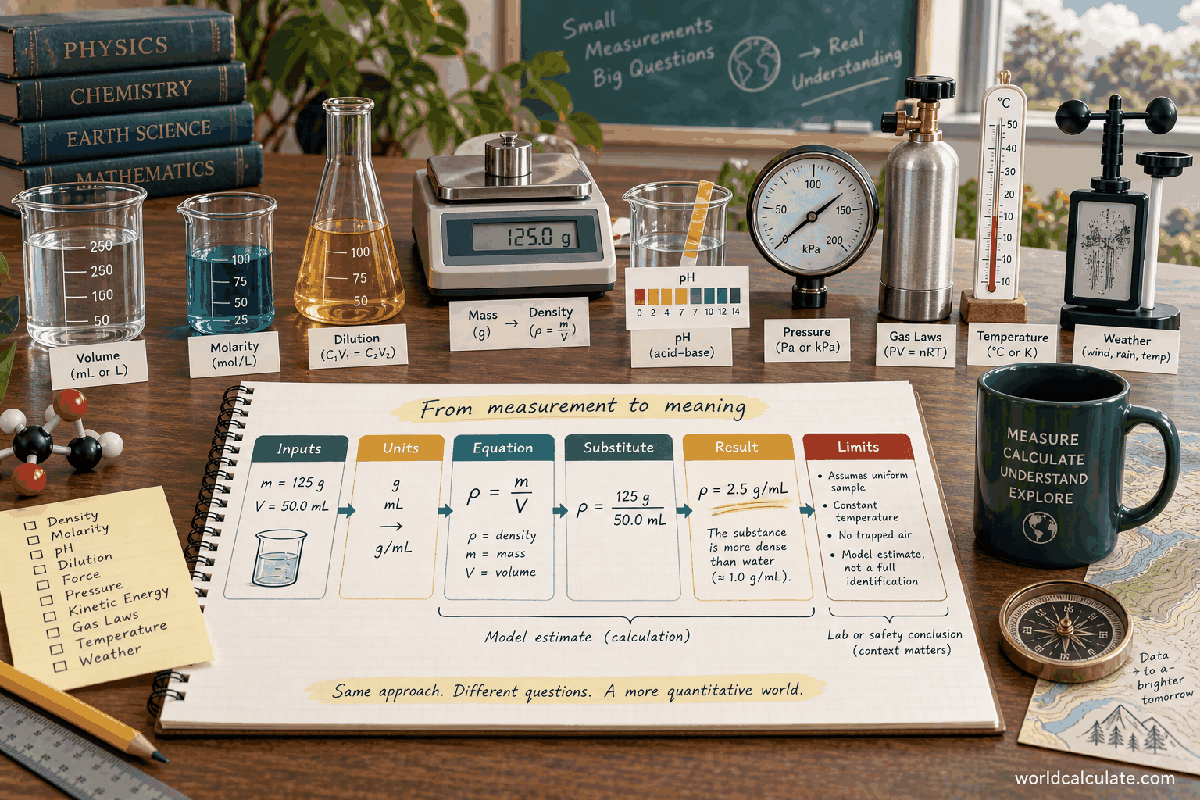
A buoyancy experiment becomes much easier to review when the two readings and every conversion remain visible. This worksheet starts with a mass in air and an apparent mass while the object is submerged, then uses their difference to estimate displaced fluid and object density.
The central observation is an apparent reduction in the scale reading when an object is immersed. The object has not lost material; the fluid exerts an upward buoyant force. A scale or balance reports the changed supported force as an apparent mass under the simple model.
The page is built around that observation rather than a direct density lookup. It lets a student enter the actual pair of readings and see how the difference propagates through force, volume, and density.
The apparent mass loss is the mass reading in air minus the submerged apparent mass. Multiplying that difference by the selected gravitational acceleration gives the buoyant-force magnitude. The relation preserves the important distinction between a mass-equivalent reading and a force measured in newtons.
Changing gravity changes the force result but not the apparent mass difference. That is why local gravity is explicit even though a classroom default is supplied. The input should match the convention used by the experiment or lesson.
Archimedes’ principle connects the buoyant force to the weight of displaced fluid. After dividing the apparent mass loss by the fluid density, the worksheet obtains the displaced volume. For a fully submerged object, that volume is also the volume of the object under the stated assumptions.
The unit check is useful: kilograms divided by kilograms per cubic metre gives cubic metres. A result that is many orders of magnitude away from the object’s visible size usually signals a unit, immersion, or scale-reading problem rather than an exotic physical effect.
The density output divides the original mass in air by the estimated displaced volume. It is important to use the air reading in the numerator, not the smaller apparent submerged reading. The latter is a measurement of supported-force reduction, not the object’s material mass.
The result can be compared with a reference material only after the measurement uncertainty and sample composition are considered. A close-looking number is not proof of authenticity, purity, or identity.
The returned table separates measured inputs from derived quantities. This makes it possible to reproduce the result in a notebook: subtract the readings, multiply by gravity, divide by fluid density, and divide mass by volume. Keeping the steps visible is especially useful when teaching significant figures.
The calculator does not round inputs before calculating. Display precision is a presentation choice; the quality of the experiment still depends on balance resolution, repeatability, and recording practice.
Bubbles attached to the object increase the displaced volume and can inflate the apparent mass loss. Touching the beaker or resting on the bottom changes the force path. A wet suspension, moving fluid, or surface-tension effect can also disturb a small reading.
Repeat the measurements, record the setup, and compare the direction of the error with the physical arrangement. The handler rejects an apparent submerged mass that is equal to or above the air reading because that no longer represents the positive displacement scenario used here.
The page assumes complete immersion and a uniform static fluid. It does not model partial submersion, floating equilibrium, compressibility, fluid flow, temperature-dependent density, or a calibrated force transducer. It also does not judge whether an object is safe to immerse.
Those boundaries make the result easier to trust. A more complex setup should add the missing geometry and forces explicitly instead of stretching a single apparent-mass difference beyond its meaning.
Record object identification, fluid and temperature, balance resolution, mass in air, submerged reading, immersion depth, suspension arrangement, and gravity convention. Enter the readings without silently converting or deleting repeated trials.
Use the calculator as a transparent check of the arithmetic. Attach the raw observations and uncertainty analysis to any report so the density value can be reviewed rather than treated as a context-free answer.
Use mass readings in air and while fully submerged to estimate apparent mass loss, buoyant force, displaced volume, and object density.
Apparent mass loss = mass in air − submerged apparent mass; buoyant force = apparent mass loss × g; displaced volume = apparent mass loss ÷ fluid density; object density = mass in air ÷ displaced volume. A submerged object appears lighter because the displaced fluid produces an upward force. This experiment worksheet keeps the two scale readings visible, converts their difference into a buoyant force, estimates displaced volume from fluid density, and then calculates object density under the fully submerged static model.
Enter Mass reading in air, Apparent mass reading while submerged, Fluid density, Local gravitational acceleration, then choose Calculate.
Both scale readings are mass-equivalent values in kilograms. The object is fully submerged and does not touch the container. The fluid is static, uniform, and represented by the entered density. The suspension, surface tension, trapped bubbles, and instrument bias are neglected. The same gravitational acceleration applies to both readings. The result is a classroom measurement model, not a certification method for an unknown object.
This calculator is part of the WorldCalculate library. Its formula, example, assumptions, input bounds, and output formatting follow the official methodology.
These WorldCalculate collections connect this tool with related questions while keeping each calculation separate and transparent.