
Goal
Calculate average shear stress from a shear force and resisting area, with Pa, kPa, and MPa outputs.
Worldwide context
Saved once here, used across the site.
Currency changes display only. Country selection guides tax input; no tax rate is guessed.
Calculate average shear stress from a shear force and resisting area, with Pa, kPa, and MPa outputs.
Average shear stress τ = shear force ÷ resisting area; 1 Pa = 1 N/m².A clearer path to an answer
This page keeps the calculation transparent: define the goal, enter the matching values, inspect the method, and decide what the result means in your situation.
Calculate average shear stress from a shear force and resisting area, with Pa, kPa, and MPa outputs.
Shear force · Resisting shear area
Average shear stress τ = shear force ÷ resisting area; 1 Pa = 1 N/m².
Calculate, review the assumptions below, then compare a related tool when the decision needs more context.
Calculate average shear stress from a shear force and resisting area, with Pa, kPa, and MPa outputs.
Open the Average Shear Stress Calculator pageMore science tools
Download PDFDownload Word (.doc)
Enter your values above and choose Calculate to see the result here.
Calculation map
Average shear stress τ = shear force ÷ resisting area; 1 Pa = 1 N/m².
Bounded, transparent calculation
Your recent runs stay in this browser session only.
Formula: Average shear stress τ = shear force ÷ resisting area; 1 Pa = 1 N/m².
The average stress model divides a supplied shear force by a supplied resisting area. It provides a transparent screening value and deliberately avoids pretending that local stress concentrations or material limits can be inferred from two inputs.
Worked example: 12,000 N over 0.006 m² gives 2,000,000 Pa = 2,000 kPa = 2 MPa.
The displayed limits are checked before the handler runs. Model-specific domain checks may also reject impossible or non-finite inputs.
Methodology: This calculator follows the WorldCalculate input, formula, precision, and boundary policy. Read the official methodology.
Calculator usage statistics
This section counts anonymous successful Calculate submissions, not unique visitors. Counts and top tools appear only when trusted aggregate data is available; country analysis is shown only under the same condition and reporting threshold.
Answer-first guide
Calculate average shear stress from a shear force and resisting area, with Pa, kPa, and MPa outputs. Start with one clearly defined goal, enter values in the units shown, and keep the result attached to the assumptions below.
This tool is useful when your question includes shear stress calculator, force area shear stress, average shear stress. It returns the outputs declared in the calculator contract rather than a live quote, approval, diagnosis, or professional sign-off.
Shear force · Resisting shear area. Keep the same time period, unit system, and currency wherever the form requires comparable values.
Run the worked example first, compare its output with the page's example, then change one input at a time. This makes an unexpected result easier to trace to a unit, boundary, or assumption.
Need a wider view? Browse Science Calculators or compare the related tools below. The WorldCalculate methodology explains how formulas, examples, limits, and revisions are reviewed.
Average shear stress τ = shear force ÷ resisting area; 1 Pa = 1 N/m².
The average stress model divides a supplied shear force by a supplied resisting area. It provides a transparent screening value and deliberately avoids pretending that local stress concentrations or material limits can be inferred from two inputs.
12,000 N over 0.006 m² gives 2,000,000 Pa = 2,000 kPa = 2 MPa.
Context and background
Science calculators define a system, choose an equation, apply units and constants, and show the substitution. Effects outside that model remain outside the result.
Introductory science problem solving builds from measured quantities and idealized relationships. Those models are valuable for learning and first-pass estimates, while experiments and engineering decisions need additional evidence.
Research and review
Researched by Hassan ALRowaie, Founder and editorial researcher at WorldCalculate.
This guide follows the live calculator's declared inputs, formula, worked example, assumptions, validation boundaries, and source-backed methodology. The review date describes editorial review of the calculator explanation; it is not a promise that external facts or rates remain current.

Shear stress describes a force acting parallel to an area. The average formula is short, but a professional design may have uneven load paths, holes, edges, or concentration effects. This guide keeps the simple result useful without overstating it.
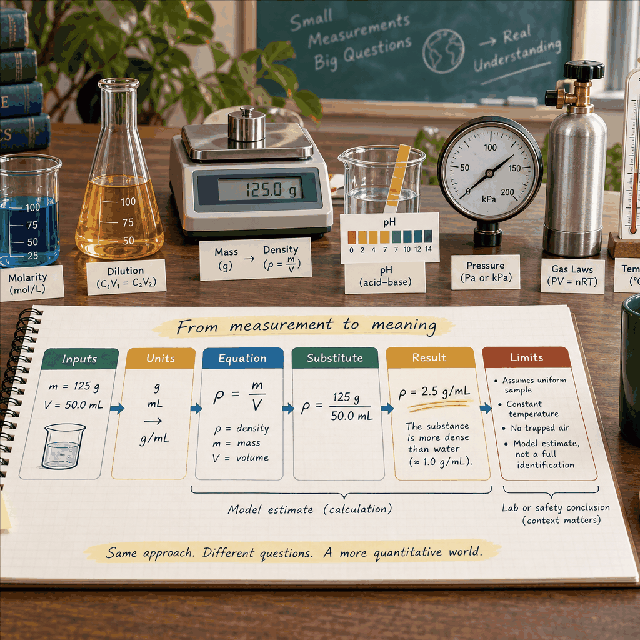
Average shear stress is a force-per-area quantity for a specified load path. It is a screening value when the force and effective resisting area are known.
Use τ = V/A, where V is the supplied shear force and A is the resisting area. With newtons and square metres, the result is pascals because one pascal equals one newton per square metre.
A 12,000 N shear force over 0.006 m² gives 12,000 ÷ 0.006 = 2,000,000 Pa. That is 2,000 kPa or 2 MPa, and each label describes the same average result.
Large values are easier to read in kPa or MPa, but the underlying calculation remains N/m². Confirm that a drawing’s area is in square metres rather than millimetres or square millimetres before entering it.
A bolt group, weld, plate, shaft, or adhesive joint can have a different effective area depending on the load path. The calculator does not discover that area; the visitor must define it from the physical configuration.
A uniform distribution is an idealization. Holes, corners, eccentric loading, contact, and connection stiffness can make local stresses higher than the average value.
Material strength and allowable stress depend on material, temperature, manufacturing, load duration, safety factors, code, and failure mode. Compare the result with an authoritative design basis rather than an unverified number.
This page does not approve a structure or machine part. It answers the arithmetic question force divided by area; use professional review for a real load-bearing decision.
Calculate average shear stress from a shear force and resisting area, with Pa, kPa, and MPa outputs.
Average shear stress τ = shear force ÷ resisting area; 1 Pa = 1 N/m². The average stress model divides a supplied shear force by a supplied resisting area. It provides a transparent screening value and deliberately avoids pretending that local stress concentrations or material limits can be inferred from two inputs.
Enter Shear force, Resisting shear area, then choose Calculate.
Force is entered in newtons and area in square metres. The entered area is the effective resisting area for the stated load path. The force is treated as uniformly distributed for the average value. The area is positive and nonzero. The result is reported in Pa, kPa, MPa, and N/m². Connection geometry, eccentricity, holes, edge distance, and load sharing are not inferred. Material strength, safety factors, fatigue, buckling, and code checks are outside this arithmetic. A qualified engineer must review a real structural or machine design.
This calculator is part of the WorldCalculate library. Its formula, example, assumptions, input bounds, and output formatting follow the official methodology.
These WorldCalculate collections connect this tool with related questions while keeping each calculation separate and transparent.