
Goal
Check whether three positive lengths can form a non-degenerate triangle, show every inequality slack, and calculate Heron area when valid.
Worldwide context
Saved once here, used across the site.
Currency changes display only. Country selection guides tax input; no tax rate is guessed.
Check whether three positive lengths can form a non-degenerate triangle, show every inequality slack, and calculate Heron area when valid.
A non-degenerate triangle requires a < b+c, b < a+c, and c < a+b; when valid, Heron area = √(s(s−a)(s−b)(s−c)).A clearer path to an answer
This page keeps the calculation transparent: define the goal, enter the matching values, inspect the method, and decide what the result means in your situation.
Check whether three positive lengths can form a non-degenerate triangle, show every inequality slack, and calculate Heron area when valid.
Side a · Side b · Side c
A non-degenerate triangle requires a < b+c, b < a+c, and c < a+b; when valid, Heron area = √(s(s−a)(s−b)(s−c)).
Calculate, review the assumptions below, then compare a related tool when the decision needs more context.
Check whether three positive lengths can form a non-degenerate triangle, show every inequality slack, and calculate Heron area when valid.
Open the Triangle Inequality Calculator pageMore math tools
Download PDFDownload Word (.doc)
Enter your values above and choose Calculate to see the result here.
Calculation map
A non-degenerate triangle requires a < b+c, b < a+c, and c < a+b; when valid, Heron area = √(s(s−a)(s−b)(s−c)).
Bounded, transparent calculation
Your recent runs stay in this browser session only.
Formula: A non-degenerate triangle requires a < b+c, b < a+c, and c < a+b; when valid, Heron area = √(s(s−a)(s−b)(s−c)).
Three positive numbers are not automatically the sides of a triangle. Each side must be shorter than the sum of the other two. This calculator reports the three slacks, the possible open range for a third side, and the area only when strict conditions are satisfied.
Worked example: The sides form a valid triangle; the three slacks are 6, 4, and 2, and Heron area is 6 square units.
The displayed limits are checked before the handler runs. Model-specific domain checks may also reject impossible or non-finite inputs.
Methodology: This calculator follows the WorldCalculate input, formula, precision, and boundary policy. Read the official methodology.
Calculator usage statistics
This section counts anonymous successful Calculate submissions, not unique visitors. Counts and top tools appear only when trusted aggregate data is available; country analysis is shown only under the same condition and reporting threshold.
Answer-first guide
Check whether three positive lengths can form a non-degenerate triangle, show every inequality slack, and calculate Heron area when valid. Start with one clearly defined goal, enter values in the units shown, and keep the result attached to the assumptions below.
This tool is useful when your question includes triangle inequality calculator, can three sides form a triangle, triangle side check. It returns the outputs declared in the calculator contract rather than a live quote, approval, diagnosis, or professional sign-off.
Side a · Side b · Side c. Keep the same time period, unit system, and currency wherever the form requires comparable values.
Run the worked example first, compare its output with the page's example, then change one input at a time. This makes an unexpected result easier to trace to a unit, boundary, or assumption.
Need a wider view? Browse Math Calculators or compare the related tools below. The WorldCalculate methodology explains how formulas, examples, limits, and revisions are reviewed.
A non-degenerate triangle requires a < b+c, b < a+c, and c < a+b; when valid, Heron area = √(s(s−a)(s−b)(s−c)).
Three positive numbers are not automatically the sides of a triangle. Each side must be shorter than the sum of the other two. This calculator reports the three slacks, the possible open range for a third side, and the area only when strict conditions are satisfied.
The sides form a valid triangle; the three slacks are 6, 4, and 2, and Heron area is 6 square units.
Context and background
Math calculators move from named quantities to a relation, then to a result that can be checked with substitution, units, or an alternate form.
Arithmetic, algebra, geometry, trigonometry, and number theory provide reusable structures for classroom work and everyday reasoning. Each page narrows that structure to one declared problem.
Research and review
Researched by Hassan ALRowaie, Founder and editorial researcher at WorldCalculate.
This guide follows the live calculator's declared inputs, formula, worked example, assumptions, validation boundaries, and source-backed methodology. The review date describes editorial review of the calculator explanation; it is not a promise that external facts or rates remain current.
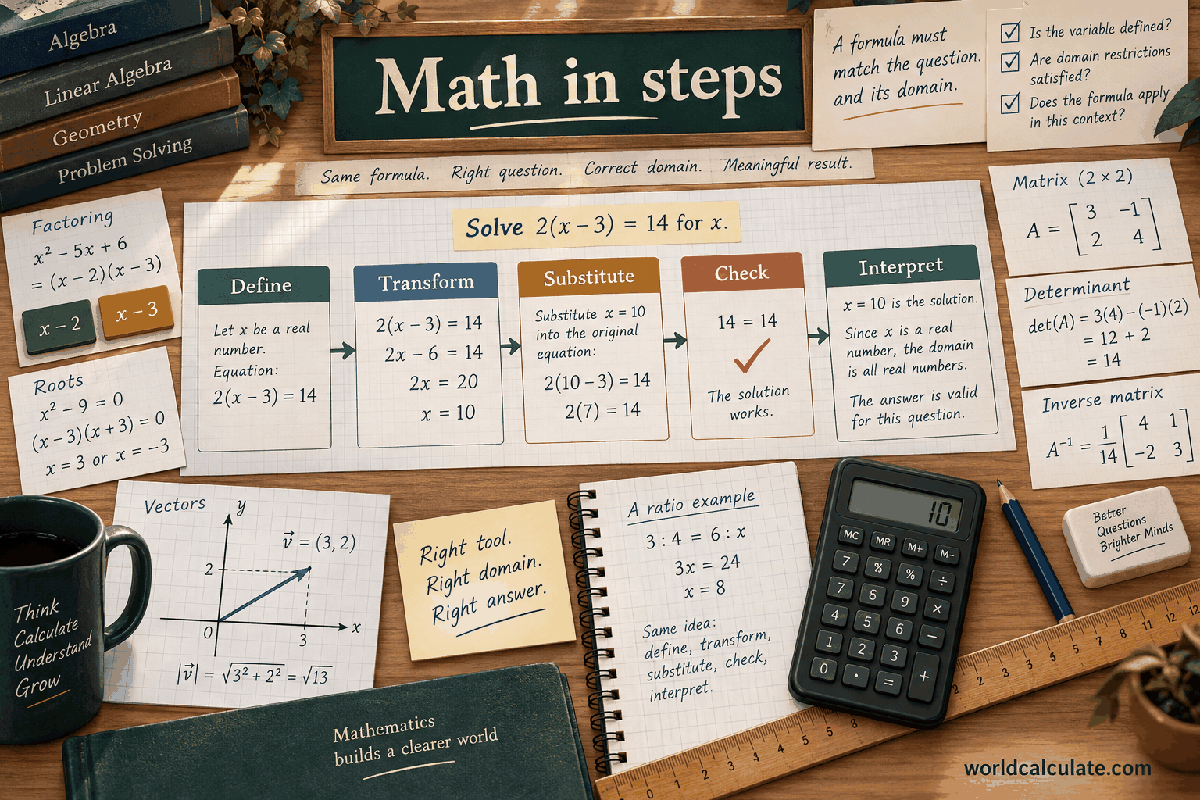
Before calculating an angle, area, or perimeter, check whether the proposed side lengths can close into a triangle at all. The triangle inequality gives that structural test and explains why a zero-area flat arrangement is not treated as a valid triangle here.
For side lengths a, b, and c, each side must be less than the sum of the other two: a < b+c, b < a+c, and c < a+b.
The strict sign matters. Equality produces a straight line with zero area, not an ordinary triangle, so the page reports equality as invalid or degenerate.
The slack for side a is b+c−a. Positive slack means that inequality has room to close; zero means the side exactly consumes the other two; negative slack means it is too long.
Showing all three slacks is more informative than returning only valid or invalid. It tells a learner which condition is close to its boundary.
If a and b are fixed, a third side c must lie between their absolute difference and their sum: |a−b| < c < a+b. Both bounds are open because either endpoint flattens the triangle.
This range is useful before a side is measured. It is a feasibility interval, not a recommendation for a physical design; measurement tolerance must be considered separately.
For a valid triangle, let s be the semiperimeter, (a+b+c)/2. Heron's formula computes area as √(s(s−a)(s−b)(s−c)). The page applies it only after the strict check passes.
Skipping validation can lead to a square root of a negative number for invalid inputs. Returning no area in that case is a correctness feature.
With sides 3, 4, and 5, the slacks are 6, 4, and 2. All are positive, so the triangle is valid. Its semiperimeter is 6 and Heron's formula returns area 6.
The area agrees with the familiar right-triangle result, but the inequality check does not assume the triangle is right. It is a general feasibility step.
Sides 1, 2, and 3 fail because 1+2−3 equals zero. They can lie end to end as a straight line, but they cannot enclose positive area. Sides 1, 2, and 4 fail because 1+2−4 is negative.
A very small positive slack may be mathematically valid while being impractical for a physical measurement. The calculator reports the mathematics, not the application's uncertainty.
The page does not identify angles, orientation, coordinates, material, or construction safety. It does not convert between units, so compatible units must be entered before comparing sides.
It also does not replace a survey, CAD constraint solver, or specification. The open bounds describe an ideal Euclidean condition.
A side equal to the sum of the other two forms a straight configuration, not a non-degenerate triangle. Heron area is withheld for an invalid set because its radicand is not a valid positive-area model.
Any side can be checked; the three inequalities are symmetric. The reported third-side interval simply uses the entered a and b as the fixed pair for a planning view.
Check whether three positive lengths can form a non-degenerate triangle, show every inequality slack, and calculate Heron area when valid.
A non-degenerate triangle requires a < b+c, b < a+c, and c < a+b; when valid, Heron area = √(s(s−a)(s−b)(s−c)). Three positive numbers are not automatically the sides of a triangle. Each side must be shorter than the sum of the other two. This calculator reports the three slacks, the possible open range for a third side, and the area only when strict conditions are satisfied.
Enter Side a, Side b, Side c, then choose Calculate.
The three inputs are positive real lengths in compatible units. A flat zero-area configuration is treated as invalid because the inequalities are strict. The sides describe an ordinary Euclidean triangle, not a spherical or hyperbolic triangle. Heron's formula is used only after the inequalities pass. The possible third-side bounds are open: |a−b| < c < a+b. The tool does not account for measurement tolerance, uncertainty, construction fit, or surveying error. Very large or very small values remain subject to finite-number display and precision limits.
This calculator is part of the WorldCalculate library. Its formula, example, assumptions, input bounds, and output formatting follow the official methodology.
These WorldCalculate collections connect this tool with related questions while keeping each calculation separate and transparent.