
Goal
Solve the missing fourth term in a:b = c:x and show the equivalent ratio.
Worldwide context
Saved once here, used across the site.
Currency changes display only. Country selection guides tax input; no tax rate is guessed.
Solve the missing fourth term in a:b = c:x and show the equivalent ratio.
For a:b = c:x, x = b x c / a.A clearer path to an answer
This page keeps the calculation transparent: define the goal, enter the matching values, inspect the method, and decide what the result means in your situation.
Solve the missing fourth term in a:b = c:x and show the equivalent ratio.
First term a · Second term b · Known third term c
For a:b = c:x, x = b x c / a.
Calculate, review the assumptions below, then compare a related tool when the decision needs more context.
Solve the missing fourth term in a:b = c:x and show the equivalent ratio.
Open the Ratio Calculator pageMore math tools
Download PDFDownload Word (.doc)
Enter your values above and choose Calculate to see the result here.
Calculation map
For a:b = c:x, x = b x c / a.
Bounded, transparent calculation
Your recent runs stay in this browser session only.
Formula: For a:b = c:x, x = b x c / a.
The tool solves a proportion rather than confusing a ratio with a percentage or a unit conversion.
Worked example: 2:3 = 10:15, so the missing fourth term is 15.
The displayed limits are checked before the handler runs. Model-specific domain checks may also reject impossible or non-finite inputs.
Methodology: This calculator follows the WorldCalculate input, formula, precision, and boundary policy. Read the official methodology.
Calculator usage statistics
This section counts anonymous successful Calculate submissions, not unique visitors. Counts and top tools appear only when trusted aggregate data is available; country analysis is shown only under the same condition and reporting threshold.
Answer-first guide
Solve the missing fourth term in a:b = c:x and show the equivalent ratio. Start with one clearly defined goal, enter values in the units shown, and keep the result attached to the assumptions below.
This tool is useful when your question includes ratio calculator, proportion, equivalent ratios. It returns the outputs declared in the calculator contract rather than a live quote, approval, diagnosis, or professional sign-off.
First term a · Second term b · Known third term c. Keep the same time period, unit system, and currency wherever the form requires comparable values.
Run the worked example first, compare its output with the page's example, then change one input at a time. This makes an unexpected result easier to trace to a unit, boundary, or assumption.
Need a wider view? Browse Math Calculators or compare the related tools below. The WorldCalculate methodology explains how formulas, examples, limits, and revisions are reviewed.
For a:b = c:x, x = b x c / a.
The tool solves a proportion rather than confusing a ratio with a percentage or a unit conversion.
2:3 = 10:15, so the missing fourth term is 15.
Context and background
Math calculators move from named quantities to a relation, then to a result that can be checked with substitution, units, or an alternate form.
Arithmetic, algebra, geometry, trigonometry, and number theory provide reusable structures for classroom work and everyday reasoning. Each page narrows that structure to one declared problem.
Research and review
Researched by Hassan ALRowaie, Founder and editorial researcher at WorldCalculate.
This guide follows the live calculator's declared inputs, formula, worked example, assumptions, validation boundaries, and source-backed methodology. The review date describes editorial review of the calculator explanation; it is not a promise that external facts or rates remain current.

A ratio compares two quantities in an ordered relationship. This calculator uses the proportion a: b = c: x and solves for the missing fourth term x with x = b x c / a. You enter three finite numeric terms, and the page returns the missing value plus an equivalent form of the right-hand ratio c: x. The first term a must not be zero. The other terms may be positive, zero, or negative, and the arithmetic keeps their signs rather than replacing them with absolute values. The equivalent-ratio display follows an intentionally exact contract: it is reduced with a greatest-common-divisor step only when both c and the computed missing value are integers and their common divisor is positive. Noninteger values remain in the displayed c: x form. The guide explains the equation, signs, zero cases, simplification branch, validation, and the boundary between a ratio calculation and percentage or unit conversion.
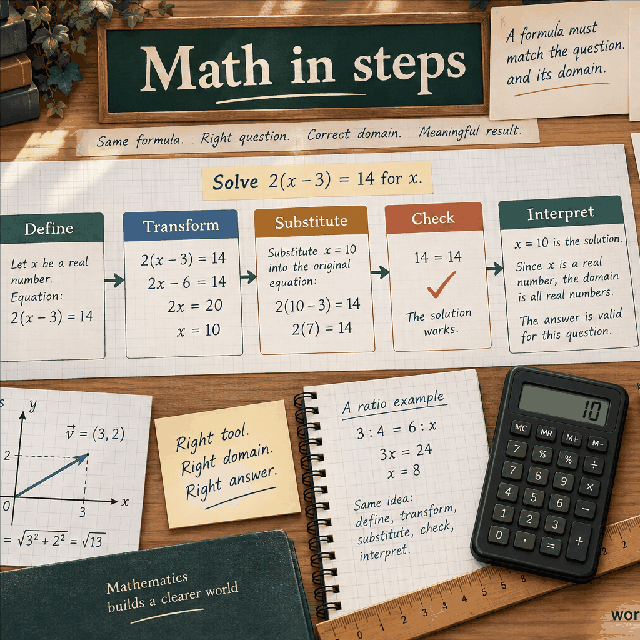
The calculator starts with a proportion written as a: b = c: x. The first ratio has known terms a and b. The second ratio has known term c and an unknown fourth term x. The goal is not to compare two arbitrary values or calculate a percentage; it is to find the number that makes the two ordered ratios equal under the displayed equation. Keeping the positions visible prevents a common mistake in which the known terms are paired with the wrong denominator.
A ratio is ordered. The pair a: b is not automatically interchangeable with b: a, and c: x is not the same arrangement as x: c. Reversing both sides can describe a related reciprocal relationship, but reversing only one side changes the problem. This page follows the field labels and formula exactly: a is the first term, b is the second, c is the known third term, and the result fills the fourth position.
The result is a numerical missing term followed by an equivalent-ratio text result. The second result is based on c and x, not a claim that every possible representation of the proportion has been listed. Read the result together with the input order and the formula. A bare number without its positions can be misleading, especially when signed or zero terms are involved.
The First term a field supplies the denominator used when solving for x. The Second term b is multiplied by c. The Known third term c becomes the first displayed term of the equivalent right-hand ratio. The field labels are deliberately explicit because a proportion is easier to audit when every position has a name rather than an unlabeled list of three numbers.
Each field accepts a finite number from negative one billion through positive one billion. Decimal notation and signed values are allowed. The engine rejects a nonfinite value, such as an infinite result supplied by an integration, and it rejects a value outside the stated range. The first term has one additional rule: a cannot be zero because solving the equation would require division by zero.
The fields do not ask for units, currency, percentages, or a scale description. If the terms represent quantities with units, the units must be compatible with the relationship you are modeling. The calculator performs the entered arithmetic; it cannot tell whether a ratio of lengths, amounts, counts, or abstract values makes sense in your context.
Starting with a: b = c: x, interpret each ratio as a fraction: a divided by b is equal to c divided by x only if the notation and denominator positions are being used consistently. For the calculator's stated missing-fourth-term contract, the direct cross-multiplication step is written as a x = b c. Solving that equation for x gives x = b c / a. The page shows this relationship so the multiplication order is not hidden behind a result number.
The formula can be checked by substituting the result back into a x = b c. Replacing x with b c / a gives a times b c / a, which returns b c whenever a is nonzero. That is the reason for the nonzero rule. It is an algebraic condition of the solution, not an arbitrary preference about acceptable inputs.
The calculation uses the signed values as entered. It does not apply absolute value before multiplying, and it does not force the result to be positive. A negative product divided by a positive first term remains negative, while two negative factors can produce a positive product. Sign behavior follows ordinary multiplication and division throughout the formula.
Use a = 2, b = 3, and c = 10. The formula gives x = 3 x 10 / 2, so x = 15. The proportion is therefore 2:3 = 10:15. The cross products match: 2 x 15 equals 30, and 3 x 10 also equals 30. This is the catalog example and provides a compact reference for the field order.
The right-hand ratio 10:15 contains whole numbers, so the simplification branch can inspect their common divisor. The greatest common divisor of the absolute values 10 and 15 is 5. Dividing both displayed terms by 5 yields 2:3. The calculator reports that reduced equivalent ratio alongside the missing numeric term.
Notice that the calculator did not need to guess a scale factor from a visual pattern. It derived x from the equation and then used a separate integer reduction step for the right-hand pair. Keeping those two operations separate makes it easier to understand why a decimal result is still valid even when no integer reduction is shown.
A signed input is still a valid input when it is finite and within the field range. The handler carries the sign through b x c / a. For example, with a = 2, b = -3, and c = 10, the result is x = -15. With a = -2, b = 3, and c = 10, the result is also x = -15 because a negative denominator reverses the sign of the quotient. The sign is arithmetic information, not an error label.
With two negative factors in the numerator, the product is positive. If a = -2, b = -3, and c = 10, then b x c is -30 and division by -2 gives x = 15. If c is also negative, the sign changes again according to ordinary multiplication. The page does not normalize a signed ratio into positive magnitudes because doing so would discard the convention supplied by the user.
The equivalent-ratio text preserves signs as well. Its common divisor is calculated from absolute values, but the division is applied to the original signed c and x. That means a negative pair can reduce to a form such as -2:-3 rather than becoming 2:3. The positive divisor normalizes the shared scale, not the direction or sign of either term.
The first term a cannot be zero because the formula divides by a. The second term b may be zero, and when b is zero the computed missing term is zero for every allowed nonzero a, regardless of the value of c. This follows directly from x = b c / a. It does not mean that every ratio notation involving zero can be rearranged freely; it only describes the operation this page applies to the entered positions.
The known third term c may also be zero. When c is zero, the computed missing term is zero unless a or b creates a different arithmetic issue, and a is already required to be nonzero. The right-hand display then contains 0:0. A pair with both terms zero has no positive common divisor that can reduce both values into a new ratio, so the exact display branch leaves it as 0:0.
Zero is not the same as an empty field or an invalid nonnumeric value. It carries a mathematical meaning in the multiplication. What matters is whether the zero appears in the denominator position represented by a. If a source problem uses a different ratio arrangement, rewrite it into the calculator's a: b = c: x positions before deciding whether its zero is allowed.
The page returns an Equivalent ratio text value after calculating x. It first checks whether c is an integer and whether the computed missing value is an integer. Only when both checks pass does it calculate the greatest common divisor of the absolute values of c and x. If that common value is positive, the output is c divided by the common value, followed by a colon, followed by x divided by the common value.
This means simplification is conditional rather than cosmetic. The calculator does not round a decimal x so that a greatest common divisor can be invented. It does not simplify a pair containing a noninteger computed value, even if the decimal looks close to a fraction. In that branch the output remains the displayed c: x form. The exact distinction protects the relationship between the numeric result and the text result.
The positive common divisor is found from magnitudes so that negative signs are not treated as a shared scale. After the divisor is found, the original signs are retained during division. If the common divisor is zero, no division is performed and the pair is printed in its original c: x order. That final condition matters for the 0:0 edge case.
Suppose a = 4, b = 6, and c = 14. The missing term is x = 6 x 14 / 4 = 21. Both right-hand terms are integers, and gcd(abs(14), abs(21)) is 7. The equivalent ratio therefore reduces from 14:21 to 2:3. The reduction does not change the cross-product relationship; it only removes a shared integer scale from the two displayed terms.
With signs, take a = 4, b = -6, and c = 14. The missing term is -21. The common divisor is still 7 because it is based on absolute values. Dividing the original terms gives 2:-3. The negative sign is not erased, and the order remains c first and x second. A reader can still recover the original sign relationship from the reduced pair.
If c and x share no divisor greater than one, the equivalent ratio may look unchanged. For c = 5 and x = 7, the common divisor is 1, so the output is 5:7. A gcd of one is still a successful integer check; it simply indicates that the pair is already reduced under the positive common-divisor convention.
Take a = 3, b = 2, and c = 5. The missing term is x = 10/3, which is not an integer. The handler still returns the numeric value, subject to its ordinary result formatting, but it does not pretend that the right-hand pair is an integer ratio ready for gcd reduction. The equivalent text remains c: x, using the computed value rather than a rounded substitute.
This behavior is important for proportional reasoning. A decimal or fractional answer is not a failure merely because it cannot be represented as two whole terms in the display branch. Rounding 10/3 to 3 would produce a different cross product and would no longer solve the entered equation. Keeping the noninteger value visible is more faithful than displaying a neat but false reduced pair.
If you need an exact fractional representation for a decimal input, use a workflow that preserves rational numerator and denominator information from the start. This calculator receives JavaScript finite numbers, not symbolic fractions, and its documented equivalent-ratio branch intentionally reduces only the integer values it can identify exactly. Do not infer an unrevealed rational form from a rounded screen value.
Ratios can be written with different common scales. The pairs 2:3, 4:6, and 10:15 describe the same positive relationship because each term in a pair is multiplied by the same nonzero scale. The calculator's reduction step removes a common integer scale from the right-hand pair when its contract permits. It does not recalculate the left-hand inputs or claim that the original field values were themselves reduced.
A common scale must be applied to both terms. Dividing only c or only x changes the relationship. Multiplying one term by a factor while leaving the other fixed also changes the cross product. When checking an equivalent ratio by hand, compare cross products or divide both terms by the same positive divisor. This keeps equivalence separate from an arbitrary alteration of one field.
Signed ratios add another reason to preserve order and scale. A negative common factor could move signs between terms, but this calculator deliberately uses a positive gcd from absolute values and keeps the original signs in place. That gives a stable, readable convention for the text result instead of presenting multiple sign-equivalent spellings.
A ratio and a percentage can be related, but they answer different questions. A ratio such as 2:3 keeps two ordered quantities visible. A percentage usually describes one quantity relative to a chosen whole and requires a stated conversion convention. This calculator does not multiply a result by 100, attach a percent sign, or decide which term should be treated as the denominator of a percentage.
The same numbers can have different meanings in different contexts. A ratio of 2:3 might describe a mixture relationship, a geometric scale, or an abstract comparison. Turning it into 66.67 percent would require deciding that 3 is the whole and 2 is the part, while another context might use the sum 2 + 3 as the whole. That interpretation is not encoded by the three fields.
Units also need their own check. Ratios of like units can be dimensionless after cancellation, while a proportion involving different but compatible units may express a conversion rate. The page only applies the numerical relationship you enter. It does not convert units, select a denominator convention, or attach a domain meaning to a sign.
The input bounds allow values as small as a nonzero finite number near zero. Because a appears in the denominator, a very small magnitude can make b x c / a very large. The result formatter refuses a nonfinite numeric result rather than displaying infinity or an unusable value as though it were ordinary output. This is a result-safety check, not a claim that every large finite number is meaningful in a physical context.
If a result is unexpectedly rejected, inspect the magnitude of a and the product b x c. Confirm that all three inputs are numeric, finite, and within the inclusive field range. Also check that the intended denominator was entered as a rather than accidentally placed in b or c. A valid proportion with a different field order can still produce an invalid result when transcribed into this page incorrectly.
The range limits bound browser work and keep the calculator contract explicit. They are not a statement about the largest ratio that mathematics can represent, nor are they a recommendation for a real measurement. A larger problem should be handled in a number system and unit convention selected for that problem, with overflow and precision behavior understood.
The fastest independent check is the cross product. After the calculator returns x, calculate a x x and compare it with b x c using the same entered numbers. Small decimal discrepancies can reflect ordinary numeric representation, but a large discrepancy usually signals a field-order mistake or a copied value error. For integer examples, exact multiplication provides a simple audit with no rounding ambiguity.
A second check is sign analysis. Determine the sign of b x c, then determine whether division by a keeps or reverses that sign. If the displayed result disagrees with that expectation, re-read the signs and positions. A third check is scale: if b doubles while a and c remain fixed, x should double; if a doubles while b and c remain fixed, x should halve in the algebraic model.
Finally, inspect the equivalent-ratio branch rather than treating it as a separate answer. If c and x are integers, calculate gcd(abs(c), abs(x)) and divide both original signed terms by that positive number. If either is noninteger, expect the unsimplified c: x text. These checks mirror the contract and make it easier to spot a mistaken assumption about when reduction occurs.
The calculator is useful for a homework proportion, a scale comparison, a repeated-unit relationship, or a quick arithmetic check where three terms are known and the fourth is missing. It can also help explain why a negative or zero result is not automatically invalid when the underlying relationship permits signed values. The visible formula and equivalent-ratio output make a small calculation easier to discuss with another reader.
It is not a measurement instrument, a data-quality judge, or a domain-specific decision rule. The page cannot tell whether an entered ratio describes a safe mixture, a valid financial assumption, a fair allocation, or a correct physical model. It also cannot infer missing units or decide whether a sign represents direction, debt, orientation, or a bookkeeping convention. Those meanings must be supplied and reviewed outside the arithmetic.
If the source problem has more than one unknown, a list of several ratios, uncertainty ranges, or symbolic variables, this single proportion is too small a model. Write down the full relationship first and reduce it to a: b = c: x only when that transformation preserves the intended positions. A cleanly bounded tool is more reliable when its boundary is respected.
Write the intended relationship as a: b = c: x before entering numbers. Put the denominator position that must be nonzero into a. Enter finite values within the supported range, retaining signs and zeros exactly as the source problem states. Then calculate x = b x c / a and read the numeric result with its fourth-term meaning rather than as an unlabeled standalone value.
Next, inspect the Equivalent ratio output. If c and x are both integers, the page finds gcd(abs(c), abs(x)) and reduces only when that gcd is positive. If either displayed value is noninteger, it retains c: x without rounding. If both values are zero, the common divisor is not positive, so the pair remains 0:0. These details are the exact text-output contract.
Finally, verify the cross products and keep the scope honest. The tool preserves signed finite arithmetic, but it does not decide whether a ratio has a useful real-world interpretation. It does not convert the result to a percentage, add units, or provide advice. The best use is a transparent proportion check whose inputs, signs, positions, and reduction rule can all be explained.
Solve the missing fourth term in a:b = c:x and show the equivalent ratio.
For a:b = c:x, x = b x c / a. The tool solves a proportion rather than confusing a ratio with a percentage or a unit conversion.
Enter First term a, Second term b, Known third term c, then choose Calculate.
The first ratio term is not zero. Inputs can be signed; the result preserves the entered arithmetic convention.
This calculator is part of the WorldCalculate library. Its formula, example, assumptions, input bounds, and output formatting follow the official methodology.
These WorldCalculate collections connect this tool with related questions while keeping each calculation separate and transparent.