
Goal
Check whether a nonnegative whole number is the square of an integer.
Worldwide context
Saved once here, used across the site.
Currency changes display only. Country selection guides tax input; no tax rate is guessed.
Check whether a nonnegative whole number is the square of an integer.
n is a perfect square when its integer square root r satisfies r x r = n.A clearer path to an answer
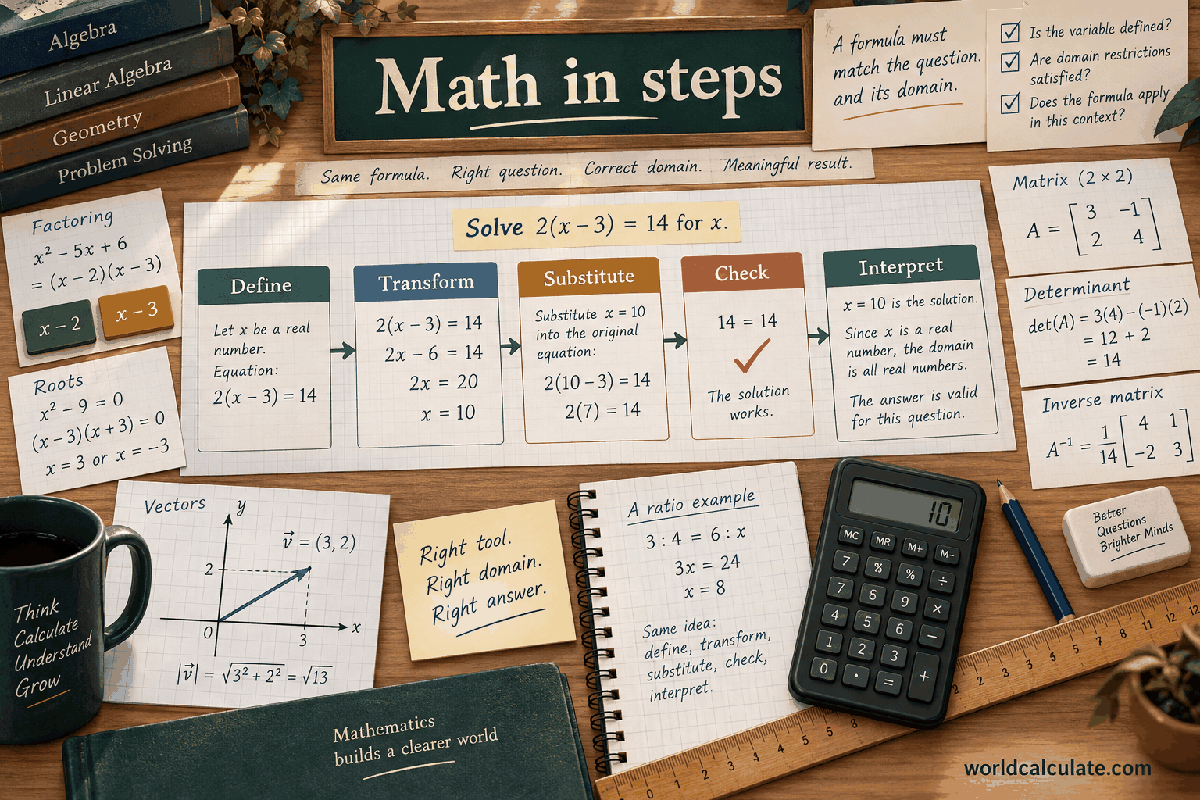
This page keeps the calculation transparent: define the goal, enter the matching values, inspect the method, and decide what the result means in your situation.
Check whether a nonnegative whole number is the square of an integer.
Whole number
n is a perfect square when its integer square root r satisfies r x r = n.
Calculate, review the assumptions below, then compare a related tool when the decision needs more context.
Check whether a nonnegative whole number is the square of an integer.
Open the Perfect Square Test pageMore math tools
Download PDFDownload Word (.doc)
Enter your values above and choose Calculate to see the result here.
Calculation map
n is a perfect square when its integer square root r satisfies r x r = n.
Bounded, transparent calculation
Your recent runs stay in this browser session only.
Formula: n is a perfect square when its integer square root r satisfies r x r = n.
The test finds the integer square root and compares its square with the input. It does not round a nearby non-square into a positive result.
Worked example: 144 is a perfect square because its integer square root is 12.
The displayed limits are checked before the handler runs. Model-specific domain checks may also reject impossible or non-finite inputs.
Methodology: This calculator follows the WorldCalculate input, formula, precision, and boundary policy. Read the official methodology.
Calculator usage statistics
This section counts anonymous successful Calculate submissions, not unique visitors. Counts and top tools appear only when trusted aggregate data is available; country analysis is shown only under the same condition and reporting threshold.
Answer-first guide
Check whether a nonnegative whole number is the square of an integer. Start with one clearly defined goal, enter values in the units shown, and keep the result attached to the assumptions below.
This tool is useful when your question includes perfect square, square number, integer square root. It returns the outputs declared in the calculator contract rather than a live quote, approval, diagnosis, or professional sign-off.
Whole number. Keep the same time period, unit system, and currency wherever the form requires comparable values.
Run the worked example first, compare its output with the page's example, then change one input at a time. This makes an unexpected result easier to trace to a unit, boundary, or assumption.
Need a wider view? Browse Math Calculators or compare the related tools below. The WorldCalculate methodology explains how formulas, examples, limits, and revisions are reviewed.
n is a perfect square when its integer square root r satisfies r x r = n.
The test finds the integer square root and compares its square with the input. It does not round a nearby non-square into a positive result.
144 is a perfect square because its integer square root is 12.
Context and background
Math calculators move from named quantities to a relation, then to a result that can be checked with substitution, units, or an alternate form.
Arithmetic, algebra, geometry, trigonometry, and number theory provide reusable structures for classroom work and everyday reasoning. Each page narrows that structure to one declared problem.
Research and review
Researched by Hassan ALRowaie, Founder and editorial researcher at WorldCalculate.
This guide follows the live calculator's declared inputs, formula, worked example, assumptions, validation boundaries, and source-backed methodology. The review date describes editorial review of the calculator explanation; it is not a promise that external facts or rates remain current.
A perfect square is a nonnegative whole number that can be written as an integer multiplied by itself. This calculator answers that question exactly for one safe whole-number input from 0 through 1,000,000,000,000. It finds the integer square root r, meaning the greatest integer whose square does not exceed n, and then checks the decisive equality r * r = n. A Yes result means the entered number is exactly a square; a No result means it lies between two consecutive squares. The page never changes a nearby non-square into a square just because a decimal square root rounds close to an integer. This guide explains the definition, input contract, floor-root algorithm, precision boundary, useful mental checks, factor and geometry connections, programming implications, and the limits of treating this page as an exact predicate rather than a general radical simplifier.
A perfect square is an integer that equals k multiplied by k for some integer k. The word perfect emphasizes exactness: there must be an integer whose product with itself is the input, with no fractional remainder and no approximation. Examples include 0, 1, 4, 9, 16, 25, and 36 because they are 0 * 0, 1 * 1, 2 * 2, 3 * 3, 4 * 4, 5 * 5, and 6 * 6. The square-number sequence continues indefinitely, but this calculator works inside a deliberately finite input interval.
Negative integers can be used as the multiplier k, but they do not create negative squares. Both 7 * 7 and -7 * -7 equal 49. For that reason, every integer square is nonnegative. The calculator reports the nonnegative root, so it uses 7 as the integer square root of 49 rather than presenting both 7 and -7. This is a choice of representation, not a claim that the negative factor is impossible in the underlying multiplication.
It helps to separate three related ideas. The number 49 is the perfect square, 7 is its nonnegative integer square root, and the operation 7 * 7 is the multiplication that proves the relationship. A calculator that returns Yes and an integer root is answering whether the first object has the second relationship. It is not merely displaying a decimal approximation to a square root. That distinction becomes important for values such as 50, whose real square root is close to 7 but whose exact integer relationship is different.
The Whole number field accepts a nonnegative safe whole number from 0 through 1,000,000,000,000, inclusive. In programming terms, the value must be finite, integral, and safely represented by the numeric type used by the calculator. The lower endpoint is valid, the upper endpoint is valid, and every integer between them is part of the supported domain. A decimal such as 144.0 may display as a whole-looking value in some interfaces, but the mathematical contract still requires an integer value rather than a fraction or a value that needs interpretation.
The word safe protects the exactness of the input before the square test begins. JavaScript Number can represent all integers in this page's interval exactly because 1,000,000,000,000 is below the Number safe-integer limit. That does not mean every larger integer can be entered as a Number without loss. A value that was already rounded by a form, spreadsheet, or program cannot be recovered by the square test. The calculator therefore rejects an invalid or unsafe input instead of silently substituting a nearby integer.
A negative value is outside this page even though negative numbers can appear in other square-root discussions. The ordinary real square of an integer is never negative, but rejecting a negative input also keeps the page's classification contract visible: it tests nonnegative whole numbers only. Decimals, fractions, infinity, text that is not a number, and values above the maximum need a different input and output policy. They are not rounded, truncated, or converted into the nearest supported value here.
For every nonnegative integer n, there is a unique nonnegative integer r that satisfies r * r <= n < (r + 1) * (r + 1). This r is called the integer square root, or the floor of the real square root. It is the largest whole number whose square fits at or below n. The calculator uses this r as its root result. The perfect-square predicate is then one exact comparison: if r * r equals n, the answer is Yes; otherwise the answer is No.
The inequality explains what the root result means when the answer is No. If n is 145, r is 12 because 12 * 12 = 144 and 13 * 13 = 169. The number 145 is larger than 144 and smaller than 169, so no integer square can equal it. If n is 144, the same lower comparison becomes an equality: 12 * 12 = 144, so the answer is Yes. There is no need to guess a root between 12 and 13 because the exact integer question has already been settled.
The integer root is not the nearest integer to the real square root. For a non-square, nearest and floor can differ, especially when the value lies closer to the next square. This page deliberately uses the floor root because it gives a stable interval witness for every input. A returned root of 12 on a No result does not claim that the true radical is exactly 12. It says that 12 is the greatest integer with a square no larger than the input.
Use n = 144 as the direct example. The integer square root is 12, and 12 * 12 = 144 exactly. The calculator returns Perfect square: Yes and Integer square root: 12. A written check can stop there because the defining equality holds. It is stronger than saying that a square-root button displayed 12, since the multiplication reconstructs the original input without an approximation step.
Change the input by one to n = 145. The integer square root remains 12 because 144 <= 145 and 145 < 169. However, 12 * 12 is 144, not 145, so the calculator returns No. This neighboring example shows why a square test cannot infer membership from a root that looks close. The first number is a square and the next number is not, even though their floor roots are the same.
Try n = 50 for another non-square. Seven squared is 49 and eight squared is 64, so the integer root is 7 and the result is No. For n = 81, the root is 9 and 9 * 9 = 81, so the result is Yes. For n = 999, the root is 31 because 31 * 31 = 961 while 32 * 32 = 1024. These examples make the two-part check visible: locate the interval first, then compare the lower square with n.
Zero is a perfect square because 0 * 0 = 0. Its integer square root is 0, and the calculator should return Yes rather than treating zero as missing, false, or invalid. Zero is also the first member of the square-number sequence. The surrounding inequality works without a special numerical trick: 0 * 0 <= 0 < 1 * 1. This makes zero a useful test of both the mathematical definition and the lower input boundary.
One is also a perfect square because 1 * 1 = 1. Its integer square root is 1. The first few values therefore begin 0, 1, 4, 9, 16, and 25. Notice that the jump from 0 to 1 is one, the jump from 1 to 4 is three, and the jump from 4 to 9 is five. Those odd-number gaps provide a useful pattern for mental work, while the calculator still uses the exact root-and-square comparison rather than relying on a sequence table.
The values immediately around one illustrate the boundary between a square and a non-square. Zero is square, one is square, two lies between 1 and 4, and three also lies between 1 and 4. Thus both 2 and 3 receive No with integer root 1. Treating a small non-square as an exceptional approximation would weaken the definition; the same exact rule applies at the smallest inputs and at the largest supported inputs.
The largest accepted input is itself a perfect square: 1,000,000,000,000 equals 1,000,000 * 1,000,000. The calculator therefore returns Yes and an integer square root of 1,000,000 at the upper endpoint. This is a useful boundary example because the input has thirteen decimal digits while its root has seven. The range limit is an engineering contract for safe, predictable numeric work, not a statement that square numbers stop there.
Now consider 999,999,999,999, which is one less than the largest supported square. It is not a perfect square. The lower neighboring square is 999,999 * 999,999 = 999,998,000,001, and the next square is 1,000,000 * 1,000,000 = 1,000,000,000,000. The integer root is 999,999, but its square is not the input. This example is deliberately close to a square and demonstrates why a one-unit difference cannot be ignored.
Floating-point square-root functions return approximations even when their result is printed with many reassuring digits. A calculation that tests whether an approximate root is close to a whole number can accidentally accept a non-square, especially when it uses a fixed tolerance that is too large for the scale of n. Near one million, consecutive square roots are separated by a small amount, so closeness in the decimal root does not prove equality of the original integers. The safer order is to obtain a candidate integer root, multiply it by itself using exact integer arithmetic within the supported range, and compare that product with n.
For this page, all accepted inputs and all possible root squares remain within the exact safe range of the JavaScript Number type. That makes the final comparison reliable after the integer root has been corrected. It does not make floating-point arithmetic exact in general, and it does not authorize larger inputs. If an application must process integers beyond the safe range, it should preserve the input as text and use an arbitrary-precision integer-square-root routine rather than passing a rounded Number into this handler.
The handler begins with the floor of the built-in square-root result. That first estimate is efficient, but it is not treated as the final authority. The code then checks whether the proposed root is too small or too large. If the next integer's square is still no greater than n, the root is increased. If the current root's square is greater than n, the root is decreased. These correction steps continue until the defining floor-root inequalities hold.
This matters because a floating-point square-root routine can have a tiny representation error at a boundary. The correction loops use integer-looking products and comparisons to recover the correct discrete answer. For example, if an estimate landed one below the true floor root, the upward check would find that (r + 1) * (r + 1) still fits and would advance it. If an estimate landed one above the true floor root, the downward check would see that r * r is too large and would reduce it. The final equality test happens only after this correction.
The algorithm does not generate every square from zero and does not search through all possible factors. It starts near the answer and makes only the adjustments required to establish the interval. The input maximum also keeps every product within the calculator's exact numeric range: the largest possible root is 1,000,000, and its square is 1,000,000,000,000. The result is deterministic and bounded, which is useful for a browser page that must respond predictably to every valid input.
A binary-search implementation can find the same floor root without using a floating-point square root. Set a lower candidate of 0 and an upper candidate of 1,000,000 for this page. Test the midpoint. If midpoint * midpoint is less than or equal to n, keep that midpoint as a possible answer and search higher; if it is greater than n, search lower. When the interval closes, the largest candidate whose square fits is r. Because the range contains at most about one million candidates, only around twenty halvings are needed.
An integer version of Newton's method is another option. Starting from a positive estimate x, repeatedly replace it with the integer quotient of x + n / x divided by 2, then correct the candidate and verify its square. The n = 0 case needs a direct return of 0 because division by zero must not occur in the iteration. Newton-style methods can converge quickly, but the stopping condition and final adjustment still matter; an approximate iteration is not complete until the exact inequalities and equality check have been performed.
There is also a pattern based on odd numbers: 1 + 3 + 5 +... + (2k - 1) = k * k. It can explain why the gaps between successive squares are 1, 3, 5, 7, and so on. Repeatedly subtracting odd numbers is educational for small values but is not a practical general algorithm for a large input. Whether a program uses correction, binary search, Newton iteration, or another integer method, the final contract is the same: return the floor root and classify Yes only when r * r equals n.
Mental checks are useful for rejecting impossible candidates quickly. A square can end only in 0, 1, 4, 5, 6, or 9 in decimal notation. Therefore a number ending in 2, 3, 7, or 8 cannot be a perfect square. This is a necessary condition, not a complete test: 21 ends in 1 but is not square, while 121 ends in 1 and is square. The final exact multiplication remains necessary when a candidate survives the last-digit filter.
Modulo checks provide stronger small filters. A square is congruent to only 0 or 1 modulo 4, so a number with remainder 2 or 3 after division by 4 cannot be square. Modulo 8, the possible square remainders are 0, 1, and 4. Modulo 9, the possible remainders are 0, 1, 4, and 7. These facts can make a hand check faster, but they do not certify every surviving number. For example, 49 passes every simple filter because it really is 7 * 7; many non-squares also pass some filters.
Known squares and intervals are often the most practical mental method. If you remember that 20 * 20 = 400 and 21 * 21 = 441, then every integer from 401 through 440 is not square. For a number such as 428, no multiplication search is needed once it is located in that interval. For a larger number, estimate the leading digits of the root, test the nearby integers, and keep the lower and upper squares separate. Use estimation to choose candidates, never to replace the equality check.
Perfect squares have a precise factor pattern. For a positive integer, the number is a square exactly when every exponent in its prime factorization is even. For example, 144 = 2 * 2 * 2 * 2 * 3 * 3, so the exponents of 2 and 3 are 4 and 2. Pairing equal prime factors gives 12 * 12. By contrast, 72 has three factors of 2 and two factors of 3, so one factor of 2 remains unpaired and 72 is not a perfect square.
Factor pairs show the same idea without fully writing a prime factorization. The positive factor pairs of 36 are (1, 36), (2, 18), (3, 12), (4, 9), and (6, 6). A square has a middle pair with equal factors, and that repeated factor is its integer root. A non-square has factor pairs that pass from one unequal pair to another without meeting at an equal pair. This is why checking whether a factor pair has equal members can classify a number, although it may be slower than a root test.
The calculator does not factor n, list its divisors, or prove primality. It uses the root relationship directly. A Yes result implies that r is a factor and that the factorization can be paired symmetrically around r, but it does not tell you all of the other factors. A No result does not mean n has no factors; it only means the factors cannot be arranged so that every prime exponent is even and the full number is one integer times itself.
The geometric meaning of a square number is easy to see with a grid. If n unit cells can be arranged in r equal rows and r equal columns, then the grid has r * r cells and n is a perfect square. Sixty-four cells form an 8 by 8 square, so 64 is square. Fifty cells cannot form a filled square grid with an integer side: 7 by 7 uses 49 cells and 8 by 8 needs 64. The calculator's integer root is the largest complete equal side that fits in the count.
Area uses the same formula. A geometric square with an integer side length s has area s * s, so an area expressed as a whole number of square units can be a perfect square when its integer side is relevant. An area of 144 square units has side 12 units under that interpretation. An area of 145 square units has a real side length of square root of 145, but it does not have an integer side, so this page returns No for the whole-number predicate.
Units and measurement assumptions matter. The page accepts an abstract whole number, not a value with a unit conversion, uncertainty interval, or measurement tolerance. A decimal area such as 2.25 square meters may have a meaningful real side of 1.5 meters, but it is not an accepted input for this calculator because the page is not testing rational or real squares. Likewise, changing units can change the numerical representation. Decide what the integer count means before applying a square classification to a physical problem.
In a program, the central operation is a predicate: calculate an integer candidate r and return whether r * r === n. A predicate is deliberately narrower than a general square-root function. It produces a boolean classification, while the calculator also exposes the floor root as a useful witness. Code should keep those meanings separate. A root value of 12 for n = 145 is not permission to replace n with 144; it is evidence that 145 lies in the interval from 144 through 168.
A common implementation mistake is to write a tolerance test such as absolute value of sqrt(n) minus round(sqrt(n)) less than epsilon. That may be reasonable for some noisy measurements, but it is the wrong contract for exact integer membership. The choice of epsilon changes the answer, and a fixed epsilon can be too generous at one scale or too strict at another. Another mistake is to round n before testing it. Both operations answer a different question from whether the original safe integer equals an integer square.
For the current numeric bounds, Number validation and exact multiplication are sufficient. A broader service that accepts identifiers or counts beyond the safe-integer range should use text input and arbitrary-precision integers. In JavaScript, BigInt multiplication can preserve large integer products, but the integer square-root algorithm must also operate on BigInt values and the final output must be designed for serialization. Converting a large BigInt to Number just before the square comparison would discard the precision that the larger design was meant to preserve.
Good tests should cover both the mathematics and the type boundary. Include zero, one, a small non-square, adjacent squares, a large square, one below a large square, the exact maximum, negative input, a decimal, and values just outside the accepted interval. Also test that the returned root satisfies r * r <= n < (r + 1) * (r + 1). A single default example such as 144 cannot detect an off-by-one root, a permissive rounding policy, or a bad upper-bound check.
One mistake is confusing a square with its root. If the input is 144, the answer is not 12 as the square status; 12 is the integer square root, while 144 is the number being classified. Read the result labels carefully. The page returns Yes or No for the predicate and 12 for the root. Writing the multiplication 12 * 12 = 144 prevents the two roles from being swapped.
Another mistake is rounding a nearby non-square. With n = 145, a person may notice that its square root is near 12 and report a square. That changes an exact membership question into a closeness question. The same issue is more dangerous for large numbers, where a value can differ from a square by one while its decimal root looks extremely close. Always square the integer candidate and compare the product with the original input.
Last-digit rules are also easy to overstate. Ending in 1 does not guarantee a square, and passing a modulo filter does not establish an integer root. Negative input should not be repaired with an absolute value, because this page's accepted domain is explicitly nonnegative. Finally, do not mistake the maximum for a mathematical endpoint or assume that a physical measurement with a rounded whole-number display is exact. Each of these shortcuts replaces the stated contract with a different one.
A floating-point number stores a finite approximation to many real values. The real square root of a non-square is usually irrational, so it cannot be represented exactly in a finite decimal or binary floating-point value. Even a square root that is mathematically an integer passes through a numerical operation whose implementation and representation deserve checking. A printed result such as 11.999999999999998 or 12 can be a display of an approximation, not a proof about the original integer.
The correct verification returns to integer arithmetic. Take the candidate integer root, calculate its product with itself, and compare that product with n. If the product is equal, the number is square. If it is lower, the number is not that square; if it is too high, the candidate was not the floor root and must be adjusted. For the supported interval, these products stay within the exact numeric range, so equality is meaningful after validation and root correction.
A tolerance can be useful when measuring a physical quantity that already contains noise, but it has no place in this exact predicate unless the contract explicitly changes. Imagine an input one less than a large square. Its real root is close to the integer root of the square, but calling it square because the difference is small would erase a real integer distinction. The page chooses a stronger rule: no tolerance, no rounded substitute, and no nearby value accepted in place of n.
The page answers whether an accepted whole number is the square of an integer. It does not simplify every radical expression. For example, 72 is not a perfect square, and its integer square root is 8 because 8 * 8 = 64 while 9 * 9 = 81. A separate algebraic simplifier may write the real expression square root of 72 as 6 times square root of 2, but that is a useful simplification of a radical, not a Yes result for this page. The two operations have different domains and outputs.
The same distinction applies to 50, which can be written as 5 times square root of 2 under radical simplification. The calculator returns No and integer root 7 because it is testing whether 50 itself equals an integer square. It does not return an unevaluated radical, factor the radicand to pull out square factors, rationalize a denominator, or provide a decimal approximation of the real square root. Those tasks require more input and a different mathematical representation.
Fractions make the boundary even clearer. A rational value such as 1/4 is the square of 1/2, but it is not an accepted input because this page does not test squares of rational numbers. The contract is specifically nonnegative safe whole numbers that are squares of integers. Exactness does not mean every kind of exact square is included; it means that the narrower question is answered without silently changing the domain.
In number theory and classroom arithmetic, the predicate helps identify members of the square-number sequence and verify an integer-root exercise. It can support a lesson about consecutive squares, factor pairs, prime exponents, or modular filters. The returned root gives a second piece of information that makes a No result explainable: it identifies the lower square and therefore the interval containing n. A student can compare 145 with 12 * 12 and 13 * 13 instead of memorizing a label.
In programming, exact square tests appear in grid sizing, array dimensions, integer geometry, puzzle validation, and algorithms that need to distinguish a square count from an arbitrary count. The result can be used as a gate before constructing an r by r structure. The caller should still validate what n represents. A count of records, a number of pixels, and an area measurement may all be integers while carrying different business meanings and different consequences if a square arrangement is impossible.
In data checks, a perfect-square predicate can flag whether an encoded count has the expected shape or whether a generated test value follows a known pattern. It is useful as one invariant among several, not as proof that a dataset is correct. A square result says only that the integer has an exact repeated-factor form. It does not prove that the data was collected correctly, that a grid will fit a physical surface, or that a downstream formula should use the root without checking its units and assumptions.
This calculator has one numeric input and one bounded mathematical question. It accepts only nonnegative safe whole numbers between 0 and 1,000,000,000,000. It does not accept negative integers, fractions, decimals, measurements with uncertainty, complex values, text identifiers, or arbitrarily large integers. The upper boundary is an intentional implementation and interface limit. A number above it may be a perfectly valid mathematical square, but it is outside the page's supported contract and is rejected rather than approximated.
The result includes a Yes or No classification and the floor integer square root. It does not return a decimal square root for non-squares, list all factors, calculate a prime factorization, simplify radicals, solve an equation with an unknown on both sides, or test whether a rational number is a square of a rational. It also does not decide whether a square interpretation is appropriate for an area, a count, a storage size, or another real-world quantity. Those applications need their own units and assumptions.
Exact arithmetic cannot repair an inexact input. If an upstream system rounded a measurement to a whole number, the result describes the rounded number that was entered, not the unobserved value. Similarly, a Yes result does not establish that the chosen integer root is a physical side length or a permitted layout dimension. Read the output narrowly and accurately: within the declared domain, n is or is not equal to the square of its returned nonnegative integer root.
Start by confirming what n represents and that it is an accepted whole number. Check the sign, the integer property, and the inclusive range before interpreting any result. If you are working by hand, estimate a nearby root or use a last-digit and modulo filter to narrow the candidates. Keep that estimate separate from the proof. The proof is the exact product of the candidate root and itself compared with the original n.
For n = 144, the process is short: the candidate root is 12, 12 * 12 equals 144, and the classification is Yes. For n = 145, the floor root is still 12, but 12 * 12 equals 144 rather than 145; the next square is 169, so the classification is No. For n = 0, use 0 * 0 = 0. For n = 1, use 1 * 1 = 1. These anchors catch sign, endpoint, and off-by-one misunderstandings before a larger example is attempted.
For a large value, write both bounding squares when practical. At the maximum, 999,999 * 999,999 = 999,998,000,001 and 1,000,000 * 1,000,000 = 1,000,000,000,000. The input 1,000,000,000,000 matches the upper square, while 999,999,999,999 lies just below it and does not match either neighboring square. Reporting the input, returned root, equality check, and conclusion gives another reader enough information to reproduce the decision without guessing whether rounding was used.
Why does a non-square still receive an integer root? Because the page returns the floor square root for every valid input. For 50, the root is 7 even though square root of 50 is not the integer 7. The inequality 7 * 7 <= 50 < 8 * 8 explains the result. The Yes or No status is determined separately by checking whether the lower square equals n.
Can a negative integer be a perfect square? A negative integer cannot equal k * k for any real integer k, because every such product is nonnegative. This page rejects negative inputs before calculation rather than returning No for them, since negative values are outside the declared input domain. That distinction is useful: a valid non-square and an invalid input are not the same result state.
Is the largest input accepted? Yes. The input 1,000,000,000,000 is exactly 1,000,000 squared, so it returns Yes with root 1,000,000. Is the next integer also square? No. It is one below that square and remains a valid non-square only if it is within the page's range; the page's exact upper limit means 1,000,000,000,001 is rejected rather than classified.
Why not round the square root and compare the rounded value? Rounding can identify a nearby integer, but it cannot prove that the original n equals that integer's square. The page's purpose is an exact predicate, so it verifies the integer product directly. If you need a decimal radical, a measurement tolerance, or a symbolic simplification, use a tool designed for that broader question instead of interpreting this Yes or No result as an approximation.
Check whether a nonnegative whole number is the square of an integer.
n is a perfect square when its integer square root r satisfies r x r = n. The test finds the integer square root and compares its square with the input. It does not round a nearby non-square into a positive result.
Enter Whole number, then choose Calculate.
The input is a nonnegative safe whole number. Only integer squares are classified as perfect squares. The result does not factor the number or estimate irrational roots beyond the displayed integer root.
This calculator is part of the WorldCalculate library. Its formula, example, assumptions, input bounds, and output formatting follow the official methodology.
These WorldCalculate collections connect this tool with related questions while keeping each calculation separate and transparent.