
Goal
Check a supplied sine and cosine pair against the Pythagorean identity and calculate tangent and reciprocal identities when defined.
Worldwide context
Saved once here, used across the site.
Currency changes display only. Country selection guides tax input; no tax rate is guessed.
Check a supplied sine and cosine pair against the Pythagorean identity and calculate tangent and reciprocal identities when defined.
sin²(θ)+cos²(θ)=1; tan(θ)=sin(θ)/cos(θ); sec(θ)=1/cos(θ); csc(θ)=1/sin(θ).A clearer path to an answer
This page keeps the calculation transparent: define the goal, enter the matching values, inspect the method, and decide what the result means in your situation.
Check a supplied sine and cosine pair against the Pythagorean identity and calculate tangent and reciprocal identities when defined.
sin(θ) · cos(θ)
sin²(θ)+cos²(θ)=1; tan(θ)=sin(θ)/cos(θ); sec(θ)=1/cos(θ); csc(θ)=1/sin(θ).
Calculate, review the assumptions below, then compare a related tool when the decision needs more context.
Check a supplied sine and cosine pair against the Pythagorean identity and calculate tangent and reciprocal identities when defined.
Open the Fundamental Trigonometric Identities Checker pageMore math tools
Download PDFDownload Word (.doc)
Enter your values above and choose Calculate to see the result here.
Calculation map
sin²(θ)+cos²(θ)=1; tan(θ)=sin(θ)/cos(θ); sec(θ)=1/cos(θ); csc(θ)=1/sin(θ).
Bounded, transparent calculation
Your recent runs stay in this browser session only.
Formula: sin²(θ)+cos²(θ)=1; tan(θ)=sin(θ)/cos(θ); sec(θ)=1/cos(θ); csc(θ)=1/sin(θ).
The visitor supplies sine and cosine values from one angle. The page checks the Pythagorean identity within a small tolerance and then evaluates quotient and reciprocal identities, explicitly reporting undefined denominators.
Worked example: sin²θ + cos²θ = 1, tanθ = 0.75, secθ = 1.25, and cscθ = 1.6667.
The displayed limits are checked before the handler runs. Model-specific domain checks may also reject impossible or non-finite inputs.
Methodology: This calculator follows the WorldCalculate input, formula, precision, and boundary policy. Read the official methodology.
Calculator usage statistics
This section counts anonymous successful Calculate submissions, not unique visitors. Counts and top tools appear only when trusted aggregate data is available; country analysis is shown only under the same condition and reporting threshold.
Answer-first guide
Check a supplied sine and cosine pair against the Pythagorean identity and calculate tangent and reciprocal identities when defined. Start with one clearly defined goal, enter values in the units shown, and keep the result attached to the assumptions below.
This tool is useful when your question includes trigonometric identities calculator, sin squared plus cos squared, tangent identity. It returns the outputs declared in the calculator contract rather than a live quote, approval, diagnosis, or professional sign-off.
sin(θ) · cos(θ). Keep the same time period, unit system, and currency wherever the form requires comparable values.
Run the worked example first, compare its output with the page's example, then change one input at a time. This makes an unexpected result easier to trace to a unit, boundary, or assumption.
Need a wider view? Browse Math Calculators or compare the related tools below. The WorldCalculate methodology explains how formulas, examples, limits, and revisions are reviewed.
sin²(θ)+cos²(θ)=1; tan(θ)=sin(θ)/cos(θ); sec(θ)=1/cos(θ); csc(θ)=1/sin(θ).
The visitor supplies sine and cosine values from one angle. The page checks the Pythagorean identity within a small tolerance and then evaluates quotient and reciprocal identities, explicitly reporting undefined denominators.
sin²θ + cos²θ = 1, tanθ = 0.75, secθ = 1.25, and cscθ = 1.6667.
Context and background
Math calculators move from named quantities to a relation, then to a result that can be checked with substitution, units, or an alternate form.
Arithmetic, algebra, geometry, trigonometry, and number theory provide reusable structures for classroom work and everyday reasoning. Each page narrows that structure to one declared problem.
Research and review
Researched by Hassan ALRowaie, Founder and editorial researcher at WorldCalculate.
This guide follows the live calculator's declared inputs, formula, worked example, assumptions, validation boundaries, and source-backed methodology. The review date describes editorial review of the calculator explanation; it is not a promise that external facts or rates remain current.
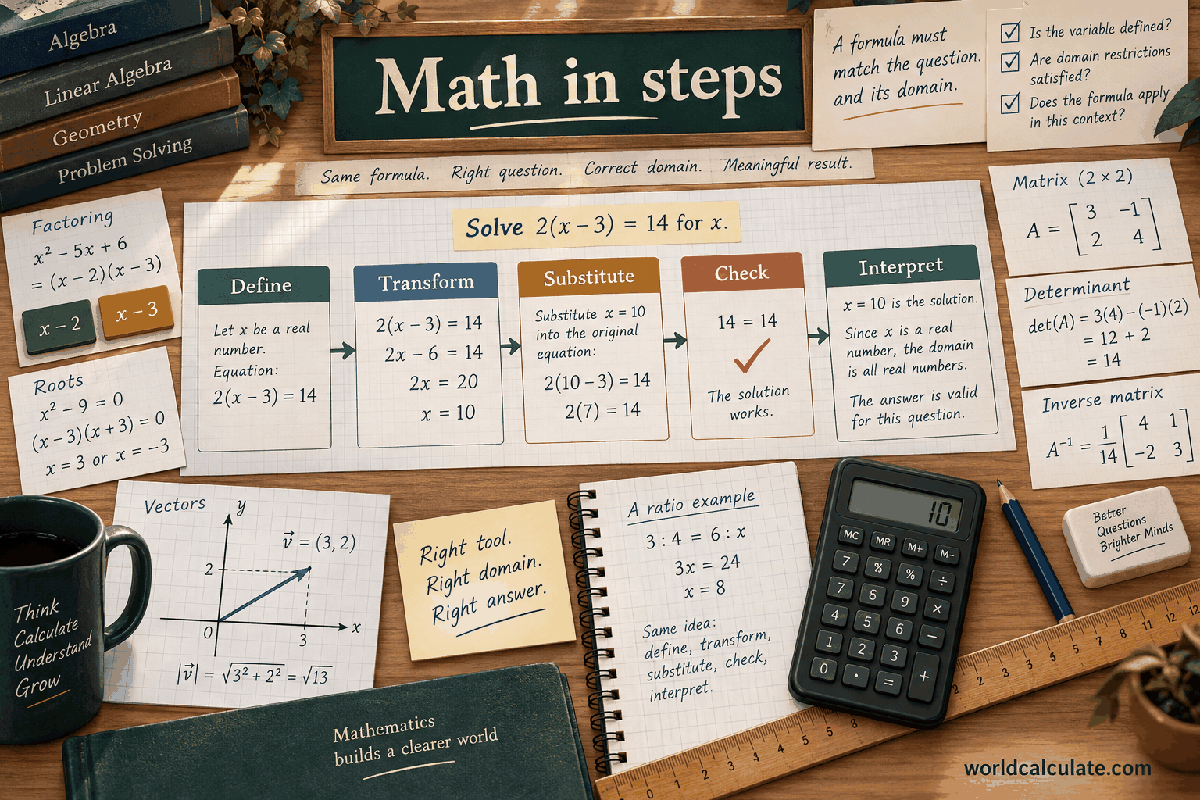
Fundamental trigonometric identities connect the three basic ratios in a right triangle and the coordinates of a point on the unit circle. This checker starts with sin(θ) and cos(θ), verifies the Pythagorean relationship, and then derives tangent, secant, and cosecant when their denominators are defined. It is intentionally a value checker rather than an angle solver: rounded sine and cosine values can support an identity check, but they do not contain enough information to choose one unique angle or quadrant.
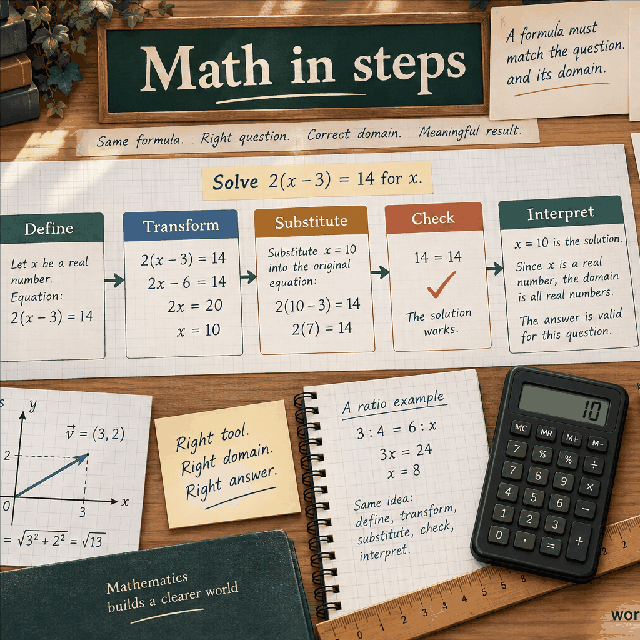
For one angle, sin²(θ) + cos²(θ) = 1. On the unit circle, sine and cosine are the coordinates of a point whose distance from the origin is one, so the identity is the coordinate form of the Pythagorean theorem.
Because students often work with rounded decimals, the page reports the identity residual rather than demanding exact binary arithmetic. A residual near zero means the entered pair is consistent within the displayed tolerance; a large residual suggests the values belong to different angles or were copied incorrectly.
Tangent is the quotient sin(θ)/cos(θ). The signs follow the signs of sine and cosine, so tangent can be positive or negative depending on the quadrant. If cosine is zero, division is undefined and the calculator says so instead of returning an enormous number.
This identity connects a coordinate pair to the slope-like ratio of vertical change to horizontal change. It does not by itself identify the angle because many angles share a tangent value.
Secant is the reciprocal of cosine and cosecant is the reciprocal of sine. The same denominator rule applies: secant is undefined where cosine is zero, and cosecant is undefined where sine is zero. These are domain facts, not calculator errors.
If an input is very close to zero, the reciprocal can be large. That result is mathematically consistent, but rounded input near a zero should be interpreted carefully because a small measurement or rounding change can have a large effect.
A sine value alone appears at multiple angles, and a cosine value also repeats around the circle. Even a compatible pair should be treated as coordinates with signs, not as a single principal angle unless a separate inverse-trigonometric convention is chosen.
This page therefore keeps the input contract simple and avoids silently selecting a quadrant. If an angle is needed, use the correct inverse function and include the known quadrant or domain in the next step.
For sinθ = 0.6 and cosθ = 0.8, the squares are 0.36 and 0.64, which add to 1. The quotient gives tanθ = 0.75, while the reciprocals give secθ = 1.25 and cscθ = 1.6667. The result is a compact chain of related identities rather than four unrelated calculations.
When checking homework, compare the residual first. If it is not close to zero, do not continue interpreting the reciprocal outputs as values for one valid angle; correct the pair or revisit the rounding used in the exercise.
Sine and cosine carry the signs of the coordinates. In different quadrants, one or both may be negative, but their squares still add to one. The checker therefore accepts negative values and preserves their signs when calculating tangent and the reciprocals.
A compatible pair does not need both values to be positive. What matters is that the two values came from the same point on the unit circle, within the tolerance allowed for rounded input.
A rounded pair such as 0.6 and 0.8 is convenient, but real unit-circle values may have more digits. The residual tells you how close the pair is to the identity. If the residual is too large, correct the pair before interpreting the derived ratios.
When sine or cosine is near zero, its reciprocal can be large and sensitive to the last decimal place. When it is exactly zero, the corresponding reciprocal is undefined, and the page reports that domain fact as text.
The checker evaluates one supplied pair of numbers. It can show that the pair is numerically compatible with the Pythagorean identity within the displayed tolerance, but a single substitution is not the same as proving an equation for every allowed angle. A proof works with symbols and domain conditions; a calculator check works with a selected example.
This distinction matters in homework and in technical notes. Use the page to test an intermediate result, catch a sign or transcription error, or explore a pattern. When the task says prove an identity, write the algebraic transformation and use the checker as a sanity check after the proof rather than as the proof itself.
A right triangle gives the same relationships in a geometric language. Relative to a chosen acute angle, sine is opposite over hypotenuse and cosine is adjacent over hypotenuse. Dividing those fractions cancels the common hypotenuse and leaves opposite over adjacent, which is tangent. The unit-circle version keeps the signs that a first-quadrant triangle diagram does not show.
The checker starts with sine and cosine because that pair is enough to derive the quotient and the reciprocals. It does not require a side length, so the result is scale-free. A triangle with sides 3, 4, and 5 and a triangle with sides 30, 40, and 50 have the same ratios; their absolute lengths differ, but their sine, cosine, and tangent for corresponding angles agree.
If one ratio is missing, the Pythagorean identity can provide a magnitude. For example, if the cosine magnitude is 0.8, then the sine magnitude is the square root of 1 minus 0.8 squared, or 0.6. The plus-or-minus choice cannot be discarded without a quadrant or sign condition. A calculator that accepts both values is intentionally asking the visitor to supply that context instead of guessing it.
The same caution applies in reverse. If sine is 0.6, cosine can be positive or negative depending on the angle's location. A positive decimal copied from a first-quadrant diagram is not automatically valid for a third- or fourth-quadrant problem. Write the sign information beside the missing-value calculation before entering the pair.
When teaching or revising, record the entered pair and every derived quantity in a small table. Put the input, operation, output, and domain note in separate columns. A row for the Pythagorean sum shows the compatibility check; a row for tangent shows the quotient; the secant and cosecant rows show the reciprocal operations. This format makes a missing denominator visible before a student interprets a result.
For the worked pair 0.6 and 0.8, the table contains 0.36, 0.64, and their sum 1; 0.6 divided by 0.8 equals 0.75; 1 divided by 0.8 equals 1.25; and 1 divided by 0.6 is approximately 1.6667. If a teacher changes the pair, the same columns provide a repeatable audit trail rather than a collection of memorized answers.
A zero cosine corresponds to a point on the vertical axis of the unit circle. Tangent and secant use cosine as a denominator, so both are undefined there. A zero sine lies on the horizontal axis, making cosecant undefined. The page reports a text state for an undefined reciprocal because replacing it with zero, infinity, or an arbitrary large value would teach the wrong domain rule.
A value that is merely close to zero is different. Dividing by a small nonzero denominator can produce a large finite quotient. That number may be mathematically valid, but it is sensitive to rounding and measurement noise. If cosine changes from 0.01 to 0.009, the reciprocal changes substantially even though the input change looks small. Read the denominator before trusting the displayed precision.
The unit circle gives a fast sign check. In quadrant I, sine and cosine are positive. In quadrant II, sine is positive and cosine negative, so tangent and secant are negative while cosecant remains positive. In quadrant III, both sine and cosine are negative, making tangent positive while both reciprocals are negative. In quadrant IV, sine is negative and cosine positive, making tangent and cosecant negative while secant is positive.
This sign pattern is a powerful diagnostic when a calculator answer does not match a diagram. Squaring hides signs in the Pythagorean identity, so a pair can pass that check while a quotient sign still reveals a copied coordinate or a quadrant mistake. Compare the requested angle region with the signs before adjusting an answer by hand.
Published tables and classroom exercises often round sine and cosine values. If the exact values are 0.6018 and 0.7986, a shortened pair may no longer satisfy the identity exactly even though both numbers came from the same angle. A residual close to zero is expected in that situation. The useful question is whether the discrepancy is consistent with the number of digits shown and the task's tolerance.
Do not round the squares separately when a more accurate input is available. Keep full input precision through the intermediate calculation, then round the final displayed outputs. If the input itself is only known to two decimal places, report the result with a matching level of restraint. More decimal places on a screen do not recover information lost before the calculation.
The four relationships on this page are building blocks for longer expressions. Replacing 1 over cosine with secant can make a reciprocal form easier to read, while replacing tangent with sine over cosine can put an expression over a common denominator. Replacing sine squared plus cosine squared with one can remove a repeated pair and expose the remaining structure. The direction of a substitution should serve the goal of the problem.
Algebraic cancellation has conditions. Dividing by sine or cosine requires that the chosen denominator is nonzero, and multiplying an equation by an expression can change which values must be excluded. Write the restrictions beside the step. A shorter expression is not automatically equivalent at a point where a canceled denominator was zero.
When a result looks wrong, inspect the problem in a fixed order. First confirm that the sine and cosine values belong to the same angle. Next verify that the values are in the allowed range from negative one to one. Then calculate the two squares and the residual. After the pair passes, inspect the denominator of each quotient or reciprocal and only then round the outputs.
This order prevents a common failure mode: trying to repair a large tangent value before checking that cosine is close to zero, or trying to repair a nonzero residual by changing a sign without looking at the original angle. Keep the original inputs and the corrected pair in the record so another person can see what changed.
In a laboratory, robotics, surveying, or graphics workflow, sine and cosine may come from a measured angle, a sensor, a coordinate pair, or a software export. The identity check can reveal a normalization or transcription problem, but it cannot identify which instrument failed. Record the coordinate frame, angle convention, units, timestamp, and rounding rule beside the result.
A pair can pass numerically and still be attached to the wrong frame or object. Conversely, a small residual can be completely reasonable when the inputs are measured with limited precision. Use the checker as one validation step in a larger quality process that includes calibration, repeated measurements, and domain-specific acceptance limits.
If the pair is valid but the task asks for an angle, use an inverse-trigonometric calculator with an explicit quadrant or a two-argument angle method where appropriate. If the task asks for a missing side, use a right-triangle or Pythagorean tool and enter the units of the physical lengths. If the task asks for a graph, use the unit-circle relationship to place the coordinate and then inspect the signs over a chosen interval.
These are different jobs even though they share the same identity. Linking the next tool to the question keeps the reader from forcing this checker to solve an angle, side, or graph problem it was not designed to answer. A clear handoff is more useful than adding every possible trigonometric feature to one page.
For a short study session, begin by drawing the unit circle axes and writing the sign of sine and cosine in each quadrant. Choose one exact pair such as 3/5 and 4/5, then verify the identity symbolically and numerically. Derive tangent and the reciprocals without looking at the answer, and state which outputs become undefined on each axis.
Finish with one rounded pair and one negative-quadrant pair. Compare the residuals, sign pattern, and denominator sensitivity. This routine turns the calculator into an active learning check: the learner predicts the structure, enters the values, inspects the work, and explains why the outputs make sense.
A diagram can communicate more than two decimals. Identify the angle, the positive x direction, the positive y direction, and the point or triangle used to define the ratios. If a point lies in quadrant II, expect a positive sine and a negative cosine; if it lies in quadrant IV, expect a negative sine and a positive cosine. This visual prediction is often the fastest way to catch a sign copied from the wrong quadrant.
If the diagram shows a reference triangle, decide whether the labels are lengths or already-normalized ratios. A side marked 3 and a hypotenuse marked 5 implies a sine or cosine ratio only after selecting which side is opposite or adjacent to the angle. Do not enter 3 and 5 directly as sine and cosine; both function values must remain between negative one and one.
A useful result note includes the original sine and cosine values, the identity sum or residual, the tangent quotient, the reciprocal outputs, the rounding rule, and any undefined denominator. Add the exercise or measurement context and the date if the result is being used in a project. This is enough information for another learner to reproduce the check without seeing the original screen.
Avoid writing only ‘the identity is true.’ Say that the entered pair produced a residual within the chosen tolerance and state whether the values were exact, rounded, measured, or copied from a table. If the output is used to support a later angle, length, or engineering calculation, carry the quadrant and units into that next record.
Can the checker find θ? It does not reconstruct an angle because inverse trigonometric functions use principal branches and a full quadrant choice must be stated. Can it verify a double-angle formula? This page covers the fundamental quotient and reciprocal identities; use a dedicated double-angle workflow for expressions involving 2θ.
What should I do when the residual is not close to zero? Recheck that sine and cosine came from the same angle, inspect rounding, and confirm that the fields were not swapped with another exercise.
Check a supplied sine and cosine pair against the Pythagorean identity and calculate tangent and reciprocal identities when defined.
sin²(θ)+cos²(θ)=1; tan(θ)=sin(θ)/cos(θ); sec(θ)=1/cos(θ); csc(θ)=1/sin(θ). The visitor supplies sine and cosine values from one angle. The page checks the Pythagorean identity within a small tolerance and then evaluates quotient and reciprocal identities, explicitly reporting undefined denominators.
Enter sin(θ), cos(θ), then choose Calculate.
The sine and cosine values describe the same angle. Each entered value lies between −1 and 1. Rounded inputs may produce a small identity residual. Tangent and secant are undefined when cosine is zero. Cosecant is undefined when sine is zero. The tool verifies values; it does not reconstruct a unique angle or choose a quadrant.
This calculator is part of the WorldCalculate library. Its formula, example, assumptions, input bounds, and output formatting follow the official methodology.
These WorldCalculate collections connect this tool with related questions while keeping each calculation separate and transparent.